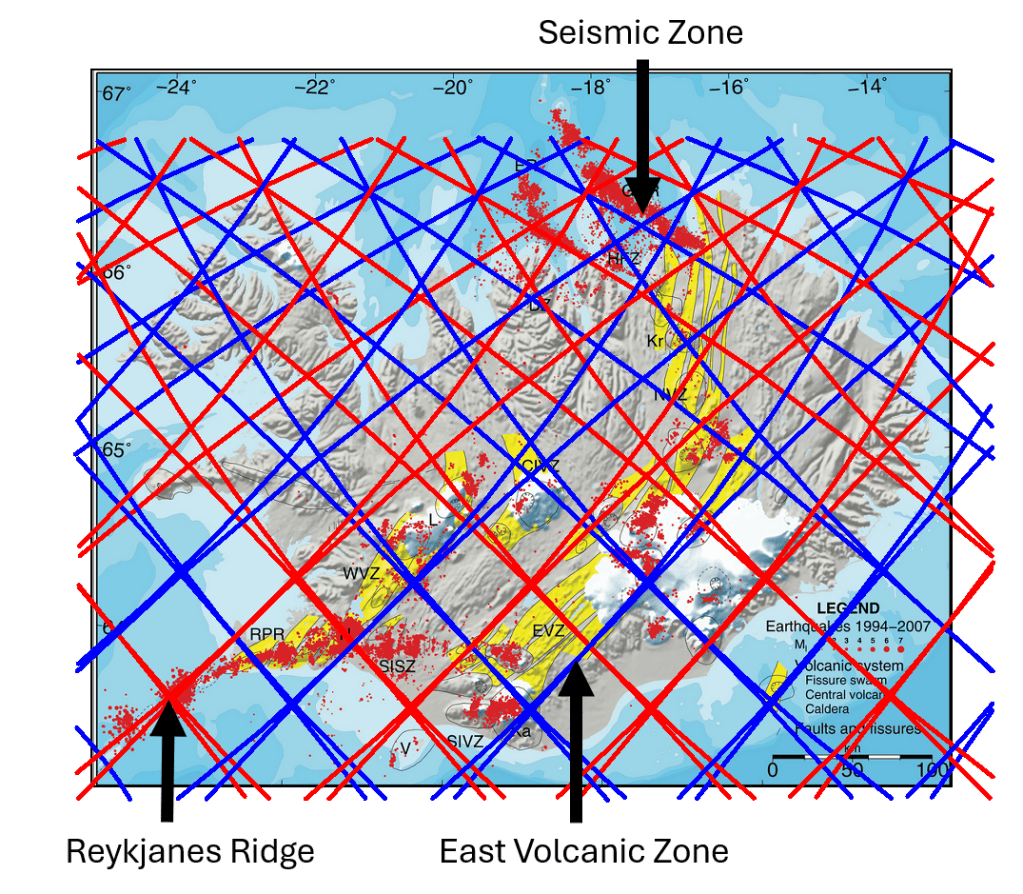
When considering the spreading of Iceland and the boundary between the North American and Eurasian plates, three main types of tectonic boundaries or structures need to be taken into account. These are, first, mid-ocean ridges; second, volcanic zones; and third, seismic zones. Within the convection-roll model, all of these follow lines that can be constructed on a map on the basis of the geometrical analysis of the convection rolls.
Reykjanes Ridge, East Volcanic Zone and Tjörnes Fracture Zone.
The convection-roll system follows a simple mathematical pattern, with each depth layer having its own set of convection rolls. In Iceland, however, the situation is more complex than in many other regions because the convection rolls of the polar system and the equatorial system meet and interact there. The correspondence is clearly visible on the map. The Reykjanes Ridge, for example, follows convection-roll divisions associated with the 120 km level over a considerable distance.
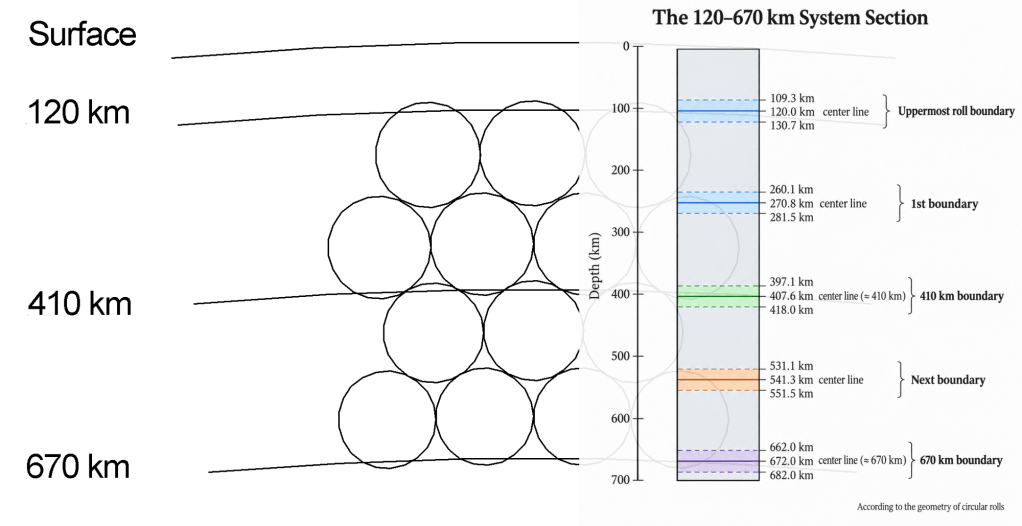
Main Upper Layers.
In southern Iceland, the situation is further complicated by the fact that division lines belonging to convection rolls at different depths often lie very close to one another, so that they may appear almost as a single line. A precise description of the boundaries shown on the map is therefore considerably more complex than the simplified interpretation presented here. The depth levels are used primarily as convenient reference levels.
As can be seen, the comparison can be extended across the whole of Iceland, revealing correspondences between the calculated lines and geological structures. Blue downwelling lines reproduce the eastern boundaries of both the Eastern Volcanic Zone and the Western Volcanic Zone with considerable precision. The geometry also shows that the two volcanic zones are separated by approximately 3°.
A similar relationship occurs in the Tjörnes Fracture Zone in northern Iceland. There, two principal seismic source lines correspond to adjacent convection-roll division lines separated by 1.5°. As more geological information is incorporated into the comparison, an increasing number of features can be tested against, and found to correspond with, this convection-roll framework.
To compare these lines with the 120–670 km System Section, each mapped line can be related to the boundary of a particular depth interval. The section illustrated here applies to regions south of 60.7°N and also north of 67.3°N. Within the intervening latitude range, the geometry is considerably more complex: the number of layers effectively doubles, while their thicknesses vary with latitude. Nevertheless, the basic division is retained, and each layer can still be followed mathematically, allowing the boundaries of the convection rolls to be constructed with precision.
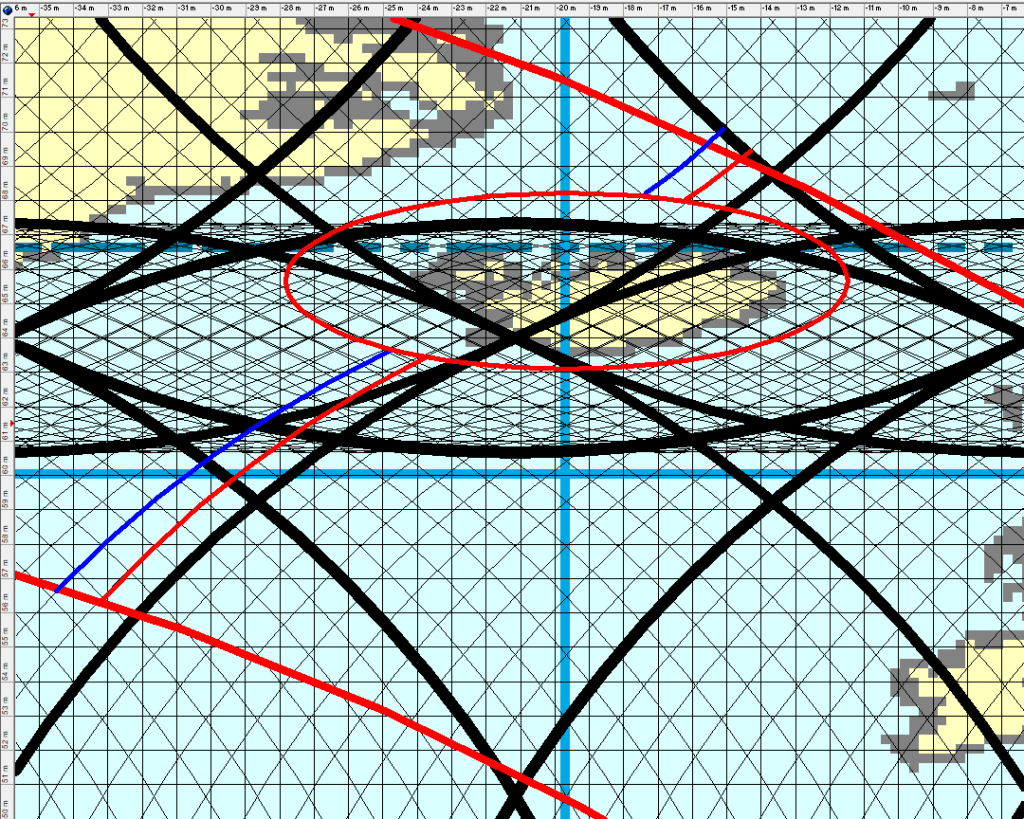
The polar system takes over progressively from the equatorial system and is superimposed upon it. At 64°N, however, the two systems act in combination, and the convection rolls of the two systems are aligned directly above one another. North and south of this latitude, the corresponding rolls gradually diverge from one another. Farther north, the polar system becomes increasingly dominant.
It is particularly noteworthy that the principal seismic zones—the Tjörnes Fracture Zone and the South Iceland Seismic Zone—are associated with different convection-roll division lines from those followed by the Reykjanes Ridge and the volcanic zones. These seismic-zone divisions are related to deeper parts of the system, specifically to the convection rolls immediately above the 410 km boundary. The same geometrical pattern is then repeated between the 410 km and 670 km depth levels.
Iceland provides an unusually detailed example of the relationship between surface tectonic structures and the proposed mantle convection-roll division system.
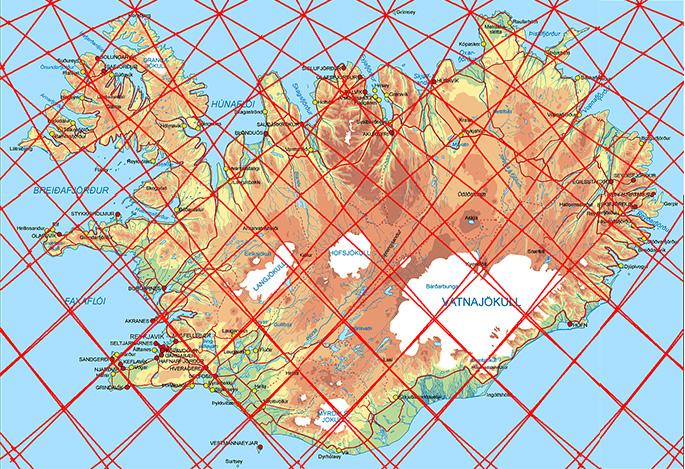
Convection Rolls System Division Lines of Iceland.
On the scale of the major oceanic plates, the convection-roll geometry can be compared with long plate boundaries, mid-ocean ridges and the elliptical tectonic rings. In Iceland, however, the same framework can be examined at much higher resolution. Volcanic zones, individual volcanic systems, fracture zones and even smaller polygonal structures can be compared directly with calculated mantle-division lines.
Four different types of correspondence are particularly useful.
1. Volcanic zones — the Eastern Volcanic Zone
One of the clearest examples is the Eastern Volcanic Zone of Iceland.
Its general orientation corresponds closely to the calculated direction of the convection-roll system beneath Iceland. Rather than treating the volcanic zone simply as an irregular surface continuation of plate spreading, the convection-roll model provides an underlying geometrical direction against which the zone can be compared.
This is important because the mantle divisions do not everywhere trend directly north–south. Their calculated orientation varies systematically with latitude. Iceland therefore provides a particularly useful test: the direction of the volcanic structures can be compared with a direction calculated independently from the convection-roll geometry.
The Eastern Volcanic Zone represents the first level of correspondence:
In other words, the model can be tested against the orientation of an entire volcanic belt.
2. Intersection points — Hekla
A second type of relationship occurs at intersections between calculated structural lines.
Hekla provides an important example.
Its position is associated not merely with the direction of one convection-roll division, but with a location where different geometrical elements of the system intersect. Such intersection points are potentially more important than individual lines because they represent places where different components of the underlying geometrical framework act together.
This provides a second level of correspondence:
Hekla is therefore useful not simply because it is a major volcano, but because its location can be examined in relation to a predicted geometrical crossing point. This may also help explain why some locations within a volcanic zone become much more prominent than others. A volcanic belt defines a broader structural corridor, while intersections may define particularly favourable locations within that corridor.
3. Polygonal structures, the South Iceland polygon
A third expression of the system appears when the calculated division lines are combined to form polygonal structures. South Iceland provides one of the clearest examples.
Here the relevant convection-roll divisions do not produce only isolated N–S or E–W lines. Their interaction defines a larger geometrical framework within which the tectonic structures of South Iceland can be analysed.
The South Iceland polygon is particularly important because it shows that the model is not restricted to matching the orientation of individual faults or volcanic zones. The intersections and connecting lines form a larger geometrical unit.
The relationship can therefore be written:
Within such a framework, individual fracture zones, volcanic systems and changes in structural orientation can occupy different sides, corners or internal divisions of the polygon.
This is also important for understanding the South Iceland Seismic Zone. The surface deformation need not reproduce the deeper geometrical framework as one continuous fault. Instead, the larger stress field can be accommodated through numerous smaller faults and fracture systems.
Thus, a relatively simple underlying geometry may produce a considerably more complex surface expression.
4. Linear boundaries — the Tjörnes Fracture Zone
The Tjörnes Fracture Zone provides a fourth type of comparison. Here the relationship is expressed through comparatively long tectonic lines and changes in direction that can be compared directly with the calculated convection-roll divisions. This differs from Hekla, where the emphasis is on an intersection, and from South Iceland, where the emphasis is on a polygonal framework.
The Tjörnes system illustrates the more direct relationship:
The fracture zone therefore provides another independent way of testing the model. A calculated mantle division can be compared not only with volcanic structures but also with a major transform and fracture-zone system.
Four expressions of the same underlying geometry
Taken together, these examples are particularly useful because they are not repetitions of the same type of observation. They represent four different geometrical relationships:
Volcanic-zone alignment — Eastern Volcanic Zone
Intersection point — Hekla
Polygonal framework — South Iceland
Linear tectonic structure — Tjörnes Fracture Zone
The significance of Iceland is therefore not based on one volcanic zone or one particularly favourable line. The same calculated framework appears to correspond to different types of geological structures at different scales.
The sequence can be summarized as:
This is one reason why Iceland has been so important in the development of the convection-roll model. The geological structures are sufficiently detailed to allow relationships to be examined on a much smaller scale than is possible around most major oceanic plates.
From Iceland to the global system
Iceland can therefore be regarded as a high-resolution calibration area for the larger geometrical framework. The same principles that can be examined locally in Iceland—directional divisions, intersections, polygonal structures and transitions between structural lines—can subsequently be investigated on the scale of entire tectonic plates.
This creates an important connection between the Icelandic examples and the analyses of the African, Somali and Nazca plates: In Iceland, the convection-roll framework can be examined at high resolution through volcanic zones, intersection points, polygons and fracture zones. On the scale of the major plates, the same geometrical principles appear as long plate boundaries and their interaction with the larger tectonic-ring system.
The tectonic structure surrounding Iceland can be viewed as the interaction of four related but distinct components. These are: (1) the mantle convection-roll system and its regularly spaced flow lines, (2) the overlap zone between the equatorial and polar parts of that system, expressed particularly through the Greenland–Iceland–Faroe Ridge Complex, (3) the large tectonic ellipse surrounding the Icelandic shelf, and (4) the active ridge–transform–volcanic-zone system that transfers plate separation through Iceland.
The continuity of the mid-ocean ridges – Reykjanes Ridge and Kolbeinsey Ridge.
These components should not be regarded as different descriptions of the same structure. Each appears to have a different geometrical and tectonic function. The convection-roll system defines large-scale mantle-flow trajectories; the overlap zone creates a special structural domain around Iceland; the tectonic ellipse appears to delimit a region in which ridge behaviour changes; and the active volcanic and transform zones accommodate the actual plate separation through Iceland.
Taken together, these four elements provide a coherent geometrical framework for the unusually complex tectonics of Iceland and its surrounding oceanic ridges.
The mid-ocean ridges and the tectonic ring framework, compared with the convection-roll system and the elliptical form of the Icelandic Plateau.
1. The Mantle Convection-Roll Framework
In the convection-roll model, tectonic structures are related to regularly spaced mantle-flow trajectories described by circular equations. Two sets of equations are important in the Iceland region.
The equatorial system is represented by:
[(x-C_n)^2+(y-32)^2=35.34^2]
whereas the polar system is represented by:
[(x-C_n)^2+(y-96)^2=35.34^2]
The values of (C_n) occur at intervals of approximately 1.5°. Consequently, the system consists not merely of individual lines but of repeated 1.5°-wide flow domains, each of which can be regarded as containing an upwelling side and a corresponding downstream or descending side.
This distinction is important when considering the oceanic ridges north and south of Iceland. A ridge axis does not necessarily have to coincide exactly with the calculated upwelling line. Instead, the ridge may occupy a particular position within the flow cell and may migrate laterally across it. The Reykjanes and Kolbeinsey ridges provide a striking example, as south of Iceland, the relevant upwelling trajectory is represented by approximately
[C_n=-7.66]
whereas the adjacent downstream line lies at
[C_n=-9.16]
North of Iceland the corresponding pair is
[C_n=-37.66]
and
[C_n=-39.16]
The difference is 1.5° in both cases. Furthermore, the northern and southern corresponding trajectories are separated by exactly 30°:
[-37.66-(-7.66)=-30^\circ]
and
[-39.16-(-9.16)=-30^\circ]
Thus, the two oceanic ridge systems occupy equivalent positions within two geometrically corresponding mantle-flow domains.
This suggests that the relevant tectonic unit is not simply the individual upwelling line but the entire convection-roll cell.
2. The Polar–Equatorial Overlap Zone and the Greenland–Iceland–Faroe Ridge
The second component is the overlap between the equatorial and polar parts of the convection-roll system.
The two equation families intersect systematically around 64°N. Their corresponding upwelling trajectories meet near approximately 64°N, 22.7°W, while the associated downstream trajectories meet approximately 1.5° farther west, near 64°N, 24.2°W. This creates a structurally distinctive overlap zone around Iceland.
The Greenland–Iceland–Faroe Ridge Complex appears to be particularly closely related to this geometry. The Greenland–Iceland Ridge to the west and the Iceland–Faroe Ridge to the east together define a broad WNW–ESE to E–W transverse structure across the North Atlantic. Their orientation differs fundamentally from the approximately N–S to NE–SW orientation of the active Mid-Atlantic spreading system.
This transverse ridge system can therefore be interpreted primarily in relation to the overlap of the equatorial and polar convection-roll systems. The Greenland–Iceland–Faroe Ridge should consequently not be treated simply as an extension of the active spreading ridges. It represents a different structural element. The overlap zone provides a possible explanation for why the Iceland region contains an anomalously broad and thickened crustal domain crossing the otherwise longitudinal Mid-Atlantic spreading system.
In this interpretation, the Greenland–Iceland–Faroe Ridge Complex is primarily associated with the interaction between two large-scale mantle-flow systems, whereas another geometrical feature—the Icelandic tectonic ellipse—controls the outer extent of a somewhat different tectonic regime.
3. The Tectonic Ellipse Surrounding Iceland
The third component is the large ellipse surrounding the Icelandic shelf. This ellipse should be distinguished from the mantle-flow trajectories themselves. Its centre is not located at the polar–equatorial intersection around 64°N and 22–24°W. Instead, the central tectonic point associated with the Icelandic shelf ellipse lies near approximately 65.6°N, 19.7°W.
The flow-line intersections then describe the geometry of the convection-roll system, whereas the shelf ellipse appears to define a tectonic domain surrounding Iceland. Iceland lies between an inner and an outer elliptical boundary. The Greenland–Iceland–Faroe Ridge crosses this domain approximately along its WNW–ESE structural orientation, but the most revealing evidence for the significance of the ellipse may be found where the active oceanic spreading ridges cross its northern and southern margins.
At both locations, the character of the ridge system changes, and this suggests that the ellipse may function as a tectonic regime boundary rather than simply describing the shape of the Icelandic shelf.
Outside the ellipse, the oceanic ridges can follow mathematically regular convection-roll trajectories for considerable distances. Inside it, the geometry becomes more complex. The spreading system divides into oblique volcanic zones, transform zones and multiple active rift axes. The ellipse therefore appears to mark the transition between two different modes of tectonic organisation.
4. Reykjanes Ridge: Entry into the Icelandic Tectonic Domain
Southwest of Iceland, the Reykjanes Ridge follows the mantle-flow geometry over a long oceanic distance.Its position is related to the flow domain between (C_n=-7.66) and (C_n=-9.16). The former represents the calculated upwelling trajectory, while mantle flow within the model is directed westward across the cell toward the latter.
An important feature of the southern Reykjanes Ridge is that the ridge axis itself shows a tendency to migrate westward within this flow domain. Instead of remaining strictly centred on the upwelling trajectory, it approaches the downstream side of the cell. Near the inner boundary of the tectonic ellipse, this behaviour becomes particularly important.
The ridge changes orientation. The more regular oceanic ridge system gives way to the oblique spreading structure that continues toward Iceland as the Reykjanes Oblique Rift and the volcanic systems of the Reykjanes Peninsula. The change is therefore not merely a bend in an otherwise uniform ridge.
It represents a transition from an oceanic ridge following a relatively regular mantle-flow trajectory into the more complicated tectonic regime surrounding Iceland.
Farther northeast, plate separation is transferred through the South Iceland Seismic Zone. This approximately E–W transform-related zone links the western volcanic systems to the active volcanic zones farther east. The sequence can therefore be expressed schematically as:
Reykjanes Ridge → elliptical boundary → Reykjanes Oblique Rift → South Iceland Seismic Zone → Eastern Volcanic Zone.
An important point is that the physical transition is not necessarily confined to a single sharp line. Changes in ridge morphology, crustal thickness, magmatic productivity and tectonic structure occur over a substantial distance. The ellipse may therefore identify the boundary of a broader transition zone rather than a single mechanical discontinuity.
5. Kolbeinsey Ridge: The Northern Equivalent
A remarkably similar relationship occurs north of Iceland. Much of the Kolbeinsey Ridge can be approximated by the polar-system trajectory with
[C_n=-39.16]
This is particularly significant because (-39.16) is not the calculated upwelling line. The corresponding upwelling trajectory lies one flow interval farther east, at approximately
[C_n=-37.66]
Thus, the Kolbeinsey Ridge occupies a position toward the downstream side of the same type of 1.5° mantle-flow cell seen south of Iceland. In this respect, the Kolbeinsey Ridge appears to display over much of its length the same tendency that becomes particularly clear on the southern Reykjanes Ridge: the spreading axis is displaced westward from the calculated upwelling trajectory toward the downstream part of the convection-roll cell.
As the Kolbeinsey Ridge approaches Iceland, however, its behaviour changes. Near the northern boundary of the Icelandic shelf ellipse, the ridge begins to assume a much more nearly N–S orientation. It subsequently enters the complex Tjörnes Fracture Zone, through which plate separation is transferred eastward into the Northern Volcanic Zone.
The northern sequence is therefore broadly comparable to the southern one:
The correspondence is particularly important because the observed change at the northern elliptical boundary is not restricted to geometry. Geochemical studies along the Kolbeinsey Ridge indicate changes in mantle-source and basaltic characteristics in this general region. The Iceland-related geochemical influence decreases northward, and changes occur between the southern Kolbeinsey Ridge and the more northerly ridge segments toward the Jan Mayen region.
Thus, whereas the southern elliptical boundary is expressed very clearly through a change in ridge orientation and tectonic style, the northern boundary may be expressed particularly strongly through petrological and geochemical changes. The manifestations are different, but both indicate a change in tectonic regime.
6. The Transform Zones as Lateral Transfer Systems
The South Iceland Seismic Zone and the Tjörnes Fracture Zone occupy corresponding positions within the overall system. Neither is simply a continuation of an oceanic ridge, instead both transfer plate separation laterally between offset spreading systems.
In the south, the Reykjanes system is connected through the South Iceland Seismic Zone to the volcanic zones farther east, but in the north, the Kolbeinsey system is connected through the Tjörnes Fracture Zone to the Northern Volcanic Zone. This creates an approximate large-scale symmetry:
South: Reykjanes Ridge → oblique volcanic belt → SISZ → Eastern Volcanic Zone
The geometry is quite symmetrical. Both transform zones perform the same fundamental function: they allow oceanic spreading axes outside the Icelandic shelf domain to connect with the displaced volcanic axes within Iceland.
7. The Northern and Eastern Volcanic Zones as the Internal Connection
The Northern Volcanic Zone and Eastern Volcanic Zone complete the system. Once the oceanic spreading axes enter the Icelandic tectonic domain, their plate-separation function is no longer carried by one continuous Mid-Atlantic ridge axis. Instead, spreading is distributed between volcanic zones and transform systems.
The Northern Volcanic Zone receives the plate-boundary displacement transferred through the Tjörnes Fracture Zone, and the Eastern Volcanic Zone receives a substantial part of the displacement transferred eastward across South Iceland. Together, these volcanic zones form the active internal connection between the northern and southern oceanic ridge systems.
The resulting geometry can be represented as a large tectonic pathway:
Kolbeinsey Ridge
Tjörnes Fracture Zone
Northern Volcanic Zone
Central Icelandic tectonic domain
Eastern Volcanic Zone
South Iceland Seismic Zone / Reykjanes system
Reykjanes Ridge
The Mid-Atlantic plate boundary therefore remains continuous in a kinematic sense, although its surface expression changes profoundly when it enters the Icelandic elliptical domain.
8. Four Components, Four Different Functions
The resulting model becomes clearer if the four components are assigned distinct functions.
1. The convection-roll system
This defines the large-scale mantle-flow geometry. Outside the Icelandic shelf domain, both the Reykjanes and Kolbeinsey ridges follow corresponding convection-roll cells for long distances and can therefore be approximated mathematically.
2. The polar–equatorial overlap zone
This produces a special mantle-structural domain around Iceland. The Greenland–Iceland–Faroe Ridge Complex appears to be particularly strongly related to this overlap and its WNW–ESE transverse geometry.
3. The Icelandic tectonic ellipse
This defines the region within which tectonic behaviour changes. At its margins, the relatively regular oceanic ridge system begins to reorganise. South of Iceland this is expressed especially clearly by changes in ridge orientation and physical structure. North of Iceland the transition is also reflected in petrology and mantle-source characteristics.
4. The volcanic and transform system within Iceland
This accommodates active plate separation inside the elliptical domain.
The Reykjanes Oblique Rift, South Iceland Seismic Zone, Eastern Volcanic Zone, Northern Volcanic Zone and Tjörnes Fracture Zone together replace the simpler ridge-axis geometry characteristic of the surrounding ocean basin.
9. A Coherent Tectonic Interpretation
Seen in this way, Iceland is not simply an enlarged section of the Mid-Atlantic Ridge, nor can its structure be explained by one geometrical feature alone. The oceanic ridges north and south of Iceland show a long-distance relationship with calculated mantle convection-roll trajectories. Their axes may be displaced within individual flow cells, particularly toward the downstream side, but their overall geometry remains mathematically recognisable.
When these ridges approach the Icelandic shelf ellipse, however, their behaviour changes. The Reykjanes Ridge changes orientation and enters the oblique Reykjanes volcanic system before plate motion is transferred through the South Iceland Seismic Zone.
The Kolbeinsey Ridge changes toward a nearly N–S orientation and enters the Tjörnes Fracture Zone before connecting with the Northern Volcanic Zone. Within Iceland, the Northern and Eastern volcanic zones maintain the active spreading connection. Crossing this approximately N–S active plate-boundary system is the Greenland–Iceland–Faroe Ridge Complex, which appears to belong primarily to another component of the model: the overlap between the polar and equatorial convection-roll systems.
The tectonic ellipse then provides the larger boundary within which these different structural systems interact. The resulting picture is therefore hierarchical rather than based on a single tectonic cause:
mantle convection-roll geometry provides the regional framework; the polar–equatorial overlap produces the transverse Greenland–Iceland–Faroe structural domain; the tectonic ellipse defines the Icelandic regime boundary; and volcanic zones and transform belts accommodate active plate separation within that boundary.
This arrangement also explains why the Reykjanes and Kolbeinsey ridges can be mathematically predictable over long oceanic distances while becoming structurally much more complicated as they enter the Icelandic region. The mathematical mantle-flow geometry remains present, but within the tectonic ellipse it interacts with a second-order regional structure that redistributes spreading into volcanic zones, oblique rifts and transform systems.
In this interpretation, the unusual tectonics of Iceland are not an exception to the larger mantle-flow geometry. Rather, Iceland represents a region where several geometrical and tectonic systems overlap, and where their interaction becomes visible at the surface.
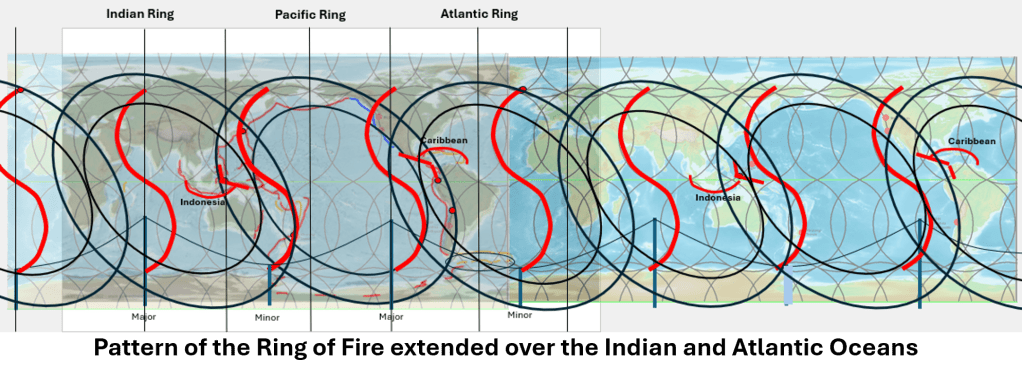
After the mantle convection roll system had been analysed, a number of secondary relationships became easier to recognize. The geometry of the Ring of Fire became more comprehensible, and extrapolation of its form led to the hypothesis that the Ring of Fire may represent only one of three adjacent large-scale tectonic systems of comparable dimensions surrounding the Earth.
Arrangement according to Ring of Fire, extrapolated.
An important clue was that the dimensions of the Ring of Fire could be defined by its span across the equatorial region and then traced away from the equator. The inner boundary was found to span 120°, from approximately 146°E to 94°W. This suggested a simple possibility: the Pacific Ring may occupy one of three approximately equal 120° sectors around the globe, with comparable tectonic rings associated with the Atlantic and Indian Oceans.
The outer boundary of the Ring of Fire is somewhat more difficult to define. A first approximation suggests a span of about 150°, but comparison with major tectonic structures indicates that the effective width may be somewhat greater. Features such as the Kermadec–Tonga system, and particularly the Red Sea, provide important constraints on the position of the outer boundaries of these large-scale elliptical tectonic forms.
Africa as a Test of the Geometry
Africa provides a useful example of how major tectonic structures correspond to this geometrical duplication of the Ring of Fire.
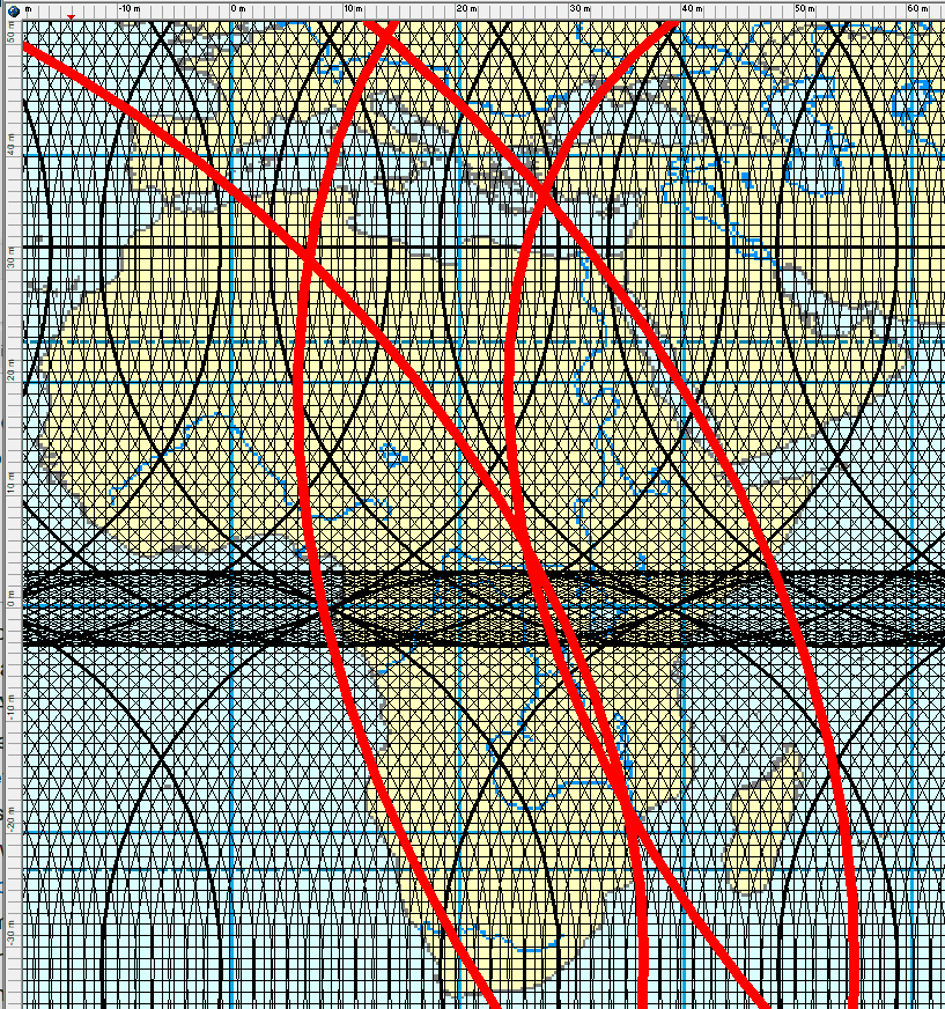
Africa and the Mediterranean Ocean.
The Red Sea follows the orientation of the proposed outer ellipse remarkably closely. In the present mathematical construction, the ellipse is centred at approximately 29.3°W, 6.0°S, with minor and major axis lengths of 71 and 96.5 units, respectively, and is rotated by 45°, corresponding to a slope of −1 in the planar representation. The corresponding inner ellipse has minor and major axis lengths of 51.8 and 77.7 units.
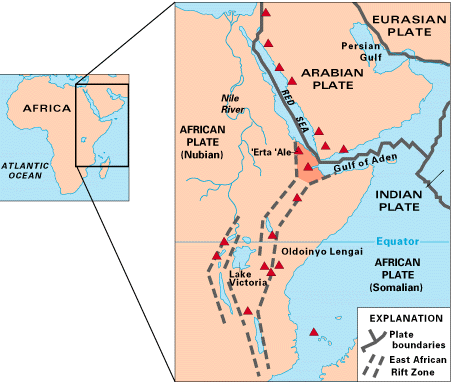
Simplified tectonic map from Wikipedia.
The major-axis direction of the outer ellipse also extends mathematically close to the South Pole, linking the geometry of the oceanic rings with the Antarctic system.
A Six-Part Global Arrangement
Although three elliptical tectonic rings are identified, the complete arrangement can also be viewed as a six-part system, because each ellipse consists of two opposing halves.
This introduces an interesting comparison with hexagonal geometry. In a regular hexagon, each side has the same length as the radius of the circumscribed circle. Sixfold arrangements are also common in physical systems where comparable units are distributed around a centre.
The possible relationship with the mantle convection roll system therefore deserves examination. If the tectonic arrangement is divided into six principal sectors, the positions of the convection-roll divisions can be compared with the boundaries between these sectors. However, the numerical relationship between the number of rolls and the six sectors should be treated separately and tested precisely rather than assumed from the geometry alone.
Width of the Tectonic Rings at the Equator
The western boundary of each outer ellipse appears to be closely related to a principal equatorial upwelling node, while the corresponding inner boundary shows a similar relationship to a downwelling node.
The tectonic boundaries do not coincide exactly with these theoretical points. The outer and inner limits appear to lie slightly to the west and east of them, respectively. This displacement may be significant, particularly where subduction systems extend several degrees beyond the underlying geometrical division.
The observed east–west width of the tectonic rings at the equator therefore appears to be closer to 20° than to 15°. A theoretical value of 21° would fit the convection-roll framework particularly well: a 15° lower-mantle convection unit, combined with two 1.5° upper-mantle roll widths on each side, gives
15° + 3° + 3° = 21°.
This provides a possible geometrical explanation for the greater width of the tectonically active zone relative to the underlying 15° division.
The African Rift System Within the Ring Geometry
When the geometry is compared with a tectonic map of Africa and the surrounding oceans, several major relationships become apparent.
The Red Sea lies along the outer boundary of the proposed Atlantic tectonic ring. The Mediterranean region, including its major subduction systems, occupies a position comparable to an active segment of the Ring of Fire.
The East African Rift System also falls within the proposed large-scale tectonic geometry. Particularly striking is the southern continuation of the rift system through the Malawi Rift toward the Indian Ocean. This major tectonic division follows approximately the double boundary separating the proposed Atlantic and Indian Ocean Rings.
Thus, several of Africa’s most important active tectonic structures—the Mediterranean convergence zone, the Red Sea spreading system, the East African Rift and its continuation toward the Indian Ocean—can all be examined within the same geometrical framework derived initially from the Ring of Fire.
A Framework for Further Testing
This geometrical construction raises a large number of new questions, but they can be addressed individually.
The important point is that the geometry provides specific, testable predictions. The positions of spreading centres, subduction zones, rift systems, plate boundaries and major tectonic junctions can be compared independently with the predicted inner and outer ellipses and with the underlying mantle-convection divisions.
The next stage is therefore not to add further complexity to the model, but to test each correspondence separately and determine how accurately the simple geometrical construction agrees with the observed tectonic structure of the Earth.
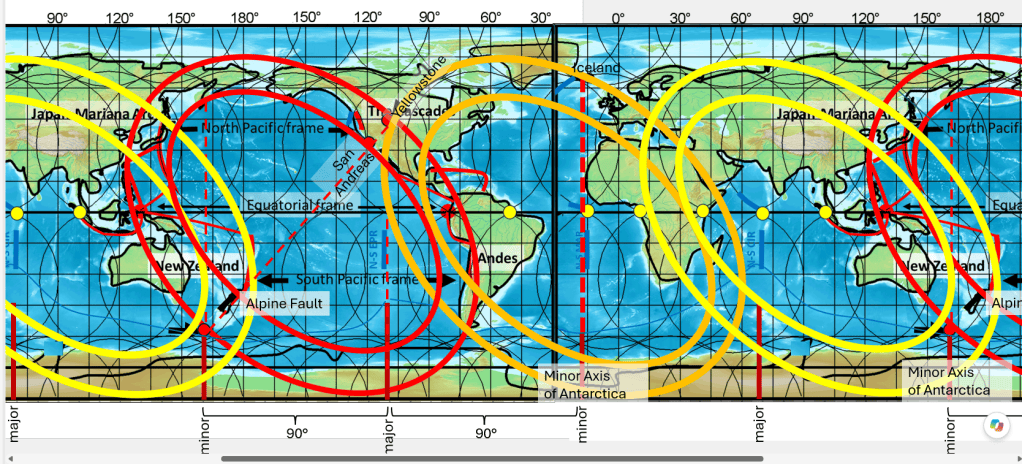
The analysis of the Ring of Fire has raised the possibility that its overall form is considerably more regular than is generally apparent, and that its geometry may be controlled by large-scale mantle circulation together with the configuration of adjacent parts of the Earth. This naturally directs attention toward Antarctica, which is itself arranged in a remarkably systematic way around the South Pole.
Most important lower mantle divisons marked with thick red lines.
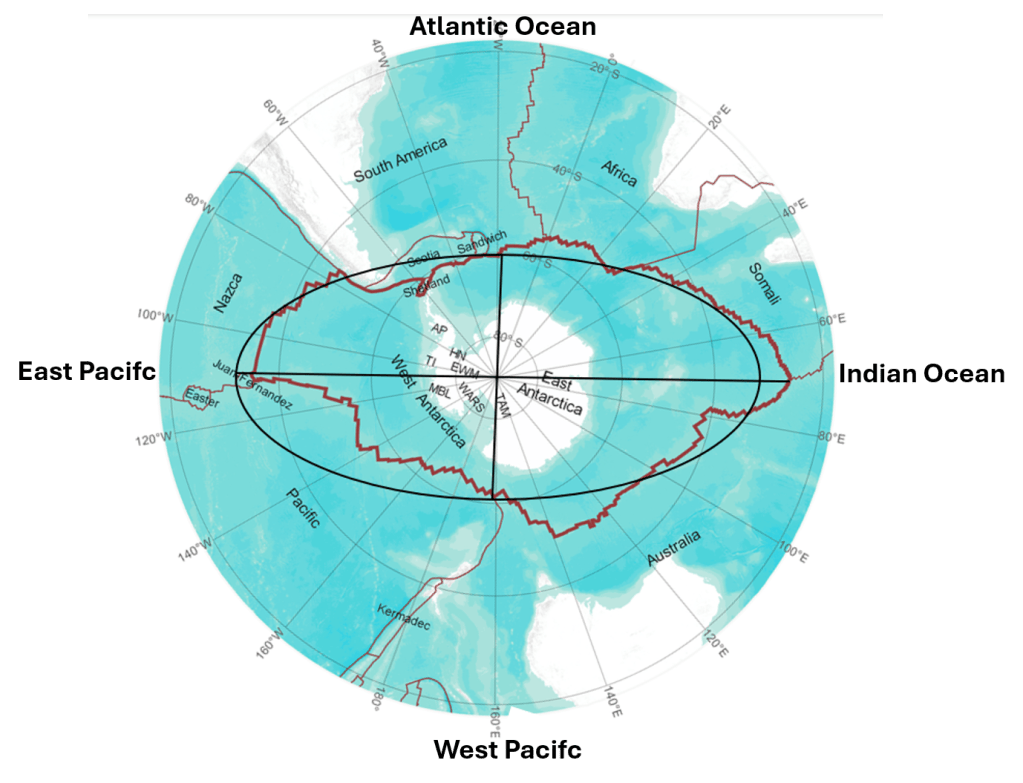
The division of Antarctica into East and West Antarctica is well established, and the geological boundary between the two passes relatively close to the geographic South Pole. When the entire Antarctic Plate is considered, rather than only the continental landmass, its overall form is elongated and can be approximated by an ellipse. Significantly, the minor axis of this ellipse follows the principal division between East and West Antarctica.
The World’s Oceans in Relation to the Elliptical Geometry of the Antarctic Plate.
The endpoints of the major axis correspond approximately to the major oceanic-ridge junctions on opposite sides of Antarctica: toward the Indian Ocean ridge system on one side and the East Pacific Rise system on the other.
The Mantle Convection Roll Model also corresponds closely with the orientations of the major and minor axes in the western and eastern Pacific sectors surrounding Antarctica. The relevant boundaries intersect these axes near 64°S. A considerable degree of geometrical agreement therefore emerges between the Ring of Fire, the proposed mantle-convection-roll system, and the principal axes of the Antarctic Plate in the southern Pacific region. This relationship is illustrated on the accompanying map.
Extending the Geometry Beyond the Pacific
To examine whether this correspondence represents a broader global pattern, the Atlantic and Indian Ocean regions must also be considered. The inner boundary of the Ring of Fire spans here theoretically 120° from east to west where it crosses the equatorial region. This suggests a simple research hypothesis: if the Pacific system occupies approximately one third of the Earth’s circumference, comparable tectonic rings might occupy the other two 120° sectors.
The first test of this idea can deliberately be kept as simple as possible. A mathematical ellipse is constructed to span 120° at the equator, with its centre positioned 6° south of the equator and with a major-to-minor axis ratio of 1.5. A second, outer ellipse is then constructed around it, spanning 150°, while retaining the same centre. The 150° span corresponds to measureable distance between concrete points along the equator. This provides a straightforward geometry that can be compared directly with mapped tectonic structures. In the Atlantic case, the centre of the proposed elliptical system is placed at approximately 6°S, 29.5°W. The important point is that these parameters are established before detailed geological adjustment. The question is therefore not whether an ellipse can be fitted retrospectively to selected tectonic features, but how well a deliberately simple geometrical construction corresponds to the actual tectonic pattern.
Correspondence with Major Tectonic Structures
When this geometry is plotted on a global map, the agreement with several major tectonic structures appears unexpectedly strong. One of the clearest examples is the Kermadec–Tonga system, which fits naturally into the proposed Indian Ocean Ring. This is particularly significant because Kermadec–Tonga is conventionally regarded as part of the wider Pacific Ring of Fire. In the present model, however, it lies within the sector where the Pacific and Indian Ocean tectonic systems overlap.
A similar relationship appears between the Pacific and Atlantic systems. The Caribbean region and Indonesia occupy broadly corresponding positions at the intersections between the major rings: the Caribbean at the junction between the Pacific and Atlantic systems, and Indonesia at the junction between the Pacific and Indian Ocean systems. Both therefore occupy geometrically comparable positions relative to the proposed mantle-convection-roll framework and to major divisions in the lower mantle. This correspondence is important because the two regions are among the most tectonically complex areas on Earth. Rather than lying randomly within the global pattern, each appears close to a junction between two of the proposed large-scale tectonic systems.
A further complex relationship occurs between South America and Antarctica. The Scotia–Drake Passage–South Sandwich region contains a particularly complicated combination of spreading, transform motion and subduction, yet this system also appears to display symmetry relative to intersection points derived from the mantle-convection-roll geometry.
Overlapping Tectonic Rings
The derivation of these tectonic rings is in several respects more difficult than the derivation of the mantle-convection-roll system itself. The latter concerns an idealized organization within the mantle, whereas the tectonic rings are expressed through lithospheric plates that have evolved, fragmented, rotated and interacted over geological time. The regions where the proposed rings overlap therefore constitute a separate field of investigation.
Nevertheless, it is significant that such a simple initial construction produces such extensive correspondence with mapped tectonic structures. The geometry was not derived independently for each region. Instead, the same basic parameters are repeated around the Earth and then compared with the geology. Considerable work is still required before the system can be defined precisely. Among the factors that must be examined are the geometry of the Earth’s geoid, the use of latitude and longitude on a curved rather than planar surface, and the apparent southward displacement of the tectonic-ring system, which in the present construction places the centres approximately 6° south of the equator.
The distinction between mathematical geometry on a map projection and geometry on the actual surface of the Earth is particularly important. Future calculations should therefore define the ellipses geodetically rather than treating longitude and latitude simply as Cartesian coordinates.
The Red Sea as a Particularly Strong Correspondence
Apart from Kermadec–Tonga, the Red Sea appears to provide one of the clearest correspondences with the tectonic geometry derived from the Ring of Fire. The outer boundary of the proposed Atlantic Ring runs approximately along the central axis of the Red Sea. This is especially interesting because the Red Sea is not merely a geographical depression but an active divergent plate boundary containing an axial spreading system and developing oceanic crust. Its position therefore provides a potentially important test of the model.
The Red Sea relationship also appears to repeat a geometrical pattern observed on the opposite side of the system, along western North America. From the San Andreas region southward through Mexico and the Gulf of California, active plate-boundary structures and spreading centres follow a broadly comparable orientation along the outer margins of the large-scale tectonic ellipses. The corresponding boundary lines are separated by approximately 105°, consisting of 90° between the parallel outer edges of the two elliptical systems plus the intervening 15°-wide tectonically active zone.
The comparison is not intended to imply that these regions have identical tectonic histories. Rather, they appear to occupy corresponding positions and orientations within the larger geometrical framework.
Repeated Ridge Orientations at 90° Intervals
This relationship recalls an earlier observation concerning the Reykjanes Ridge and the Juan de Fuca Ridge. These ridge systems occur approximately 90° apart within the proposed global geometry, yet follow corresponding structural directions. Such repetitions become increasingly important when several independent tectonic features are considered together. A single alignment can readily be coincidental. A repeated combination of alignments, orientations, intersection points and distances is more informative and can be tested quantitatively.
The mantle-convection-roll system also provides a direct geometrical continuation from the minor axis of Antarctica toward the Reykjanes Ridge and Iceland. Thus, Iceland does not appear in this framework merely because it lies on the Mid-Atlantic Ridge. Its position can also be related to one of the principal Antarctic axes and to the wider system of global tectonic divisions.
Multiple Independent Relationships
The resulting pattern is therefore not based on one isolated correspondence. Several different relationships appear simultaneously: The axes of the Antarctic Plate, the geometry of the Ring of Fire, the proposed Atlantic and Indian Ocean Rings, major spreading ridges, major subduction systems, complex plate-boundary junctions, and the mantle-convection-roll divisions all show repeated geometrical relationships.
Previous analysis has also shown that the world’s principal geyser regions can be placed within the same geometrical framework. Iceland, Yellowstone, Kamchatka, New Zealand, Chile and East Africa each occupy positions that can be related to major axes, ring boundaries, intersections or tectonic divisions within the proposed system. This does not by itself establish a common physical cause. It does, however, considerably increase the number of independent geological observations against which the geometry can be tested.
A Working Global Hypothesis
The purpose of the present construction is therefore not to claim that the three tectonic rings have already been demonstrated as physical mantle structures. At this stage they are best regarded as a geometrical research hypothesis derived from the observed form of the Ring of Fire.
The procedure is intentionally simple: First, identify the regularities already present in the Ring of Fire; then construct equivalent geometrical forms at 120° intervals around the Earth; and finally compare those forms with independently mapped tectonic structures.
The surprising result is that the comparison does not produce random relationships. Instead, major structures repeatedly appear close to predicted axes, boundaries, overlaps and intersection zones. If further quantitative analysis confirms these relationships, the three-ring geometry may provide an additional way of examining how the lithosphere is organized above large-scale mantle circulation. The central question is therefore no longer simply why the Pacific Ring of Fire has its familiar form. A broader question arises:
Is the Ring of Fire one visible part of a larger, globally organized tectonic system extending through the Pacific, Atlantic and Indian Ocean regions and geometrically linked to Antarctica and the underlying mantle circulation?