
The South Aegean Volcanic Arc, including Santorini, is one of the most active and famous volcanic regions of the Mediterranean. It formed mainly through subduction of the African Plate beneath the Aegean/Eurasian region along the Hellenic subduction zone. The arc includes, from west to east, the volcanic fields of Sousaki–Aegina–Methana–Poros; Milos; Christiana–Santorini–Kolumbo; and Kos–Nisyros–Yali/Gyali.
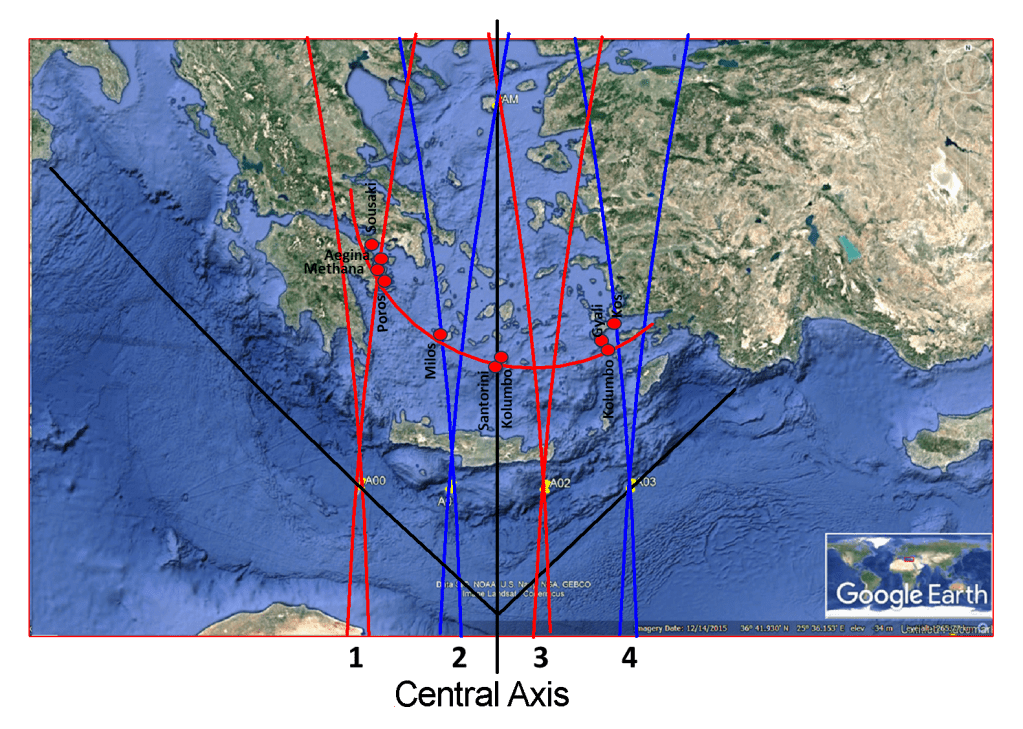
In the convection-roll model, the arc is highly symmetrical around the central axis of the Aegean Sea, and the model as well, while still being affected by the westward tectonic drift of the Anatolian region. The volcanoes appear to fall along specific modeled convection-roll lines. This close fit between a mathematical model and observed surface volcanism adds statistical support to the relevance of the model.
The volcanic alignment can be summarized as follows:
Sousaki, Aegina, Methana, and Poros are situated above the westernmost set 1.
Milos lies above the second set of downwelling lines.
Central Axis: Santorini and Kolumbo are located near the central axis of the Aegean Sea.
Nisyros, Gyali (Yali), and Kos are positioned above the easternmost downwelling line of set 4.
Within the South Aegean volcanic arc, four sets of lines are identified in the convection-roll model. However, volcanic centers are concentrated above only three of these. Notably, no volcanoes are observed directly above the line of the pair marked as number 3. Instead, volcanic activity, most prominently at Santorini and Kolumbo, is located between lines marked as 2 and 3, aligning closely with the central axis of the Aegean Sea.
This pattern suggests that the central axis may act as a preferential path for magma ascent. Similar axial focusing has been observed in other tectonic settings, such as Iceland (particularly the North Volcanic Zone), where mantle upwelling and crustal weaknesses combine to localize volcanism and high temperature areas along a central N-S aligned axis.
Within the framework of this model, it can be hypothesized that mantle material associated with line 3 does not produce surface volcanism directly above it. Instead, the flow may be laterally redistributed, potentially westward, before rising along zones of reduced lithospheric strength at the central axis. This would imply that the interaction between convection patterns and lithospheric structure plays a key role in determining the final location of volcanic activity.
This suggests that the division lines of the convection rolls play a decisive role in determining the exact locations of volcanic activity. The activity itself is, of course, initiated by the subduction of the African Plate and the associated processes. As in many other regions of the world, subduction creates a volcanic arc that is clearly detectable at the surface and is dotted with volcanoes. It is precisely at the points where the convection-roll division lines intersect this arc that volcanic centers appear.
In this context, the blue downwelling lines may also be interpreted as marking conduits for ascending magma. The term “downwelling” refers to the slow convection of plastic mantle material; however, along the boundaries between convection rolls, at the division lines, partial melting can occur. This process may create zones of weakness within the lithosphere, providing favorable conditions for magma ascent and, ultimately, volcanic activity at the surface.


