
Iceland is unique among nations because nearly all of its geothermal power production is located directly within an active plate boundary zone. The country stands astride the northern section of the Mid-Atlantic Ridge, where the North American Plate and Eurasian Plate slowly drift apart.
Within this environment, geothermal activity is not isolated. Instead, it forms part of a large interconnected tectonic and volcanic framework extending from the Reykjanes Ridge in the south to the volcanic systems of northeast Iceland.
The seven geothermal power stations producing electricity in Iceland are therefore much more than industrial facilities. Together they outline the geometry of the active volcanic belts of Iceland itself.
The Hengill Geothermal Complex
The largest concentration of geothermal power production in Iceland is found at Hengill, one of the most active volcanic systems in southwest Iceland.
Hellisheiði Power Station
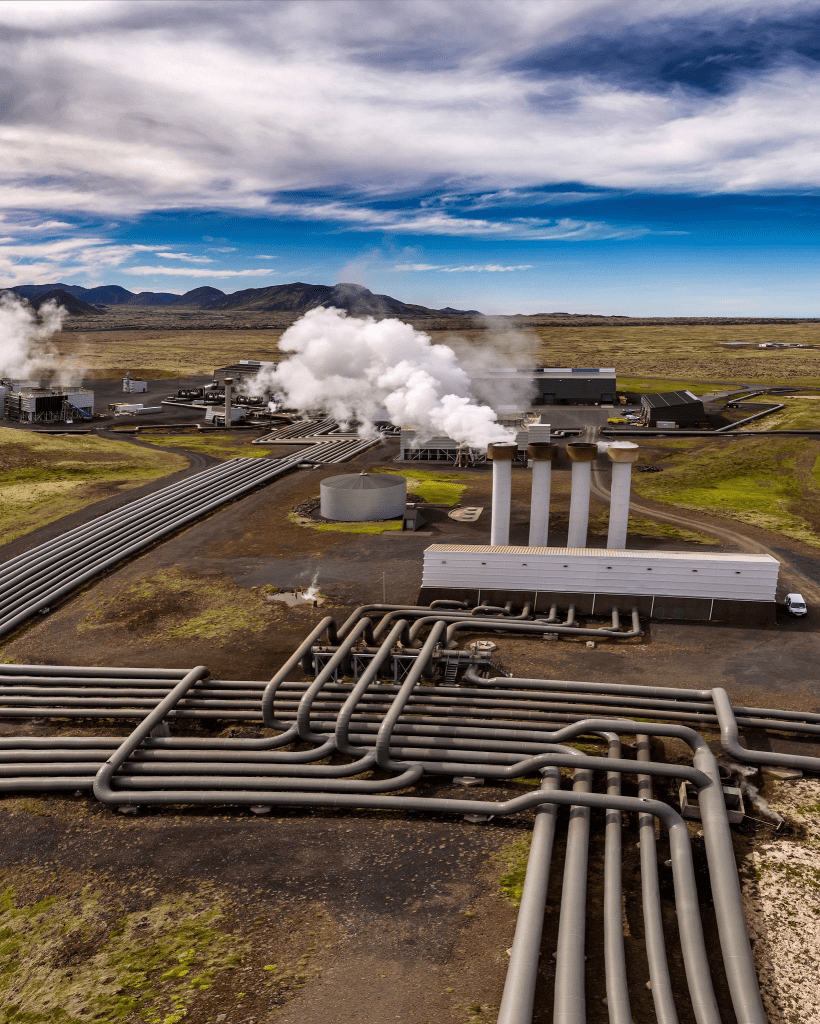
Located on the southern side of the Hengill volcanic system, Hellisheiði Power Station is the largest geothermal power station in Iceland. It produces both electricity and hot water for the Reykjavík metropolitan area. Steam rises from wells drilled deep into fractured volcanic rocks directly above the active rift zone.
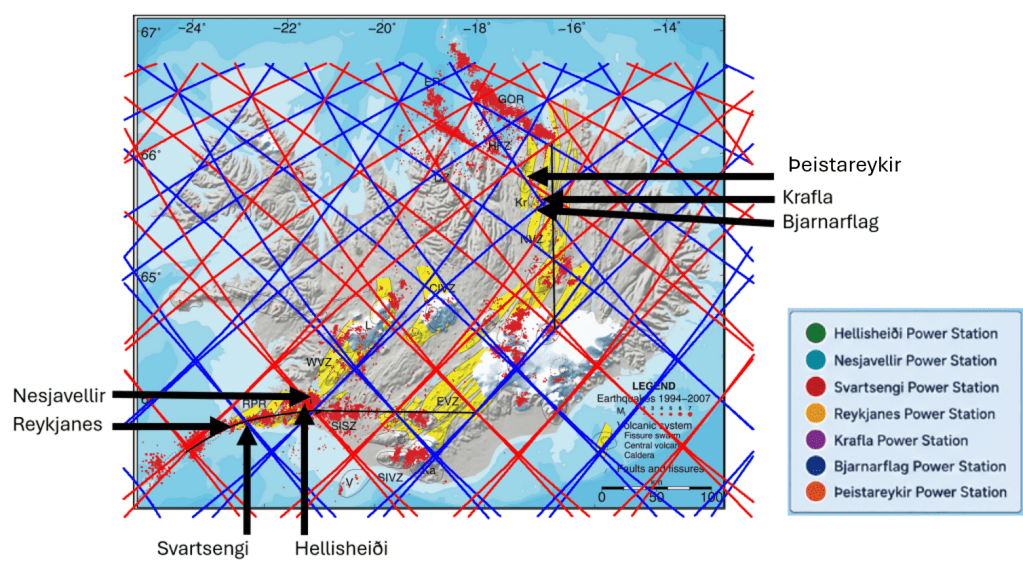
However, it is noticeable that Hellisheiði Power Station is not situated exactly above the tectonic division line between the plates, but slightly offset along the mantle convection rolls division lines interpreted in the area. These red upwelling lines, associated with the second and fourth convective layers, being rather evenly distributed between approximately 120 and 670 km below Earth’s surface, form the boundary between the Reykjanes Oblique Rift Zone and the West Volcanic Zone.
In this respect, the location of Hellisheiði resembles that of Svartsengi Power Station, as both are positioned along opposite sides of the same convection-roll framework.
Nesjavellir Geothermal Power Station
Situated near Þingvallavatn, Nesjavellir Geothermal Power Station occupies another section of the same tectonic environment. Together, Hellisheiði and Nesjavellir form the largest continuous geothermal utilization area in Europe. The two power stations largely make use of the same geothermal resources associated with the Hengill Volcanic System.
The location is highly significant geologically. The Hengill region lies exactly where volcanic activity, tectonic spreading, and large-scale fracture systems intersect.
Reykjanes Peninsula — Directly Above the Plate Boundary
The geothermal stations on the Reykjanes Peninsula are perhaps the clearest examples in the world of energy production directly tied to an exposed oceanic rift zone on land.
Svartsengi Power Station
Svartsengi Power Station became internationally known because of the nearby Blue Lagoon. However, geologically it is equally fascinating. The station extracts geothermal fluids from highly permeable volcanic formations created by repeated rifting episodes.
The intersections between the tectonic division line of Iceland and the interpreted convection-roll division lines are particularly apparent in this area.
Reykjanes Power Station
At the southwestern tip of Iceland, Reykjanes Power Station operates in one of the most tectonically active environments in the North Atlantic. Here, geothermal reservoirs are strongly influenced by seawater interaction and high-temperature magmatic systems beneath the peninsula.
The recent volcanic activity on Reykjanes has demonstrated how dynamic this part of Iceland remains.
Northeast Iceland — Rift Volcanism and High Heat Flow
The northeastern volcanic zone contains another cluster of geothermal power production associated with active crustal spreading.
Krafla Power Station
Krafla Power Station stands within one of Iceland’s most famous volcanic systems. The eruptions and rifting events of 1975–1984 transformed scientific understanding of how magma intrusions accompany plate spreading. A central hub, where several interpreted convection-roll division lines intersect within a comparatively small area, coincides with the geothermal activity associated with Krafla, Bjarnarflag Power Station, and Þeistareykir Power Station.
All of these three power stations are located slightly west of the tectonic division line, in apparent association with the mantle convection-roll division lines.
Bjarnarflag Power Station
Located near Mývatn, Bjarnarflag was one of Iceland’s earliest geothermal power stations. Though relatively small, it occupies an extremely important geological setting along the active rift.
Þeistareykir Power Station
Þeistareykir is one of Iceland’s newest geothermal developments. The area had long been known for extensive geothermal manifestations, but only in recent years has large-scale utilization become possible.
A Geological Pattern
What makes these seven power stations especially interesting is their apparent relationship both to the tectonic division line between the North American and Eurasian plates and to the interpreted divisions between the modeled mantle convection rolls mapped here. They are not randomly distributed across the country. Reykjanes Power Station and Svartsengi Power Station are found at the western end of the Reykjanes Peninsula, closely associated with the plate boundary zone itself.
In addition, Svartsengi appears to coincide with two downwelling lines associated with the second and fourth convective mantle layers. As mentioned before, these four modeled layers are interpreted as being rather evenly distributed between approximately 120 and 670 km below Earth’s surface.In many ways, the geothermal power stations themselves appear to reflect the tectonic framework of Iceland.
The pattern also illustrates a broader geological principle: geothermal energy is fundamentally linked to large-scale heat transport within Earth’s crust and upper mantle. Iceland simply exposes this relationship more clearly than almost anywhere else on Earth. For that reason, Iceland remains one of the world’s most remarkable natural laboratories for studying mantle processes, crustal spreading, volcanism, and geothermal systems.


