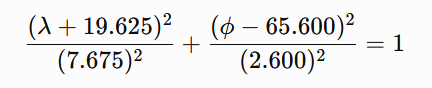
It has long been recognized that the Pacific Ring of Fire is linked, within the global plate-tectonic system, to the mid-ocean ridges of both the Atlantic and Indian Oceans. New oceanic crust is generated along the spreading ridges, while large amounts of old oceanic lithosphere are returned to the mantle through subduction around the margins of the Pacific. There are also major spreading ridges within the Pacific itself. Nevertheless, the Pacific differs fundamentally from the other two major oceanic domains: instead of being dominated by a central ridge system bounded largely by passive continental margins, much of its circumference is characterized by active plate boundaries, subduction zones, volcanic arcs and major fault systems. This is the basis for the familiar concept of the Pacific Ring of Fire.

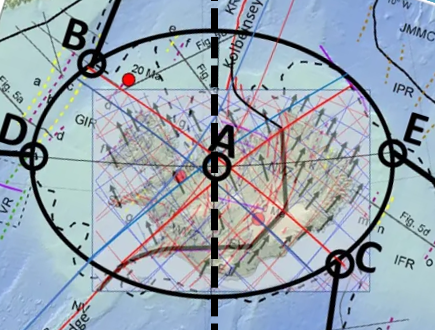
By analysing the Ring of Fire more closely in relation to the proposed mantle convection-roll system, and drawing in particular on the detailed structural relationships that can be studied in Iceland and compared with other regions, it became possible to define two broad elliptical forms—an inner and an outer tectonic ellipse—within which most of the major active structures associated with the Ring of Fire can be placed. I presented this geometric interpretation at Stanford University in 2024.
The fit is not perfect, nor should it necessarily be expected to be. Some major tectonic structures initially appear to be exceptions. The Tonga–Kermadec system, for example, lies well inside the zone defined between the inner and outer boundaries of the Pacific Ring of Fire. This was difficult to explain if the Pacific system was considered in isolation.
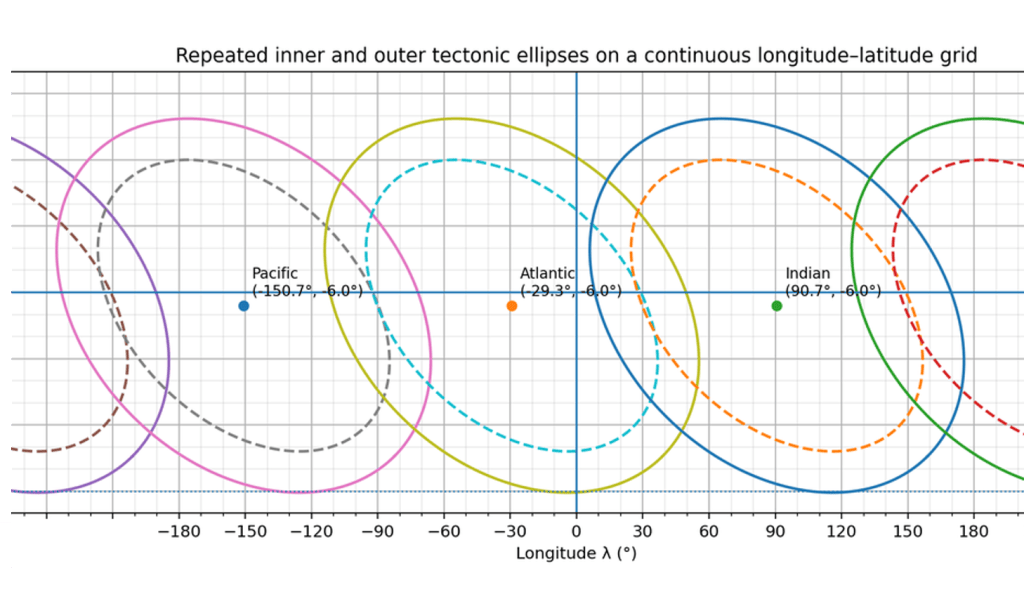
A more important geometrical relationship became apparent when the inner ellipse was examined in greater detail. Its equatorial width is approximately 120° of longitude. Earlier work had concentrated more heavily on the outer ellipse, which theoretically spans about 150° from east to west at the equator. In practice, the outer boundary extends slightly beyond 150°, its geometric centre lies somewhat south of the geographic equator, and the ellipse itself is oblique: its general elongation is from northwest to southeast, while its minor axis therefore trends approximately southwest–northeast.
The 120° width of the inner ellipse raises a fundamental possibility. Since 120° is exactly one third of 360°, the Ring of Fire may not represent an isolated tectonic geometry. It becomes possible to test whether the Earth’s large-scale tectonic framework contains a threefold, approximately 120° organization.
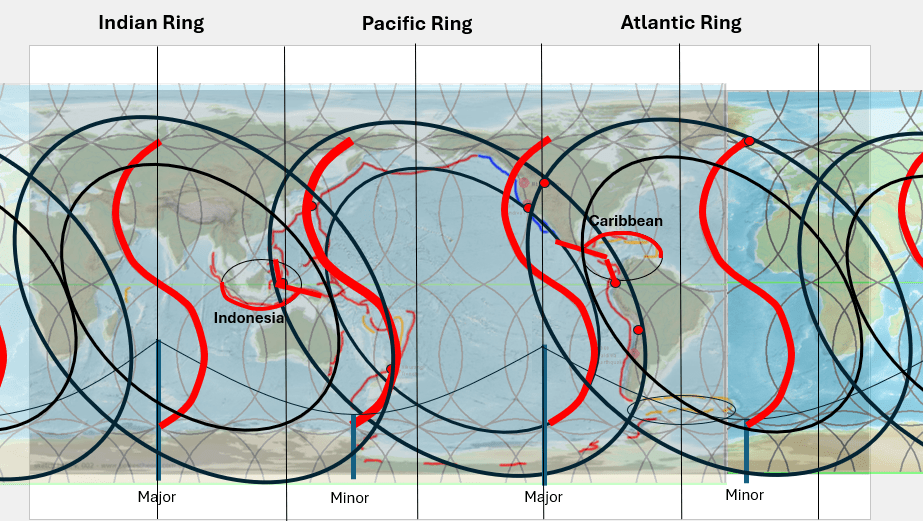
When three comparable tectonic ellipses—or, more accurately, three pairs of inner and outer ellipses—are projected around the Earth, the resulting geometry shows a striking degree of correspondence with major geological structures. These may provisionally be called the Pacific Ring, the Indian Ocean Ring, and the Atlantic Ring.
This broader geometry changes the interpretation of several apparent anomalies.
The Tonga–Kermadec subduction system, rather than being an unexplained feature lying inside the Pacific Ring, falls close to the outer boundary of the Indian Ocean tectonic ellipse. In this interpretation it is located in an overlap zone between two large tectonic systems.
Similarly, the Red Sea no longer appears simply as an isolated, unusually linear rift system. It lies close to the outer boundary of the Atlantic ellipse. From there, the same broad tectonic boundary can be followed through Europe, where I described relationships between tectonic structures and the proposed convection-roll pattern in my 2023 Stanford presentation, and northward toward Iceland.
Iceland itself is situated on the outer boundary of the Atlantic tectonic ellipse. This provides a potentially important geometric context for its exceptional combination of a mid-ocean ridge, thickened crust, intense volcanism and major tectonic segmentation.
The geometry becomes particularly interesting where the large ellipses overlap. The continuation of the Atlantic ellipse toward North America approaches the regions of Yellowstone and the San Andreas fault system. At approximately the same locations, the boundaries of two tectonic ellipses intersect and the minor axes of the ellipses are expressed.
Thus, three independent geometrical relationships appear in approximately the same areas:
- boundaries within the proposed lower-mantle—and, at smaller scales, upper-mantle—convection-roll system;
- the minor axes of the large tectonic ellipses; and
- intersections between the boundaries of neighbouring tectonic ellipses.
What makes this particularly interesting is that several exceptionally distinctive geological regions occur near such intersections. Yellowstone, the San Andreas system and New Zealand are obvious examples. They represent very different kinds of geological environments, yet all occupy unusually complex positions within the proposed global geometry.
This distinction is important. The model does not imply that Yellowstone, San Andreas and New Zealand were created by an identical local process. Rather, their positions may indicate places where several components of the global tectonic system interact. The geometry may therefore describe the framework within which different tectonic processes operate, rather than a single mechanism producing identical structures everywhere.
The three tectonic rings
The three proposed systems also have distinctly different geological expressions.
The Pacific Ring is exceptional because there is no major continent occupying the interior of its inner ellipse. The Pacific Plate and associated oceanic plates therefore dominate a huge part of the system. Subduction around its margins is correspondingly prominent, producing the classical Ring of Fire.
The Atlantic Ring has a different character. Its most obvious feature is the remarkable continuity of the Mid-Atlantic Ridge system from the Southern Ocean northward through the Atlantic and into the Arctic domain. Rather than being surrounded predominantly by subduction zones, as in the Pacific, the Atlantic contains a major spreading system through its central region. Its outer tectonic ellipse consequently interacts extensively with continental lithosphere in Africa, Europe and the Americas.
The Indian Ocean Ring is different again and may be regarded as fundamentally divided between north and south. Its southern part is dominated by oceanic lithosphere and the interconnected Indian Ocean ridge system, whereas its northern part is occupied by the large continental masses of Africa, Arabia, India and Eurasia and by the effects of major continental collision. Nevertheless, a comparable broad elliptical geometry can still be traced through the system.
The three rings therefore need not produce identical surface geology. Their importance lies instead in the possibility that a common large-scale geometry is being expressed through three very different lithospheric configurations.
One particularly striking example is the eastern margin of Australia, which lies close to the inner boundary of the proposed Indian Ocean ellipse. Likewise, the relationship between the Izu–Bonin system in the Northern Hemisphere and Tonga–Kermadec in the Southern Hemisphere becomes more meaningful when both are considered in relation not only to the Pacific Plate but also to the underlying boundaries proposed for the convection-roll system. Both appear to be associated with the same broad division in the western Pacific mantle system, even though their surface tectonic histories and plate geometries differ.
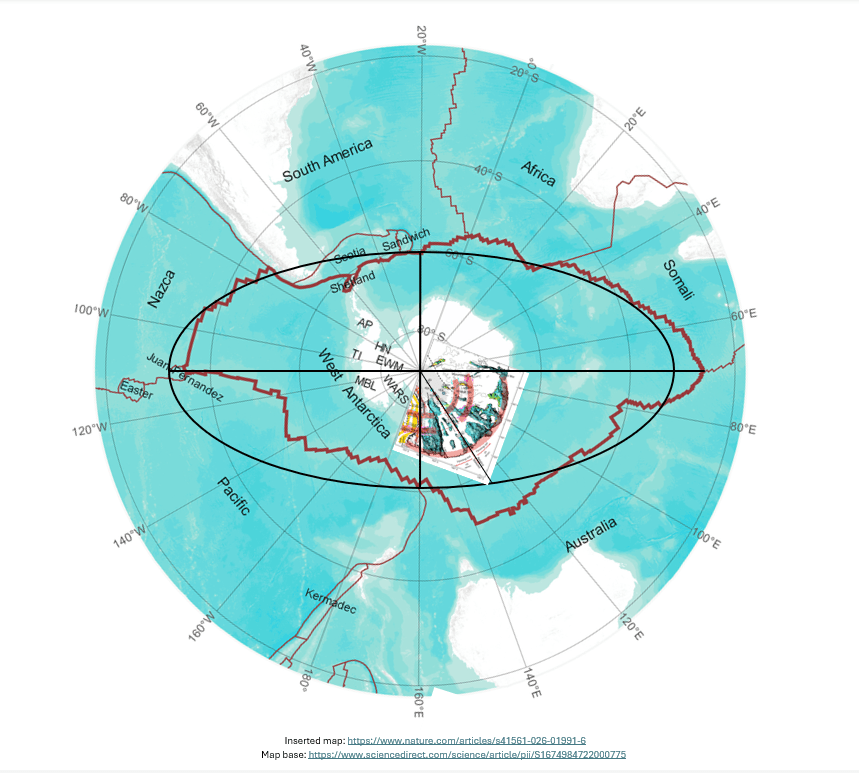
The Atlantic sector provides another useful example. When the proposed lower-mantle divisions are projected northward from Antarctica, one of the principal boundaries can be followed toward the North Atlantic and Iceland. The apparent continuity between Southern Ocean geometry, the Atlantic ridge system, Europe and Iceland is difficult to appreciate when these regions are examined individually, but becomes much clearer when they are placed within a single global geometric framework.
How could such rings form?
The origin of these large elliptical tectonic patterns is, of course, a much more difficult theoretical question than simply identifying their geometry.
The lithosphere cannot be treated as a perfectly rigid shell. Although its upper portion behaves rigidly over geological timescales, its deeper parts interact with the ductile asthenosphere and upper mantle. The large-scale geometry observed at the surface must therefore result from a combination of processes acting over very long periods.
At least three components may be involved:
- the rotation of the Earth and the directional constraints that rotation imposes on global-scale flow;
- persistent forcing associated with organized convection within the mantle;
- and horizontal displacement and deformation of the lithospheric plates themselves.
These processes would not operate independently. A plate moving horizontally across the Earth’s surface is simultaneously affected by its own internal stresses, by interactions with surrounding plates, by ridge generation and slab subduction, and by stresses transmitted from the underlying mantle. Continental and oceanic lithosphere would respond differently because of their very different thicknesses, densities, compositions and mechanical histories.
This may help explain why the same underlying geometrical system could produce such different surface expressions in the Pacific, Atlantic and Indian Ocean regions.
The concept should therefore not be interpreted as three rigid circles stamped onto the Earth’s crust. A better analogy is a set of overlapping, deformable tectonic domains, each responding to the same global physical system but modified by the heterogeneous lithosphere through which the forces are expressed. Their boundaries may consequently shift, broaden, bifurcate or become locally obscured.
This also provides a possible explanation for why the ellipses do not correspond perfectly to every geological structure. A geometrical model operating at mantle scale should define preferred zones and relationships rather than mathematically exact surface lines. Continental collision, inherited crustal structures, changing plate boundaries and the creation or destruction of oceanic lithosphere will inevitably modify their surface expression.
What is significant is therefore not that every tectonic boundary lies precisely on an ellipse, but that a recurring 120° geometry appears to organize a surprisingly large number of otherwise separate tectonic features.
If this threefold relationship is real, the Pacific Ring of Fire should no longer be viewed solely as a unique circum-Pacific phenomenon. It would instead represent the clearest surface expression of one member of a larger global system. The Atlantic and Indian Ocean systems would be less visually obvious because their lithospheric environments are different, but geometrically they could belong to the same underlying organization.
That possibility opens a much larger field for investigation. The exact positions of the inner and outer boundaries can be tested against ridge segments, transform faults, subduction zones, volcanic arcs, continental rifts, major fault systems and seismic structures. Their intersections can be examined independently, as can their relationship with predicted mantle-flow boundaries at different depths.
Particular attention should be given to locations where several elements coincide: ellipse intersections, minor-axis positions and independently predicted mantle boundaries. Such locations provide the strongest tests of the model because their positions can be predicted geometrically before the local geology is examined.
In this sense, the purpose of the model is not simply to draw ellipses around existing tectonic structures. Its scientific value depends on whether the geometry can be defined independently and then used to predict where unusual tectonic relationships should occur.
The Pacific Ring of Fire, the Atlantic system and the Indian Ocean system may therefore be three different surface expressions of a single, much larger geometrical organization of the Earth. The differences between them are substantial—but those differences may be exactly what should be expected when the same underlying mantle framework interacts with three fundamentally different arrangements of continents, oceans and lithospheric plates.
And this is where the analysis can now be taken considerably further.