
At first glance, the Yellowstone hotspot and the Changbai Mountains seem to lie far outside the familiar boundaries of the Ring of Fire. They are usually treated as exceptions, features belonging to entirely different systems. But what if they are not exceptions at all? What if they are clues? See: https://www.youtube.com/watch?v=3C2HVOB-g5s
A geometrical starting point
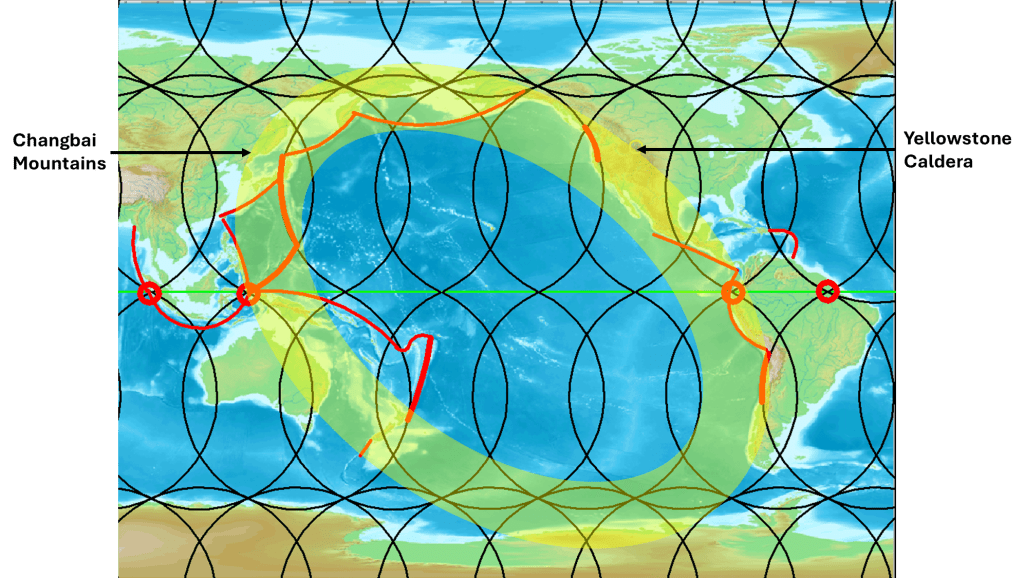
Trying to define a strict geometrical shape for the Ring of Fire may seem futile. Still, it is worth attempting, not as a final answer, but as a way of revealing structure. A useful starting point is to consider two major anchor regions roughly 150° apart along the equator: the subduction zones along Indonesia and those along the west coast of South America. These are not arbitrary points; they represent fundamental expressions of how the Pacific Plate interacts with its surroundings.
From here, an elliptical form can be traced around the Pacific basin. It is basically a perfect ellipse. The Earth is rotating, and the Coriolis effect acts in opposite directions in the two hemispheres. The result is a systematic distortion: the structure is skewed westward in the Northern Hemisphere and eastward in the Southern Hemisphere.
Why the Ring is not a ring
This distortion helps explain something that has long puzzled geologists: the Ring of Fire is not actually a closed ring. It resembles a horseshoe.
One key reason lies in the western Pacific. Subduction zones there, particularly the Tonga–Kermadec system, do not simply trace the outer boundary. Instead, they appear within it, as if mirrored inward. This is consistent with a rotating system where structures are not just arranged spatially, but dynamically shaped. The “ring” is therefore not a rigid boundary. It is the visible expression of a deeper, moving system.
Extending the pattern
If this geometrical framework has any validity, it should not stop neatly at the edges of the Pacific. And indeed, it does not. Volcanic regions in Antarctica can be fitted into the same broad pattern. This alone suggests that we are not dealing with a local phenomenon, but with something that reflects global-scale mantle behavior. And this is where the two outposts come back into focus.
Rethinking Changbai
The Changbai Mountains have long been considered outside the Ring of Fire. Yet seismic evidence shows that material from the Pacific Plate has descended into the mantle transition zone (410–660 km depth) and then spread laterally beneath northeastern Asia. In other words, the influence of Pacific subduction does not stop at the trench. It continues far beneath the surface, so therefore Changbai is not disconnected. It is linked, but in a way that is not immediately visible from above.
Yellowstone as a counterpart
On the opposite side, Yellowstone sits deep within the North American continent. It is typically explained as a mantle plume, rising independently from great depth. But its position relative to the broader geometry is striking. If we extend the distorted elliptical framework, Yellowstone lies close to its outer margin, mirroring Changbai on the other side of the Pacific system.
Beyond the outline
So what lies behind the geometry? The Ring of Fire, when viewed not as a boundary but as a pattern, appears to outline something larger: a system of long, connected mantle flows encircling the Pacific. Subduction zones are only the surface expression of this system. The deeper structure may extend far beyond them, both laterally and vertically.
In that context, Yellowstone and Changbai are not anomalies. They are signals. They suggest that the system does not end at the edges we draw on maps. It continues beneath them. And that may be where the real structure lies.


