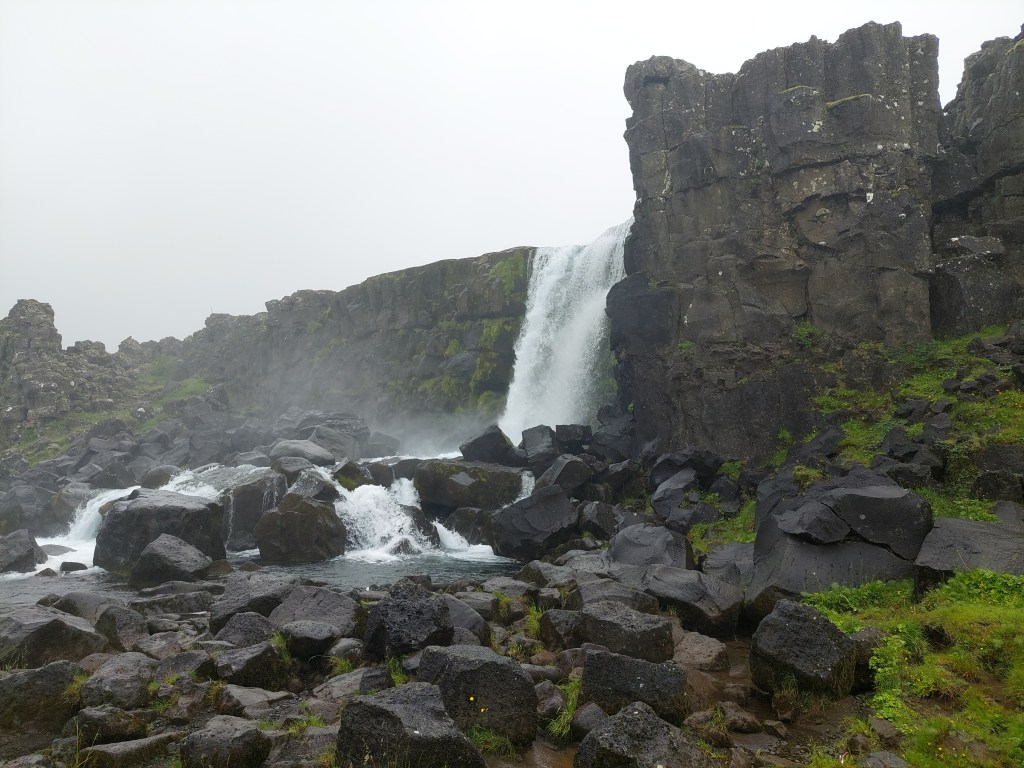
Öxarárfoss cascades over the edge of the North American Plate.
Öxarárfoss
Although it appears completely natural, the waterfall is actually man-made. The course of the Öxará River was deliberately diverted so that it would flow through the site of the Althing, Iceland’s ancient parliament, which was held nearby in the Þingvellir Rift Valley.
According to Haukdælaþáttur, the Öxará River was diverted into Almannagjá, from where it flowed through the assembly site at Þingvellir, providing a reliable supply of fresh water for the thousands of people and horses who gathered at the Althing each summer. The General Assembly lasted for two weeks, beginning at the end of June, every year from AD 930 until 1798. In 1799, it was transferred to Reykjavík.
The Þingvellir Rift Valley was formed by extensional forces as the North American and Eurasian plates move apart. But how do the plates actually move?
Modern GPS measurements are made using the International Terrestrial Reference Frame (ITRF), a global coordinate system that allows scientists to measure the positions and motions of points on the Earth’s surface with millimetre accuracy.
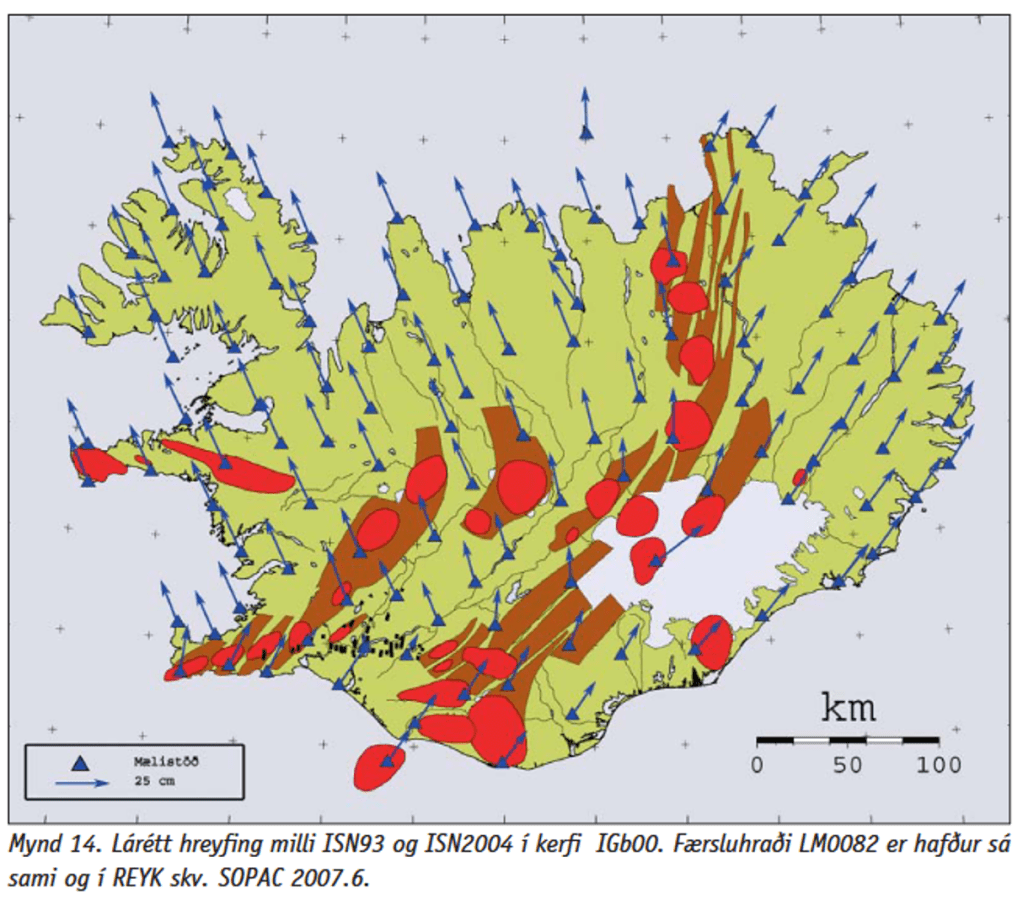
GPS surveys carried out in 1993 and 2004 showed that Iceland as a whole moves primarily northward in the ITRF reference frame. The western part of the country, resting on the North American Plate, moves toward the northwest, while the eastern part, on the Eurasian Plate, moves toward the northeast. Because both sides have a northward component of motion, the island itself drifts northward, while at the same time the two plates gradually move away from each other.
The original GPS data show both northward motion and rifting.
The relative spreading rate across Iceland averages about 18–20 millimetres per year, although it varies somewhat between different volcanic zones. At Þingvellir, this extension is accommodated by repeated earthquakes and movement along normal faults, gradually widening the rift valley. Individual earthquakes can produce sudden offsets of a few centimetres to several decimetres, while the long-term plate motion amounts to only a few centimetres per year.
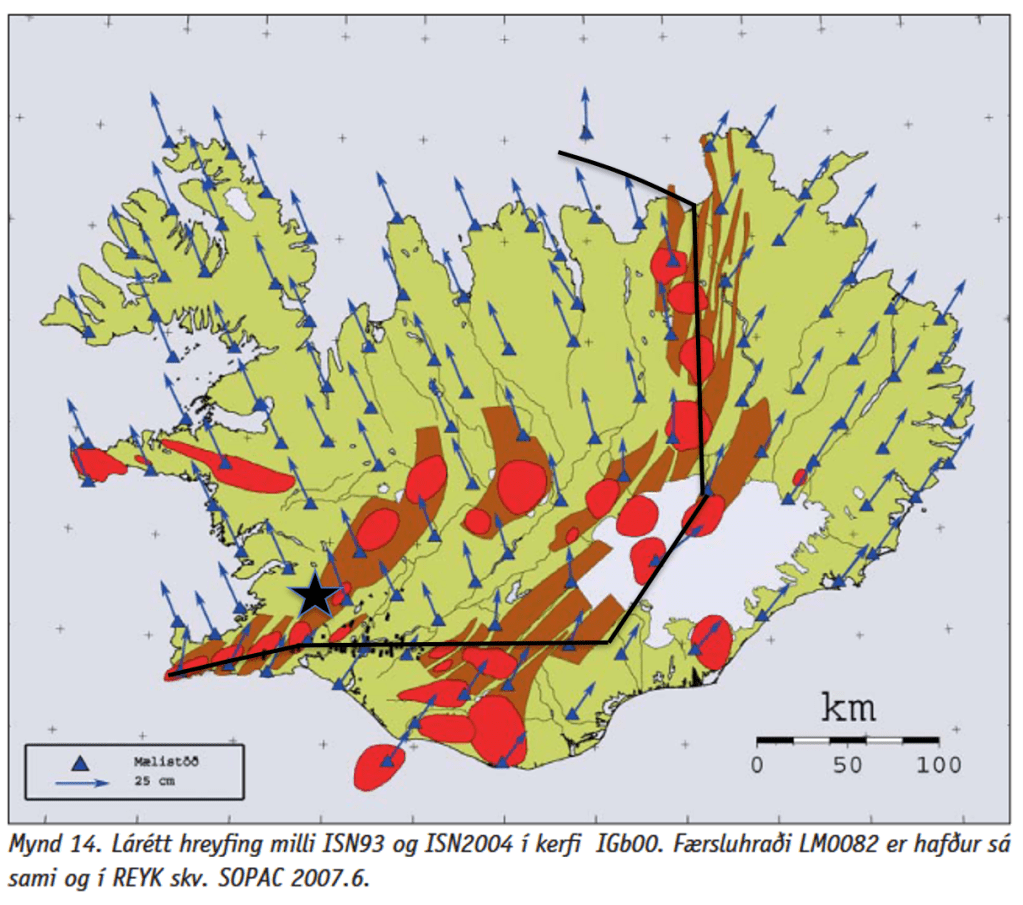
Star shows approximate location of Öxarárfoss, north of the main division line.
The northward component of Iceland’s motion has received relatively little attention in the geological literature compared with the more widely discussed process of plate separation. This is understandable, as scientific understanding develops gradually, and established models often remain the primary framework for interpreting new observations. As more high-precision GPS measurements become available, they provide an opportunity to further examine the significance of Iceland’s overall northward motion and its relationship to the opening of the rift zones.
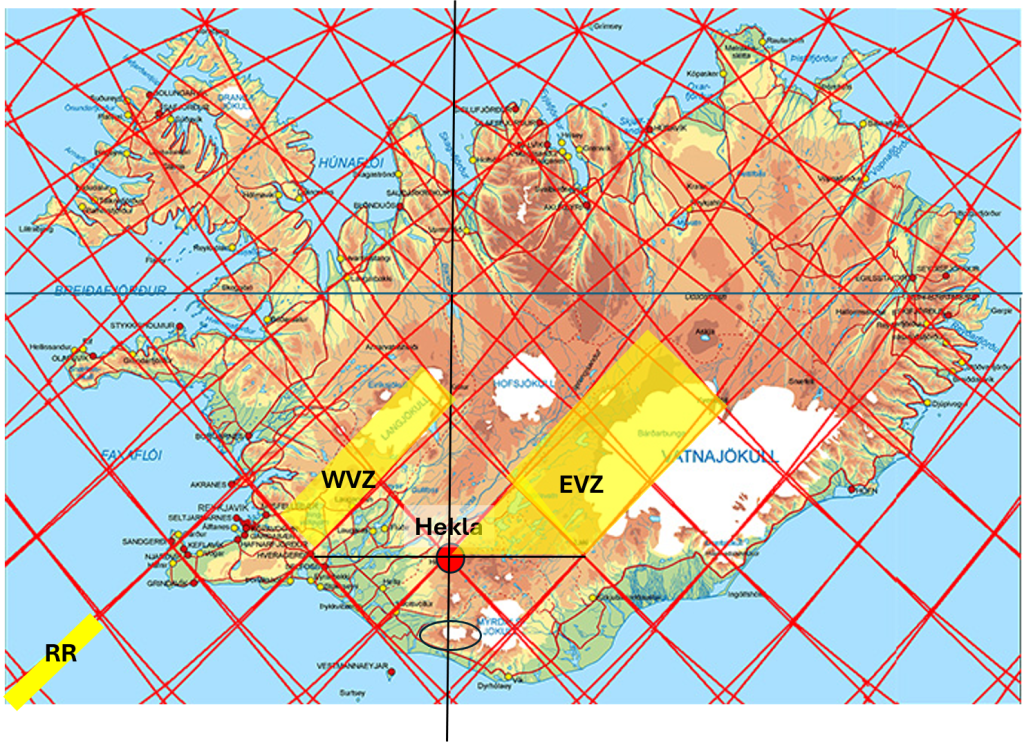
Hekla is known to occupy a uniquely important geological position within Iceland. It lies at the eastern end of the South Iceland Seismic Zone (SISZ) and simultaneously forms the southwestern gateway into the East Volcanic Zone (EVZ). In many ways, Hekla stands at the transition between two fundamentally different tectonic expressions: the transform-style seismic deformation of South Iceland and the broad volcanic rifting of the eastern volcanic systems.
The rifting process commonly described in Icelandic geology, where one side of Iceland drifts roughly 1 cm westward each year while the other moves about 1 cm eastward, can be visualized as being organized around a central tectonic division line that reaches the latitude and structural position of Hekla. This gives Hekla a particularly important geometric and tectonic role within the overall framework of Iceland.
The East Volcanic Zone is more difficult to represent with a single line than the oceanic ridges north and south of Iceland, because the EVZ is not a narrow ridge crest but rather a broad tectono-volcanic corridor 1.5° wide from east to west. In this interpretation, special emphasis is placed on the eastern boundary of the EVZ, which appears to function as a major division between tectonic domains associated with the North American and Eurasian plates. Rather than viewing the EVZ simply as a diffuse volcanic belt, it can therefore be examined as a structured rift system occupying a broad zone between deeper mantle flow divisions.
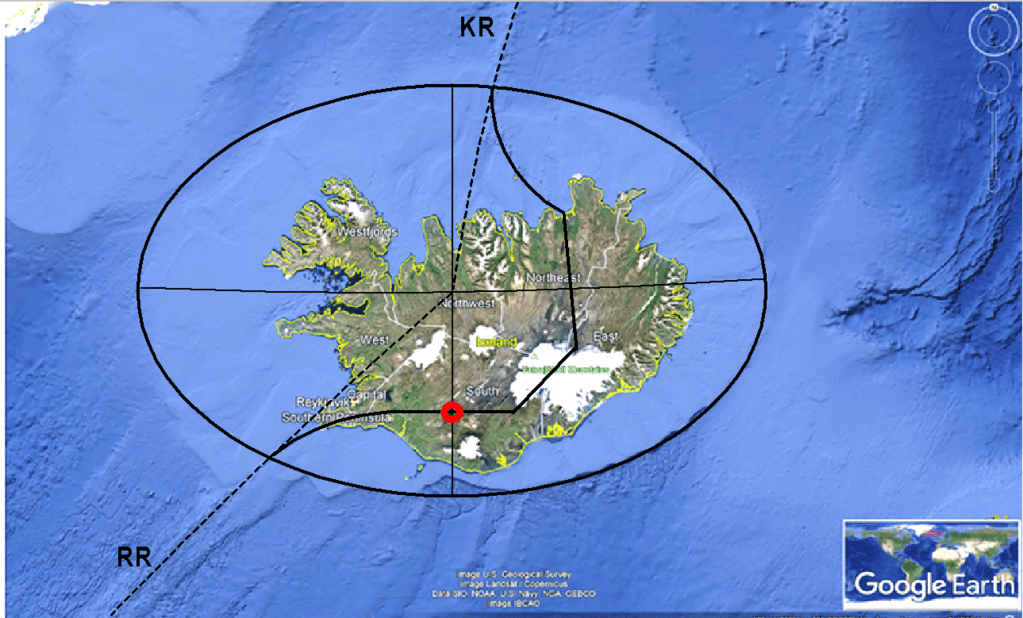
When zooming out to examine the large-scale geometry of Iceland itself, including the mid-ocean ridges and the surrounding continental shelf, an even more remarkable arrangement becomes visible, with Hekla occupying a central position within the overall symmetry.
Location of Hekla (red circle) and the Elliptical Outline of the Continental Shelf of Iceland.
The continental shelf surrounding Iceland has a surprisingly regular form. The southeastern quarter of the shelf, in particular, remains relatively undisturbed and displays a sharp elliptical geometry that can be detected mathematically. The ellipse possesses clearly identifiable major and minor axes aligned directly east–west and north–south respectively. Significantly, Hekla is located on the north–south minor axis of this elliptical structure.
The N-S central axis.
If the major and minor axes of the Icelandic shelf ellipse are drawn, and the oceanic segments of the Reykjanes Ridge and Kolbeinsey Ridge are extended toward Iceland from the south and north, the two ridge extensions converge precisely in the central point of the ellipse itself (extrapolation shown with dotted lines). This creates a striking geometric relationship between:
the elliptical form of the Icelandic continental shelf,
the mid-ocean ridge system north and south of Iceland,
the tectonic division between the North American and Eurasian plates,
and the position of Hekla within the overall structure.
The tectonic division line through Iceland also appears remarkably symmetrical when compared with both the elliptical outline of the shelf and the extended ridge axes. North and south of Iceland alike, the plate division lines merge naturally into the mid-ocean ridges exactly where those ridges intersect the elliptical margins of the shelf.
Within this broader framework, the detailed geometry of mantle convection-roll polygons and their division lines becomes increasingly important. The interaction between different mantle layers, tectonic boundaries, volcanic zones, and continental-shelf geometry may together help explain why Hekla occupies such an exceptional position within Icelandic geology.
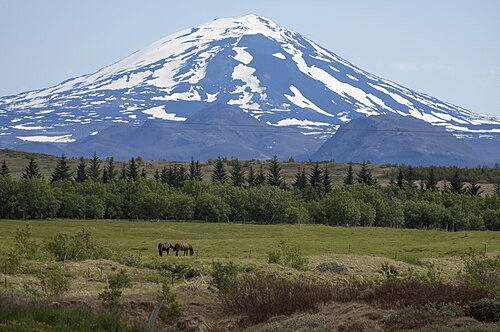
Location of Hekla.
Hekla has been regarded as Iceland’s most famous volcano for centuries, and perhaps not only because of its frequent eruptions and dramatic appearance. Its location suggests that it occupies one of the most structurally significant positions in the entire geological framework of Iceland.
The largest glacier in Iceland, Vatnajökull, covers several major volcanic systems. Direct geological research beneath the glacier is difficult because of the extreme environmental conditions, thick ice cover, and active geothermal areas. Nevertheless, a remarkable amount is known about the volcanic framework beneath the ice.
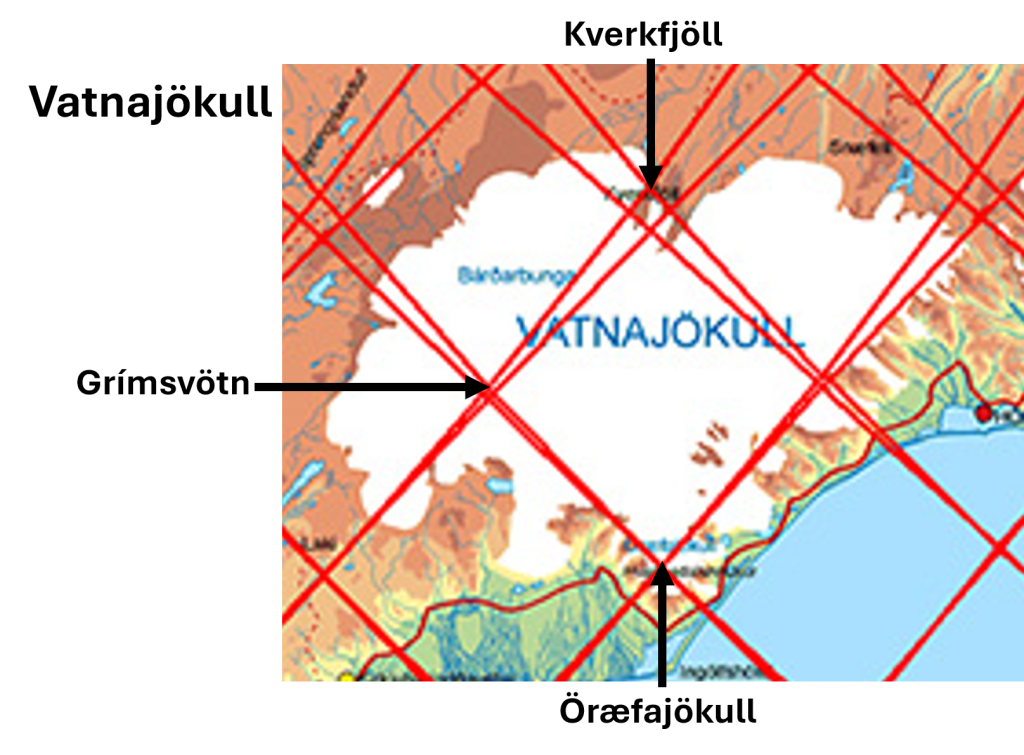
Vatnajökull with Öræfajökull, Grímsvötn and Kverkfjöll.
Three prominent volcanic regions are especially important in this context because they appear to fit clearly into the proposed pattern of mantle convection roll division lines.
The first is Öræfajökull, the tallest volcano in Iceland, situated close to the 64th parallel. The second is Grímsvötn, a vast but more obscure volcanic and geothermal complex beneath central Vatnajökull. The third is Kverkfjöll, which occupies a relatively small polygon directly north of Öræfajökull.
Kverkfjöll is particularly significant because it marks the southern starting point of the North Volcanic Zone. From there, a remarkably direct volcanic axis can be traced northward all the way to Öxarfjörður, where the North Volcanic Zone meets the Tjörnes Fracture Zone. This fracture zone, in turn, connects the volcanic systems of Iceland with the offshore Kolbeinsey Ridge.
The geometrical relationship between these three volcanic centers is striking. The polygon formed by Öræfajökull, Grímsvötn, and Kverkfjöll appears exceptionally clear within the proposed convection-roll framework. In addition, Grímsvötn and Kverkfjöll are known to be petrologically related, suggesting a deeper structural connection beneath Vatnajökull.
Grímsvötn was also the source region of the magma and dyke propagation that eventually produced the catastrophic Laki eruption in 1783. Within this framework, the magma migration becomes especially interesting because the dyke propagated from one calculated division line toward another before the eruption began. Laki itself lies on one division line, whereas Grímsvötn occupies another.
The line extending from Kverkfjöll through Grímsvötn to Laki closely coincides with the eastern boundary of the East Volcanic Zone. The width of this volcanic zone can be measured directly on the surface, and it corresponds closely to the calculated width of the relevant convection roll in the model.
On the opposite side of the Grímsvötn–Kverkfjöll line lies Öræfajökull, which also marks the beginning of another volcanic alignment: the Öræfajökull Flank Zone. This zone trends northeast–southwest and extends toward Snæfell northeast of Vatnajökull. In total, the flank zone spans approximately the equivalent of two polygons within the proposed geometrical framework.
The repeated appearance of the same fundamental geometrical unit — polygons with an approximate east–west width of 1.5° — is one of the main reasons the model may provide a valuable tool for examining geological structures. According to this interpretation, the same geometrical relationships are not confined to Iceland alone, but may also appear in tectonic and volcanic systems throughout the world.
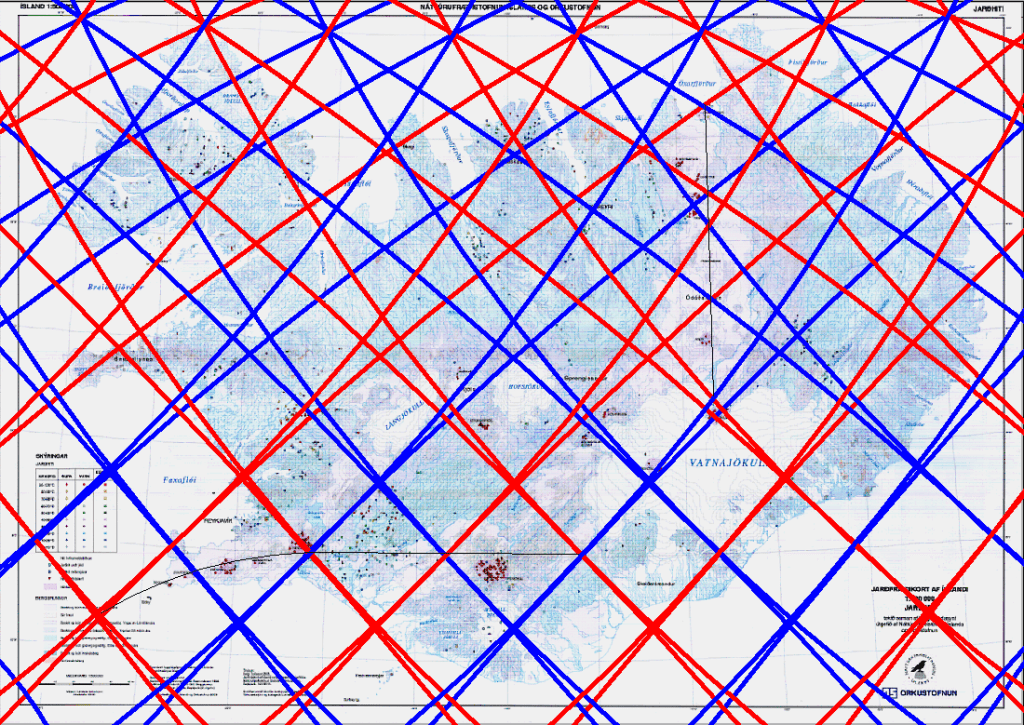
Geothermal areas of Iceland with superimposed mantle convection roll division lines and the tectonic boundary between the North American and Eurasian plates.
Within Iceland, however, Vatnajökull provides one of the clearest large-scale examples. Beneath the ice cap, some of the country’s most powerful volcanic systems appear organized in a pattern that mirrors the calculated geometry of the mantle convection roll model. Each polygon therefore becomes something like a chapter in a book, with each one containing its own distinct geological characteristics, tectonic structures, volcanic systems, geothermal activity, and landscape evolution.
Viewed in this way, Iceland can be examined as a sequence of interconnected geological “chapters,” where every polygon reveals a slightly different expression of the same underlying mantle convection roll system. One polygon may be dominated by rifting and fissure swarms, another by central volcanoes and geothermal fields, while a third may display transform faulting, glacial volcanoes, or complex magma interactions beneath ice caps.
This approach is valuable because it provides a structured way to examine geology step by step. Instead of viewing Icelandic geology as a collection of isolated volcanic systems, each region can be interpreted as part of a larger geometrical framework extending through the crust and into the mantle below.
The same method can also be applied to other parts of Iceland. The Reykjanes Peninsula, the South Iceland Seismic Zone, the Hengill area, the central highlands, and the northern volcanic systems all become individual “chapters” whose geological behaviour can be compared within the same overall framework.
In that sense, the polygon system is not only a geometrical model. It also becomes an organizational tool for understanding geology across many different scales — from magma migration beneath a glacier to the overall tectonic structure of Iceland itself.
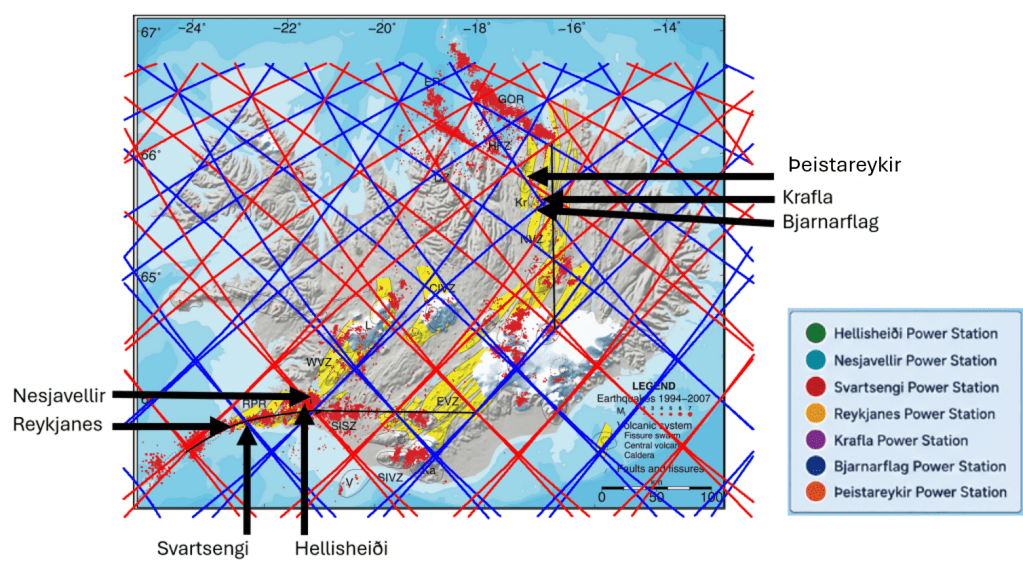
Iceland is unique among nations because nearly all of its geothermal power production is located directly within an active plate boundary zone. The country stands astride the northern section of the Mid-Atlantic Ridge, where the North American Plate and Eurasian Plate slowly drift apart.
Within this environment, geothermal activity is not isolated. Instead, it forms part of a large interconnected tectonic and volcanic framework extending from the Reykjanes Ridge in the south to the volcanic systems of northeast Iceland.
The seven geothermal power stations producing electricity in Iceland are therefore much more than industrial facilities. Together they outline the geometry of the active volcanic belts of Iceland itself.
The Hengill Geothermal Complex
The largest concentration of geothermal power production in Iceland is found at Hengill, one of the most active volcanic systems in southwest Iceland.
Hellisheiði Power Station
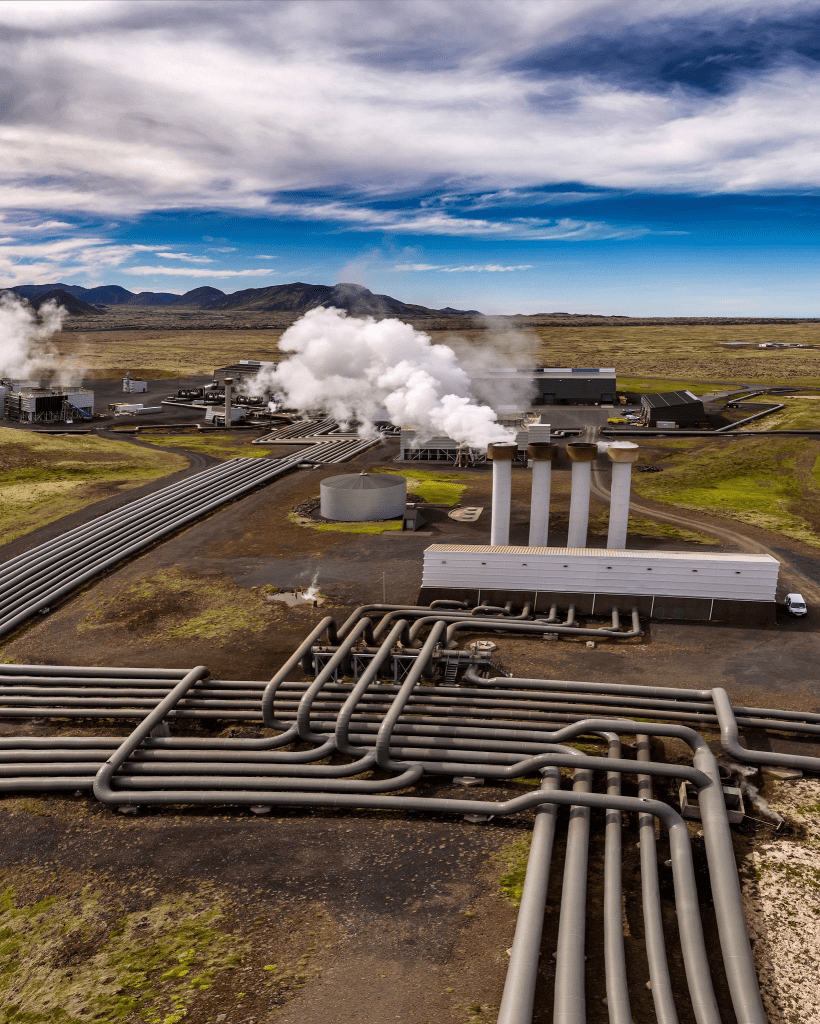
Hellisheiði Power Plant
Located on the southern side of the Hengill volcanic system, Hellisheiði Power Station is the largest geothermal power station in Iceland. It produces both electricity and hot water for the Reykjavík metropolitan area. Steam rises from wells drilled deep into fractured volcanic rocks directly above the active rift zone.
However, it is noticeable that Hellisheiði Power Station is not situated exactly above the tectonic division line between the plates, but slightly offset along the mantle convection rolls division lines interpreted in the area. These red upwelling lines, associated with the second and fourth convective layers, being rather evenly distributed between approximately 120 and 670 km below Earth’s surface, form the boundary between the Reykjanes Oblique Rift Zone and the West Volcanic Zone.
In this respect, the location of Hellisheiði resembles that of Svartsengi Power Station, as both are positioned along opposite sides of the same convection-roll framework.
Nesjavellir Geothermal Power Station
Situated near Þingvallavatn, Nesjavellir Geothermal Power Station occupies another section of the same tectonic environment. Together, Hellisheiði and Nesjavellir form the largest continuous geothermal utilization area in Europe. The two power stations largely make use of the same geothermal resources associated with the Hengill Volcanic System.
The location is highly significant geologically. The Hengill region lies exactly where volcanic activity, tectonic spreading, and large-scale fracture systems intersect.
Reykjanes Peninsula — Directly Above the Plate Boundary
The geothermal stations on the Reykjanes Peninsula are perhaps the clearest examples in the world of energy production directly tied to an exposed oceanic rift zone on land.
Svartsengi Power Station
Svartsengi Power Station became internationally known because of the nearby Blue Lagoon. However, geologically it is equally fascinating. The station extracts geothermal fluids from highly permeable volcanic formations created by repeated rifting episodes.
The intersections between the tectonic division line of Iceland and the interpreted convection-roll division lines are particularly apparent in this area.
Reykjanes Power Station
At the southwestern tip of Iceland, Reykjanes Power Station operates in one of the most tectonically active environments in the North Atlantic. Here, geothermal reservoirs are strongly influenced by seawater interaction and high-temperature magmatic systems beneath the peninsula.
The recent volcanic activity on Reykjanes has demonstrated how dynamic this part of Iceland remains.
Northeast Iceland — Rift Volcanism and High Heat Flow
The northeastern volcanic zone contains another cluster of geothermal power production associated with active crustal spreading.
Krafla Power Station
Krafla Power Station stands within one of Iceland’s most famous volcanic systems. The eruptions and rifting events of 1975–1984 transformed scientific understanding of how magma intrusions accompany plate spreading. A central hub, where several interpreted convection-roll division lines intersect within a comparatively small area, coincides with the geothermal activity associated with Krafla, Bjarnarflag Power Station, and Þeistareykir Power Station.
All of these three power stations are located slightly west of the tectonic division line, in apparent association with the mantle convection-roll division lines.
Bjarnarflag Power Station
Located near Mývatn, Bjarnarflag was one of Iceland’s earliest geothermal power stations. Though relatively small, it occupies an extremely important geological setting along the active rift.
Þeistareykir Power Station
Þeistareykir is one of Iceland’s newest geothermal developments. The area had long been known for extensive geothermal manifestations, but only in recent years has large-scale utilization become possible.
A Geological Pattern
What makes these seven power stations especially interesting is their apparent relationship both to the tectonic division line between the North American and Eurasian plates and to the interpreted divisions between the modeled mantle convection rolls mapped here. They are not randomly distributed across the country. Reykjanes Power Station and Svartsengi Power Station are found at the western end of the Reykjanes Peninsula, closely associated with the plate boundary zone itself.
In addition, Svartsengi appears to coincide with two downwelling lines associated with the second and fourth convective mantle layers. As mentioned before, these four modeled layers are interpreted as being rather evenly distributed between approximately 120 and 670 km below Earth’s surface.In many ways, the geothermal power stations themselves appear to reflect the tectonic framework of Iceland.
The pattern also illustrates a broader geological principle: geothermal energy is fundamentally linked to large-scale heat transport within Earth’s crust and upper mantle. Iceland simply exposes this relationship more clearly than almost anywhere else on Earth. For that reason, Iceland remains one of the world’s most remarkable natural laboratories for studying mantle processes, crustal spreading, volcanism, and geothermal systems.
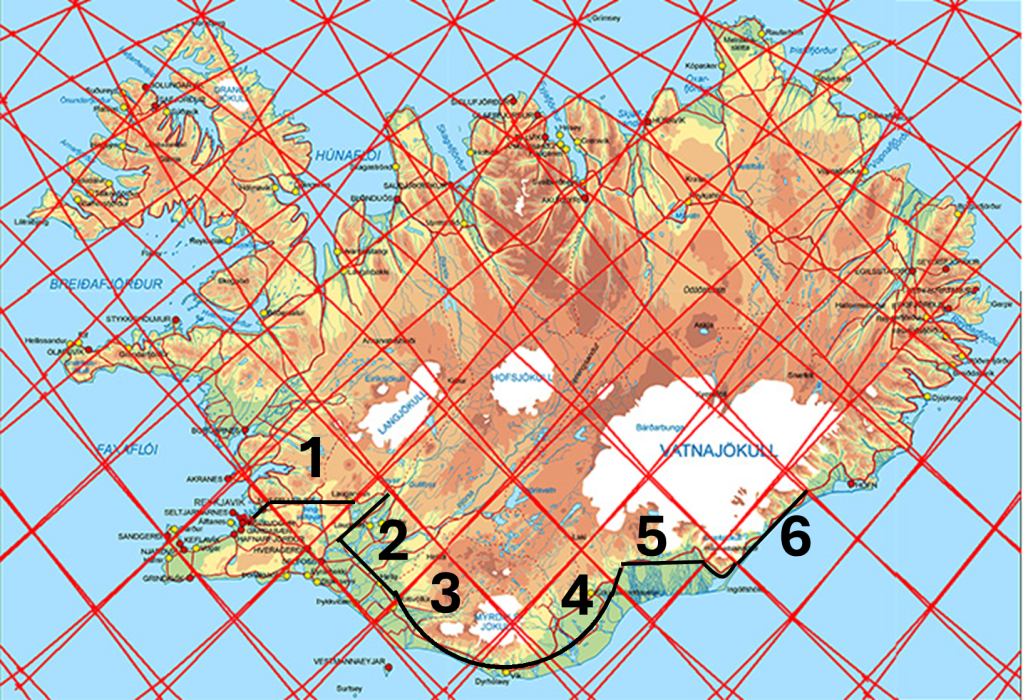
The six “chapters” of the tourist route through South Iceland
For the first chapter marked on the map, you visit Þingvellir National Park. In order to get there, you pass through the highland structure of the West Volcanic Zone, and at its central axis you find the rift valley of Þingvellir. You then drive all the way to Laugarvatn, where abundant geothermal activity is found along the boundary of polygon 2. From there, you turn north until you reach the Geysir area and Gullfoss at the northern end.
If you wish to continue to other scenic areas in the south, you can follow the main road running parallel to the boundary between polygons 1 and 2 until you reach the Ring Road, where you make a 90° turn toward the southeast. The road remains fairly straight until it crosses the boundary between polygons 2 and 3. After that, it curves around the two glaciers Eyjafjallajökull and Mýrdalsjökull.
Polygon 3 is centered around Eyjafjallajökull and includes two famous waterfalls: Seljalandsfoss at its western end and Skógafoss on its southern slopes. After passing the town of Vík í Mýrdal, at the southernmost point of Iceland, you enter chapter 4.
There, you pass two enormous lava fields, the largest on Earth formed in recorded history, one from the Eldgjá eruption of 939 and the other from the Laki eruption of 1783. There are two parallel roads there, and you would probably choose the northern one (road No. 1), but I chose the southern one for illistration 🙂 At the boundary between polygons 4 and 5, another turn is made to the right, crossing that polygon and passing the glacial rivers flowing from Vatnajökull. This area is generally known as Skeiðarársandur.
Upon reaching the end of polygon 5, you drive around Öræfajökull, the largest volcano in Iceland. Entering polygon 6, you are on the road toward the Glacier Lagoon, Jökulsárlón. You can then continue along the road running parallel to the side of the polygon all the way to the eastern end.
If you notice other roads that fit this pattern in a similar way, convection rolls underneath affecting the road system, it would be very interesting to examine them as well.