The development of global plate tectonics in relation to Robert J. Stern’s research and the Mantle Convection Rolls Model
Two Perspectives on the Same Tectonic System
When considering the Earth’s tectonic activity, an important distinction must be made between the present operation of the system and its long-term geological evolution.
On a human timescale, tectonic processes appear relatively stable. Earthquakes and volcanic eruptions take place, tectonic plates move a few centimetres each year, and deformation accumulates along plate boundaries. Nevertheless, the general geographical arrangement of the major tectonic systems changes very little during the period of human observation.
On the timescale of millions or billions of years, however, the situation is entirely different. Oceans open and close, continents assemble and separate, and subduction zones develop, migrate, and eventually disappear.
These are not two different systems. They are two perspectives on the same evolving physical processes.
The distinction is particularly important when examining the Pacific Ring of Fire. The Ring of Fire represents a major component of the Earth’s present tectonic activity. It is not, however, a geographical structure that has remained unchanged throughout geological history.
Understanding its present configuration therefore requires two complementary approaches: investigating the historical development of subduction tectonics and analysing the physical processes responsible for the present distribution of tectonic boundaries.
Robert J. Stern and the Geological History of Subduction
Robert J. Stern, a geologist at the University of Texas at Dallas, has devoted considerable attention to the origin and evolution of subduction zones.
In a paper published in Geology in 2005, Stern argued that the present episode of modern-style subduction tectonics may have begun during the Neoproterozoic Era, within approximately the last billion years.
His interpretation was based on three important types of geological evidence:
- Ophiolites, representing fragments of oceanic lithosphere preserved within continental geological formations.
- Blueschists, metamorphic rocks formed under high-pressure and relatively low-temperature conditions, typically associated with subduction.
- Ultrahigh-pressure metamorphic rocks, indicating that crustal material has descended to considerable depths before returning to the surface.
These geological indicators are particularly useful because they preserve evidence of tectonic processes that can no longer be observed directly.
One remarkable feature of the geological record is that ophiolites are predominantly young when compared with the age of the Earth.
This observation raises a fundamental question: did subduction develop relatively late in Earth’s history, or have most traces of earlier subduction simply disappeared?
The distinction is important because oceanic lithosphere is continuously recycled into the mantle. The geological record of ancient ocean basins is therefore much less complete than that of continental crust.
The Age Distribution of Ophiolites
A particularly useful quantitative investigation was published by Kent C. Condie and Robert J. Stern in 2023.
Their paper, Ophiolites: Identification and tectonic significance in space and time, examined 257 occurrences identified as ophiolites and evaluated their geological ages, tectonic environments, and reliability of identification.
The following table summarizes their findings.
Table 1. Distribution of ophiolites through geological time
| Geological interval | Number | Forearc settings | Occurrences per 100 million years |
|---|---|---|---|
| Phanerozoic (539 Ma–present) | 175 | 94% | 32 |
| Neoproterozoic (1,000–539 Ma) | 49 | 92% | 11 |
| Mesoproterozoic (1,600–1,000 Ma) | 16 | 87% | 2.6 |
| Paleoproterozoic (2,500–1,600 Ma) | 10 | 50% | 1.1 |
| Neoarchean (2,800–2,500 Ma) | 7 | 100% | 2.3 |
| Total | 257 |
Source: Condie and Stern (2023), Table 1. The numbers describe preserved and identified occurrences, not the total number of subduction zones that existed during each interval. Geological boundaries are rounded.
The age distribution is striking.
Of the 257 identified occurrences, 224 belong to the Neoproterozoic and Phanerozoic, representing approximately 87% of the total.
Furthermore, the number of recorded occurrences per 100 million years increases considerably toward the present.
This does not necessarily imply that subduction was absent during earlier geological periods.
Indeed, Condie and Stern identify much older examples. The Zunhua ophiolite in northern China dates to approximately 2,550 million years ago, while the Jormua and Purtuniq ophiolites date to approximately 1,950–2,000 million years ago.
The oldest preserved ophiolites therefore indicate that processes resembling modern oceanic spreading and subduction were operating long before the Neoproterozoic.
Nevertheless, the marked increase in younger ophiolites suggests that something important changed during the later stages of Earth’s geological history.
Condie and Stern consider three possible explanations: more extensive investigation of young geological formations, better preservation of younger ophiolites, and an actual increase in the geographical extent of interconnected plate tectonics.
These explanations are not mutually exclusive.
From Local Subduction to Global Plate Tectonics
An important aspect of Stern’s interpretation is the distinction between the occurrence of individual subduction zones and the existence of a globally integrated plate-tectonic system.
It is possible for localized subduction to occur without the entire lithosphere being divided into the interconnected system of moving plates observed today.
This suggests three general levels of tectonic development.
Stage 1 — Mantle convection and crustal deformation
Heat transfer from the Earth’s interior produces mantle circulation, magmatism, and deformation of the overlying lithosphere. These processes do not necessarily require a global network of moving tectonic plates.
Stage 2 — Localized or intermittent subduction
Under suitable mechanical conditions, parts of the oceanic lithosphere may descend into the mantle. Such processes can occur regionally and need not immediately establish a global plate-tectonic system.
Stage 3 — Globally interconnected plate tectonics
Oceanic spreading ridges, subduction zones, transform faults, and moving lithospheric plates become components of an integrated global system.
The present Ring of Fire belongs to this third category.
These stages are best understood as different levels of tectonic organization rather than a simple sequence that occurred only once.
Stern’s More Recent Interpretation
Stern has subsequently developed the idea that the Earth may have experienced alternating episodes of global plate tectonics and single-lid tectonics.
In a paper published online in 2024 and appearing in the 2025 volume of the Geological Society of America Bulletin, he proposed four successive tectonic episodes during the last 2.5 billion years.
Two were dominated by plate tectonics and two by single-lid regimes.
In a single-lid regime, the lithosphere forms a relatively coherent outer shell, although substantial internal deformation and volcanic activity can still occur.
Stern identified an earlier episode of plate tectonics during the Paleoproterozoic, followed by a long Mesoproterozoic interval dominated by single-lid behavior.
According to his interpretation, the present episode of global plate tectonics began approximately 800 million years ago.
This is an important development of his earlier theory.
Rather than asking exclusively when plate tectonics first began, Stern now emphasizes the possibility that Earth has experienced different tectonic regimes at different times.
It is therefore possible that subduction existed very early in geological history, temporarily became widespread, declined, and subsequently developed into the global system operating today.
This interpretation remains debated. Other researchers place the emergence of widespread plate tectonics much earlier, and ancient rock assemblages can be interpreted in different ways.
Nevertheless, Stern’s framework provides an interesting evolutionary perspective on the tectonic system.
The Initiation of Individual Subduction Zones
An additional distinction concerns the initiation of individual subduction zones within an already established global tectonic system.
Stern and Scott A. Whattam examined the connection between subduction initiation and ophiolite formation in their 2011 paper describing the subduction initiation rule.
Their work showed that many ophiolites preserve a characteristic sequence of magmatic rocks formed during the early stages of subduction.
The Izu–Bonin–Mariana system provides a particularly important modern example.
Subduction began there approximately 52 million years ago. During the early development of the system, seafloor spreading and extensive magmatism produced new crust within the forearc.
The resulting geological formations resemble the sequences preserved in many ancient ophiolites.
This relationship allows present-day subduction systems to be used in interpreting geological formations hundreds of millions of years old.
It also emphasizes an important chronological distinction.
The global tectonic regime may have existed for hundreds of millions of years, while individual subduction systems within it may be much younger.
Consequently, the geological age of an individual trench or volcanic arc cannot be used as the age of the global tectonic system itself.
The Ring of Fire in Its Present Configuration
The Pacific Ring of Fire comprises a broad geographical arrangement of active subduction zones, volcanic arcs, major faults, and associated tectonic structures surrounding much of the Pacific Ocean.
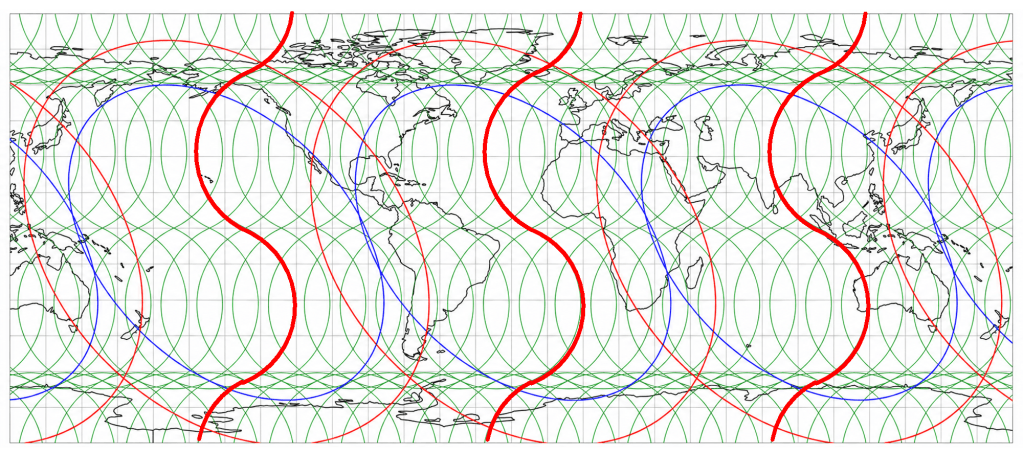
It extends along the western margins of the Americas, through Alaska and the Aleutian Islands, and southward through the western Pacific toward New Zealand.
Although this structure is often represented as a continuous ring, its individual components have different geological histories and mechanical characteristics.
Some of the principal subduction systems are separated by major transform faults or other tectonic boundaries. Their initiation and development occurred at different times.
The Ring of Fire must therefore be understood as a present-day arrangement of active tectonic systems rather than the remains of one ancient, continuous geological structure.
However, this raises another question.
Why does the present arrangement of tectonic boundaries form such an extensive and apparently systematic geographical pattern?
The conventional plate-tectonic explanation describes the movement and interaction of individual lithospheric plates. It also provides the mechanical framework for understanding subduction, spreading, and transform motion.
The Mantle Convection Rolls Model investigates an additional possibility: whether the geometry of mantle circulation contributes to the spatial organization of these boundaries.
The Ring of Fire and the Mantle Convection Rolls Model
The Mantle Convection Rolls Model is based on the proposed development of organized convection rolls within the Earth’s mantle.
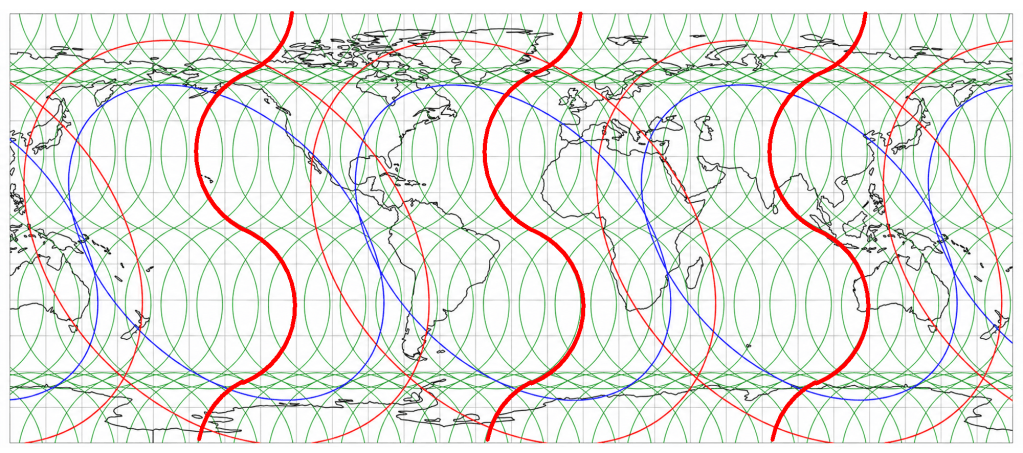
The model distinguishes between larger convection structures in the lower mantle and smaller convection rolls in the upper mantle and asthenosphere.
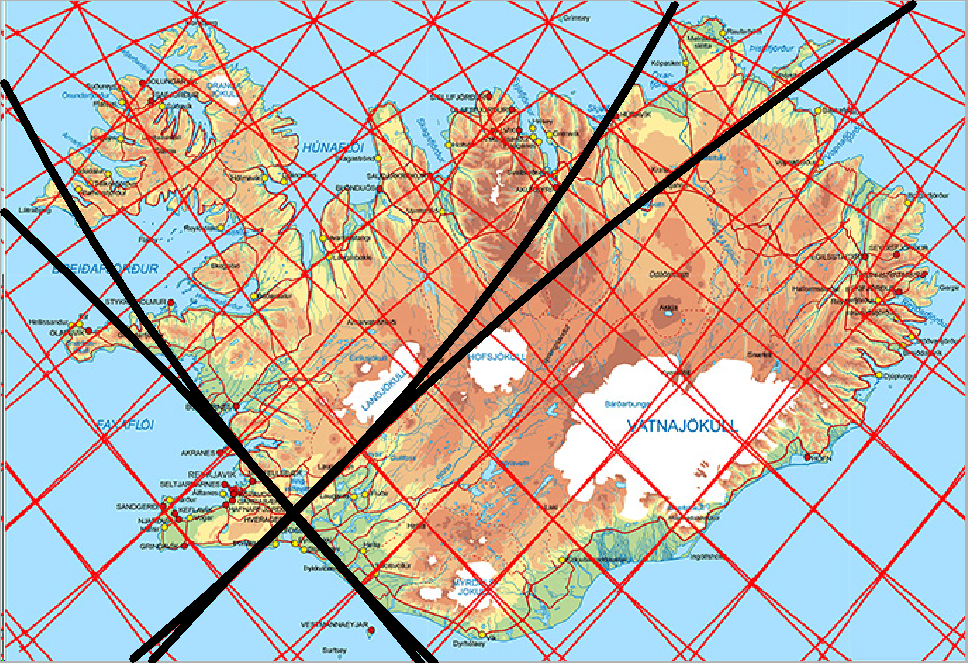
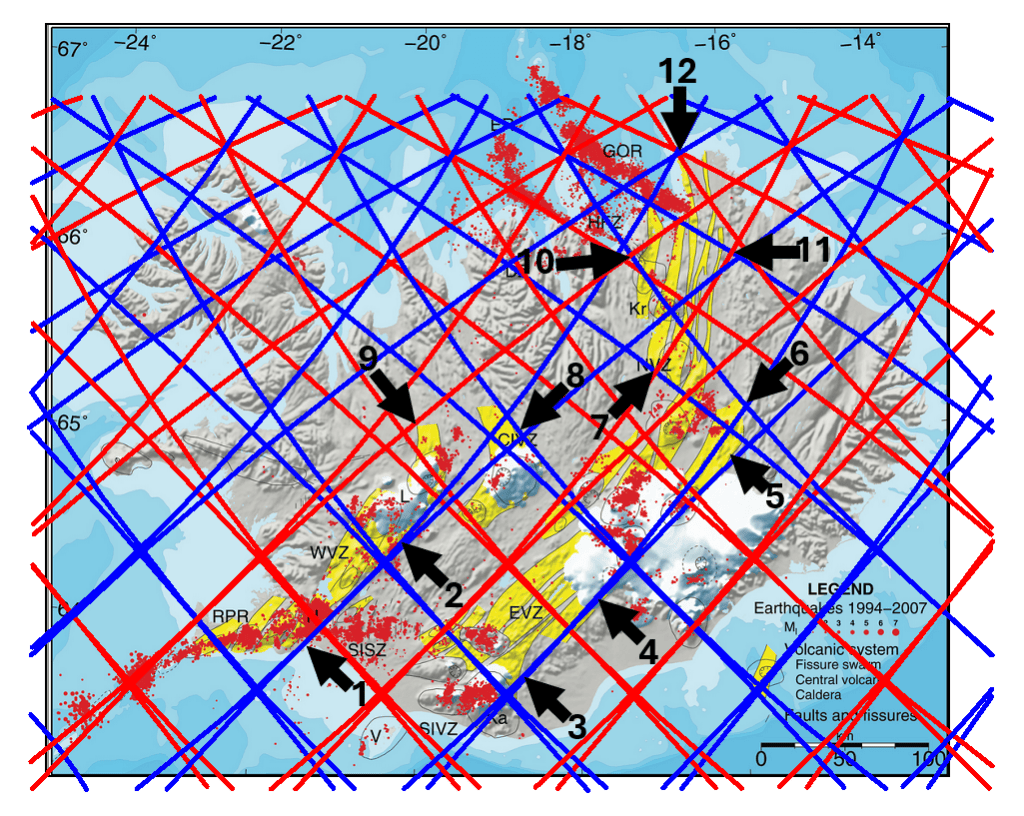
The geometry of the upper-mantle roll system has been developed using approximately 1.5° intervals, while larger-scale mantle divisions are proposed to influence the organization of major tectonic structures.
Within this interpretation, the surface expression of mantle circulation may involve several different types of interaction between mantle flow and the lithosphere.
These interactions include divergent boundaries, convergent boundaries, and deformation zones in which the relative orientation of the proposed convection structures changes.
The Ring of Fire is particularly important because it contains some of the world’s most extensive convergent boundaries.
The model proposes that their present spatial arrangement may reflect a larger geometrical organization of mantle circulation.
Three Global Tectonic Rings
Recent geometrical investigations presented on MagicMagma have extended the analysis beyond the Pacific.
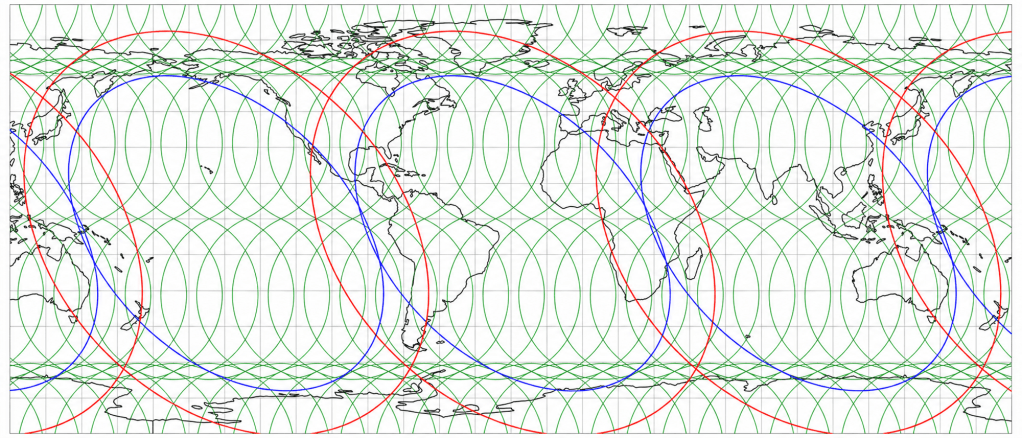
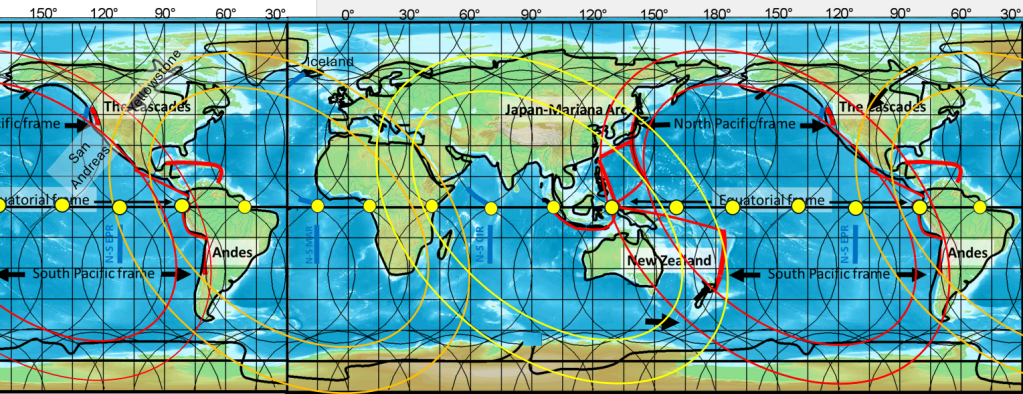
The working hypothesis identifies three adjacent large-scale tectonic ring systems associated with the Pacific, Atlantic, and Indian Oceans.
Their reference centers are separated by 120° of longitude:
| Tectonic ring | Reference center |
|---|---|
| Pacific | 149.3°W, 6°S |
| Atlantic | 29.3°W, 6°S |
| Indian Ocean | 90.7°E, 6°S |
The proposed ring boundaries are represented by families of inclined ellipses, with their major axes oriented at approximately −45° in longitude–latitude coordinates.
In the basic geometrical construction, the inner ellipse has a major-to-minor axis ratio of 3:2.
These angular relationships are part of the proposed model. Their application to the spherical Earth requires consideration of the changing physical distance represented by degrees of longitude at different latitudes.
The essential idea is that the Ring of Fire may represent one component of a larger geometrical system rather than an isolated tectonic feature.
The relationship between the Pacific ring and the Atlantic and Indian Ocean systems consequently becomes important.
This approach is particularly interesting because it attempts to examine divergent and convergent tectonic boundaries within the same geometrical framework.
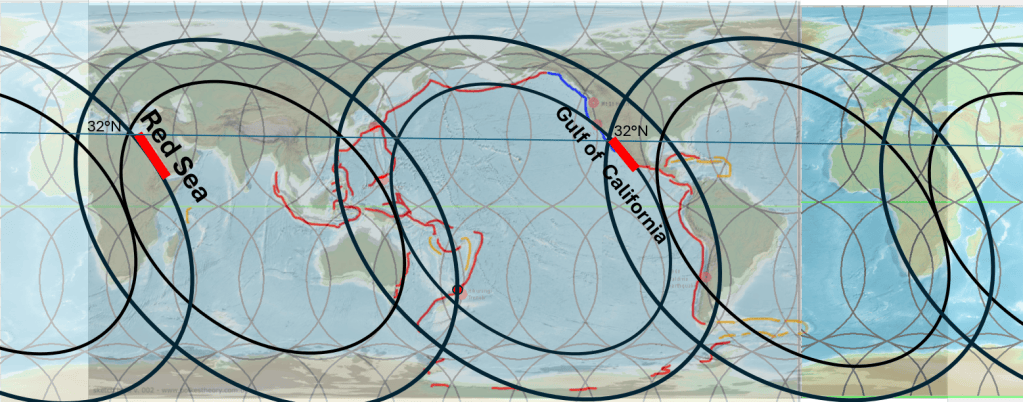
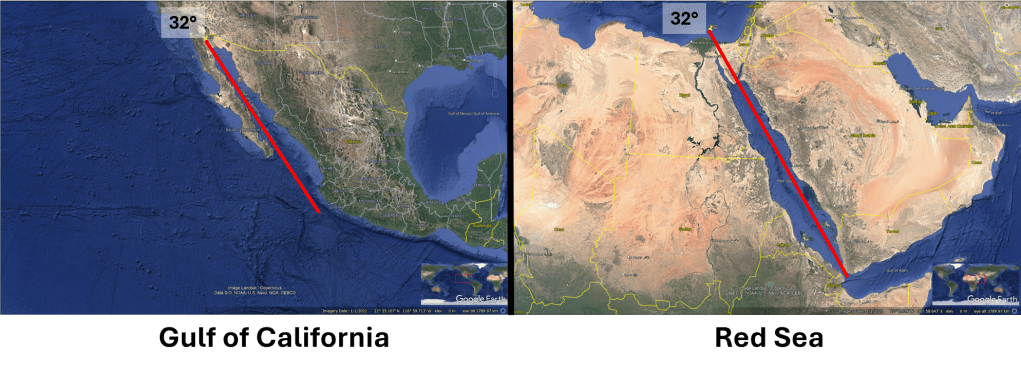
For example, the Gulf of California and the Red Sea represent different extensional environments, but their geographical positions may be compared with the proposed inner and outer ring boundaries.
Likewise, the relationships between the Mariana Trench, Japan, New Zealand, the Andes, and the Aleutian Islands can be examined relative to the predicted convection-roll divisions.
Such comparisons provide possible geometrical evidence, but geographical correspondence alone cannot establish the underlying mechanical cause. The model must also be evaluated against plate velocities, mantle-flow constraints, and the geological history of the boundaries.
Geological Evolution and the Persistence of Mantle Convection
Here the distinction between geological history and present-day activity becomes especially important.
Mantle convection is a fundamental mechanism of heat transfer within the Earth. It must have operated under a wide range of thermal and mechanical conditions during the planet’s history.
The organization and interaction of mantle convection and the lithosphere, however, need not have remained constant.
The early Earth was considerably hotter than the present Earth. Oceanic lithosphere was probably different in thickness, density, and mechanical strength.
These factors would have influenced the conditions under which subduction could begin and continue.
In Stern’s interpretation, the cooling and mechanical evolution of the lithosphere eventually allowed long-lived subduction to become a dominant component of global tectonic activity.
The Convection Rolls Model approaches the same development from the perspective of mantle circulation.
One possibility worth investigating is that mantle convection provided a persistent source of deformation and stress while the response of the overlying lithosphere changed through geological time.
Under this interpretation, the difference between early tectonic regimes and the present system would not necessarily require the appearance of mantle convection as an entirely new process.
Instead, it could reflect changes in the mechanical coupling between the mantle and the lithosphere.
This possibility does not imply that the detailed geometry of the present convection-roll model has existed unchanged since the early Earth.
Changes in mantle temperature, viscosity, lithospheric strength, and plate configuration could all influence the geometry and dynamics of convection.
The question is whether the present system exhibits an underlying geometrical organization that can be explained by the proposed convection-roll mechanism.
Tectonic Evolution and the Development of Life
The geological development of plate tectonics may also have had important consequences for the evolution of life.
In 2024, Stern and Taras V. Gerya published a paper investigating the importance of continents, oceans, and plate tectonics for the development of complex life.
Their interpretation connects the transition toward modern plate tectonics with major environmental and biological changes during the Neoproterozoic.
Life had existed on Earth for billions of years before this transition.
However, the later development of large and complex multicellular organisms took place during a period of significant changes in the atmosphere, oceans, climate, and tectonic environment.
Several possible connections can be considered.
First, increased tectonic activity can promote mountain building, continental weathering, and the transport of nutrients into the oceans.
Second, changing continental configurations influence ocean circulation, marine habitats, and the distribution of shallow seas.
Third, tectonic activity affects the long-term carbon cycle and can contribute to changes in atmospheric carbon dioxide and global climate.
Finally, changes in biological productivity, organic carbon burial, and nutrient cycling may influence the oxygenation of the oceans and atmosphere.
These relationships are particularly relevant to the interval between approximately 800 and 500 million years ago.
The great Neoproterozoic glaciations occurred between approximately 717 and 635 million years ago. The Ediacaran Period, from about 635 to 539 million years ago, witnessed the appearance and diversification of many large, complex organisms.
The subsequent Cambrian Period saw a major expansion in the diversity of animals preserved in the fossil record.
Stern and Gerya suggest that changes in the Earth’s tectonic regime may have contributed to the environmental conditions supporting this biological development.
This interpretation is not established as a direct causal relationship. Evolutionary innovations, ecological interactions, and changes in oxygen availability all require separate consideration.
Nevertheless, the chronological relationship is significant.
It suggests that the evolution of the Earth’s interior and the evolution of surface environments cannot always be treated as entirely separate subjects.
Two Timescales, One Physical System
The main distinction can now be summarized.
Over geological time, the Earth has experienced major changes in the thermal state of its interior, the mechanical properties of the lithosphere, and the organization of its tectonic boundaries.
Stern’s work investigates this long-term development using evidence preserved in ancient rocks.
The present Ring of Fire, however, represents only the contemporary configuration of part of that evolving system.
The Convection Rolls Model investigates the geometry of this present configuration and proposes that organized mantle circulation may contribute to the position and orientation of the major tectonic boundaries.
These approaches address different aspects of the same general problem.
The historical record constrains when different tectonic processes were operating. The geometry of the present system provides information about how the Earth’s tectonic activity is organized today.
An important next step is to determine whether the proposed mantle-convection geometry is mechanically consistent with the observed motion of tectonic plates and whether it can account for the changes in plate-boundary configuration revealed by geological reconstructions.
In particular, the Ring of Fire provides opportunities to compare major subduction systems with the predicted positions of mantle-flow divisions.
The tests should include the geographical distribution of trenches, the inclination and geometry of descending slabs, plate-motion vectors, and the timing of subduction initiation.
A successful explanation should account not only for the position of tectonic boundaries but also for the forces responsible for their development.
Conclusion
The age distribution of ophiolites and other geological indicators suggests that the organization of Earth’s tectonic system has changed significantly throughout geological history.
Robert J. Stern’s investigations provide an evolutionary framework in which localized subduction, globally integrated plate tectonics, and alternative tectonic regimes may have occurred during different periods.
The present Ring of Fire forms part of the current globally integrated plate-tectonic system.
Its individual components have different geological ages, but together they define an extensive geographical arrangement of active convergent boundaries.
The Mantle Convection Rolls Model approaches this arrangement from the perspective of an organized mantle-flow system and proposes that the geometry of the Ring of Fire may be related to a wider set of tectonic rings distributed around the Earth.
The long-term evolution of tectonic regimes and the present geometry of tectonic boundaries should therefore be considered as related but distinct problems.
The geological history tells us how the tectonic system developed. Its present geometry may help reveal how the system is organized and operates today.
References
- Stern, R. J. (2005). Evidence from ophiolites, blueschists, and ultrahigh-pressure metamorphic terranes that the modern episode of subduction tectonics began in Neoproterozoic time. Geology, 33(7), 557–560.
https://doi.org/10.1130/G21365.1 - Whattam, S. A., & Stern, R. J. (2011). The ‘subduction initiation rule’: A key for linking ophiolites, intra-oceanic forearcs, and subduction initiation. Contributions to Mineralogy and Petrology, 162, 1031–1045.
https://doi.org/10.1007/s00410-011-0638-z - Stern, R. J., & Gerya, T. (2018). Subduction initiation in nature and models: A review. Tectonophysics, 746, 173–198.
https://doi.org/10.1016/j.tecto.2017.10.014 - Stern, R. J. (2020). The Mesoproterozoic Single-Lid Tectonic Episode: Prelude to Modern Plate Tectonics. GSA Today, 30(12).
https://www.geosociety.org/gsa-today/december-2020/the-mesoproterozoic-singlelid-tectonic-episode-prelude-to-modern-plate-tectonics - Condie, K. C., & Stern, R. J. (2023). Ophiolites: Identification and tectonic significance in space and time. Geoscience Frontiers, 14(6), 101680.
https://doi.org/10.1016/j.gsf.2023.101680 - Stern, R. J., & Gerya, T. V. (2024). The importance of continents, oceans and plate tectonics for the evolution of complex life: Implications for finding extraterrestrial civilizations. Scientific Reports, 14, 8552.
https://doi.org/10.1038/s41598-024-54700-x - Stern, R. J. (2025). A reinterpretation of the past 2.5 billion years of Earth’s tectonic history: Two episodes each of plate and single-lid tectonics. Geological Society of America Bulletin, 137(5–6), 2079–2100. Published online December 2024.
https://doi.org/10.1130/B37966.1
Related articles on MagicMagma