
The largest glacier in Iceland, Vatnajökull, covers several major volcanic systems. Direct geological research beneath the glacier is difficult because of the extreme environmental conditions, thick ice cover, and active geothermal areas. Nevertheless, a remarkable amount is known about the volcanic framework beneath the ice.
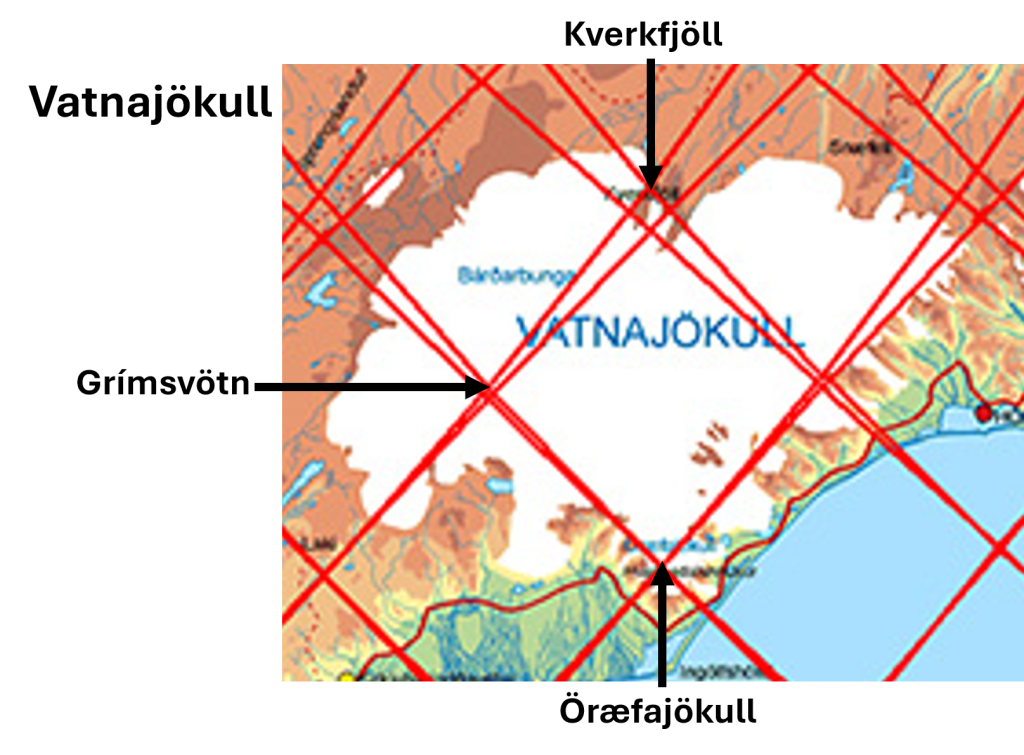
Three prominent volcanic regions are especially important in this context because they appear to fit clearly into the proposed pattern of mantle convection roll division lines.
The first is Öræfajökull, the tallest volcano in Iceland, situated close to the 64th parallel. The second is Grímsvötn, a vast but more obscure volcanic and geothermal complex beneath central Vatnajökull. The third is Kverkfjöll, which occupies a relatively small polygon directly north of Öræfajökull.
Kverkfjöll is particularly significant because it marks the southern starting point of the North Volcanic Zone. From there, a remarkably direct volcanic axis can be traced northward all the way to Öxarfjörður, where the North Volcanic Zone meets the Tjörnes Fracture Zone. This fracture zone, in turn, connects the volcanic systems of Iceland with the offshore Kolbeinsey Ridge.
The geometrical relationship between these three volcanic centers is striking. The polygon formed by Öræfajökull, Grímsvötn, and Kverkfjöll appears exceptionally clear within the proposed convection-roll framework. In addition, Grímsvötn and Kverkfjöll are known to be petrologically related, suggesting a deeper structural connection beneath Vatnajökull.
Grímsvötn was also the source region of the magma and dyke propagation that eventually produced the catastrophic Laki eruption in 1783. Within this framework, the magma migration becomes especially interesting because the dyke propagated from one calculated division line toward another before the eruption began. Laki itself lies on one division line, whereas Grímsvötn occupies another.
The line extending from Kverkfjöll through Grímsvötn to Laki closely coincides with the eastern boundary of the East Volcanic Zone. The width of this volcanic zone can be measured directly on the surface, and it corresponds closely to the calculated width of the relevant convection roll in the model.
On the opposite side of the Grímsvötn–Kverkfjöll line lies Öræfajökull, which also marks the beginning of another volcanic alignment: the Öræfajökull Flank Zone. This zone trends northeast–southwest and extends toward Snæfell northeast of Vatnajökull. In total, the flank zone spans approximately the equivalent of two polygons within the proposed geometrical framework.
The repeated appearance of the same fundamental geometrical unit — polygons with an approximate east–west width of 1.5° — is one of the main reasons the model may provide a valuable tool for examining geological structures. According to this interpretation, the same geometrical relationships are not confined to Iceland alone, but may also appear in tectonic and volcanic systems throughout the world.
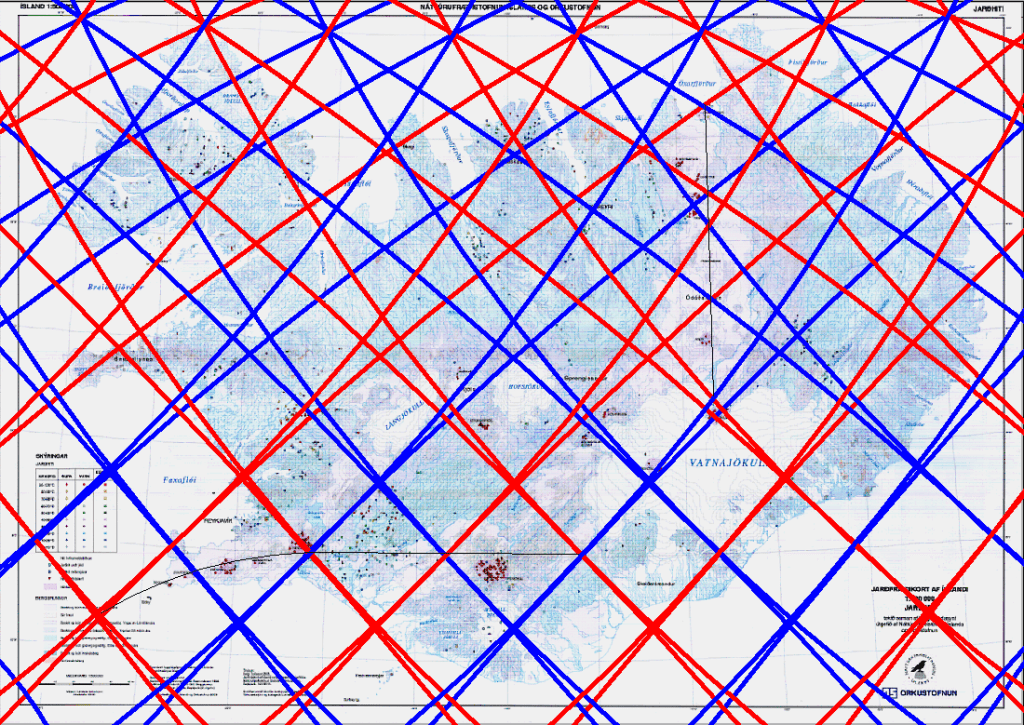
Within Iceland, however, Vatnajökull provides one of the clearest large-scale examples. Beneath the ice cap, some of the country’s most powerful volcanic systems appear organized in a pattern that mirrors the calculated geometry of the mantle convection roll model. Each polygon therefore becomes something like a chapter in a book, with each one containing its own distinct geological characteristics, tectonic structures, volcanic systems, geothermal activity, and landscape evolution.
Viewed in this way, Iceland can be examined as a sequence of interconnected geological “chapters,” where every polygon reveals a slightly different expression of the same underlying mantle convection roll system. One polygon may be dominated by rifting and fissure swarms, another by central volcanoes and geothermal fields, while a third may display transform faulting, glacial volcanoes, or complex magma interactions beneath ice caps.
This approach is valuable because it provides a structured way to examine geology step by step. Instead of viewing Icelandic geology as a collection of isolated volcanic systems, each region can be interpreted as part of a larger geometrical framework extending through the crust and into the mantle below.
The same method can also be applied to other parts of Iceland. The Reykjanes Peninsula, the South Iceland Seismic Zone, the Hengill area, the central highlands, and the northern volcanic systems all become individual “chapters” whose geological behaviour can be compared within the same overall framework.
In that sense, the polygon system is not only a geometrical model. It also becomes an organizational tool for understanding geology across many different scales — from magma migration beneath a glacier to the overall tectonic structure of Iceland itself.


