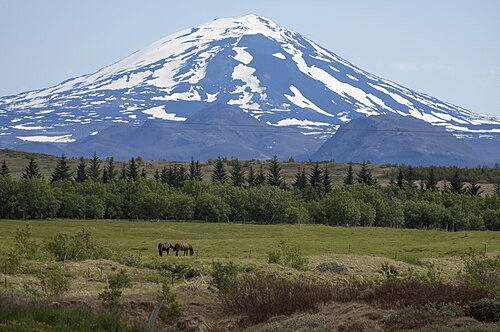
Hekla is known to occupy a uniquely important geological position within Iceland. It lies at the eastern end of the South Iceland Seismic Zone (SISZ) and simultaneously forms the southwestern gateway into the East Volcanic Zone (EVZ). In many ways, Hekla stands at the transition between two fundamentally different tectonic expressions: the transform-style seismic deformation of South Iceland and the broad volcanic rifting of the eastern volcanic systems.
The rifting process commonly described in Icelandic geology, where one side of Iceland drifts roughly 1 cm westward each year while the other moves about 1 cm eastward, can be visualized as being organized around a central tectonic division line that reaches the latitude and structural position of Hekla. This gives Hekla a particularly important geometric and tectonic role within the overall framework of Iceland.
The East Volcanic Zone is more difficult to represent with a single line than the oceanic ridges north and south of Iceland, because the EVZ is not a narrow ridge crest but rather a broad tectono-volcanic corridor 1.5° wide from east to west. In this interpretation, special emphasis is placed on the eastern boundary of the EVZ, which appears to function as a major division between tectonic domains associated with the North American and Eurasian plates. Rather than viewing the EVZ simply as a diffuse volcanic belt, it can therefore be examined as a structured rift system occupying a broad zone between deeper mantle flow divisions.
When zooming out to examine the large-scale geometry of Iceland itself, including the mid-ocean ridges and the surrounding continental shelf, an even more remarkable arrangement becomes visible, with Hekla occupying a central position within the overall symmetry.
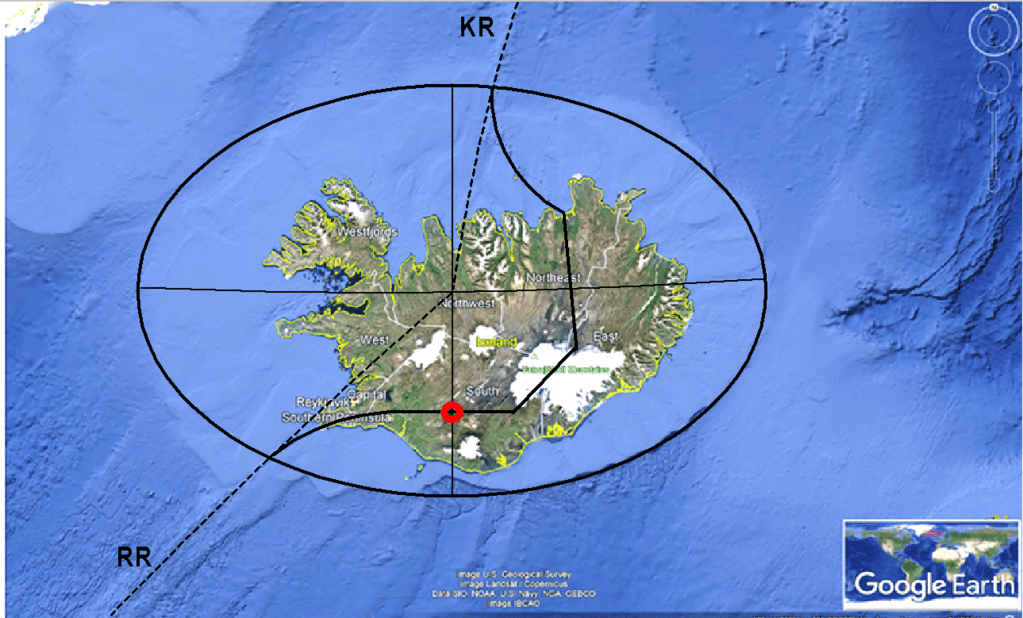
The continental shelf surrounding Iceland has a surprisingly regular form. The southeastern quarter of the shelf, in particular, remains relatively undisturbed and displays a sharp elliptical geometry that can be detected mathematically. The ellipse possesses clearly identifiable major and minor axes aligned directly east–west and north–south respectively. Significantly, Hekla is located on the north–south minor axis of this elliptical structure.

If the major and minor axes of the Icelandic shelf ellipse are drawn, and the oceanic segments of the Reykjanes Ridge and Kolbeinsey Ridge are extended toward Iceland from the south and north, the two ridge extensions converge precisely in the central point of the ellipse itself (extrapolation shown with dotted lines). This creates a striking geometric relationship between:
- the elliptical form of the Icelandic continental shelf,
- the mid-ocean ridge system north and south of Iceland,
- the tectonic division between the North American and Eurasian plates,
- and the position of Hekla within the overall structure.

The tectonic division line through Iceland also appears remarkably symmetrical when compared with both the elliptical outline of the shelf and the extended ridge axes. North and south of Iceland alike, the plate division lines merge naturally into the mid-ocean ridges exactly where those ridges intersect the elliptical margins of the shelf.
Within this broader framework, the detailed geometry of mantle convection-roll polygons and their division lines becomes increasingly important. The interaction between different mantle layers, tectonic boundaries, volcanic zones, and continental-shelf geometry may together help explain why Hekla occupies such an exceptional position within Icelandic geology.
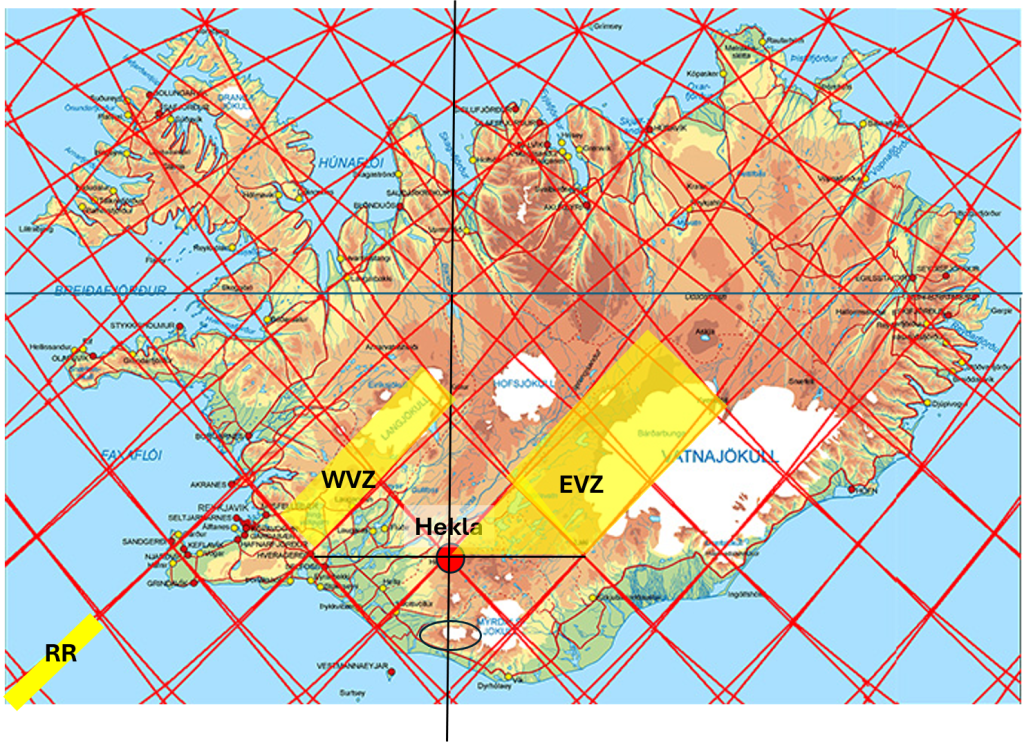
Hekla has been regarded as Iceland’s most famous volcano for centuries, and perhaps not only because of its frequent eruptions and dramatic appearance. Its location suggests that it occupies one of the most structurally significant positions in the entire geological framework of Iceland.