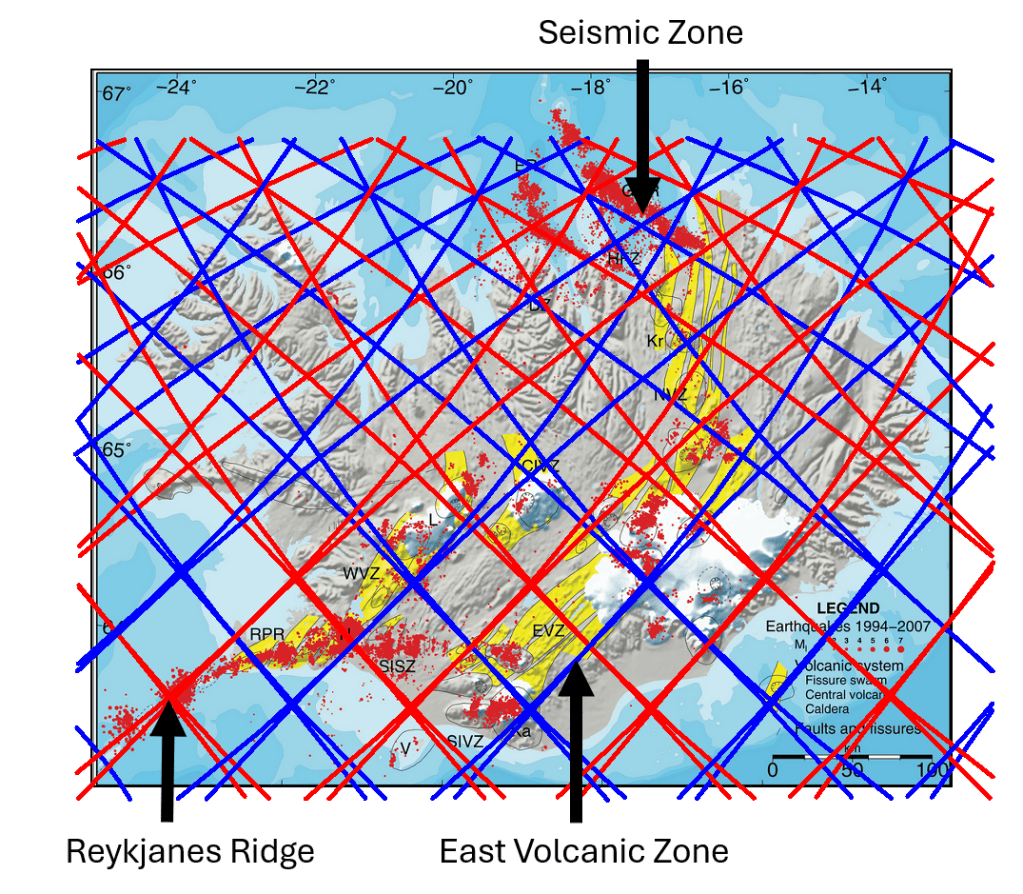
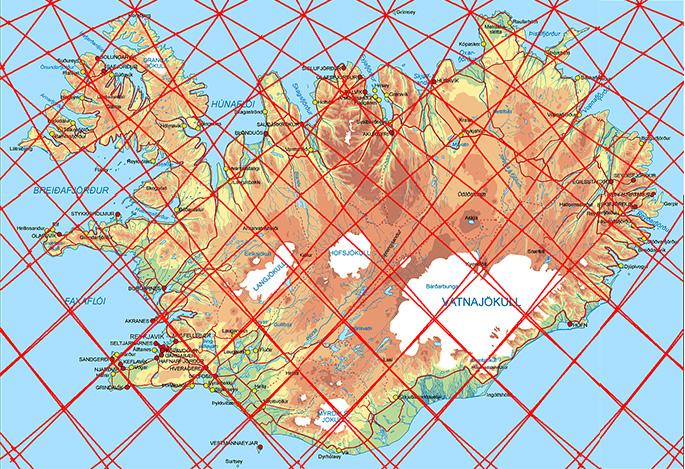
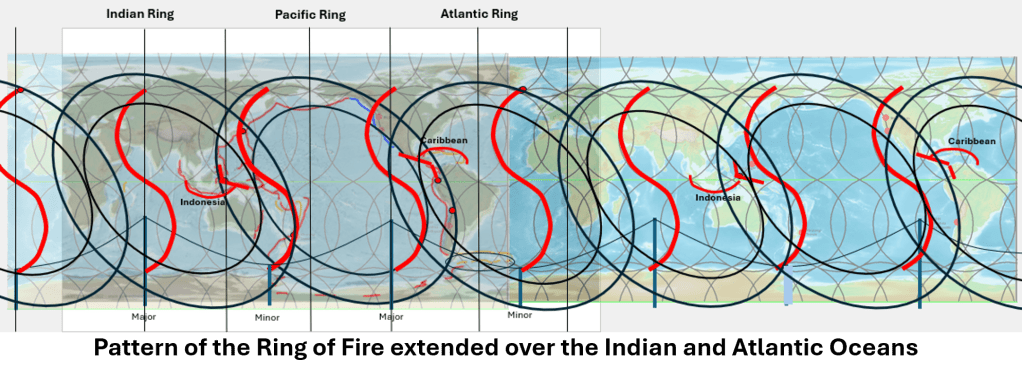
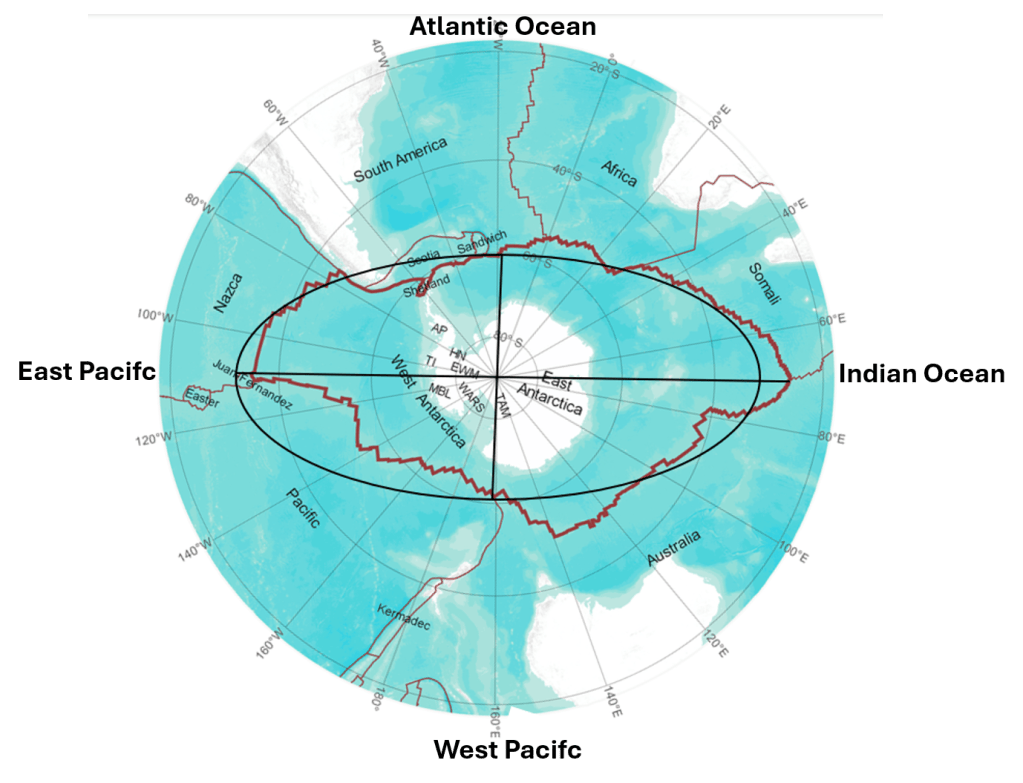
One of the most striking features of the convection-roll model is the degree of spatial correspondence between the predicted roll boundaries and the observed volcanic zones of Iceland. This correspondence is not restricted to a single volcanic zone or to a few isolated localities. It is repeated in the positions of volcanic-zone margins, changes in direction, intersections, volcanic centres, and the polygonal areas enclosed by the modelled boundaries.
The principal volcanic zones used for comparison are the Western Volcanic Zone (WVZ), Eastern Volcanic Zone (EVZ), Northern Volcanic Zone (NVZ), the Reykjanes volcanic zone, and the volcanic belt crossing Central Iceland. These are well-established components of the Icelandic volcanic and plate-boundary system, although different terminology has been used for the Central Iceland connection between the main rift zones.
Specific examples of correspondence
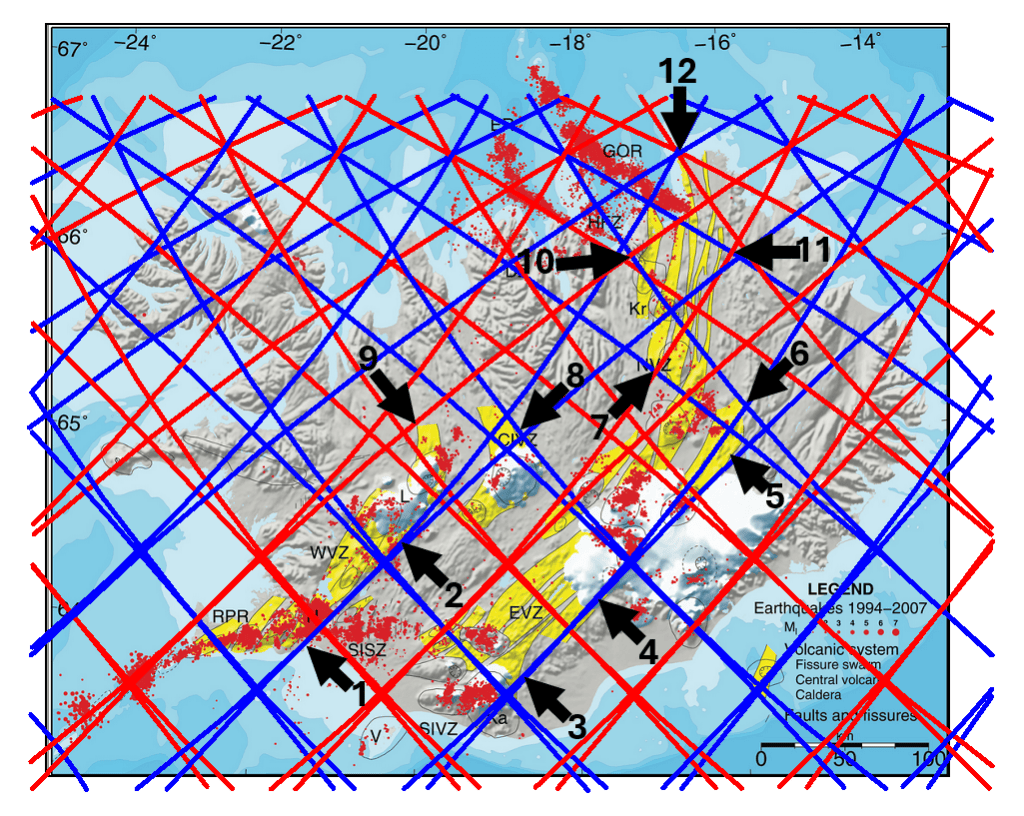
A number of locations are particularly useful for illustrating the geometrical precision of the correspondence shown on the map:
- The Reykjanes volcanic zone south of Hveragerði.
Here, one of the modelled boundaries coincides closely with the transition towards the South Iceland Seismic Zone (SISZ). The relationship is particularly informative because the SISZ forms the tectonic connection between the western and eastern rift systems of South Iceland. - The Western Volcanic Zone and Langjökull.
A modelled roll boundary closely follows the margin of the volcanic zone in the Langjökull area. The spatial relationship is sufficiently sharp to make this an important reference point when the model is compared with mapped volcanic systems. - The Eastern Volcanic Zone north of Mýrdalsjökull.
Another model boundary corresponds to the margin of the EVZ immediately north of the Mýrdalsjökull–Katla region. - The Vatnajökull boundary and Grímsvötn.
Within the Vatnajökull region, a major boundary in the convection-roll pattern passes through the area of Grímsvötn, one of the principal volcanic centres of the EVZ. - The boundary extending northeastwards from Kverkfjöll.
From the Kverkfjöll region, the mapped volcanic structures and the modelled roll boundary follow the same general northeastward direction. - The outer boundary of the Kverkfjöll volcanic system.
The extent of the Kverkfjöll system provides another example in which the margin of a volcanic system corresponds to a boundary in the convection-roll pattern. - Internal boundaries within the Northern Volcanic Zone.
The correspondence is not restricted to the outer margins of the NVZ. Several internal divisions within the volcanic zone also coincide with modelled roll boundaries. - The northwestward bend of the Central Iceland volcanic belt.
The Central Iceland Volcanic Zone, as defined here, bends towards the northwest in a manner that follows the geometry of the convection-roll pattern. - A comparable bend in the Western Volcanic Zone.
The WVZ displays a related change in orientation, extending towards another boundary in the modelled system.
10–11. The polygon occupied by the Northern Volcanic Zone.
A particularly clear geometrical relationship occurs in North Iceland, where the volcanic systems of the NVZ occupy a polygonal sector approximately 1.5° in longitudinal width. Both sides of this sector are defined by boundaries in the convection-roll system.
- The northern intersection point.
The northernmost point highlighted on the map coincides with an intersection of two boundaries in the convection-roll framework. This is significant because intersections represent geometrically more restrictive predictions than correspondence with a single line.
The Eastern Volcanic Zone
The most continuous correspondence on the map occurs along the Eastern Volcanic Zone (EVZ).
Four large polygonal sectors of the convection-roll framework are occupied by the volcanic systems shown in yellow on the map. Rather than simply following a single line, the volcanic zone repeatedly fills the areas enclosed by successive boundaries.
The relationship also places several major volcanic centres and systems—including Hekla, Tindfjöll, Eyjafjallajökull, Katla beneath Mýrdalsjökull, and the Vestmannaeyjar volcanic system—within the same geometrical arrangement.
This is important because the comparison therefore involves several different geometrical properties simultaneously: boundaries, intersections, enclosed areas, changes in orientation, and the positions of individual volcanic centres.
The Western Volcanic Zone
Immediately west of the EVZ, the eastern margin of the Western Volcanic Zone (WVZ) is particularly distinct.
In the convection-roll framework, this boundary occurs approximately 3° west of the corresponding eastern boundary of the EVZ. Thus the two volcanic zones are not treated as unrelated features. They occupy neighbouring parts of the same regularly spaced geometrical system.
The WVZ also changes orientation towards its northern end, and this curvature can be compared with the orientation of the modelled roll boundaries.
Central Iceland
The Central Iceland volcanic belt shows a somewhat different type of correspondence.
Here the most prominent geometrical control is not simply a volcanic zone centred on a modelled line. Instead, one of the sharpest boundaries of the volcanic area corresponds to a downwelling boundary extending northeastwards from the region.
This distinction may be important. If upwelling and downwelling boundaries have different mechanical effects on the lithosphere, volcanic zones should not necessarily occupy identical positions relative to each type of boundary.
The Northern Volcanic Zone
The Northern Volcanic Zone (NVZ) provides another particularly clear example.
Its principal volcanic systems are arranged along a predominantly north–south to NNE–SSW axis, while their outer limits correspond to polygonal boundaries in the convection-roll framework. Independent geological studies also show that the NVZ consists of several overlapping volcanic systems and fissure swarms, including Kverkfjöll, Askja, Fremrinámur, Krafla and Þeistareykir.
In the present model, both upwelling and downwelling lines appear to contribute to the geometry of the volcanic zone. The correspondence therefore concerns not merely the central axis of volcanism but also its width and internal subdivision.
Features not fully visible on the map
The map does not show all the relationships that can potentially be tested.
Among the additional examples are the position of Öræfajökull, the geometrical relationship between Snæfellsjökull and Snæfell, and the former Skagafjörður volcanic zone.
The Skagafjörður system is particularly interesting in this context because its position is approximately 3° west of the Northern Volcanic Zone in the geometrical framework used here. Older rift structures in the Skagi region are independently recognised in geological studies of Iceland.
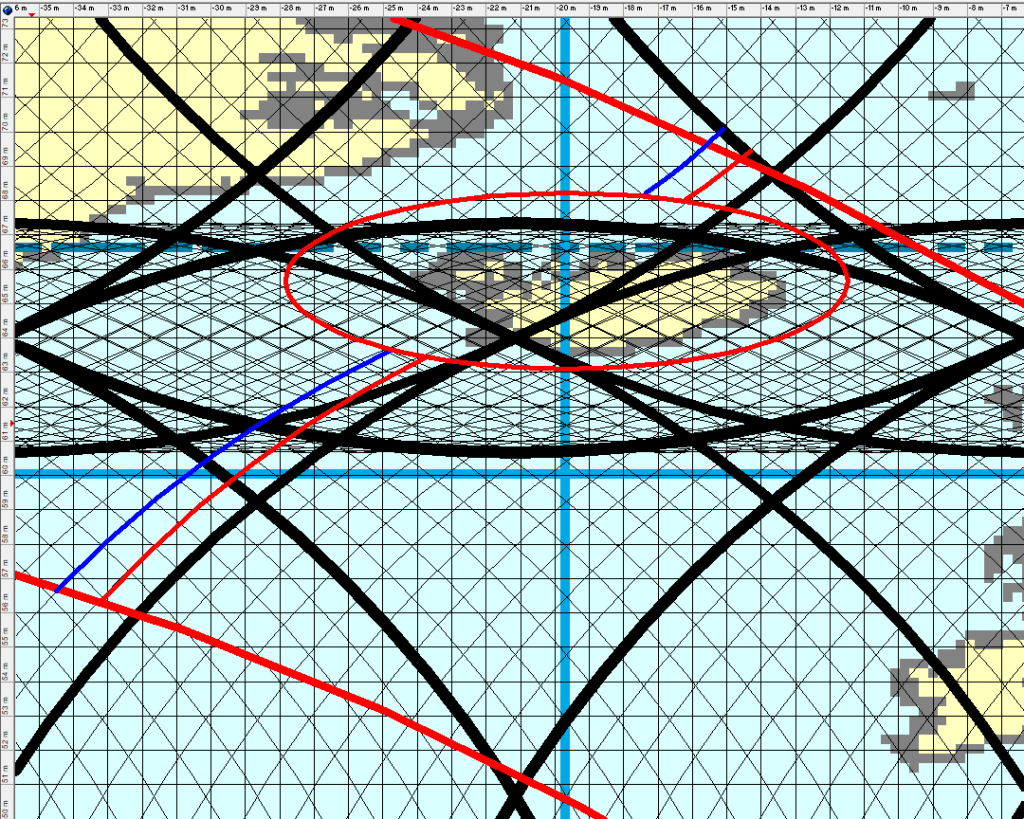
The offshore continuation provides further constraints. The orientations and positions of both the Reykjanes Ridge and the Kolbeinsey Ridge can be compared with the same convection-roll geometry. The Icelandic volcanic zones therefore form only the subaerial part of a considerably larger geometrical pattern.
Plate motion and the orientation of the roll boundaries
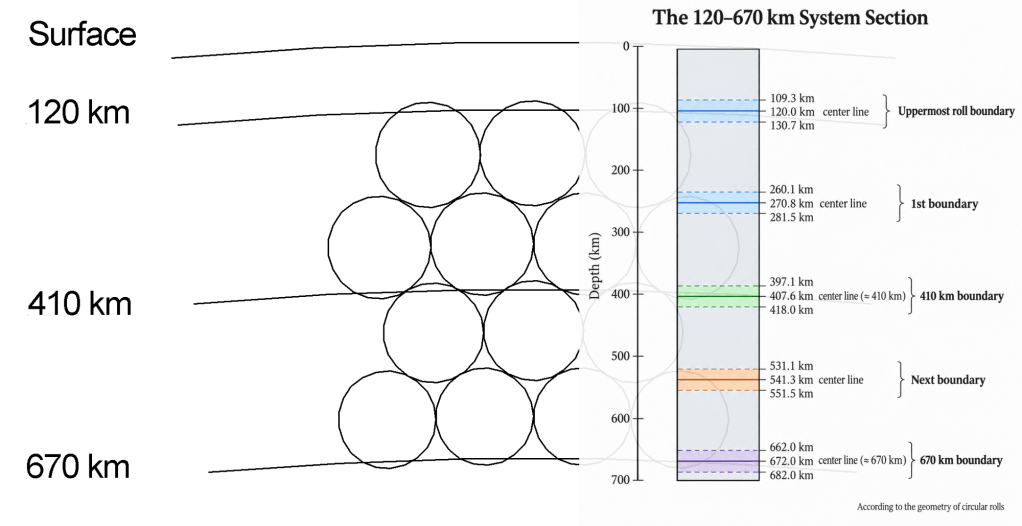
The two-dimensional geometrical correspondence is only part of the problem. The system must ultimately be interpreted in three dimensions because the lines on the map represent boundaries associated with several superimposed levels of convection rolls.
Plate motion must also be incorporated.
In the interpretation proposed here, the motion of the North American Plate away from the spreading system produces a major westward to northwestward extensional component across Iceland. This regional movement interacts with the directions of rotation of the underlying convection rolls.
This provides a possible explanation for an important feature of the map: the eastern margins of several volcanic zones are commonly associated with the blue boundaries of the model.
In the convection-roll interpretation, the roll adjacent to such a boundary rotates in a direction opposite to the motion imposed from the North American side. The opposing motions would increase differential movement across the boundary and could therefore favour extension of the overlying lithosphere.
A comparable relationship can be seen along the eastern side of the Northern Volcanic Zone, where several of the principal extensional structures are again bounded on their eastern side by blue lines.
This proposed relationship between plate motion, roll rotation and surface extension is important because it introduces a dynamic component into what would otherwise be only a geometrical comparison.
From geometrical correspondence to a testable model
The significance of the pattern lies in its repetition.
No single coincidence between a volcanic centre and a modelled boundary would provide strong evidence for a relationship. The more relevant observation is that similar relationships recur independently at the margins of several volcanic zones, at changes in their direction, at volcanic centres, at intersections, and within polygonal sectors of the model.
The Eastern Volcanic Zone is especially informative because the correspondence is repeated through several consecutive polygons rather than occurring at only one locality.
The Icelandic pattern can therefore be tested at several levels:
- the distance between mapped volcanic-zone margins and predicted roll boundaries;
- the angular agreement between volcanic structures and the modelled lines;
- the positions of volcanic centres relative to predicted intersections;
- the width of volcanic zones relative to the predicted polygonal cells;
- the relationship between active and extinct volcanic zones and successive boundaries in the model;
- and the relationship between the direction of plate motion and the inferred rotation of individual convection rolls.
Such tests would allow the apparent correspondence to be expressed quantitatively rather than only visually.
The important point is therefore not simply that volcanic activity occurs near individual lines. It is that the geometry of the Icelandic volcanic zones repeatedly reproduces several different elements of the proposed convection-roll framework—lines, margins, bends, intersections and enclosed polygons—at a range of locations across Iceland.