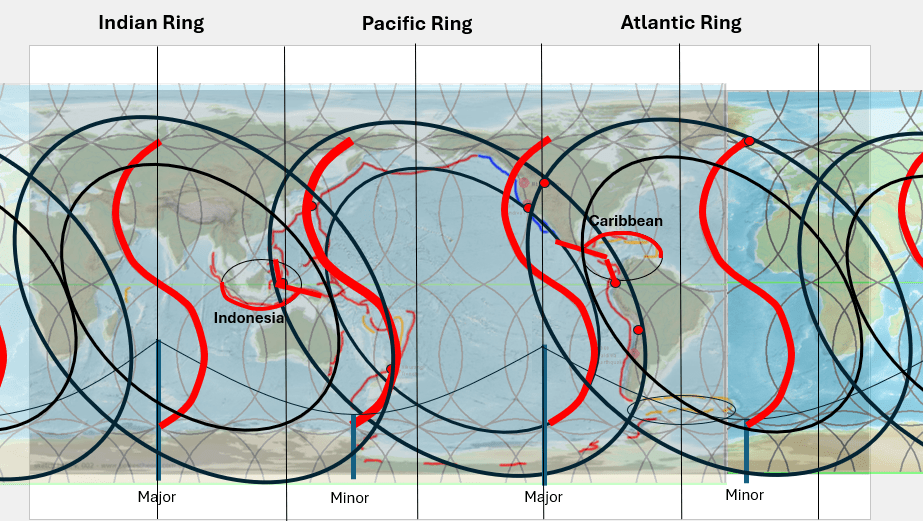
Along the Atlantic Tectonic Ring, several major geological structures become traceable. One of the clearest is the Greenland–Iceland–Faroe Ridge Complex, which forms an important North Atlantic segment of the system. Farther south and east, the ring also appears to correspond in a broad way with the Teisseyre–Tornquist Zone, as well as with the Adriatic region, the Red Sea, and the Afar triple-junction area, together with the main divergent boundaries of Africa.
On the western side of the system, its influence may be followed through the Antarctic Peninsula, the East Pacific Rise, the San Andreas system, the western Caribbean and Central America, and the Peru–Chile subduction complex. In this sense, the Atlantic Ring is not limited to the Atlantic Ocean itself, but extends into surrounding tectonic regions and connects with major plate-boundary systems on both sides of the ocean basin.
In geometrical terms, the Atlantic Ring appears to be centred on the Mid-Atlantic Ridge, together with its corresponding mantle division line in the Convection Rolls Model. This makes the Mid-Atlantic system the structural backbone of the ring. Around it, a broad set of convergent, divergent, and transform-related features seem to define a large-scale circular tectonic framework. Although some segments are more clearly expressed than others, the overall pattern suggests that the Atlantic domain may be viewed as one of the three major global tectonic rings, alongside the Pacific Ring of Fire and the proposed Indian Ocean Ring.
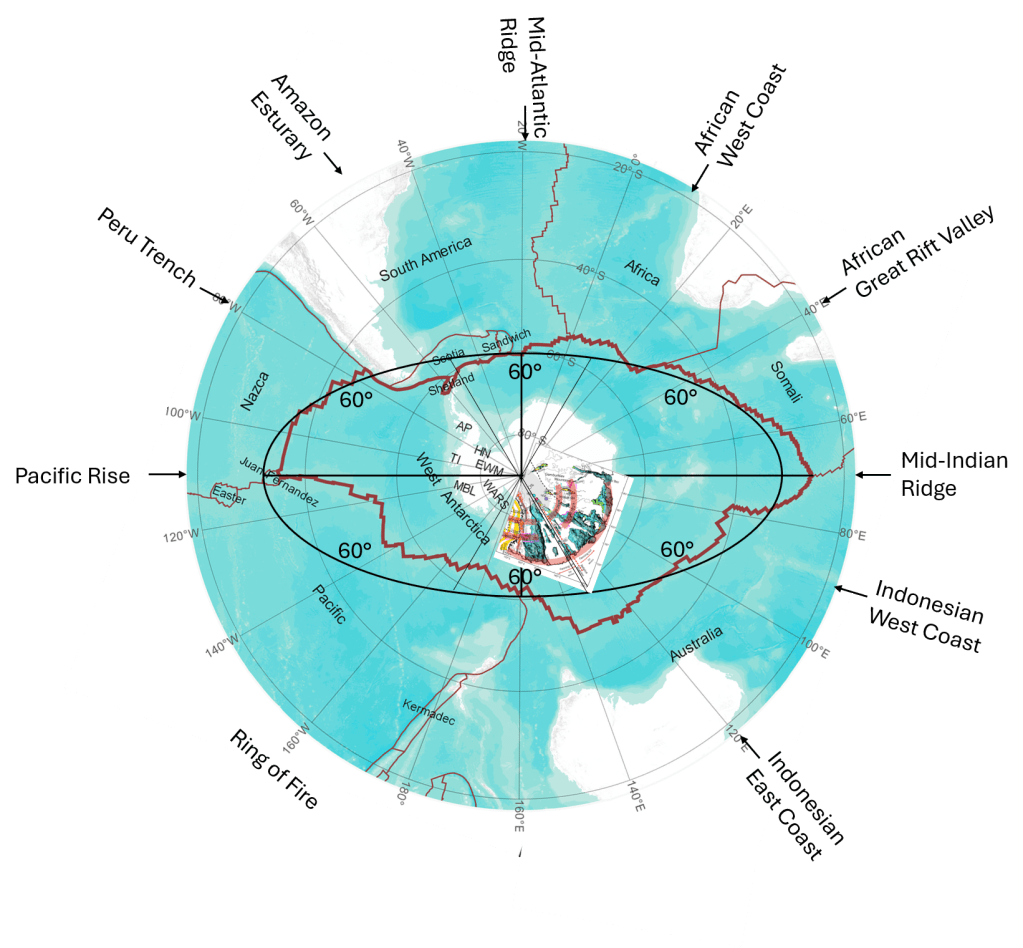
Starting from the possible sixfold division around Antarctica, it is possible to examine how this geometry relates to the tectonic plates and major tectonic systems outside the Antarctic region.
The Pacific Ring of Fire is particularly important in this respect because its geometry can be analysed in considerable detail. When examined in relation to the Mantle Convection Roll model, its overall form becomes even more clearly defined.
The Pacific Ring of Fire, Indian Ocean Ring and Atlantic Ring shown in relation to the 60° sector division around Antarctica. The three overlapping systems each span approximately 120° between their inner boundaries, providing a possible geometric connection between the pole-centred Antarctic structure and the major tectonic systems surrounding the globe.
Several key locations show remarkably simple angular relationships when measured from the geographic South Pole. For example, the angle between the directions towards the Alpine Fault in New Zealand and Yellowstone is approximately 90°. This corresponds with another geometric relationship already identified: the Alpine Fault lies close to the continuation of the minor axis of the Antarctic ellipse, whereas Yellowstone lies close to the continuation of its major axis.
Thus, two major parts of the Ring of Fire can be related directly to the two perpendicular axes of the Antarctic geometry. The Ring of Fire also extends southward into the Antarctic tectonic system. This makes it possible to examine its geometry not only as a Pacific feature, but as part of a larger global arrangement.
From 90° and 45° to 60° and 120°
The two principal axes associated with the geometry of the Ring of Fire are themselves inclined by approximately 45° relative to one another in the larger construction used here. Once the possible 60° sector division around Antarctica is introduced, another question naturally follows:
How does the geometry of the Ring of Fire relate to 60° and 120° angular divisions? An interesting relationship appears at the equator, as the outer limits of the Pacific Ring of Fire, measured approximately from Indonesia to the western margin of South America, span about 150° of longitude.
However, the inner margins of the Ring of Fire lie approximately 15° inward from each outer margin.
Therefore we get; 150° − 15° − 15° = 120°, so the effective width of the inner Ring of Fire is consequently about 120°.
This is particularly significant because 120° is exactly one third of a complete circle: 360° / 3 = 120°.
It therefore becomes possible to construct three comparable great tectonic ring systems around the Earth, each displaced by approximately 120° from the next.
These may provisionally be called:
1. The Pacific Ring of Fire 2. The Indian Ocean Ring 3. The Atlantic Ring
The Pacific Ring is by far the most conspicuous of the three because the tectonic boundaries around the Pacific are exceptionally well developed: long subduction zones, major transform systems, volcanic arcs and associated seismic belts together produce the familiar Ring of Fire.
The other two proposed rings are less visually obvious. Their boundaries are interrupted by continents, ocean basins and tectonic systems of different ages, and they have not generally been considered as parts of equivalent circular structures. Nevertheless, when their positions are examined in the same geometric framework, substantial agreement with known geological features becomes apparent.
Three overlapping 120° systems
The important point is that these three rings should not necessarily be imagined as three completely separate circles placed side by side, and they overlap.
If three equivalent rings are arranged around the globe so that the inner margins of neighbouring rings meet or intersect at the principal division points, a repeating global pattern is produced. In this construction, each ring occupies approximately a 120° internal sector, while the outer tectonic expression may extend farther and overlap with the neighbouring ring.
This overlap may be geologically important. The Pacific Ring of Fire itself becomes easier to understand when viewed in this way.
Kermadec–Tonga and the overlap with the Indian Ocean Ring
One of the most interesting examples is the Kermadec–Tonga system. Kermadec–Tonga lies noticeably inside the broader geometrical outline of the Pacific Ring of Fire rather than simply following its outermost boundary. In a model based only on a single Pacific ring, this position appears somewhat anomalous.
However, if the Indian Ocean Ring overlaps the Pacific Ring, the position of Kermadec–Tonga becomes much more natural. It lies within the zone where the two systems interact.
Thus, what may initially appear to be an irregularity in the Pacific Ring may instead represent the superposition of two larger tectonic geometries:
Pacific Ring + Indian Ocean Ring.
This would also help explain why the southwest Pacific is tectonically much more complicated than a simple elliptical outline would suggest. The region around New Zealand, Kermadec, Tonga, Fiji and the neighbouring back-arc systems lies precisely where different large-scale tectonic systems would be expected to overlap.
In this interpretation, the complexity is therefore not necessarily evidence against the larger geometry. It may actually be one of its consequences.
Antarctica as the geometric reference
Antarctica provides an unusually useful reference system for examining these relationships because several different geometries appear to be centred on, or organized around, the South Polar region.
At least three levels can be distinguished:
A global rather than a regional geometry
The important point is not simply to draw three circles on a map and search for features that happen to lie upon them. The relevant question is whether independently mapped geological structures repeatedly coincide with the predicted boundaries, axes, intersections and overlap zones.
The Pacific Ring of Fire provides the clearest test because its tectonic structure is so well mapped. Its inner and outer margins can be distinguished, its major axes can be compared with Antarctic geometry, and key locations such as the Alpine Fault, Yellowstone and Kermadec–Tonga provide additional geometric constraints.
If the same construction can then be followed through the Indian Ocean and Atlantic regions, using independently mapped ridges, subduction zones, continental margins, transforms and other major tectonic boundaries, the comparison becomes considerably more significant.
The proposed relationship can therefore be summarized as:
Antarctic 60° sectors → pairs of sectors forming 120° divisions → three overlapping tectonic rings around the Earth.
The three proposed systems are:
Pacific Ring of Fire — Indian Ocean Ring — Atlantic Ring.
Of these, the Pacific Ring is presently the clearest geological expression. The Indian Ocean and Atlantic rings require more detailed examination, but their predicted positions already coincide with several major tectonic structures.
Perhaps most importantly, viewing the three rings together does not weaken the familiar geometry of the Pacific Ring of Fire. It may actually make it more complete, because features such as the inward position of the Kermadec–Tonga system can be interpreted as the result of overlap between neighbouring global tectonic systems rather than as departures from the general pattern.
The three tectonic large-scale circles and how they relate to the Convection Rolls Model, with convectionr rolls division lines of main mid-ocean ridges and convergent boundaries superimposed on the map.
Antarctica displays several different levels of large-scale geometric organization. These should not be confused with one another, because they are based on different observations and have different degrees of certainty.
Antarctica Tectonic Plate map with a superimposed elliptical form.
At the most familiar level, the continental part of Antarctica is divided into East Antarctica and West Antarctica. East Antarctica consists largely of old Precambrian continental crust, whereas West Antarctica is much more tectonically fragmented and includes the West Antarctic Rift System. The Transantarctic Mountains form the most conspicuous boundary between these two major regions. This fundamental division has been recognized for many decades and is firmly established by geological and geophysical observations.
At another scale, when the entire Antarctic tectonic plate is considered, including its oceanic lithosphere, a broader geometric pattern becomes visible. In the Mantle Convection Roll model, the outline of the Antarctic Plate can be approximated by an elliptical form centred approximately on the South Pole. A major and a minor axis then divide this ellipse into four main sectors. The axes used in this comparison are approximately 70°22.5′E–109°37.5′W and 160°22.5′E–19°37.5′W, respectively.
A third and much more tentative possibility has now become particularly interesting. New geophysical results from East Antarctica may indicate that another level of organization exists: a division into sectors of approximately 60° around the South Pole.
This is not established. It is a geometric possibility suggested by comparison between the new observations and the larger Antarctic pattern. But the measurements are remarkable enough to make such a comparison worthwhile.
The East Antarctic Fan-Shaped Basin Province
In 2026, Armadillo et al. described what they call the East Antarctic Fan-Shaped Basin Province (EAFBP). Using improved subglacial topographic data together with seismic, gravity and magnetic information, they identified 30 major basins beneath a very large part of the East Antarctic Ice Sheet. Many are approximately V-shaped and elongated radially towards the interior of Antarctica. Collectively, the basins form a huge fan-like structure extending roughly from Prydz Bay at 70°E to the Transantarctic Mountains at about 160°E.
This is not merely a visual impression from a map. The authors fitted 60 great circles to the longitudinal edges of the basins and calculated more than one thousand intersections. From these they obtained a best-fitting Euler pole at 86.4°S, 129.9°E.
This point is only about 3.6° of latitude, or roughly 400 km, from the geographic South Pole. The fan also has a well-defined axis close to the 130°E meridian, passing through the Belgica Subglacial Highlands. The authors call this the Belgica Bisector. The observed basin system is divided by this line into a sinistral sector to the west and a dextral sector to the east.
There is additional evidence that the geometry penetrates deeply into the lithosphere. Models based on seismic and gravity information show reduced crustal thickness beneath the major basins, while seismic tomography identifies low-velocity anomalies beneath the Wilkes and Aurora basins at upper-mantle depths. Thus, the fan-shaped pattern is not simply a feature produced by glacial erosion at the surface.
Perhaps even more strikingly, the authors identify two approximately circular transverse shear belts. Independent fitting gives Euler poles at 84.2°S, 130.8°E and 83.1°S, 129.5°E.
Thus three separately calculated geometric poles cluster within a relatively small region close to the South Pole and close to the same meridian: 86.4°S, 129.9°E, 84.2°S, 130.8°E, and 83.1°S, 129.5°E.
This repeated convergence towards the polar region is an important observational result, regardless of how its cause is ultimately interpreted.
Rotational extension — observation or explanation?
Armadillo et al. interpret the structure as the product of distributed intraplate rotational extension. In their model, the crust opened rather like a handheld fan around an Euler pole close to the South Pole. The Aurora and Wilkes basins developed on opposite sides of the Belgica Bisector, and displacement increased away from the pivot. The geometry certainly supports a rotational description.
However, there is an important distinction between describing the resulting deformation and identifying the deeper force that produced it. In the interpretation considered here, rotational extension may be a secondary kinematic effect rather than the primary geodynamic cause.
The proximity of the calculated Euler pole to the geographic South Pole is therefore particularly important. It does not, by itself, prove that Earth’s rotation caused the deformation. An Euler pole is fundamentally a geometric description of rotational motion, and many plate motions have Euler poles unrelated to geographic poles. Nevertheless, when a continental-scale system of radially arranged structures produces several independently calculated deformation poles close to the geographic pole, the relationship deserves attention—particularly in a model in which mantle convection itself is organized by planetary rotation.
The role of Earth’s rotation
Earth’s rotation alone cannot provide a satisfactory direct mechanical explanation for opening major crustal basins hundreds or thousands of kilometres long. The stresses required must ultimately be transmitted through the lithosphere from processes capable of doing substantial tectonic work.
In the Mantle Convection Roll model, the connection is indirect but mechanical:
Earth’s rotation → organization of mantle convection → systematic mantle-flow stresses → deformation of the lithosphere.
The rotation of the Earth organizes the convection system. The mantle flow then supplies the forces acting on the overlying lithosphere. From this perspective, a tectonic pattern centred close to the geographic pole would not result simply from a vague “rotational force”. It would reflect the geometry of a mantle-flow system whose organization is itself controlled by rotation.
The new Antarctic measurements provide evidence for the geometry of deformation. They do not establish the Mantle Convection Roll interpretation. But they provide a new and unusually clear geometric pattern against which that model can be tested.
Could Antarctica contain six alternating 60° sectors?
The mapped EAFBP extends approximately from 70°E → 160°E.
Its Belgica dividing line lies near 130°E. Consequently, the observed western part extends approximately 70°E → 130°E = 60°.
The mapped eastern part extends only 130°E → 160°E = 30°.
But 160°E corresponds approximately to the Transantarctic Mountains and the transition into West Antarctica. The quality and nature of the available observations change substantially beyond this region. The absence of a mapped continuation therefore does not necessarily demonstrate that deformation stopped there. Indeed, the West Antarctic Rift System itself records enormous crustal extension and a long history of tectonic reorganization.
This permits an alternative geometric question. What if 130°E represents the boundary of a 60° sector, rather than the centre of the complete Antarctic deformation system? A hypothetical dextral sector could then extend approximately 130°E → 170°W, with its centre at 160°E.
The next 60° sector would extend 170°W → 110°W, and could potentially display predominantly sinistral characteristics.
If this alternating pattern continued around the pole, the full 360° circumference would consist of six sectors:
sinistral – dextral – sinistral – dextral – sinistral – dextral, each occupying approximately 60°.
This is presently only a hypothesis. The available geophysical mapping is far too incomplete to claim that such a sixfold structure has been demonstrated. But there is an interesting numerical consequence. A system beginning with a sector boundary near 130°E generates boundaries approximately at:
10°E – 70°E – 130°E – 170°W – 110°W – 50°W.
Its sector centres would lie at:
40°E – 100°E – 160°E – 140°W – 80°W – 20°W.
This has an unexpected relationship with the independently derived elliptical geometry of the Antarctic Plate.
The proposed major elliptical axis, at approximately 70°22.5′E ↔ 109°37.5′W,
lies almost exactly on two opposite boundaries of such a 60° system.
The proposed minor elliptical axis, at approximately 160°22.5′E ↔ 19°37.5′W, instead lies almost exactly through the centres of two opposite sectors. Thus the possible sixfold division would not replace the fourfold elliptical division. The two geometries could be superimposed.
One describes the principal axes and quadrants of the Antarctic Plate, and the other might describe an alternating pattern of deformation around the pole.
Antarctica therefore shows three different levels of organization
The distinction can be summarized conceptually as follows:
1. Twofold division — continental geology
East Antarctica and West Antarctica represent the first-order geological division of the Antarctic continent.
2. Fourfold division — Antarctic Plate geometry
When the oceanic part of the tectonic plate is included, the larger outline can be examined as an approximately elliptical, pole-centred structure divided into four quadrants by its major and minor axes.
3. Possible sixfold division — internal deformation
The newly identified fan-shaped basin system raises the possibility that deformation around the pole may additionally be organized into approximately 60° sectors, possibly with alternating sinistral and dextral characteristics.
Only the first of these is conventional tectonic classification. The second is a geometric observation made in the Mantle Convection Roll analysis. The third is presently a hypothesis arising from comparison with the newly published EAFBP results.
It is important not to present the sixfold division as established geology.
What is established by the new measurements is already remarkable: a semi-continental-sized system of subglacial basins is arranged radially around a focal region very close to the South Pole; two major basins are approximately symmetrically arranged about a ~130°E bisector; the crust is thinned beneath major parts of the system; and three independently calculated deformation poles cluster close to the South Pole.
A pole-centred continent
This is the broader significance of the observations.
Antarctica contains geological structures whose large-scale geometry is demonstrably organized with respect to a region close to the geographic pole.
The authors of the EAFBP study explain this through rotational extension around an Euler pole. That is a legitimate kinematic interpretation of their observations.
The Mantle Convection Roll model asks a different question: Why should a continental-scale deformation system have a rotational centre so close to the geographic South Pole in the first place?
Within this model, the answer would not be that Earth’s rotation directly tears the crust apart. Rather, Earth’s rotation organizes the underlying mantle-convection system. Different components of that system generate different directions and strengths of mantle flow, and those flows provide the forces required for extension, shear, compression and eventual continental separation.
This also provides a possible context for the fragmentation of Gondwana around Antarctica. Different continental fragments separated from different parts of the Antarctic margin at different times. Australia, Zealandia, India, Africa and South America did not detach simultaneously, and their individual histories must be treated separately. Nevertheless, it remains possible that pre-existing, pole-centred mantle-flow geometry influenced where the lithosphere was stretched, where major weaknesses developed, and how those weaknesses were repeatedly reactivated.
Interestingly, Armadillo et al. themselves propose that the northern margin of the fan-shaped province created or exploited a lithospheric weakness that later influenced the separation of Australia from Antarctica and the geometry of the conjugate continental margins.
The difference lies mainly in the proposed primary cause.
Their model begins with rotational extension of the Antarctic lithosphere.
The Mantle Convection Roll interpretation would place another level beneath it:
planetary rotation → organized mantle convection → lithospheric stress field → rotational extension and other tectonic responses.
The fan-shaped opening would therefore be an expression of the system rather than its fundamental cause. For that reason, the new East Antarctic results are particularly useful. They do not need to have been discovered from the Mantle Convection Roll model, nor do they need to have been measured specifically to test it. Quite the opposite: their value lies in being independent geophysical observations.
The structures were mapped from subglacial topography, seismic data, gravity and magnetic measurements. Their geometry was calculated independently. Only afterwards can these observations be compared with the predicted or previously identified geometry of a pole-centred mantle-convection system.
That is precisely the kind of comparison on which the model can be tested.
Reference: Armadillo, E. et al. (2026), A fan-shaped subglacial basin province in East Antarctica formed by rotational extension, Nature Geoscience 19, 715–722, doi:10.1038/s41561-026-01991-6.
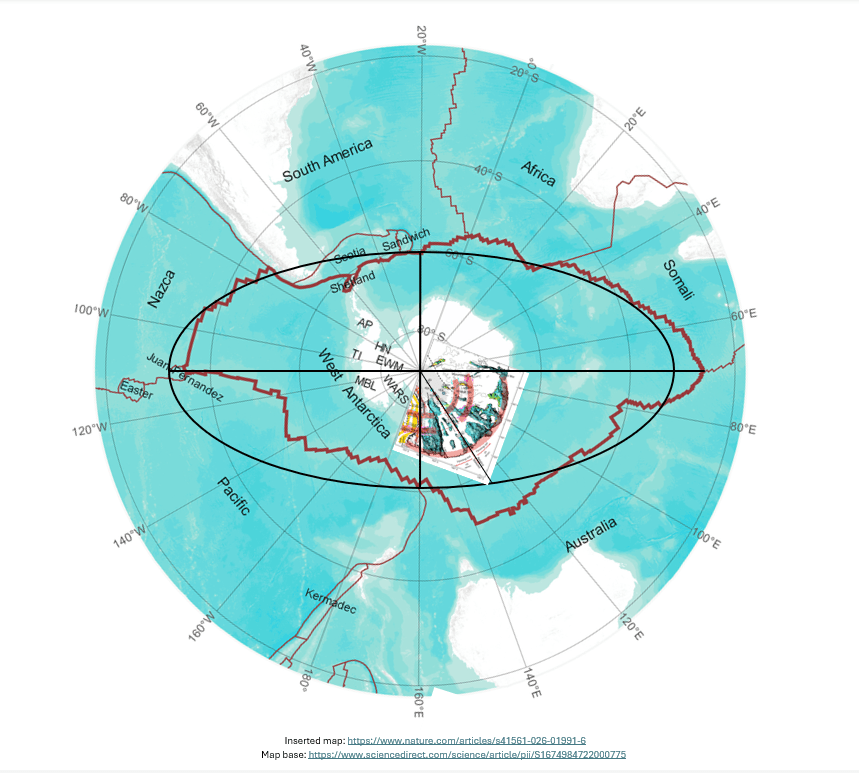
Recent work on the East Antarctic Fan-shaped Basin Province (EAFBP) has added an important new element to the large-scale tectonic interpretation of Antarctica. The newly described subglacial basin system in East Antarctica appears, in map view, as a broad fan-shaped arrangement of basins extending across a major sector of the Antarctic continent. When this pattern is placed into the wider geometric context of the Antarctic Plate, it becomes especially interesting. It falls within one of the principal quadrants of the Antarctic tectonic framework and appears to support the broader view that Antarctica has been structurally organized around the South Pole.
Map of the East Antarctic Fan-shaped Basin Province inserted into a map base of the Antarctic Tectonic Plate, with the elliptical form imposed.
In the interpretation proposed here, the fan-shaped basin province should not primarily be understood as the result of “rotational extension” in the conventional tectonic sense. That description may be useful as a secondary geometric effect, because the basin pattern does indeed resemble a system opening around a polar pivot. However, the deeper cause is interpreted differently. The main driving mechanism is proposed to be the mantle convection roll system, whose geometry is itself controlled by the rotation of the Earth. In that framework, the tectonic structures observed at the surface are not independent phenomena, but rather the upper expression of a mechanically organized global flow system.
The significance of the EAFBP is therefore not only that it reveals a remarkable basin province beneath the East Antarctic Ice Sheet, but also that it provides an additional geometric marker that can be compared with the larger Antarctic pattern. The province occupies, broadly, the sector from about 70°E to 160°E, which corresponds closely to one of the major 90-degree quadrants previously identified in the Antarctic tectonic geometry. When an elliptical form is imposed on a base map of the Antarctic Plate, this fan-shaped province falls neatly into the relevant eastern quadrant. That agreement is striking, because it suggests that the basin province is not randomly located, but is related to the same organizing framework that also defines the larger Antarctic shape.
This supports the idea that Antarctica has been shaped in a fundamentally pole-centred way. The continent is not simply a passive remnant of Gondwana later modified by local tectonic events. Rather, its large-scale geometry appears to reflect long-term organization around the South Pole, with sectors, axes, and boundaries corresponding to the underlying structure of the mantle flow field. In this view, the approximately elliptical form associated with Antarctica is not merely descriptive. It expresses a real structural order connected to the way mantle flow has been organized beneath the plate over geological time.
A key point in this interpretation is that the Earth’s rotation influences the structure of the mantle convection system. The convection rolls are not assumed to form arbitrarily. Instead, they are organized into a systematic pattern shaped by planetary rotation, including stronger and more coherent flow components associated with the equatorial zone and weaker components toward the poles. This difference in flow intensity has major tectonic consequences. Around Antarctica, it implies that the main continental mass remained largely within the high-latitude, polar part of the system, whereas Australia came to occupy a more marginal position relative to the Antarctic-centered framework.
That distinction may help explain why Australia separated from Antarctica. In this interpretation, Australia lay outside the principal polar ring, whereas most of the remaining Antarctic continental mass remained within the zone bounded near 64°S. The mantle currents extending outward from the equatorial regions are interpreted as significantly stronger than those active near the poles. As a result, Australia was subjected to a stronger northward-directed pull by the mantle flow system, while the Antarctic remainder stayed more closely tied to the polar domain. The eventual separation of Australia is therefore interpreted not simply as a local rifting event, but as the consequence of a broader contrast between strong equatorward mantle flow and weaker polar circulation.
This also gives a broader meaning to the structural boundaries found near 64°N and 64°S. These latitudes are interpreted as significant because they mark transitions between different parts of the mantle convection roll system. In other words, the tectonic and geometric organization seen near those latitudes reflects a deeper change in the style or strength of mantle flow. In the Antarctic case, the continental mass within the polar zone remained organized around the pole, while the portion extending beyond that structural limit—most notably Australia—became increasingly subject to the stronger traction of lower-latitude flow.
From this perspective, the fan-shaped basin province described in East Antarctica may be viewed as a valuable new observational constraint. Its geometry is real and important, but its significance lies less in the idea of self-contained rotational extension and more in the fact that it records how the Antarctic lithosphere responded to the larger mantle-flow architecture. The fan shape may therefore be seen as a surface expression of stress and deformation imposed by the convection system, rather than as the primary driving mechanism. “Rotational extension,” if used at all, should thus be treated as a descriptive term for the resulting geometry, not as the fundamental explanation.
The broader conclusion is that Antarctica appears to have evolved as a pole-centred tectonic system, shaped by mantle-flow organization around the South Pole and ultimately governed by the rotational dynamics of the Earth. The newly recognized EAFBP fits well into this framework. When inserted into a base map of the Antarctic Tectonic Plate with the elliptical form imposed, it strengthens the case that Antarctic tectonics is best understood not as a set of isolated regional events, but as part of a coherent global geometric system.
Suggested reference note: This interpretation can be discussed in relation to the 2026 Nature Geoscience paper on the East Antarctic Fan-shaped Basin Province, together with relevant studies on Antarctic tectonic structure, Dronning Maud Land, Prydz Bay, and the tectonic evolution of the Antarctic–Australian sector.
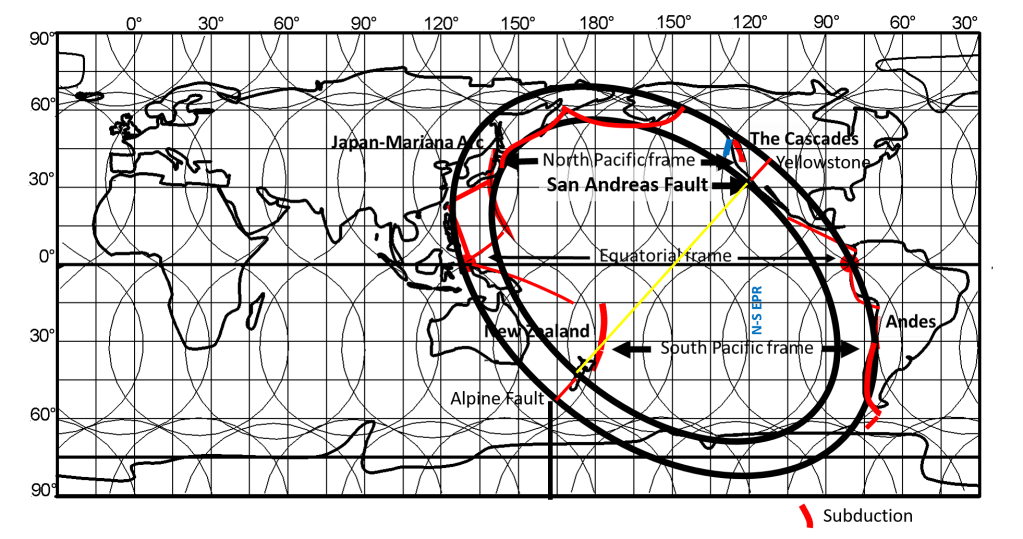
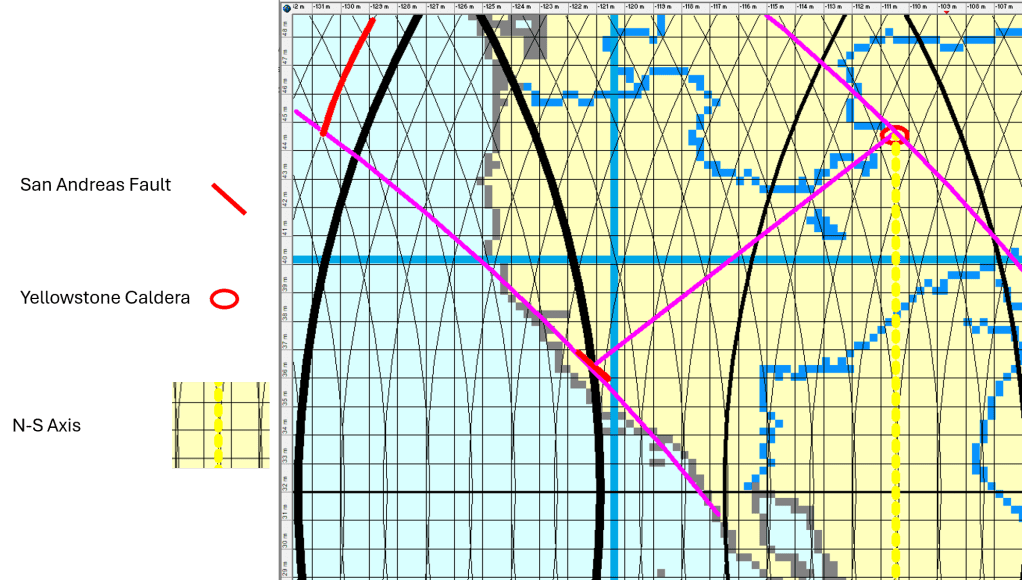
The tectonic settings of the San Andreas Fault in California and the Alpine Fault in New Zealand are comparable in several respects. When the elliptical geometry of the Ring of Fire is constructed, the two faults appear approximately opposite one another on either side of the Pacific, with their positions related to the minor axis of the ellipse. A closer comparison, however, reveals several additional geometric relationships.
As shown on the maps below, the central parts of both faults coincide with major lower-mantle boundaries predicted by the Mantle Convection Roll system. In the case of the San Andreas Fault, the inner boundary of the Ring of Fire ellipse also closely coincides with the creeping section of the fault. The San Andreas Fault therefore provides one of the clearest examples of the proposed geometric position of the inner boundary of the Ring of Fire. The midpoint of the creeping section, at approximately 36.38°N, 120.98°W, lies on one of the principal boundaries of the lower-mantle roll system.
The northwestern continuation of the San Andreas system is also noteworthy, as it trends toward the southern end of the Juan de Fuca Ridge. From the central part of the San Andreas Fault, a line can then be drawn toward the Yellowstone Caldera. Yellowstone also lies on a north–south axis that, in the geometry developed here, represents a continuation from the major axis of the Antarctic ellipse. This N–S axis also corresponds to a central axis within the Mantle Convection Roll system.
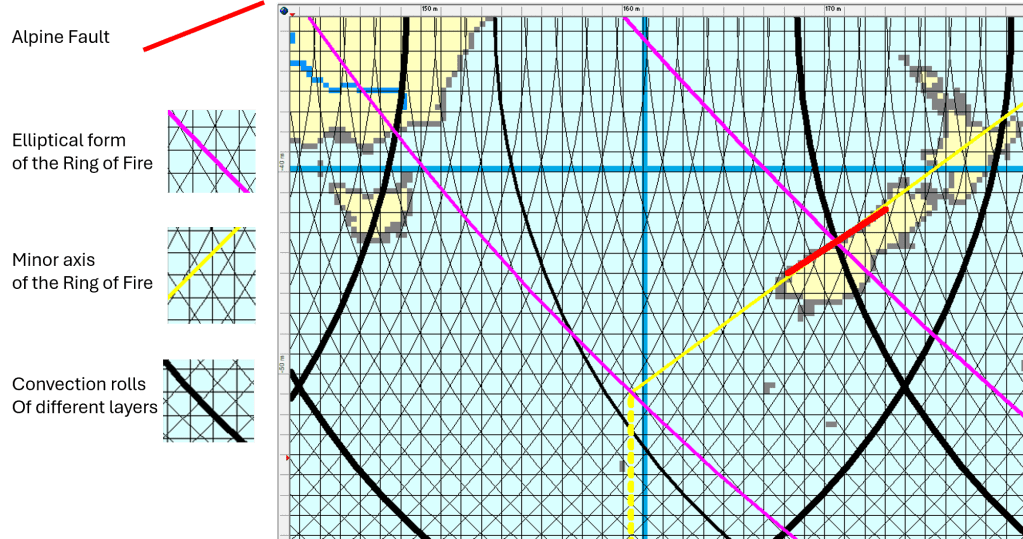
A closely comparable arrangement is found at the Alpine Fault. The central part of the fault lies on a principal lower-mantle boundary, in much the same way as the central part of the San Andreas Fault. The orientation of the Alpine Fault is also approximately parallel to the line connecting the San Andreas Fault with Yellowstone. A second parallel line can therefore be drawn from the central Alpine Fault toward an N–S axis extending from the minor axis of the Antarctic ellipse. This produces a geometric counterpart to the San Andreas–Yellowstone relationship.
The intersection between this N–S continuation of the Antarctic minor axis and the minor axis of the Ring of Fire ellipse defines, in this construction, the outer boundary of the Ring of Fire ellipse. The distance from the Alpine Fault to this intersection is shorter than the corresponding San Andreas–Yellowstone distance. This difference is related to the fact that the four N–S axes used in this geometry are systematically displaced approximately 1.5° eastward from the corresponding system centres of the Mantle Convection Roll model.
The distance between the San Andreas Fault and Yellowstone corresponds to one complete lower-mantle convection-roll interval, equivalent to ten smaller roll intervals. In the Alpine Fault case, the corresponding distance amounts to eight such intervals. According to this geometry, the inner and outer boundaries of the Ring of Fire are therefore not perfectly symmetrical.
Approximated basic shape of the Ring of Fire.
Zooming in: The comparison consequently reveals a considerable number of mutually consistent geometric relationships between the San Andreas and Alpine faults: their opposing positions relative to the minor axis of the Ring of Fire, the location of their central sections on major lower-mantle boundaries, the parallel orientation of the faults and their associated connecting lines, and the regular spacing produced by the Mantle Convection Roll system. The following maps are presented to illustrate these relationships and allow the two regions to be compared directly.