The two major fissure eruptions of Eldgjá (939 CE) and Laki (1783 CE) display several striking similarities. The eruptive fissures are broadly parallel and occur within the same general region of southern Iceland. Lava from the Laki eruption partly overlies lava produced during the earlier Eldgjá event..
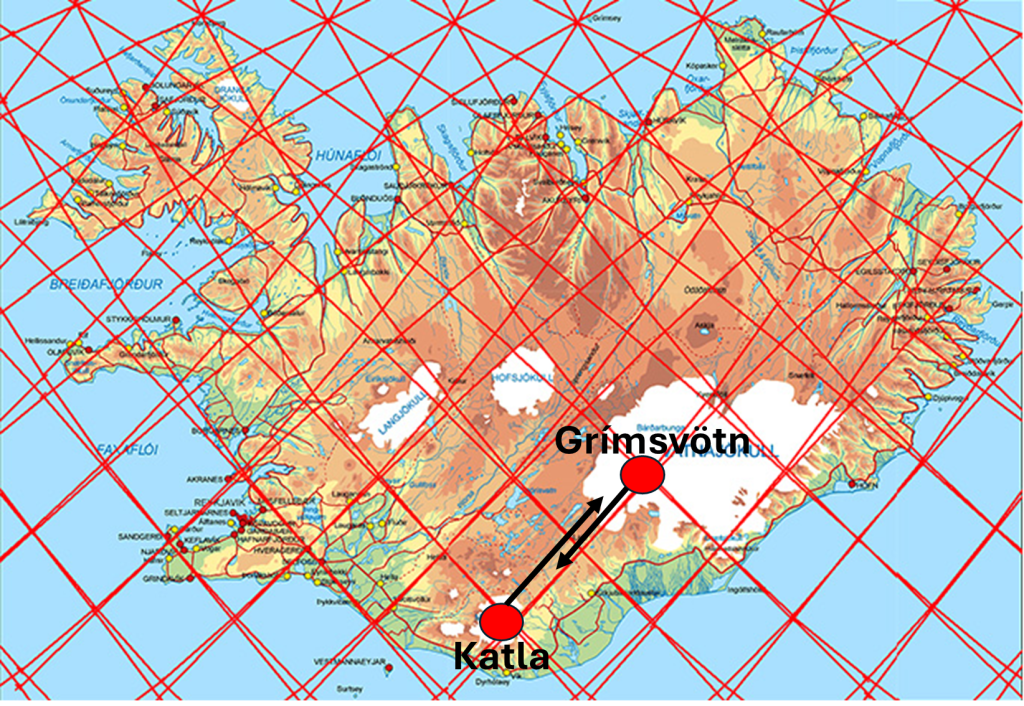
Despite these similarities, the eruptions are associated with different volcanic systems. The Eldgjá eruption is linked to the Katla volcanic system, whereas the Laki eruption belongs to the Grímsvötn system. These central volcanoes are separated by approximately 120 km. Remarkably, the Laki crater row lies almost exactly midway between the two calderas.
Both calderas also coincide with intersections of the structural division lines shown on the map. The dykes responsible for the eruptions propagated along the structural line situated between the two calderas, forming fissures that follow the same general orientation. This geometry shows that the regional stress field and crustal structure guide magma transport over large distances.
In both cases, the propagating dyke appears to cross a perpendicular structural division located between the two volcanic systems. The onset of eruption occurs shortly after this crossing. This recurring pattern suggests that the intersection between these structural elements plays an important role in controlling where magma reaches the surface.
One interpretation is that the perpendicular division represents a zone of enhanced crustal permeability, where fractures or weaknesses allow magma within the dyke to ascend more easily. Another possibility is that this structural boundary marks a deeper source region where additional hot magma is supplied from below. In this case, the propagating dyke may intersect a region of increased magma pressure or temperature, destabilizing the system and triggering eruption.
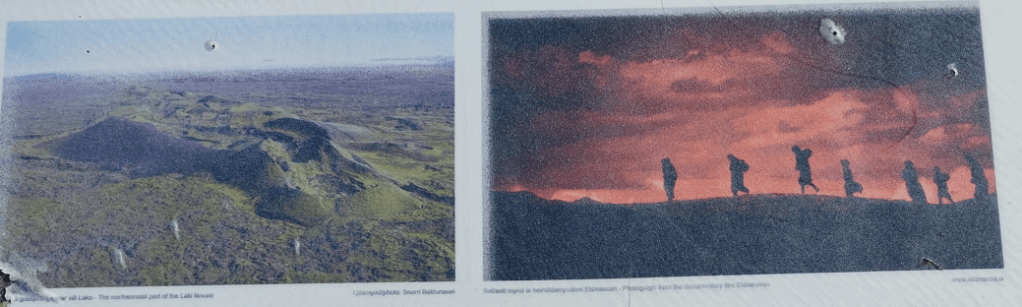
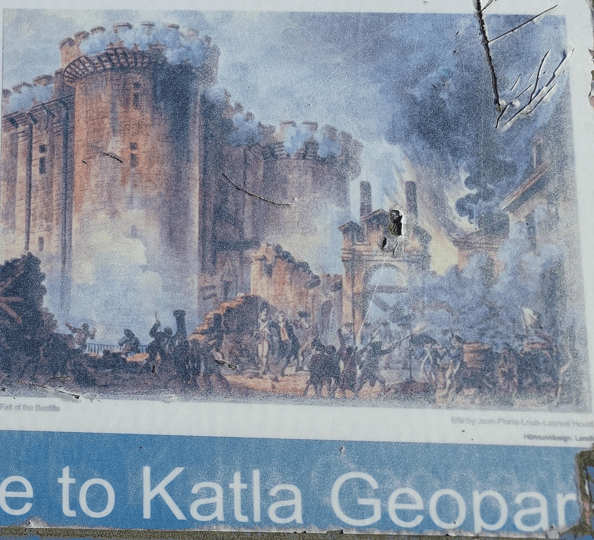
Along the Ring Road, informational displays describe the severe consequences of the 1783 Laki eruption. Images depict the suffering experienced by the Icelandic population during the event. Another image refers to the French Revolution, illustrating the wider climatic and societal effects of the eruption.
Images representing Laki eruption.Image related to the French revolution.
The volcanic haze produced by Laki spread across large parts of Europe, contributing to crop failures and famine. These environmental stresses intensified social tensions in France and are considered one of the contributing factors to the unrest that culminated in the French Revolution.
These two eruptions are did affect the history of Iceland more than any other volcanic events.
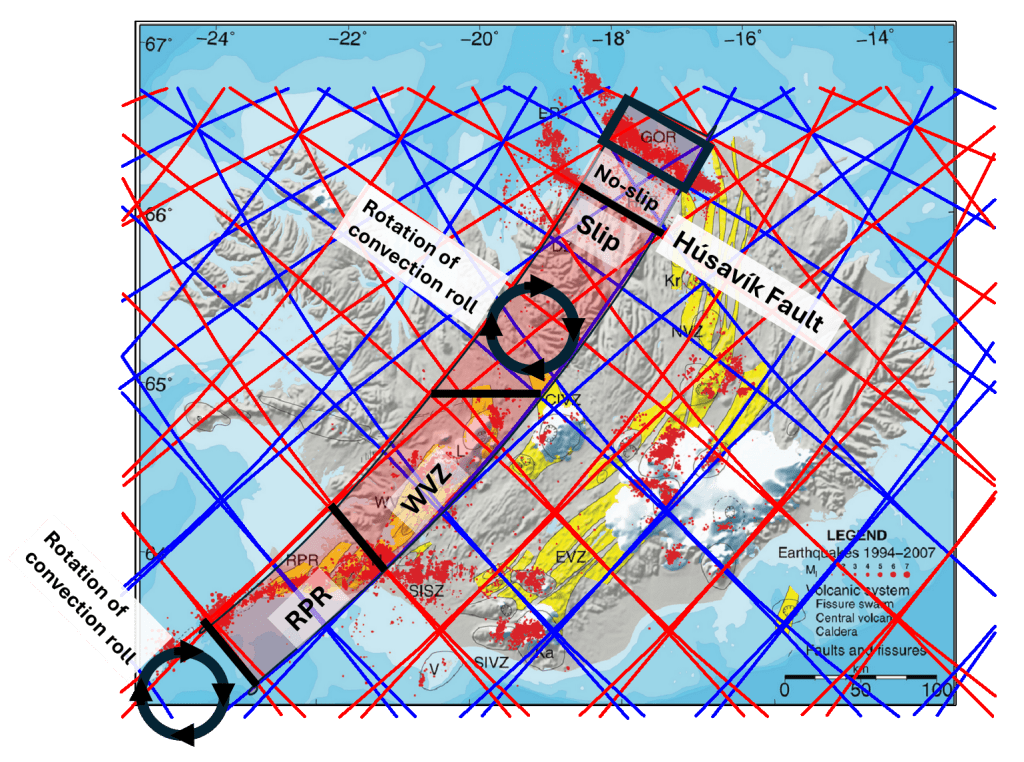
The convection roll bridging the gap between Reykjanes Ridge and Kolbeinsey Ridge
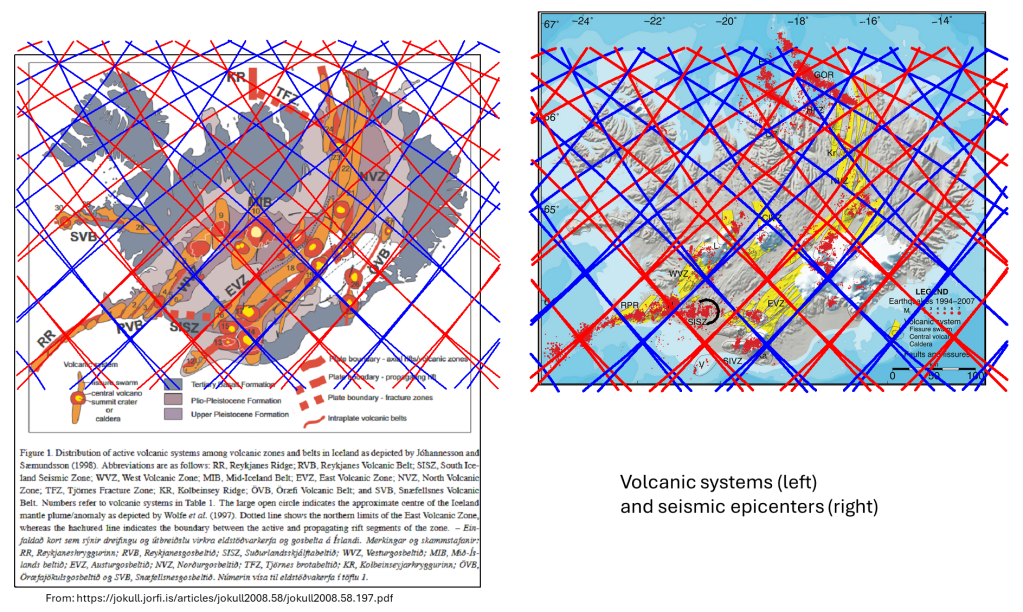
The West Volcanic Zone (WVZ) and the Húsavík–Flatey Fault (HFF) can be understood as two fundamentally different surface responses to the same mantle convection roll, whose flow direction is opposed to the absolute motion of the overlying plate. Where this roll is effectively coupled to the lithosphere, its opposition to plate motion promotes either extension or shear, depending on local boundary conditions.
The WVZ represents the extensional response to this roll–plate opposition. South of approximately 65° N, the uppermost convection roll maintains sufficient mechanical coupling to the lithosphere to drive sustained rifting and volcanism. Northward of this latitude, however, the polygonal pattern of roll-division lines becomes increasingly complex, and the uppermost roll progressively loses its grip on the plate above. As a result, the rift architecture of the WVZ terminates, and extension is no longer the dominant mode of deformation.
These conditions prevail until the system reaches the HFF. At this location, the same convection roll appears to regain effective coupling to the lithosphere, but now in a geometrical setting defined by a lower division line of the asthenosphere. The result is not extension, but efficient dextral strike-slip motion, localized into a narrow, long-lived fault zone. The HFF thus represents a shear-dominated expression of the same roll–plate opposition that elsewhere produces rift volcanism (RPR, WVZ and GOR). The area south of HHF freely drifts with the North American Tectonic Plate (a smooth displacement of 60 km has been measured). North of the HHF, things are still a bit more complicated.
North of the HFF, a small number of polygons form a region with less seismic activity in which deformation is limited and distributed neither as rifting nor as focused volcanism. Farther north, beyond the next division line parallel to the HFF, the system enters the domain of the Grímsey Oblique Rift (GOR). This boundary lies east of the division associated with the Kolbeinsey Ridge (KR), and therefore clearly within the Eurasian Plate.
Within the GOR domain, the same convection roll continues to influence deformation, but in a setting where tension is created as the North Volcanic Zone (NVZ) fissure swarms extend to the east of the GOR. The GOR is therefore trapped between the Kolbeinsey Ridge and the northern most part of NVZ. This leads to the formation of a volcanic area, linking the NVZ with the Kolbeinsey Ridge. Here, shear and extension are combined, and as a consequence, both seismic activity and volcanism become widespread. Volcanic systems within the GOR represent the volcanic manifestation of this distributed deformation, while seismicity reflects ongoing strain accommodation across the polygonal framework.
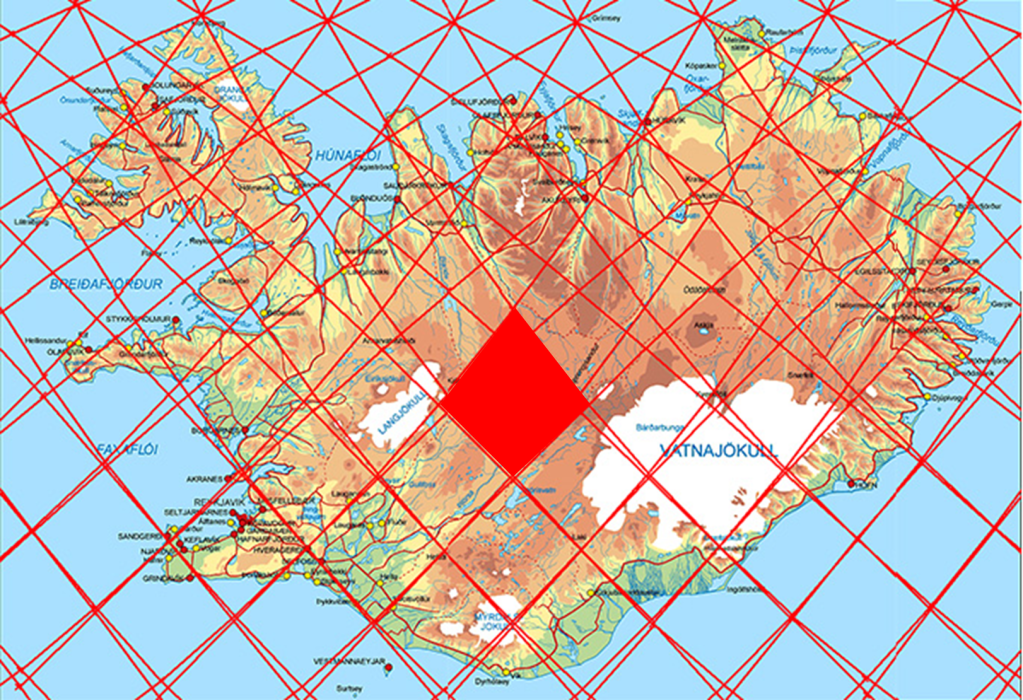
The Mid-Iceland Belt (MIB), also referred to as the Central Iceland Volcanic Zone, forms the volcanic connection between the West Volcanic Zone (WVZ) and the East Volcanic Zone (EVZ). Although the precise outlines of individual volcanic systems—particularly those associated with Hofsjökull and Kerlingarfjöll—vary somewhat between published maps, the overall geometry of the belt is consistent.
Within the Mantle Convection Rolls Model, the MIB occupies a central polygon bounded by division lines separating adjacent convection rolls. In addition, many tectonic maps depict a plate-boundary trace aligned approximately east–west through the MIB, reinforcing its interpretation as a zone of plate-scale interaction rather than a simple rift segment.
The Mid-Iceland Belt Polygon
Why the MIB differs fundamentally from WVZ and EVZ
The adjacent volcanic zones, WVZ and EVZ, can be interpreted as rifting zones located above convection rolls whose flow direction opposes the absolute motion of the overlying plate. In those zones, mantle flow and plate motion combine to promote sustained extension and focused rift volcanism.
The MIB does not fit this configuration. Located between the opposing roll-controlled rift systems, it occupies a region where this rifting mechanism does not apply directly. Its existence therefore cannot be explained as a primary spreading axis driven by roll-opposed plate motion. Instead, the MIB must be understood as a structural connection zone accommodating the transfer of deformation between the WVZ and EVZ.
Analogy with the South Iceland Seismic Zone
It has often been noted that the MIB performs a role analogous to that of the South Iceland Seismic Zone (SISZ). The SISZ is characterized by tectonically driven strike-slip and oblique faulting, accommodating lateral plate motion rather than sustained rift volcanism. The MIB is broadly parallel to the SISZ and occupies a comparable central position within its convection-roll polygon.
Between the polygons associated with the SISZ and the MIB lies an intermediate polygon, here referred to as the Hreppar Polygon (HP). Some interpretations treat the SISZ and HP—together with adjacent areas, often including the western margin identified as the Þingvellir rift—as a distinct tectonic microplate. In this framework, the northern boundary of that microplate coincides with the transition across the MIB.
Internal complexity of the MIB polygon
The MIB polygon itself displays a dual structural character. In its southern half, the bounding division lines of the convection rolls converge closely, producing a relatively unified structural pattern. Farther north, these division lines diverge, and an additional micro-polygon appears in the north corner. In this area, fissure swarms extending from the Hofsjökull central volcano exhibit an orientation that differs from that of the southern MIB, indicating localized reorganization of stress.
Comparison with the Tjörnes Fracture Zone
A useful comparison can be made with the Tjörnes Fracture Zone. Within the TFZ, the Húsavík–Flatey Fault accommodates almost exclusively horizontal dextral motion and has done so continuously for millions of years, producing a cumulative offset on the order of 60 km on each side. In contrast, the Grímsey Oblique Rift exhibits both seismic and volcanic activity. Although it is broadly parallel to the Húsavík Fault, it serves a different function: accommodating the combined tectonic and magmatic processes required to link the North Volcanic Zone with the Kolbeinsey Ridge.
In an analogous manner, the SISZ and the MIB together form a paired system: one zone primarily accommodating horizontal tectonic motion, the other incorporating significant volcanic processes.
Latitudinal variation in polygon patterns
The geometric arrangement of convection-roll polygons differs markedly between southern and northern Iceland. In the south, large and relatively regular polygons give rise to east–west-oriented structures, with one zone dominated by horizontal shear (the SISZ) and another incorporating volcanism (the MIB). In the north, the polygon pattern instead permits the development of a single, long-lived, continuous transform fault, represented by the Húsavík–Flatey Fault. Within the adjacent row of polygons, the Grímsey Oblique Rift fulfills the volcanic role associated with plate-boundary connection.
Closing synthesis
Taken together, these observations suggest that the Mid-Iceland Belt is neither a simple rift nor a conventional transform zone. Instead, it represents a mantle-controlled connection zone, complementary to the South Iceland Seismic Zone in the south. The pair of MIB and SISZ is analogous in function to the Grímsey Oblique Rift and Húsavík Fault in the north. The geometry of the MIB, internal complexity, and relationship to adjacent volcanic zones are best understood in terms of the spatial organization of mantle convection rolls rather than solely through plate-boundary kinematics.
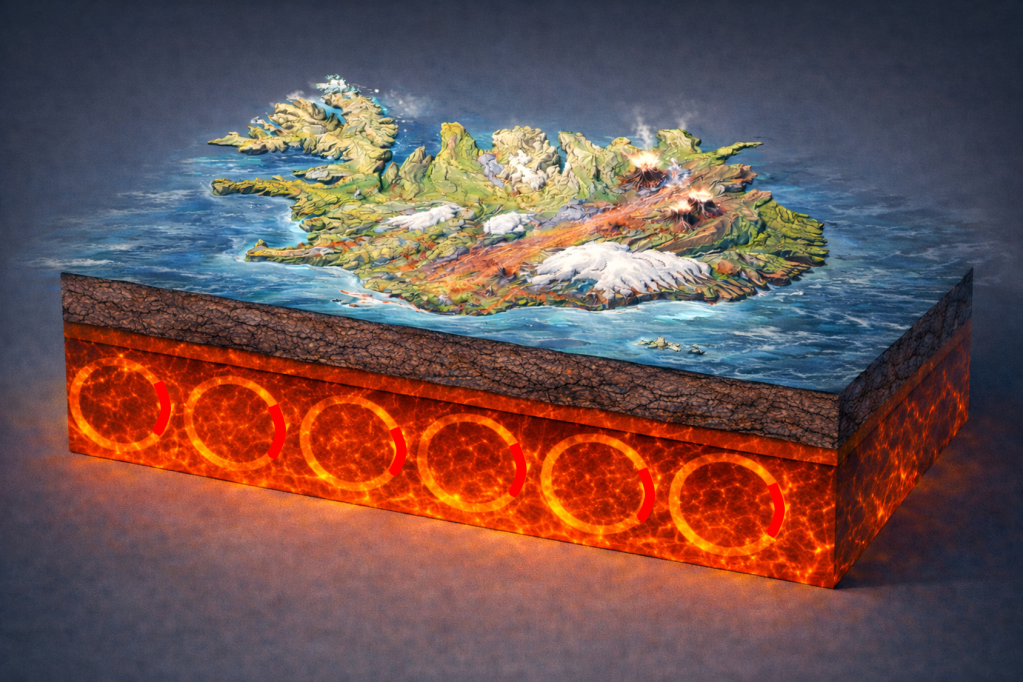
Visualizing mantle convection rolls becomes significantly easier with the use of AI-based three-dimensional models. What were once abstract concepts—difficult to imagine and even harder to communicate—can now be rendered as coherent flow structures extending through the mantle. These visualizations provide an important bridge between mathematical models of mantle dynamics and the geological features observed at Earth’s surface. Here is a beginning:
AI-made simplified version of convection rolls under Iceland.
Understanding mantle convection is essential if we are to understand nature correctly. When long-lived convection rolls are taken into account, the spatial distribution of volcanism, rift zones, and seismic belts becomes more intelligible. Location of volcanoes and earthquake zones can be explained, and mid-ocean ridges are not randomly distributed features; instead, they align along sections that can be calculated, and notably, the same mathematical framework can be used to trace subduction zones.
Iceland is exceptionally well suited for testing this type of model. Few regions on Earth display such a concentration of geological features within such a limited area. This makes it possible to compare predicted mantle-flow patterns directly with mapped surface expressions. AI-generated 3D visualizations allow these comparisons to be made more intuitively, helping to explain how the geometry of convection rolls corresponds to volcanic zones and rift systems.
The functioning of mantle convection rolls is not immediately intuitive and requires time to grasp. The mantle behaves neither as a simple liquid nor as a rigid solid. Instead, temperatures are close to the solidus, allowing slow but organized flow to take place over geological timescales. Molten magma—which may eventually erupt as lava at the surface—is originally supplied along the division lines between adjacent convection rolls, where hot mantle undergoes partial melting and ascends through the tectonic plate.
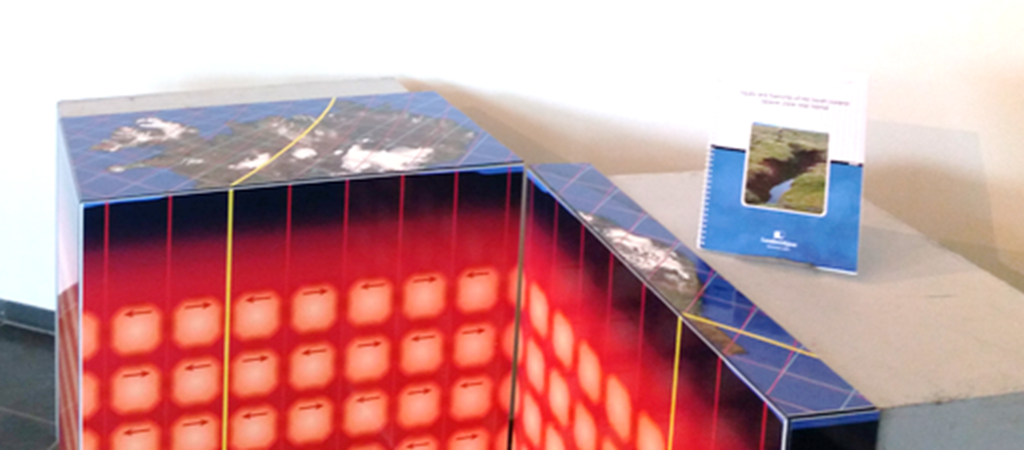
A model showing correct proportions of the convection rolls along 64°N.
These rolls exert a direct influence on the tectonic plates above them. Through basal traction, the organized mantle flow causes tectonic drift. In most cases, the direction of mantle flow reinforces the dominant tectonic drift. However, in certain regions, a smaller convection roll may locally oppose the main trend of plate motion. When this occurs, extensional stresses can develop in the overlying crust, leading to rifting.
Such rifting is not merely conceptual but measurable. Over time, an active rift zone does typically span 1.5 degrees from east to west. The East Volcanic Zone in Iceland provides a clear example. Its width, orientation, and volcanic productivity are consistent with localized interaction between mantle convection rolls.
By combining mathematical descriptions of mantle flow with AI-based visualization and geological observation, mantle convection rolls can be treated as physically coherent structures linking Earth’s deep interior to its surface expression. Rather than being abstract or speculative, they offer a unifying framework for understanding why geological features appear where they do.
Here, a geometrically constrained, physics-motivated model for the large-scale convection architecture of Earth’s interior, is developed. The central objective is to show that the apparent complexity of surface geology can be understood as the surface expression of a comparatively regular interior system—one that is (i) consistent with the known physical behavior of convective flow and (ii) strictly constrained by geophysical measurements of Earth’s layered structure.
The method is intentionally bottom-up. It begins with measured layer thicknesses and a small number of physical principles, imposes a strict geometric requirement on how convection must occupy those layers, derives a three-dimensional convection-cell architecture, and only then (in Part II) compares the resulting predictions with surface observations such as fault systems, mid-ocean ridges, volcanic zones, and geothermal provinces. Iceland serves as a particularly powerful natural laboratory because multiple parts of the system intersect there.
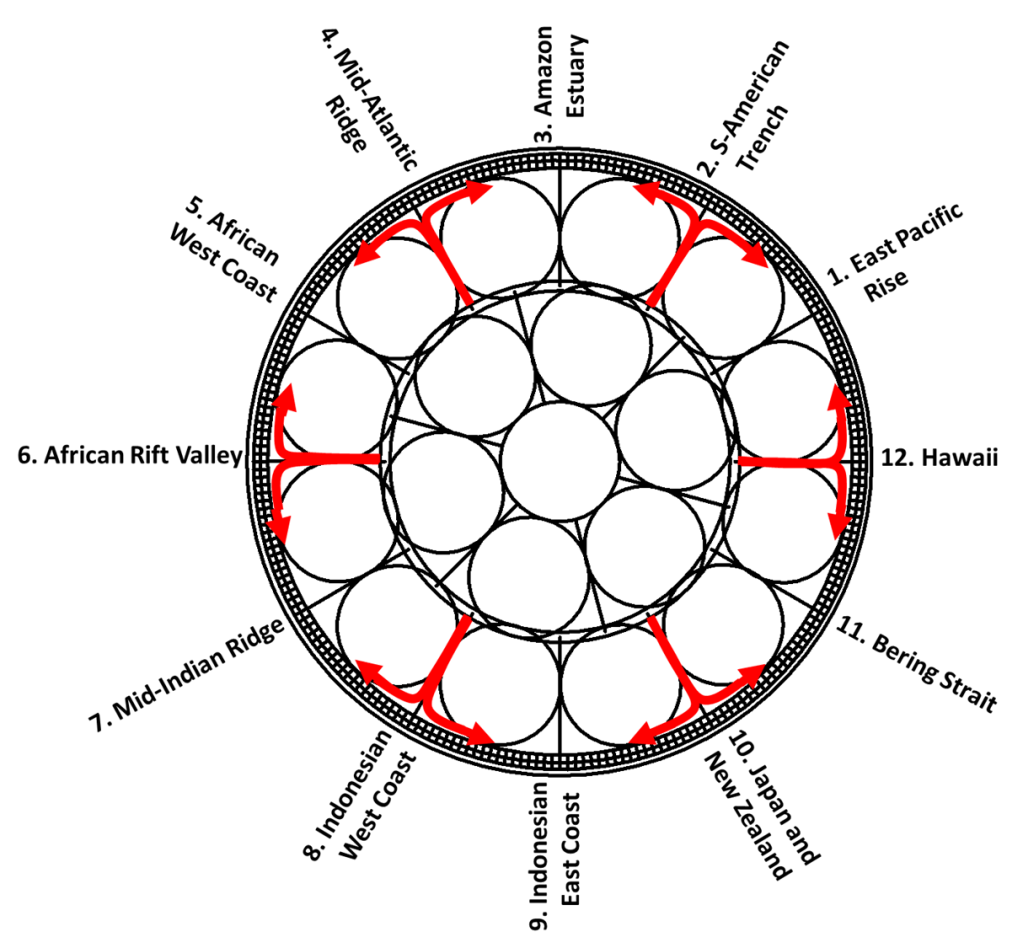
The 12 main division lines of the lower mantle convection rolls system.
A chain of implications:
Layering → Geometry Earth’s measured internal stratification defines fixed radial spaces that convection must occupy.
Physics → Cell proportions Rayleigh–Bénard convection under balanced conditions favors rolls with comparable vertical and horizontal dimensions.
Exact filling → Discrete structure When layers are required to be filled exactly by RB roll sections, characteristic cell sizes and integer counts emerge.
Rotation → Curvature Earth’s rotation constrains the horizontal planform of flow, producing systematic curvature and latitudinal organization.
Continuity → Intersection zones Global circulation requires geometrically defined zones where different roll families and layers connect smoothly.
Petrology → Two-layer interpretation The resulting upper-mantle structure naturally accommodates two chemically distinct source regions, consistent with MORB and OIB.
Heat transport → Focused pathways Convection, conduction, radiation, and focused melt transport together explain how a regular interior system can produce localized surface volcanism.
The guiding premise throughout Part I is that regularity is the default expectation for a slowly evolving, rotating convective system operating over geological timescales inside a nearly spherical body.
Background
When Earth’s internal layers—defined seismologically—are drawn to scale, their thicknesses exhibit a degree of regularity that invites geometric testing. The working hypothesis is that this regularity is not accidental: convection within the Earth organizes itself in a way that fills the available radial space efficiently and repeatedly.
The model does not introduce new physics. Instead, it organizes existing measurements within a coherent geometric and physical framework, extending classical ideas about mantle convection and plate motion in the conceptual tradition of Sir Arthur Holmes and Harry Hess, besides Alfred Wegener and others. The novelty lies in enforcing internal consistency across all layers simultaneously.
The governing preconditions are deliberately minimal:
Thermal forcing: sustained heat flow requiring convection in the mantle and outer core.
Rotation: Earth’s spin, introducing Coriolis constraints on horizontal flow.
Measured stratification: seismically determined depths of major boundaries and transition zones.
If convection has operated for billions of years in a thick, relatively homogeneous mantle, logic suggests that the system approaches a balanced, quasi-steady organization. Under such conditions, repetitive structures are expected rather than arbitrary ones.
Radial geometry and the primary constraint
The central requirement of the model is simple and strict:
Each convecting layer must be exactly filled by sections of Rayleigh–Bénard convection rolls, without adjustment of dimensions. The roll geometry is determined solely by this requirement and by the physical tendency of RB convection toward comparable vertical and horizontal length scales.
No internal length scale is assumed in advance. Instead, the measured thicknesses of the layers define the available space, and the roll dimensions must adapt to that space under the constraint of exact geometric filling. The geometry then follows the rotational plane of the Earth, starting with the equatorial plane where convection flow and centrifugal force coincide in one plane.
To make the geometry explicit, the conventional “surface-down” description of Earth’s structure is reformulated as a center-out radial system. This allows roll sections to be constructed directly within each layer. When this is done, a regular packing of roll sections emerges that simultaneously satisfies multiple layer boundaries, including the core–mantle boundary region and the upper mantle transition near ~410 km.
The key point is logical rather than numerical: when a single roll geometry fits several independent, measured layers without tuning, the probability of coincidence becomes small. The consistency itself becomes the result.
Upper mantle structure and the 410 km and 670 km discontinuities
Attention then shifts to the part of the Earth most directly coupled to surface geology: the upper mantle and asthenosphere.
Two boundaries define the active convective domain beneath tectonic plates:
an upper boundary near ~120 km, where behavior shifts from conduction-dominated lithosphere to convection-dominated asthenosphere;
a lower boundary near ~410 km, marking the top of the large lower-mantle convection system in this framework.
This creates approximately 290 km of vertical space. When exact RB roll filling is imposed on this interval, simple trigonometry shows that only certain discrete arrangements are possible. A particularly robust solution yields 240 convection cells around the globe in the upper layers, corresponding to a longitudinal spacing of 1.5°.
This number is not arbitrary. It is constrained by symmetry, by divisibility relative to the deeper system, and by the requirement that upper and lower systems nest coherently. The result is a hierarchical structure: large rolls below and smaller rolls above.
The interval between ~410 km and ~670 km is found to accommodate additional roll systems, also with a longitudinal spacing of 1.5°, nested within the larger cells. These secondary systems do not replace the primary structure but supplement it, allowing vertical and horizontal circulation to remain continuous.
Horizontal geometry, rotation, and curvature
With the vertical structure established, the model turns to horizontal geometry. In a rotating system, convection cannot remain rectilinear. The Coriolis effect causes flow paths to curve in systematic ways.
Using inertial-flow reasoning, the characteristic horizontal scale of unconstrained motion on a rotating Earth is of the order of Earth’s radius. To represent this geometry, a square latitude–longitude grid is used as a drawing space, with the understanding that it is a mathematical convenience rather than a physical projection.
Imposing two constraints—
fixed separation of roll boundaries at the equator, and
latitude-dependent horizontal scaling proportional to 1 / cos φ—
leads to a compact geometric condition whose solution identifies a characteristic latitude near 32° N and S. Circles centered near these latitudes reproduce the required horizontal dimensions while remaining consistent with rotational physics.
Earth is not a perfect sphere, but a geoid. Because curvature deviations are not uniformly distributed with latitude, the operational center is taken as approximately 32.0°, which is makes geological-scale predictions possible.
The resulting map-level representation consists of families of circular roll boundaries spaced at 1.5° intervals, supplemented by polar roll families that connect smoothly to the hemispheric system.
Importantly, the circle equations themselves are dimensionless. Angular degrees enter only when the geometry is interpreted on Earth’s surface.
MORB and OIB as expressions of a two-layer system
The geometric framework naturally accommodates a petrological distinction long recognized at the surface: MORB versus OIB.
In the model, these correspond to two vertically stacked convection layers within the upper mantle. The upper layer supplies MORB to mid-ocean ridges, while the lower layer samples deeper or compositionally distinct material consistent with OIB.
Horizontal circulation is described as linked semicircular segments: material travels along a semicircle in one layer and returns along a complementary semicircle in the other, forming a closed loop. This architecture allows continuous circulation while limiting mixing—precisely what is required if MORB and OIB remain distinct over geological time.
When the derived circle families are plotted on a world map, individual boundaries often align with major geological structures. These alignments are not assumed in advance; they become testable predictions.
Heat transfer, radiation, and focused pathways
While convection is the dominant mode of heat transport, conduction and radiation also play roles. At high temperatures, mantle materials may become increasingly transparent to thermal radiation, effectively enhancing internal heat redistribution.
In this framework, radiative transfer allows heat generated in upper layers—where radioactive elements are concentrated—to contribute to deeper thermal budgets, with convection redistributing that energy upward again.
At the boundaries between convection cells, focused upward melt transport is proposed to occur via Munroe-type effects, where geometric and thermal focusing produce narrow, persistent conduits. These conduits provide a mechanism by which a broadly regular convection system can generate sharply localized volcanism and geothermal anomalies.
Intersection zones and global continuity
A global circulation system must close smoothly. This requires intersection zones where different roll families and layers connect without violating rotational constraints.
Two principal types are identified:
Mid-to-high latitude intersections (~60.7°–67.3°), where hemispheric and polar roll systems meet. Near ~64°, roll directions become tangent, allowing exchange without disrupting curvature.
The equator, where the Coriolis effect changes sign. Here, flow must reverse curvature or transfer between layers, imposing strong geometric constraints that may explain large-scale equatorial regularities.
In these zones, effective layer doubling or reorganization may occur, producing greater structural complexity. Iceland lies within such an intersection region, explaining its unusually rich geological expression.
Integrated logic
The model proceeds as a single logical construction:
measured stratification defines the available space,
RB convection physics constrains roll proportions,
and extended heat-transfer mechanisms explain focused surface activity.
The outcome is a coherent, testable three-dimensional framework. It produces explicit geometric predictions—locations, orientations, and characteristic spacings—that can be confronted directly with geological and geophysical observations.

 Magic Magma