Uncategorized

The Golden Circle and West Iceland: Two Sides of the Same Mantle-Convection Polygon

Visitors often experience Iceland’s geothermal wonders as isolated attractions—Geysir erupting in the south, hot springs boiling at Deildartunguhver in the west, rifting on display at Þingvellir. But when viewed through the lens of long-roll mantle convection, these sites reveal a striking order. They are not randomly scattered. Instead, they follow the geometry of a single, large-scale convection-roll polygon whose division lines extend from the Reykjanes Ridge deep into Iceland’s interior.

The Golden Circle occupies the southeastern side of this polygon, while the scenic geothermal and volcanic features of West Iceland mark the northwestern side. Together, they form a coherent and predictable system—one that becomes unmistakable once the underlying structure is recognized.

An overview:

Main Tourist Sites of Golden Circle and Saga Circle

For more detailed view:

The main tourist attractions near Reykjavík

The Southeastern Side: Golden Circle Precision

Þingvellir

Þingvellir sits near the center of the polygon, directly on its north–south axis. Here, equal pulling forces from both sides create the famous rift valley. Its placement is a textbook example of where the interior of a convection polygon should produce surface extension.

Hveragerði

Hveragerði offers one of Iceland’s cleanest demonstrations of deep-mantle structure expressed at the surface. The town lies exactly at the intersection of major mantle division lines, which explains the intensity and concentration of geothermal activity. It is a surface hotspot perfectly predicted by the geometry below.

Laugarvatn

Laugarvatn also aligns with exceptional accuracy. The geothermal area sits on two upper-level down-welling lines and lies directly above a major lower-mantle division boundary. Few places illustrate the coupling of shallow and deep mantle dynamics as clearly as Laugarvatn.

Geysir

Geysir rests directly on the down-welling line that extends northwest from Hekla. It also lies just southeast of the structural intersection that defines the north corner of the polygon’s southeastern side. This convergence of trends helps explain why the geothermal field is so active and persistent.

Gullfoss

The gorge of Gullfoss aligns with the same down-welling division pattern that links Hekla, Geysir, and the West Iceland features. The waterfall marks the upper end of a gorge whose orientation is controlled by the polygon’s structural lines.

These Golden Circle sites collectively trace the southeastern edge of the polygon with remarkable precision—far too precise to be coincidental.


The Northwestern Side: West Iceland’s Mirror Image

The same polygon continues seamlessly northwest, and the geothermal and volcanic features there align with the same degree of accuracy.

Reykholt

Reykholt lies on a major upwelling line extending from the Reykjanes Ridge. This upwelling brings heat toward the surface, establishing Reykholt as a thermal center on the polygon’s NW side.

Deildartunguhver

Iceland’s most powerful hot spring sits on the calculated continuation of the main part of the Reykjanes Ridge, and exactly on the east–west axis that cuts through the Reykholtsdalur area—a key boundary separating upwelling and down-welling segments. Its location makes complete structural sense when placed on the polygon map.

Hraunfossar & Barnafoss

These hydrological features lie on the other upwelling line from the Reykjanes Ridge and near the east corner of the Reykholtsdalur mini-polygon. The unusual phenomenon of water emerging directly from lava fields reflects this deeper structural positioning.

West Iceland’s features are therefore not separate anomalies—they are the northwestern continuation of the same convection-roll polygon that shapes the Golden Circle.


A Unified Geological Framework

When viewed together, the Golden Circle and West Iceland’s geothermal fields reveal a single, coherent pattern. They form opposite sides of the same polygon, shaped by long-roll mantle convection. Each site—Hveragerði, Laugarvatn, Geysir, Reykholt, Deildartunguhver, Hraunfossar—sits exactly where the division lines predict, demonstrating the extraordinary consistency of this framework.

Iceland’s most famous natural attractions are not isolated surface features.
They are windows into the geometry of the deep Earth.

Uncategorized

The Skagafjörður Volcanic Zone: A Relic of Iceland’s Shifting Rift System

Around 3 million years ago, a volcanic zone developed in the Skagafjörður region, extending across what is now the Skagi Peninsula in northern Iceland. This area was part of the Neovolcanic Zone at the time — the active rift that carried most of Iceland’s volcanic and tectonic activity.

For roughly 2–2.5 million years, the Skagafjörður volcanic system produced extensive basaltic lava flows, which now blanket the Skagi Peninsula. These lava layers form a thick sequence of Pleistocene basalt plateaus, showing clear evidence of successive fissure eruptions and long-lived rift activity.

The Skagafjörður volcanic zone formed approximately 3° farther west, but at the same latitudes as the present-day Northern Volcanic Zone. This spatial relationship is not coincidental: it reflects the underlying mantle convection pattern. In Iceland’s mantle, long convection rolls extend roughly 1.5° in width from east to west. These rolls guide upwelling zones and determine where rifting and volcanism are concentrated at the surface.

Thus, both the Skagafjörður and Northern Volcanic Zones are expressions of the same large-scale convection pattern — successive manifestations of upwelling between the same pair of convection rolls, but active at different times as the spreading axis gradually shifted eastward.

Volcanic activity in Skagafjörður ceased less than 700,000 years ago, marking the end of its active phase. By then, the rift axis had shifted eastward and thereby replaced by the current Northern Volcanic Zone. During the active period of the Skagafjörður system, tectonic drift continued, resulting in approximately 10 km of crustal extension. This stretching contributed to the widening of Skagafjörður, later sculpted by glaciers into the broad fjord we see today.

The Skagi Peninsula, now far from any active volcanic centers, remains a silent geological record of this earlier rift episode — a remnant of the same convection-driven dynamics that continue to shape Iceland’s landscape today.

The two NS-axis of Iceland – old and new

Here you see the light blue colored area of Skagi, isolated from other volcanic areas.

https://www.langdale-associates.com/iceland_2017/prologue/geology_map.htm

Uncategorized

Volcanic and Geothermal Activity along 64° N, Iceland

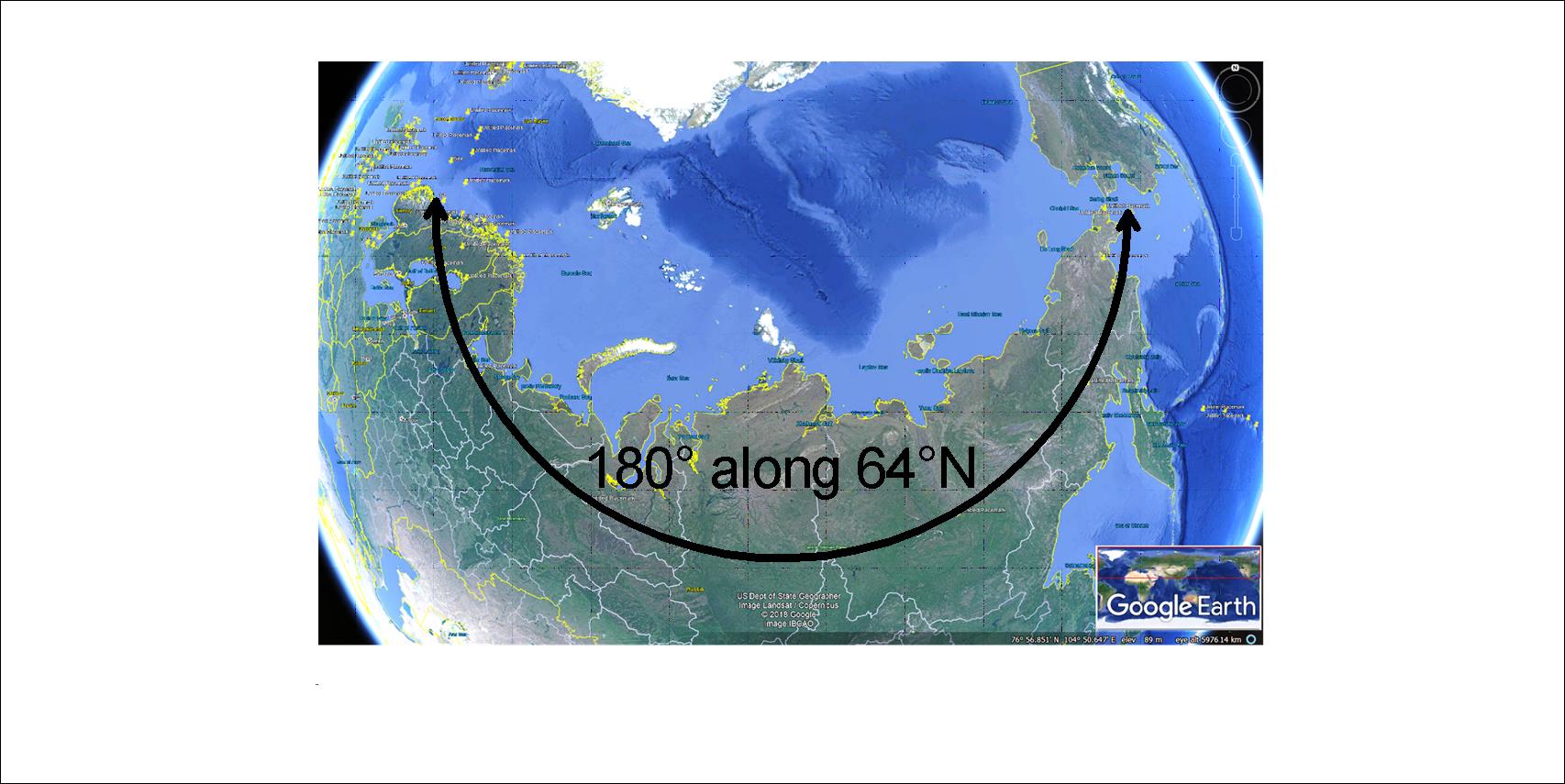
The 64th parallel intersects some of Iceland’s most significant volcanic and geothermal centers, including Hekla, Landmannalaugar, and Öræfajökull, which line up remarkably well along that latitude, about 3° of longitude apart. Let’s now trace the 64th parallel north (64°00′ N) carefully from west to east.


Tracing 64° N, Iceland

1. Western Start — Reykjanes Peninsula (22°–21° W)

The 64th parallel enters Iceland at the southern Reykjanes Peninsula, intersecting the Reykjanes Volcanic Belt, the onshore continuation of the Mid-Atlantic Ridge.

  • Key systems: Reykjanes, Svartsengi, Krýsuvík–Trölladyngja, Brennisteinsfjöll.
  • Geothermal activity:
    • Svartsengi (Blue Lagoon) — high-temperature field exploited for power and bathing.
    • Krýsuvík — intense fumaroles and sulfur deposits along faulted rhyolite ridges near Lake Kleifarvatn.
  • Volcanism: Basaltic fissure eruptions, most recently the Fagradalsfjall events (2021–2024), lie within a few kilometers north of 64° N.

2. Hengill and Hveragerði Region — Western End of SISZ (21° W)

At 64° N, the parallel runs just north of Hveragerði and crosses the Hengill volcanic system, a major geothermal center and the western terminus of the South Iceland Seismic Zone (SISZ).

  • Geothermal:
    • Hellisheiði and Nesjavellir plants utilize the Hengill field; production wells reach >300 °C.
    • Surface features include fumaroles, silica terraces, and mud pots in Hveragerði valley.
  • Tectonics: The SISZ runs eastward from here to Hekla (~19.5° W), spanning roughly 1.5° of longitude, as you noted.
    • It’s a transform zone, accommodating lateral spreading between the Western and Eastern Volcanic Zones.

3. South Iceland Seismic Zone (SISZ) — Between Hveragerði and Hekla (21°–19.5° W)

At 64° N, the line traverses the seismically complex Hreppar microplate.

  • Numerous NNE–SSW strike-slip faults and en-échelon fissures characterize this belt.
  • Though volcanic activity is minimal, earthquakes (M 6–7 historically) are frequent.
  • Geothermal springs occur near Flúðir and Laugarvatn, used locally for heating and bathing.

4. Hekla Volcano (19.7° W)

At precisely 64.00° N, 19.7° W, lies Hekla, Iceland’s most active stratovolcano.

  • Type: Elongate ridge volcano, 1491 m high.
  • Eruptive behavior: Mixed basaltic-andesitic, with both explosive and effusive events; last eruption in 2000.
  • Structure: A central fissure system about 40 km long trending SW–NE.
  • Geothermal: Weak surface manifestation; heat flux mainly magmatic.
  • Relation to SISZ: Marks the eastern terminus of the seismic zone and transition into the Eastern Volcanic Zone (EVZ).

5. Landmannalaugar–Torfajökull Region (18.8°–18.5° W)

Still right at 64° N, this area sits within the Torfajökull volcanic system, a vast rhyolitic caldera overlapping the Fjallabak fissure swarm.

  • Geothermal:
    • Active hot springs, mud pots, and steam vents along the Laugahraun lava and Brennisteinsalda area.
    • Surface temperatures reach >100 °C; deep hydrothermal systems exceed 250 °C.
  • Volcanic features:
    • Rhyolitic domes (Brennisteinsalda, Bláhnjúkur).
    • Mixed eruptions between Torfajökull and Veiðivötn fissure systems (e.g., 1477 AD event).
  • Significance: It’s one of Iceland’s largest silicic geothermal regions, directly intersected by the 64th parallel.

6. Veiðivötn–Bárðarbunga Fissure Swarms (18°–16° W)

Crossing the central highlands, 64° N passes just south of Veiðivötn, part of the Bárðarbunga–Grímsvötn volcanic system.

  • Recent activity: 1477 AD Veiðivötn eruption produced >5 km³ of basaltic tephra; the fissure extends ~100 km.
  • Geothermal: Subsurface high-temperature zones exist beneath Holocene lava fields; limited surface expression due to remoteness.
  • Topography: Alternating lava plains and crater rows — a direct result of fissure rifting at the EVZ’s central axis.

7. Northwest Vatnajökull Margin – Hamarinn & Kverkfjöll (16°–15° W)

Approaching the Vatnajökull ice cap, 64° N crosses areas where subglacial volcanism dominates.

  • Hamarinn (Loki): Central volcano beneath ice, source of jökulhlaups into the Tungnaá and Skaftá rivers.
  • Kverkfjöll (64.7° N, 16.7° W): Slightly north of the parallel but significant. Features:
    • One of Iceland’s most vigorous geothermal fields, extending under the ice margin.
    • Fumaroles, hot ice caves, and sulfur deposits at the ice edge.
    • Heat flow >1 W/m², indicating magmatic heat directly below.
  • Interaction: These subglacial systems release jökulhlaups, linking geothermal processes to glacial hydrology.

8. Öræfajökull Volcano (64.00° N, 16.65° W)

Exactly on the 64th parallel, Öræfajökull forms the southeastern corner of Vatnajökull.

  • Type: Stratovolcano; Iceland’s highest peak, Hvannadalshnúkur (2110 m).
  • Eruptive history: Catastrophic 1362 and 1727 eruptions, both explosive (VEI 5+), with ash fallout across Europe.
  • Geothermal activity:
    • Weak at the surface due to heavy glaciation, but meltwater and hydrothermal alteration indicate subglacial heat flow.
  • Structure: A large caldera, with geothermal vents beneath the ice—likely connected to a shallow intrusive complex.

9. Eastern Termination – Breiðamerkurjökull to Höfn (15°–14° W)

The 64th parallel exits Iceland across the southeast coastal plain and the Vatnajökull outlet glaciers.

  • Geothermal: Minimal visible activity; only low-temperature springs.
  • Volcanic: Ancient subglacial ridges and pillow lavas beneath the sands mark earlier Holocene eruptions under ice.

Uncategorized

Similarities between volcanic activity of Reykjanes and Snæfellsnes in Iceland

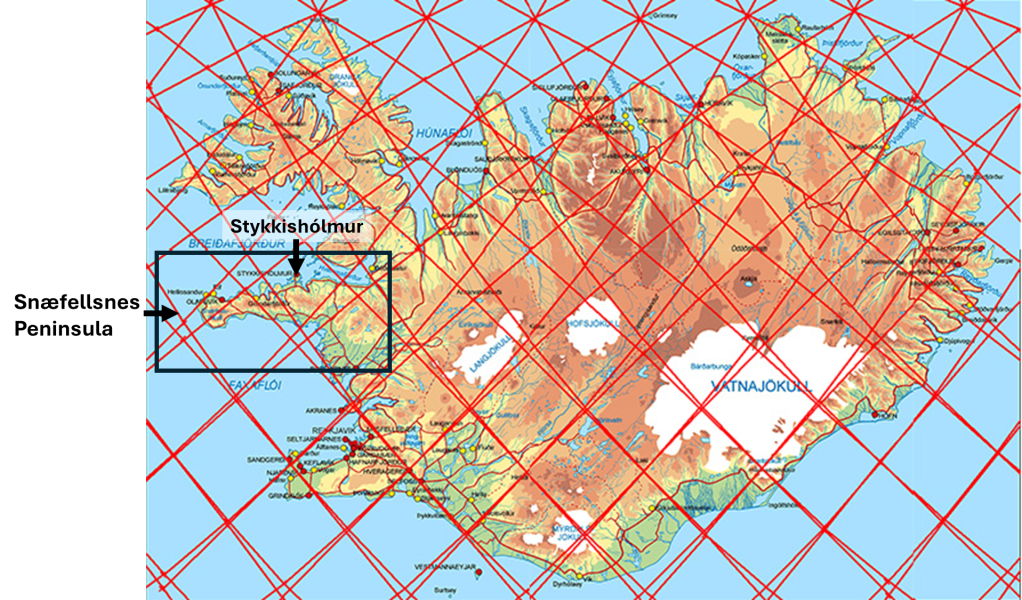
New seismic activity has been noticed at Snæfellsnes in Iceland. It can be compared with the present activity at Reykjanes where 10 eruptions have occurred since 2021.

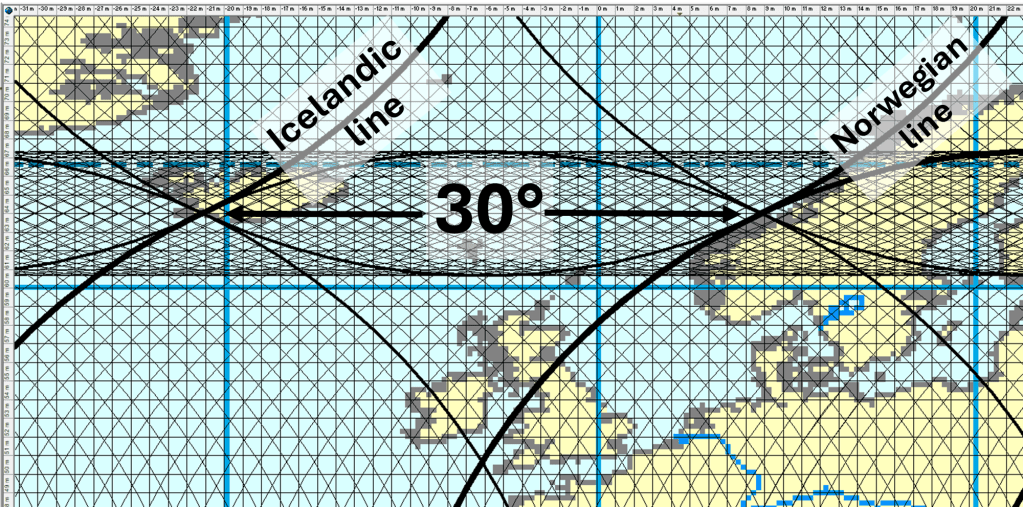
The two volcanic sites, marked on the map, can be compared with the model of convection rolls related to the formation of the Reykjanes Ridge and Kolbeinsey Ridge. Together, they form the sections of the large Mid-Atlantic Ridge found south and north of Iceland. Within Iceland, several volcanic zones replace the mid-ocean ridge, and sometimes Iceland is described as a plateu on the top of the Mid-Atlantic Ridge. The largest volcanic zones, called the West Volcanic Zone, East Volcanic Zone and North Volcanic Zone, are not marked on the map.

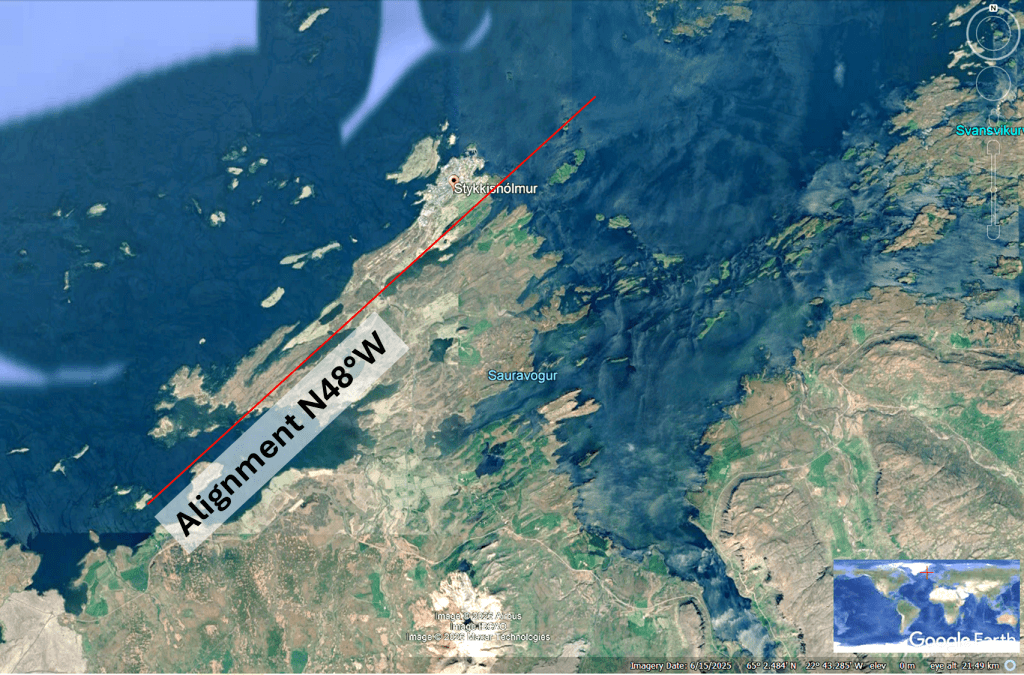
Combining the ends of the said two ridge sections, it can be seen that the two volcanic sites have a similar position compared with the relevant line. The site of Snæfellsnes has not erupted yet, but it is known that magma intrusion is responsible for seismic activity there. The Icelandic Met Office has some information regarding the activity at the Snæfellsnes Peninsula:

.https://www.vedur.is/um-vi/frettir/jardskjalftavirkni-vid-grjotarvatn-aukist-undanfarna-manudi?fbclid=IwY2xjawH-bMdleHRuA2FlbQIxMAABHcDJq8FbbUQJgLtR-HuwIEBknE8PeNannviNIDSoX_yRzFvLqyz9J-HecQ_aem_rTwKR0cWgZa59dGwFw_gEg

Uncategorized

Reykjanes Eruption – where is the origin?

The tenth eruption on the Reykjanes Peninsula started suddenly on the Sundhnúkagígar fissure. All those eruptions are thought to be connected and considered to be one volcanic event, based on rather constant flow of magma from the interior. The model used here adds an explanation of the geophysical settings of the deep roots of the volcanic site. Two convection rolls division lines coincide under the point where the magma ascends. The lines cross the outer limits of the seismic zone at this location, providing a weakness in the crust.

Convection rolls model and site of ascending magma at Reykjanes Peninsula.

To understand how the system works according to the model, this drawning can be studied. The two layeres, with division lines between convection rolls found under the point of ascending magma, are marked here as source layer A and source layer B. Layer A is found at the depth of about 260 km, and layer B at 530 km depth (530-670 km). This means that magma of different types should be found, both from layer A and B. Besides that, the hot magma from below does partially melt the ductile part of the tectonic plate (commonly referred to as upper mantle found below the brittle crust).

The petrology of the lava should therefore be compared with these modelled preconditions of the eruptions. The three eruptions on Fagradalsfjall volcano and the seven eruptions on the Sundhnúkar fissure are originated from the same source, according to the findings in the article: The Fagradalsfjall and Sundhnúkur Fires of 2021–2024: A single magma reservoir under the Reykjanes Peninsula, Iceland? ( https://www.researchgate.net/publication/381756298_The_Fagradalsfjall_and_Sundhnukur_Fires_of_2021-2024_A_single_magma_reservoir_under_the_Reykjanes_Peninsula_Iceland

The authors of the article (Valentin R. Troll. Frances M. Deegan, Thor Thordarson, Ari Tryggvason, Lukáš Krmíček, William M. Moreland, Björn Lund, Ilya N. Bindeman,
Ármann Höskuldsson and James M. D. Day), come to this conclusion: “Whole rock and mineral geochemical data show that the
2023 SVL eruption produced lava compositions that, for the most
part, continue the trends established by the lavas of the late 2021 to
2023 Fagradalsfjall Fires (Figures 4 and 5). A first-order observation
is therefore that all of the recent FVL and SVL magmas are derived
from a similar magma source (excluding perhaps the early parts of
the 2021 Geldingadalir eruption), or a similar combination of sources,
which are different to the source(s) of previous magmas erupted on
the RP…”

Considering that, according to the model of convection rolls, it is quite likely that the uppermost division lines, oriented SW-NE, often provide magma from the mantle. This time it is probably not the case, as it seems likely that the source is from those deeper layers, because the relevant division lines are found exactly under the magma source location, which might explain different composition of the lava samples considered in the said article.