
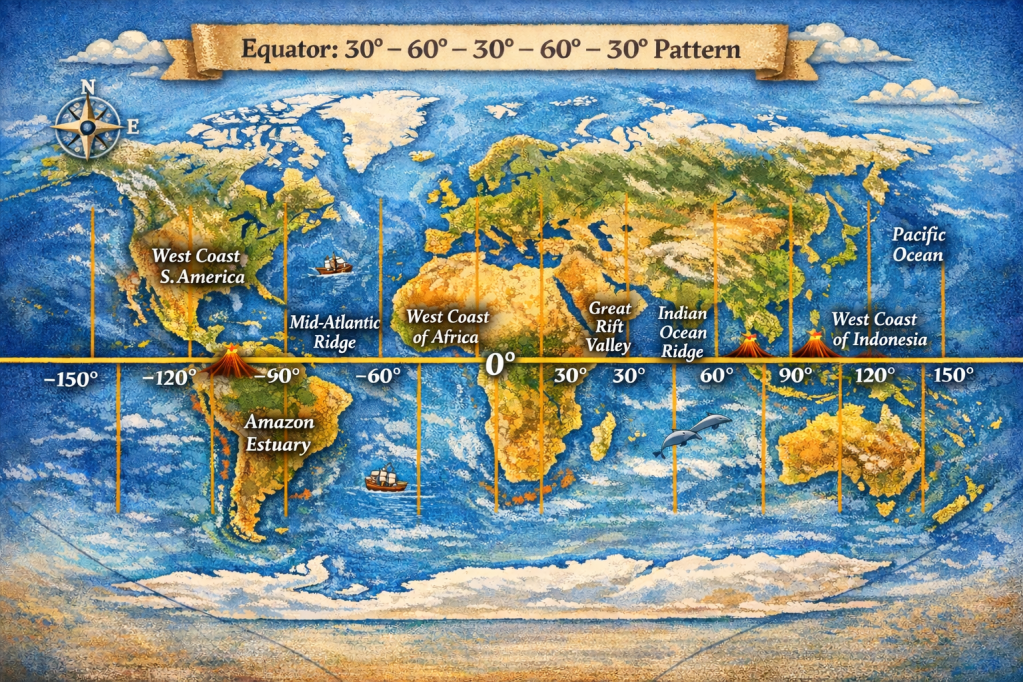
Explaining this is becoming easier with good drawings. AI got the idea! Please have a look at this map:
Try this yourself
Look at a world map and focus only on one line: the equator. Now follow it from west to east.
What do you see?
South America spans about 30° – The Atlantic Ocean spans about 60°. If you see that — keep going, and now continue along the equator:
- West coast of Africa → Great Rift Valley 30°
- Great Rift Valley → Mid-Indian Ocean Ridge 60°
- Mid-Indian Ridge → West coast of Indonesia 30°
- West coast → East coast of Indonesia 30°
Pause. Look again.
What pattern do you get?
30° – 60° – 30° – 60° – 30° One more step. Now try something else.
Start at the east coast of Indonesia
and trace the arc of the Ring of Fire
all the way to the west coast of South America.
So what do you find?
You have now followed the equator across the globe. The question is simple: Do you see a pattern — or not?Is it:more regular than expected, or less? Just look at the map. And decide for yourself. The more accurate maps you use the better. Then we are back to a more scientific approach:

Along the equator, a pattern like this should be expected, because convection within the Earth does not occur randomly but tends to organize itself within each layer. The internal layers of the Earth have been measured with considerable accuracy, and it is well established that the temperature gradient of the mantle is close to adiabatic. This implies conditions similar to those found near the base of the tectonic plates, at depths of around 120 km, where mantle material is relatively stable, and below that it becomes capable of slow flow. Laboratory experiments show that under such conditions, mantle-like material tends to form convection rolls with approximately equal height and width. From this, it is reasonable to expect that a regular pattern of this kind should emerge within the Earth.
This expectation corresponds closely with the observed distribution of continents and mid-ocean ridges along the equator. The equator is a special case, because it represents a zone of symmetry in relation to Earth’s rotation. The horizontal component of the Coriolis effect is effectively zero there, while to the north and south it acts in opposite directions. As a result, the equatorial region provides particularly regular physical conditions, making it a natural place to look for large-scale structural patterns.
A familiar demonstration is often used to illustrate rotational effects: water draining in a sink tends to rotate in opposite directions in the two hemispheres. This is frequently shown near the equator as a simple experiment. But this leads to a more fundamental question: if rotation causes opposite behavior on either side of the equator, what happens exactly at the equator itself, where these effects balance out? Accordingly, we can find a reason why continents and ocean floor sections have a special distribution exactly along the equator! It is The Equatorial 30° Mapped Fact of the World!


