
Working with numerical models is ultimately grounded in measurements and physical principles. The observational basis for Earth’s internal structure has been accumulating for more than a century, and the discovery of the inner core 90 years ago illustrates that our knowledge of the deep Earth is not new. However, it remains significantly more challenging to resolve the structure of the mantle itself, primarily because seismic observations are affected by multiple factors, including:
- limited resolution of seismic tomography,
- dependence on inversion methods and starting models,
- heterogeneity in temperature and composition,
- anisotropy and attenuation effects,
- uneven global distribution of seismic data.
Modelling therefore plays an essential role in filling the gaps between observations. We have relatively robust constraints on the layering of the Earth, and the physical behaviour of mantle materials under pressure and temperature. This makes it possible to explore simplified but physically consistent flow structures within these layers. One such approach is to introduce convection rolls into the mantle, layer by layer, guided by physical constraints.
Under an adiabatic temperature gradient, and with mantle material close to the melting point (and solidus as well) of peridotite, conditions favour Rayleigh–Bénard-type convection, which naturally produces convection rolls with approximately equal height and width. Based on this principle, a geometrically consistent model can be constructed and subsequently tested against observations.
However, this approach raises an important question: What if our current understanding of mantle layering is itself incomplete?
There are several indications that the lower mantle may not be as homogeneous as the commonly assumed continuity between ~670 km and ~2700 km suggests. For example:
- Subducting slabs often change direction or flatten at depth rather than descending vertically.
- Seismic waves may show reflections or scattering, suggesting internal structure.
- The upper mantle is already organized into paired layers:
- the asthenosphere (~120–410 km), and
- the transition zone (~410–670 km).
One possible interpretation of these paired layers is that they facilitate horizontal circulation within the mantle. If large-scale convection rolls exist below 670 km, it would seem inconsistent if that part of the mantle lacked a comparable capacity for lateral circulation. This motivates the exploration of a model in which the lower mantle is also divided into two layers, enabling similar circulation behaviour at greater depths.
Importantly, introducing such a subdivision does not significantly alter the aspects of the model that most strongly affect surface observations. The dominant surface expressions remain controlled by the ~1.5°-wide convection rolls in the asthenosphere and transition zone. Furthermore, processes below 670 km remain difficult to observe directly, and many key constraints are still derived from shallower structures such as slabs and convergent boundaries.
One intriguing aspect, however, is the possibility that there are more large-scale division lines than the 12 ones predicted by simpler whole-mantle convection models. For instance, the relatively stationary distribution of continental masses on the equator, geologically found to be 30° wide and spaced 60° apart, can be more readily interpreted if two large-scale convection rolls exist beneath them, circulating in opposite directions. This interpretation would also imply that the three major north–south trending oceanic ridges near the equator are associated with large-scale upwelling systems, with convection rolls diverging beneath them.
Based on this reasoning, an alternative geometric model can be constructed. This model:
- uses circular convection cells with equal height and width,
- connects each cell to its neighbours at a single point,
- allows global horizontal circulation, in addition to the more emphasized vertical convection.
Within this framework, geometric constraints suggest that an additional transition layer in the lower mantle should exist. Specifically:
- a discontinuity zone is predicted at approximately 1850–2030 km depth,
- with a central depth near ~1940 km,
- and a thickness of roughly ~180 km.
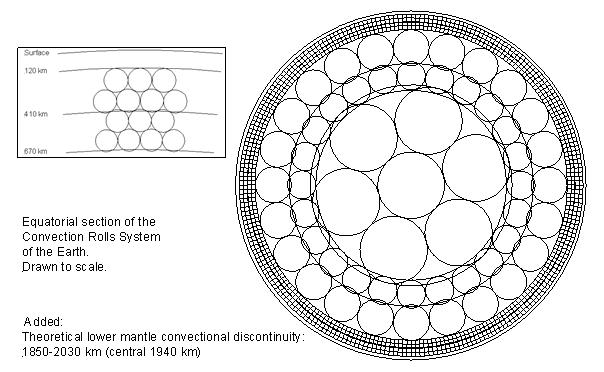
This construction follows the same mathematical logic used for the upper mantle, where the key divisions occur near 410 km and 670 km. Similarly, at the base of the mantle, the core–mantle boundary region (2700–2900 km) reflects comparable geometric considerations.


