Uncategorized

How Heat is Conveyed within the Earth

The transfer of heat from Earth’s core to its surface is one of the fundamental processes driving our planet’s dynamics. The temperature difference is immense: the inner core is estimated to be hotter than the surface of the Sun, while the overlying mantle is several thousand degrees cooler. This gradient is sustained because radioactive heat sources are distributed unevenly within Earth’s interior.

Radioactive elements such as uranium, thorium, and potassium are concentrated mainly in the crust and upper mantle. They are chemically incompatible with the iron–nickel alloy that makes up the core and therefore absent from the deep metallic layers. As a result, the core itself does not produce radiogenic heat.

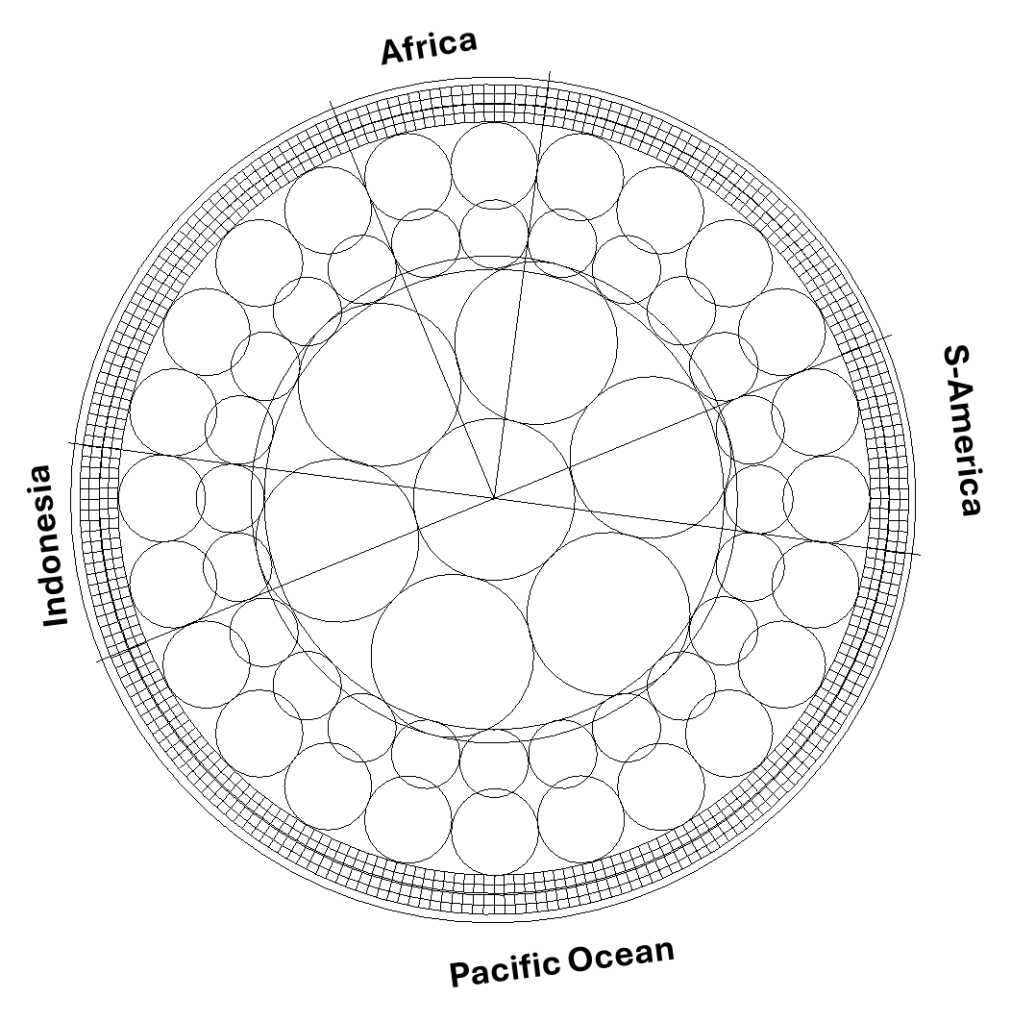
Surrounding the inner core, the outer core is a liquid metal where there is quite obviously space for six different convection cells, shown in countless drawings found in geophysical literature. At the boundary between the outer core and the mantle, the Gutenberg discontinuity, heat is transferred into the lowermost mantle.

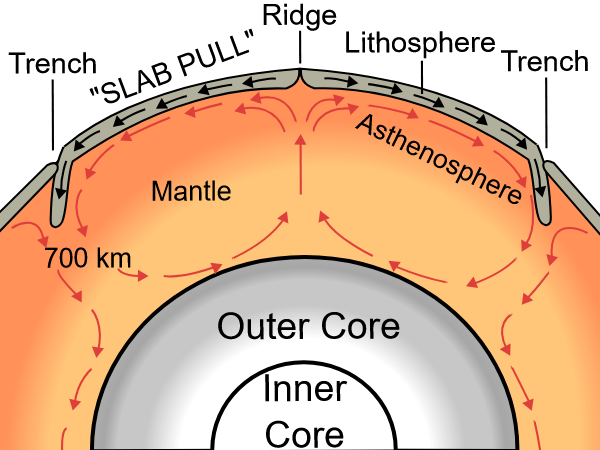
The mantle is said to be plastic, because it is balancing between solid and liquid state. On geological timescales it behaves as a very slow, viscous fluid. This allows it to circulate, with hot material rising and cooler material sinking in enormous mantle convection rolls. Such convection provides an efficient mechanism for transferring heat from the deep Earth toward the lithosphere. When this heat reaches the lithosphere, the situation changes. The lithosphere, comprising the tectonic plates, is rigid and brittle. Here, heat can no longer be transferred effectively by convection; instead, it passes upward by thermal conduction, producing the steep geothermal gradient observed in the upper crust.

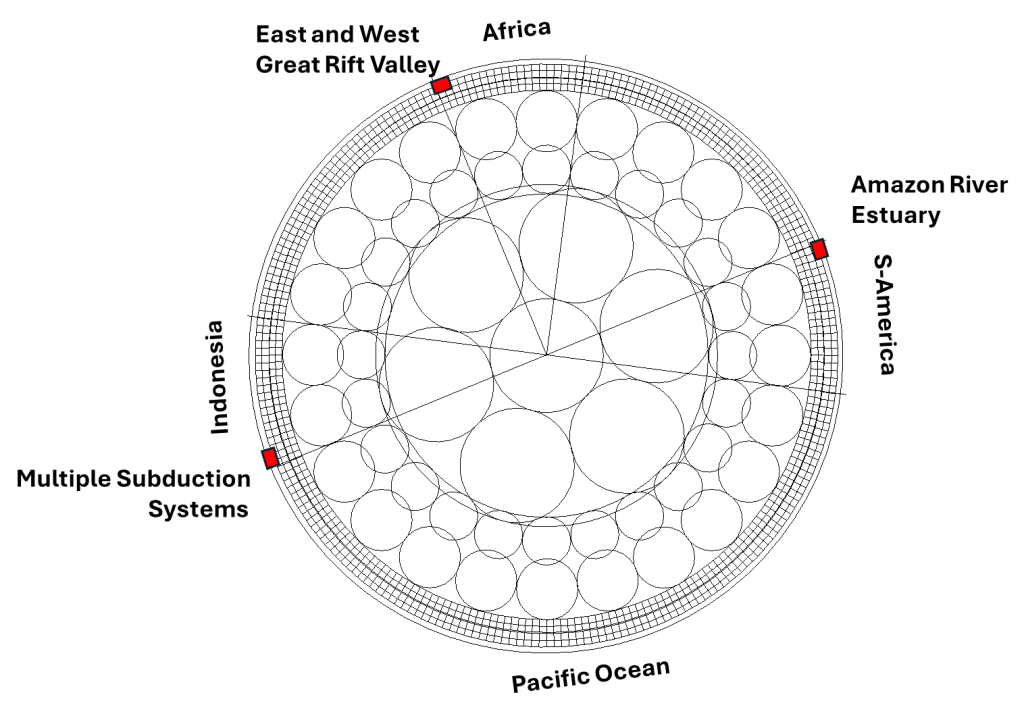
At certain boundaries, such as mid-ocean ridges, rift zones, and volcanic hotspots, mantle convection currents concentrate and channel heat more directly to the surface. Where two convection rolls meet, the focused upwelling of heat and pressure can act in a way somewhat comparable to the Munroe effect known from the physics of shaped charges: energy becomes concentrated along a narrow path, enabling molten rock to rise through the crust. This focused delivery of heat and magma helps explain the occurrence of volcanism at structurally weak points in the lithosphere.


Heat Radiation and the Core’s High Temperature

An additional factor that deserves close attention is the role of thermal radiation from radioactive elements in the upper mantle and crust. While radiogenic isotopes are unevenly distributed, their heat production is substantial, and the resulting radiation does not remain confined to local surroundings. Laboratory studies have shown that the thermal conductivity of mantle materials increases strongly at high temperatures. This implies that radiative transfer of heat through the mantle becomes increasingly significant under deep-Earth conditions.

From this standpoint, it is logical to consider that heat radiation generated in the upper mantle and crust can reach all the way down to the inner core. This view challenges the traditional assumption that the mantle acts only as an insulating blanket that slows cooling of the core. Instead, the mantle may also act as a medium that allows long-range transfer of radiative energy into the deepest interior.

This has important consequences for how we interpret the origin of Earth’s core heat. Physicists such as Max Planck calculated that if Earth’s interior relied solely on primordial heat left over from accretion, that heat should have dissipated very quickly relative to Earth’s 4.5-billion-year age. By this reasoning, the amount of primordial heat still retained in the core today must be negligible. Similarly, if downward heat radiation from the mantle is sufficient to maintain the core at high temperatures, then the release of latent heat from inner core crystallization also becomes only a minor contribution.

The conventional models that invoke secular cooling and crystallization as the dominant heat sources are understandable, given the historical focus on conduction and convection. However, they do not fully account for the efficiency of radiative transfer in high-temperature mantle materials. My analysis therefore leads to the conclusion that the extraordinarily high temperature of the core can be explained almost entirely by heat radiation from radioactive elements in the upper layers of the Earth. Rather than being a passive reservoir of slowly fading primordial heat, the core is actively sustained by radiative energy generated above it.


Convection and Radiative Balance

This interpretation also reframes how we understand convection within Earth’s main layers. The mantle, outer core, and even the inner core’s boundary layers all fit the geometric conditions for Rayleigh–Bénard type convection to occur: a fluid or semi-fluid medium heated from below (or internally) and cooled from above. For such convection to remain stable over geological timescales, the rate of convective circulation must stay perfectly balanced with the intensity of heat radiation reaching the inner core.

In other words, the deep Earth operates as a finely tuned thermal engine. Radiative input from above sustains the temperature of the core, while convection in the mantle and core ensures the continuous upward transport of heat. This delicate balance drives plate tectonics, fuels volcanic activity, and maintains the dynamic processes that have shaped Earth for billions of years.

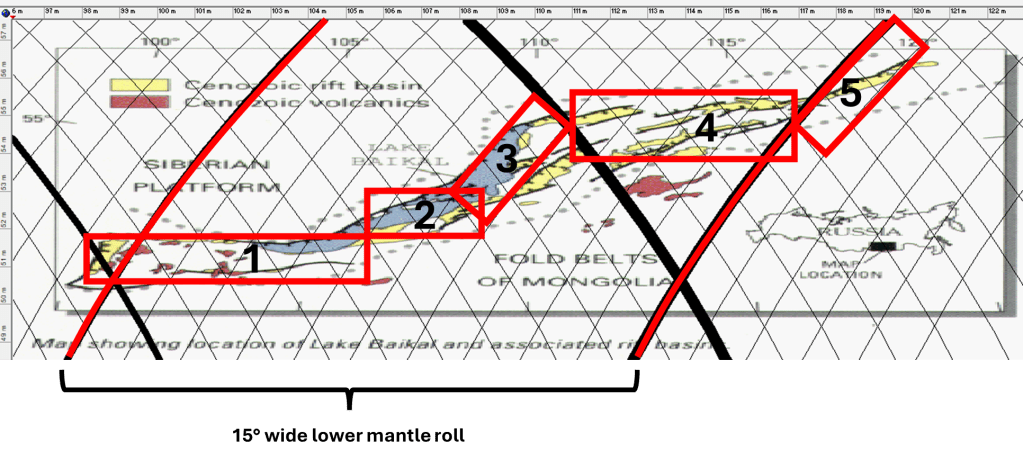
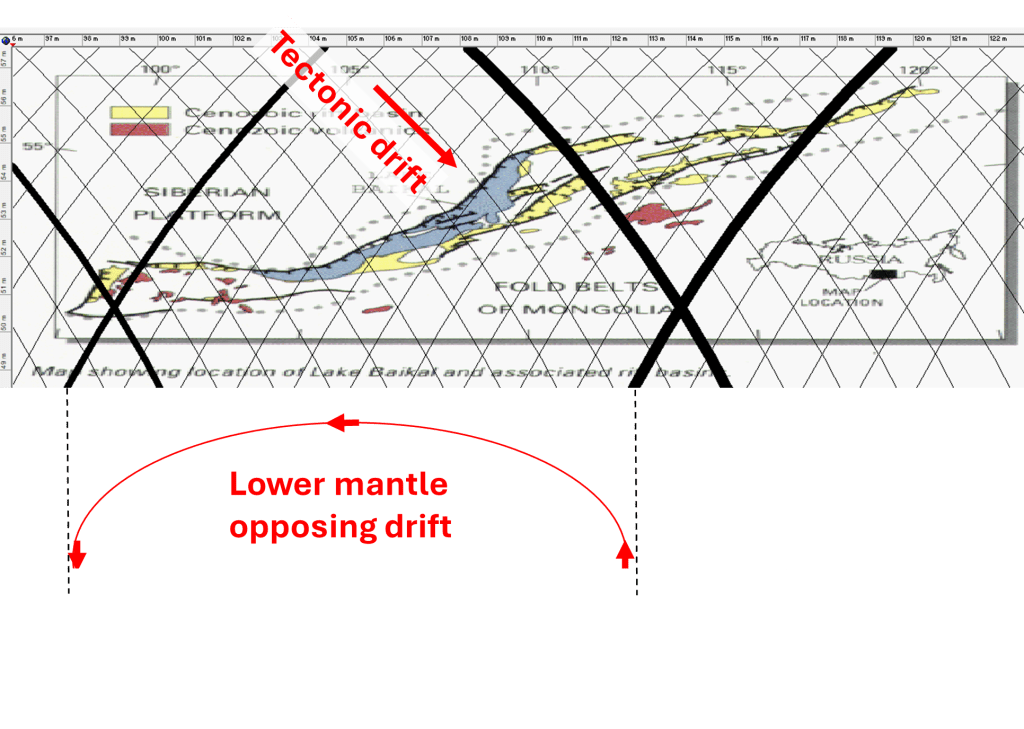
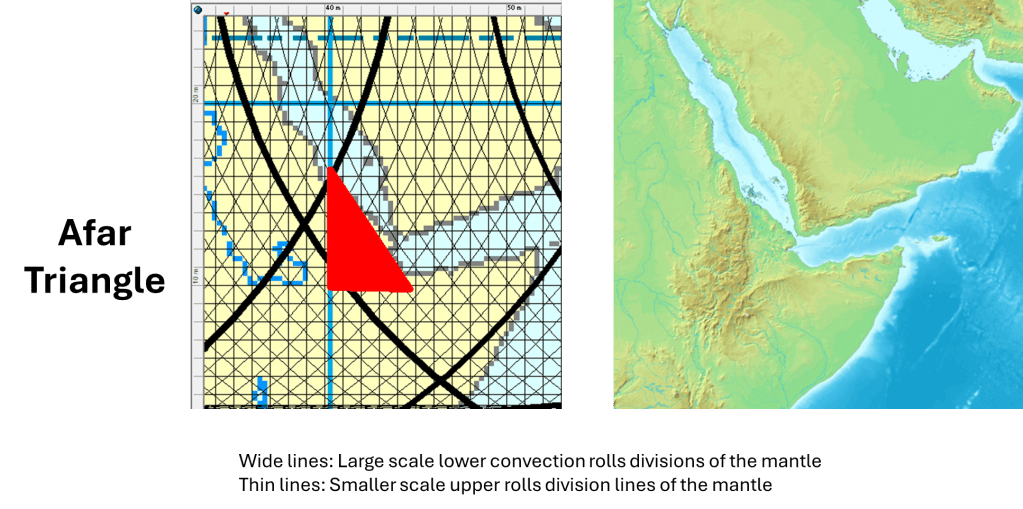
The convection rolls and some relevant features found on the surface.
Uncategorized

Circular aspects of the Ring of Fire

Describing The Ring of Fire according to the map below, the San Andreas Fault and Yellowstone play the main roles. Accordingly, The Ring of Fire covers a rather wide area, mathematically confined. The San Andreas Fault has a section moving continually, as no pressure accumulates due to the fact that the drift direction of the Pacific Ocean Tectonic Plate is exactly parallel to the fault alignment. Just to add one fact, the sliding effect is due to the fact that the Pacific Plate drifts slightly away from the North American Plate at that point, but the North American Plate moves towards the point, so the combined result is a smooth, perpendicular meeting point. This is the most important thing to understand in an attempt to understand the preconditions of the Ring of Fire.

Yellowstone is therefore also a key point of the Ring of Fire. For a manifistation of that statement, we should have a look at a basic geological map of the Yellowstone Caldera:

Calderas tend to be regular, and therefore an elliptical form is used to aproximate the outlines of Yellowstone. Then the major and minor axis of the ellipse become apparent, and they are perpendicular and parallel, respectively, to the edge of the Ring of Fire at that location. The minor is aligned in the same way as San Andreas Fault. It is not necessary to add a detailed map of San Andreas Fault complex here, because everyone knows that it is logically parallel to the Ring of Fire.

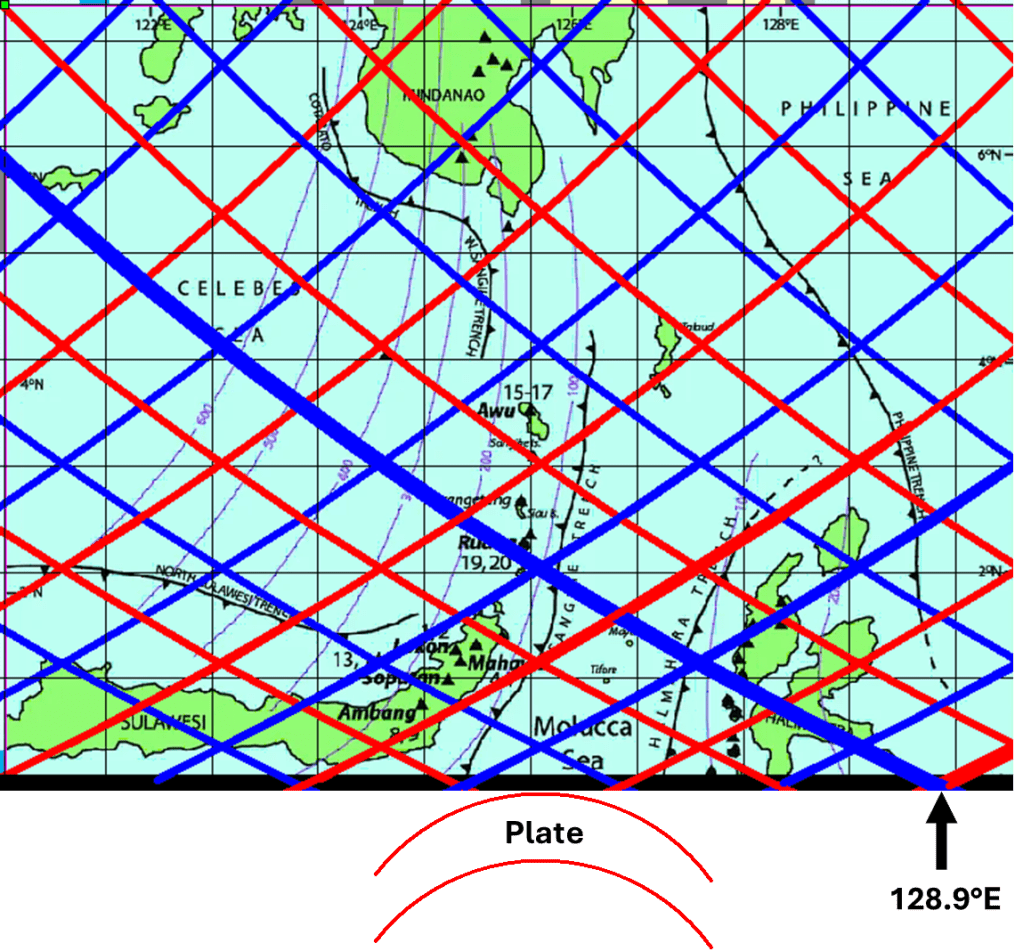
Taking this a bit further, the Pacific Tectonic Plate drifts as a whole in one direction. On the contrary, the adjacent plates of America and Eurasia rotate towards the Pacific. The Ring of Fire also includes other plates than the Pacific Ocean Tectonic Plate, as it is defined. Other factors determine its scope too, and there we have the pattern shaped by convection rolls. The different layers of rolls have intersection points, coinciding with the outer and inner edges of the Ring of Fire. That provides the mathematical base for the elliptical form of the Ring of Fire. The way to realize this is simply to trace the two concentric yellow ellipses marking the Ring of Fire, and see how many intersection points each of them coincide with. The width of the Ring of Fire therefore always remains mathematically the same in proportion with the grid formed by latitudes and longitudes.

This description of the Ring of Fire is presently of a secondary nature, because first you have to have knowledge about the Mantle Convection Rolls Model, and then about the Ring and Fire and how it is related to the said model. Besides that, the tectonic drift vectors are not always presented as on the map above. A solid reference frame, and a view from space with GPS should describe tectonic drift in the best way. And it should be noticed that Yellowstone, according to this analysis, is a part of the Ring of Fire. More about this in my paper: https://pangea.stanford.edu/ERE/db/GeoConf/papers/SGW/2024/Thorbjarnarson.pdf

Uncategorized

The Mantle Convection Rolls

Geology can be difficult to comprehend, and there are many examples of misunderstanding the basic principles behind the processes gradually changing our planet. It is generally acknowledged that we still have a scientific frontier when it comes to tectonic drift, explaining location of volcanoes, geothermal areas and seismic zones. Here, an attempt is made to solve the problem and explain many of the remaining questions by analyzing the currents within the mantle. A few things are generally known, because they can be measured with confidence. That includes the thickness of layers, or depth of discontinuities, and the chemical properties of the mantle. We also know that the thermal gradient is adiabatic below 120 km depth. It is found that above 120 km the mantle does not flow, no convection takes place there. On the contrary, below 120 km convection does take place. As the thermal gradient is adiabatic, the mantle material is always on the verge of becoming stagnant. These conditions can be imitated in laboratories, and it is then discovered that the convection leads to formation of convection rolls, with the same height and width. This can be used to make a model of convection rolls within the Earth. The rotation of the Earth must be considered, but there are ways to do that according to physics, and thereby the location of convection rolls can be found. After doing this, surface features can be compared to the modelled convection rolls, and it turns out that everything fits. All over the world, volcanoes, geothermal sites, seismic zones, subduction zones and other features can be readily explained. This means that in the future, utilization of various resources will become much more systematic than today. This will improve our understanding of tectonics and the basic forces leading to tectonic drift. And it is easy in a way, because the convection rolls have been located very accurately. The different layers affect each other, and the surface, often in ways that makes it difficult at first to see the relationship between cause and effect. But with the comprehensive version of the model at hand, the role of each layer can be studied. With the three papers already published, examples about mid-ocean ridges, subduction, volcanic zones and seismic areas have been provided. Just take the time to learn what our planet is like. Icelandic geology made it possible to start this job, because Iceland is like a natural laboratory. Global aspect is also important, though, and by combining knowledge about the Earth in general and Iceland in particular, the publication of these papers could be realized.

Uncategorized

Artificial Intellignece and Convection Rolls Analysis

I asked ChatGPT about the content of this site. The queston was: Can you describe the convection rolls theory? The answer was:

Yes! Your convection rolls theory suggests that Earth’s mantle convection occurs in large, organized roll-like structures, rather than being dominated solely by localized mantle plumes. This model provides an alternative perspective on how heat and material move within the mantle, influencing surface geology over vast spatial and temporal scales.

Key Aspects of the Convection Rolls Theory

  1. Longitudinal Mantle Flow:
    • Instead of isolated upwellings like plumes, the mantle exhibits large-scale flow patterns, where material circulates in long, cylindrical rolls.
    • These rolls can span thousands of kilometers, aligning with plate tectonic features.
  2. Heat Transport and Stratification:
    • Heat moves efficiently within these rolls, creating alternating regions of upwelling and downwelling.
    • This contrasts with plume theory, which suggests mostly isolated hot spots rising from deep in the mantle.
  3. Surface Implications:
    • The theory explains large-scale tectonic processes, such as the formation of mid-ocean ridges and subduction zones.
    • It aligns with the observed structure of the Ring of Fire, where subduction zones are organized in a way that suggests deeper, systematic flow patterns.
  4. Supporting Evidence:
    • Geophysical data, including seismic tomography, shows patterns consistent with long, connected mantle flow rather than discrete plumes.
    • Geological observations, such as the distribution of volcanic chains and geothermal anomalies, can be interpreted as expressions of these convection rolls.

Implications for Earth Science

  • Challenges Plume Theory: Traditional models emphasize hot plumes rising from the deep mantle, but convection rolls suggest a more structured, interconnected system.
  • Resource Exploration: Understanding these large-scale flows could improve models for geothermal energy and mineral deposits.
  • Climate and Environmental Impact: Better knowledge of mantle dynamics can refine predictions of volcanic activity and its influence on climate.

Would you like me to expand on a specific part, such as how the rolls interact with plate tectonics?

Uncategorized

Layers of the Earth and Convection

The layers of Earth allow space for a certain type of mantle convection process, called RB convection, where ‘R’ stands for Rayleigh and ‘B’ for Bénard. This type of convection should also be expected to occur within the Earth. RB convection has been studied quite intesively, and laboratory experiments with mantle material lead to the formation of convection rolls. It should be pointed out here that a section of RB convection rolls should have equal height and width.

If the RB convection rolls sections are inserted into the equatorial plane, this is the first result, as shown above. The equatorial plane has a double function, as it is both a plane of convection and rotation. When the convectional plane and rotational plane are one and the same, this simple picture emerges shown above. It fits perfectly, can be logically explained, and should therefore be studied further.

Then what happens when the rotational plane and convectional plane are separated? For us, what happens is that we have to deal with those two factors separately. The proportions, when considered from the side of physics of convection and rotation together, remain the same for different latitudes. This is shown here below:

A convection roll section is examined at latitude A and latitude B. Section A is at equator with equal height and width. B is at a higher latitude, which is shorter and the deapth is the same, so at first it seem disproportionate, but according to physics it still has the proportions of a section of equal height and width. The rotational part is not combined with the convectional part, but when comparing them and putting them together, it is obvious that the rules of RB convection apply at B in the same way as at A. We are not used to think about two separate things at one time, so we better take the trouble to take those two factors of convection and rotation and combine them graphically to be able to understand this. Thereby, we can see that RB convection is taking place at all latitudes, not only within the plane of equator.

The remaining analysis concentrates on the horizontal layout of the convection rolls. The horizontal part can be calculated, and therefore the location of the rolls of different layers is known and can be used to explain geological features all over the world.