Blog

Uncategorized

About Mary Tharp and the Mid-Ocean Ridges

Mary Tharp was a pioneering geologist and oceanographic cartographer who, together with Bruce Heezen, created the first comprehensive maps of the ocean floor. Her work revealed the global mid-ocean ridge system, a continuous chain of underwater mountains stretching around the planet, and provided some of the first convincing visual evidence for plate tectonics.

This painting is still the clearest depiction I know of the ridge system. When zooming in on the ridges around Iceland, we can clearly see that a continuous structure lies beneath the island: the Reykjanes Ridge to the south and the Kolbeinsey Ridge to the north, separated only by Iceland and the Icelandic shelf.

It is also fascinating to look at the globe Tharp and Heezen created, where the ridges are marked all around the world. Seeing the system on a sphere makes it much easier to grasp how continuous these features really are, something that is very difficult to comprehend on a flat map. Creating a globe like that must have been a crucial part of their work, helping them visualize Earth’s dynamic structure as a truly interconnected system.

https://en.wikipedia.org/wiki/Marie_Tharp

1977: The culmination of Tharp’s decades of work came with the publication of “The World Ocean Floor”, a full world map of the ocean ridges, created in collaboration with artist Heinrich Berann. This was the first global visualization of the continuous mid-ocean ridge system encircling the planet.

Of course it is tempting to add some aspects of the convection rolls model here:

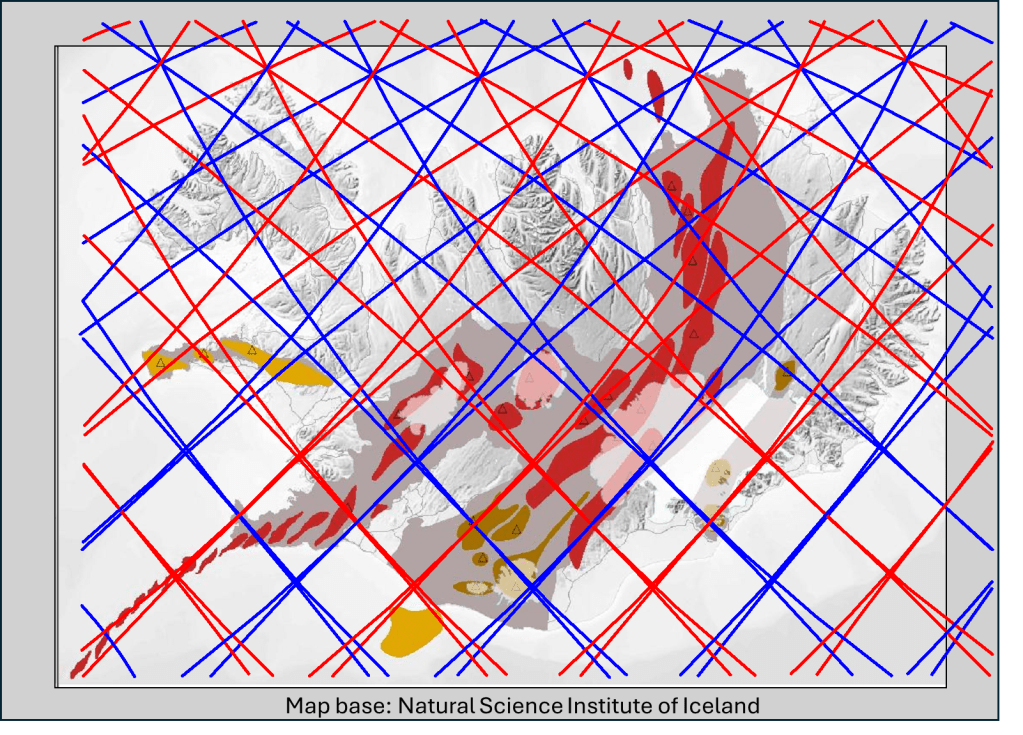
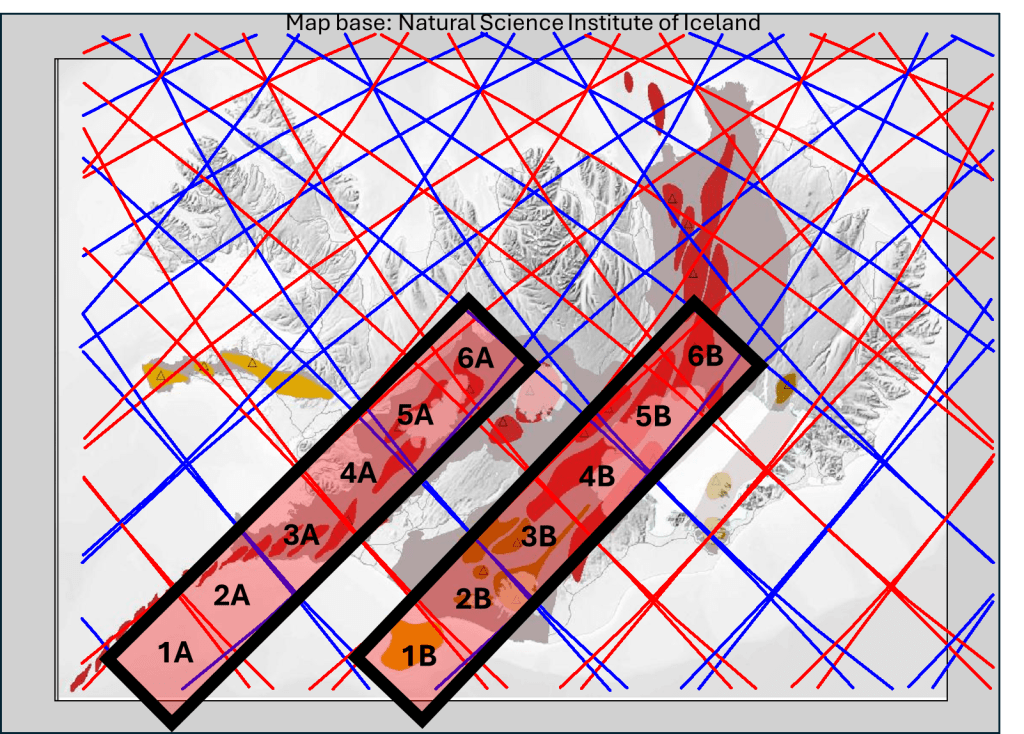
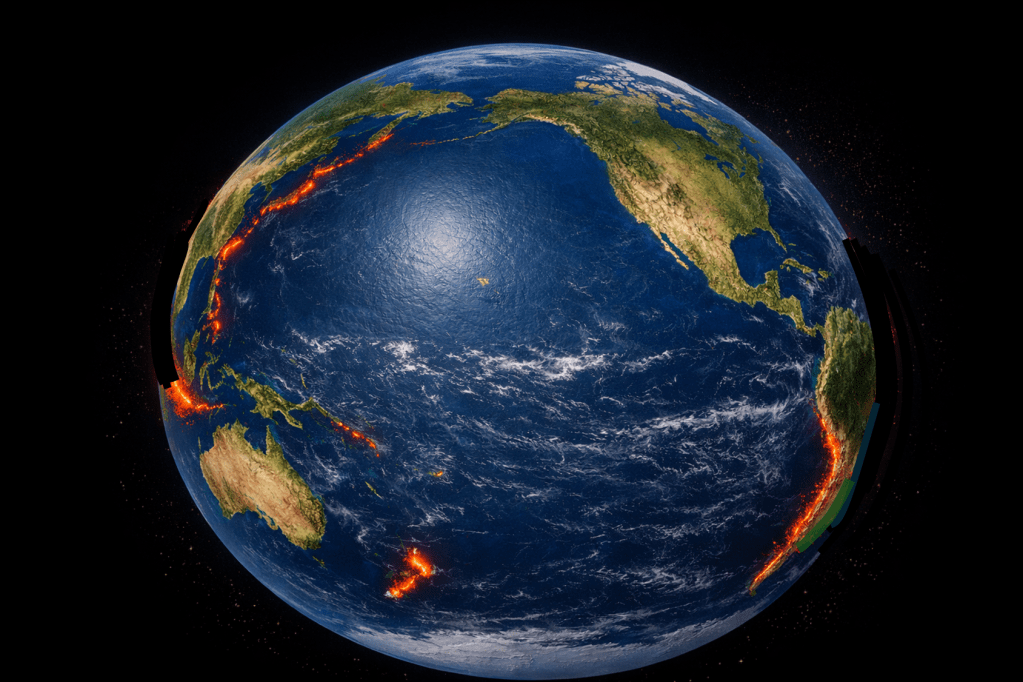
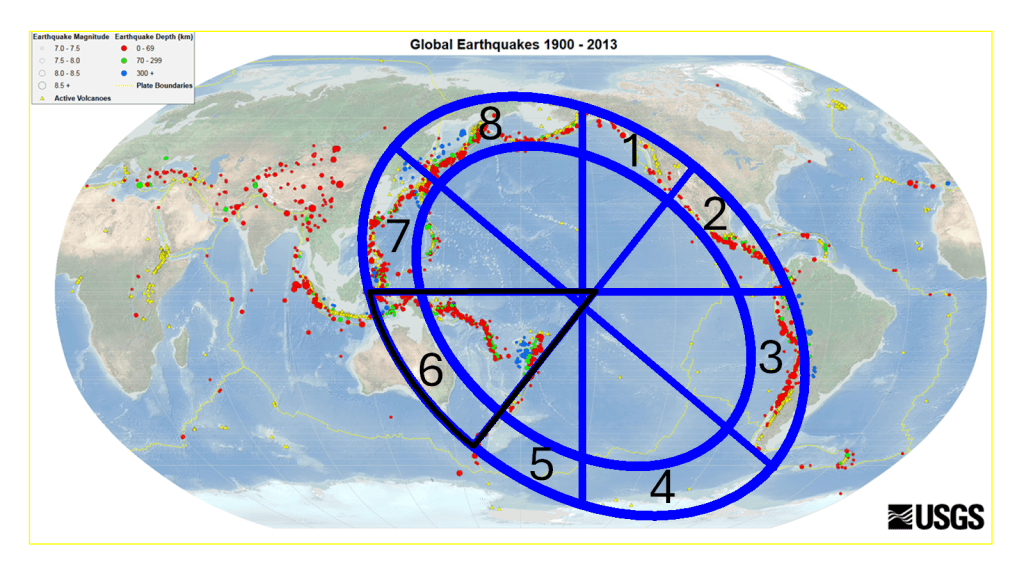
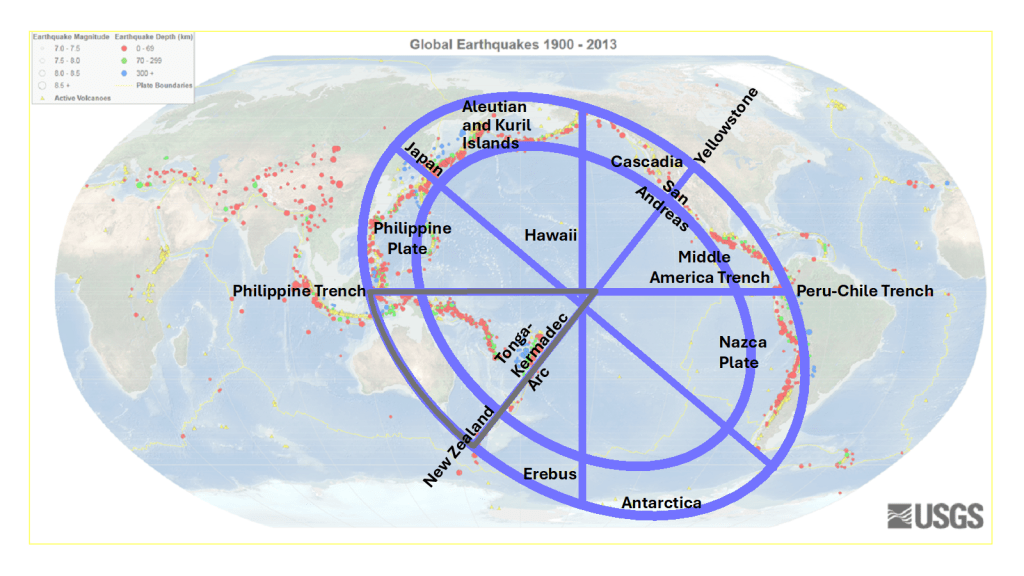
t’s hard not to be impressed by the remarkable regularity of the pattern — at once striking, convincing, and precise. The main structural divisions appear at consistent 30° intervals, outlining a symmetry that is anything but coincidental. Even with the thinnest possible lines, the geometry stands out clearly: the 30° spacing traced along the equator, the continuous arc of the Ring of Fire encircling the Pacific Ocean, and the 90° separations linking the major mid-ocean ridges across the Southern Hemisphere. Together, these alignments suggest a coherent global framework — a kind of planetary rhythm — that underlies both surface geology and deeper mantle dynamics.

Uncategorized

Volcanic and Geothermal Activity along 64° N, Iceland

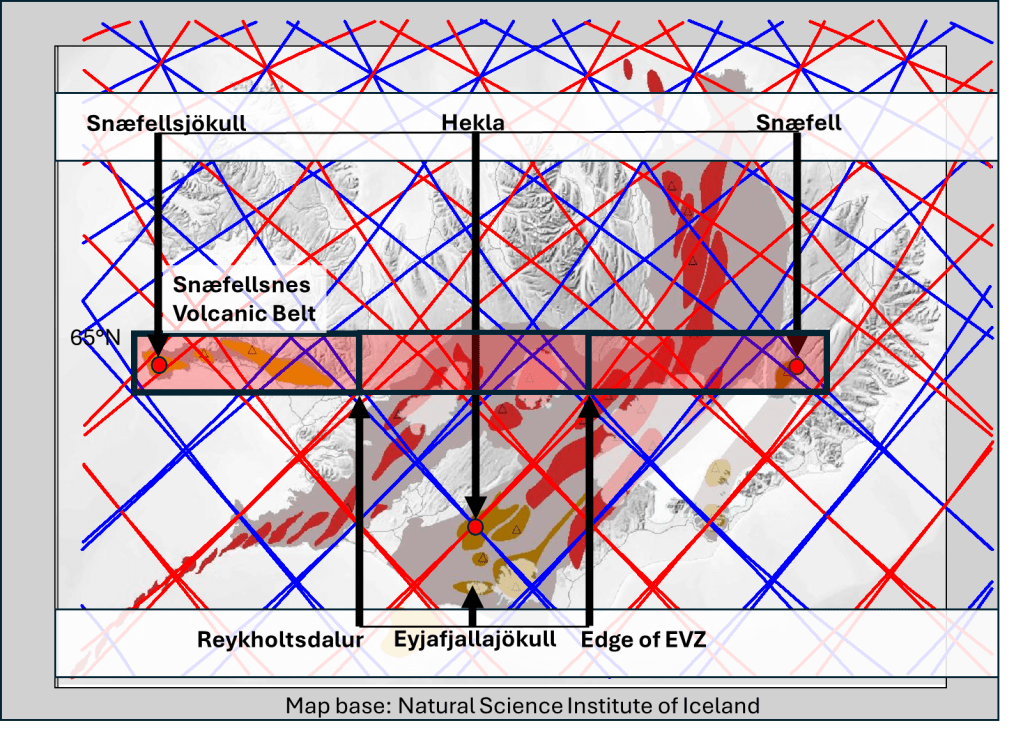
The 64th parallel intersects some of Iceland’s most significant volcanic and geothermal centers, including Hekla, Landmannalaugar, and Öræfajökull, which line up remarkably well along that latitude, about 3° of longitude apart. Let’s now trace the 64th parallel north (64°00′ N) carefully from west to east.


Tracing 64° N, Iceland

1. Western Start — Reykjanes Peninsula (22°–21° W)

The 64th parallel enters Iceland at the southern Reykjanes Peninsula, intersecting the Reykjanes Volcanic Belt, the onshore continuation of the Mid-Atlantic Ridge.

  • Key systems: Reykjanes, Svartsengi, Krýsuvík–Trölladyngja, Brennisteinsfjöll.
  • Geothermal activity:
    • Svartsengi (Blue Lagoon) — high-temperature field exploited for power and bathing.
    • Krýsuvík — intense fumaroles and sulfur deposits along faulted rhyolite ridges near Lake Kleifarvatn.
  • Volcanism: Basaltic fissure eruptions, most recently the Fagradalsfjall events (2021–2024), lie within a few kilometers north of 64° N.

2. Hengill and Hveragerði Region — Western End of SISZ (21° W)

At 64° N, the parallel runs just north of Hveragerði and crosses the Hengill volcanic system, a major geothermal center and the western terminus of the South Iceland Seismic Zone (SISZ).

  • Geothermal:
    • Hellisheiði and Nesjavellir plants utilize the Hengill field; production wells reach >300 °C.
    • Surface features include fumaroles, silica terraces, and mud pots in Hveragerði valley.
  • Tectonics: The SISZ runs eastward from here to Hekla (~19.5° W), spanning roughly 1.5° of longitude, as you noted.
    • It’s a transform zone, accommodating lateral spreading between the Western and Eastern Volcanic Zones.

3. South Iceland Seismic Zone (SISZ) — Between Hveragerði and Hekla (21°–19.5° W)

At 64° N, the line traverses the seismically complex Hreppar microplate.

  • Numerous NNE–SSW strike-slip faults and en-échelon fissures characterize this belt.
  • Though volcanic activity is minimal, earthquakes (M 6–7 historically) are frequent.
  • Geothermal springs occur near Flúðir and Laugarvatn, used locally for heating and bathing.

4. Hekla Volcano (19.7° W)

At precisely 64.00° N, 19.7° W, lies Hekla, Iceland’s most active stratovolcano.

  • Type: Elongate ridge volcano, 1491 m high.
  • Eruptive behavior: Mixed basaltic-andesitic, with both explosive and effusive events; last eruption in 2000.
  • Structure: A central fissure system about 40 km long trending SW–NE.
  • Geothermal: Weak surface manifestation; heat flux mainly magmatic.
  • Relation to SISZ: Marks the eastern terminus of the seismic zone and transition into the Eastern Volcanic Zone (EVZ).

5. Landmannalaugar–Torfajökull Region (18.8°–18.5° W)

Still right at 64° N, this area sits within the Torfajökull volcanic system, a vast rhyolitic caldera overlapping the Fjallabak fissure swarm.

  • Geothermal:
    • Active hot springs, mud pots, and steam vents along the Laugahraun lava and Brennisteinsalda area.
    • Surface temperatures reach >100 °C; deep hydrothermal systems exceed 250 °C.
  • Volcanic features:
    • Rhyolitic domes (Brennisteinsalda, Bláhnjúkur).
    • Mixed eruptions between Torfajökull and Veiðivötn fissure systems (e.g., 1477 AD event).
  • Significance: It’s one of Iceland’s largest silicic geothermal regions, directly intersected by the 64th parallel.

6. Veiðivötn–Bárðarbunga Fissure Swarms (18°–16° W)

Crossing the central highlands, 64° N passes just south of Veiðivötn, part of the Bárðarbunga–Grímsvötn volcanic system.

  • Recent activity: 1477 AD Veiðivötn eruption produced >5 km³ of basaltic tephra; the fissure extends ~100 km.
  • Geothermal: Subsurface high-temperature zones exist beneath Holocene lava fields; limited surface expression due to remoteness.
  • Topography: Alternating lava plains and crater rows — a direct result of fissure rifting at the EVZ’s central axis.

7. Northwest Vatnajökull Margin – Hamarinn & Kverkfjöll (16°–15° W)

Approaching the Vatnajökull ice cap, 64° N crosses areas where subglacial volcanism dominates.

  • Hamarinn (Loki): Central volcano beneath ice, source of jökulhlaups into the Tungnaá and Skaftá rivers.
  • Kverkfjöll (64.7° N, 16.7° W): Slightly north of the parallel but significant. Features:
    • One of Iceland’s most vigorous geothermal fields, extending under the ice margin.
    • Fumaroles, hot ice caves, and sulfur deposits at the ice edge.
    • Heat flow >1 W/m², indicating magmatic heat directly below.
  • Interaction: These subglacial systems release jökulhlaups, linking geothermal processes to glacial hydrology.

8. Öræfajökull Volcano (64.00° N, 16.65° W)

Exactly on the 64th parallel, Öræfajökull forms the southeastern corner of Vatnajökull.

  • Type: Stratovolcano; Iceland’s highest peak, Hvannadalshnúkur (2110 m).
  • Eruptive history: Catastrophic 1362 and 1727 eruptions, both explosive (VEI 5+), with ash fallout across Europe.
  • Geothermal activity:
    • Weak at the surface due to heavy glaciation, but meltwater and hydrothermal alteration indicate subglacial heat flow.
  • Structure: A large caldera, with geothermal vents beneath the ice—likely connected to a shallow intrusive complex.

9. Eastern Termination – Breiðamerkurjökull to Höfn (15°–14° W)

The 64th parallel exits Iceland across the southeast coastal plain and the Vatnajökull outlet glaciers.

  • Geothermal: Minimal visible activity; only low-temperature springs.
  • Volcanic: Ancient subglacial ridges and pillow lavas beneath the sands mark earlier Holocene eruptions under ice.

Uncategorized

Northward Drift and Symmetry of Plate Motion Across Iceland: Insights from ISNET Data

This figure presents the results of ISNET geodetic measurements from the ISN93 and ISN2004 campaigns.

https://www-gamli.lmi.is/wp-content/uploads/2011/09/isnlet2004-skyrsla.pdf

The data clearly indicate that the overall horizontal plate motion across Iceland is directed predominantly towards the north. Furthermore, the velocity field demonstrates that the plate motion in northern Iceland is approximately symmetric with respect to the north–south axis: motion vectors on the Westfjords are oriented toward the northwest, whereas those on the Eastfjords are oriented toward the northeast. The vectors on both sides of the island form nearly identical angles relative to geographic north.

The figure is based on the original measurement data and therefore represents the true directions of crustal motion. The displacement rates were derived using the SOPAC velocity field at epoch 2007.6, under the assumption that the motion at station REYK is equivalent to that observed at LM0082. Consequently, the figure provides a realistic depiction of the current kinematic framework of Iceland.

The magnitude of the plate motion is notably greater than commonly assumed. On the western part of Iceland, the motion typically reaches close to 2.5 cm/yr towards the northwest and the northeast, as shown (see arrow at lower left corner on the map, showing the length of 25 cm in 10 years). On the other hand, the spreading rate between the North American and Eurasian plates—i.e., the rate of divergence across the rift zones—is approximately 2 cm/yr. It is important to distinguish between absolute plate motion and spreading rate: while the total drift relative to a stable reference frame is on the order of 2.5 cm/yr on each side, the divergence between the two plates amounts to roughly half that value. Many descriptions of Icelandic tectonics cite about 1 cm/yr of motion to the west and 1 cm/yr to the east; however, these represent the half-spreading rates rather than the absolute plate velocities observed in geodetic measurements.

https://en.wikipedia.org/wiki/Plate_tectonics

The two different drift trends at the eastern and western sides of Iceland can also be seen on this map from Wikipedia.

Geodetic networks such as ISNET have been instrumental in quantifying this relative motion and in delineating the internal deformation of the island. The observed symmetry in motion across northern Iceland reflects the geometry of the ridge system, with extension distributed among several rift zones and connected by major transform fault systems, including the South Iceland Seismic Zone and the Tjörnes Fracture Zone. These results are consistent with the regional plate-tectonic model and provide refined constraints on the present-day strain field within the Icelandic plate boundary zone.

Uncategorized

Energy Balance of the Earth’s Interior

Introduction

The long-term stability of Earth’s internal temperature presents one of the most fundamental challenges in geophysics. If the mantle behaves adiabatically below approximately 120 km depth, as seismic and experimental evidence suggests, then its temperature should remain nearly constant through time. Under these conditions, the balance between internal heat generation and total surface heat loss must be remarkably precise.

In Earth’s early history, the quantity of radioactive elements such as uranium, thorium, and potassium was significantly higher, producing far greater radiogenic heat than at present. This excess energy would have been released through more vigorous mantle convection, enhanced volcanic and tectonic activity, and greater rates of heat transfer through the lithosphere. The total surface heat flow during that period must therefore have exceeded today’s ~47 terawatts (TW). Although the magnitude of these variations can be estimated from isotopic decay rates and thermal evolution models, the exact contributions of each geological process remain uncertain.

Despite these temporal fluctuations in radiogenic power and heat loss, the average mantle temperature appears to have remained nearly constant throughout Earth’s history. This implies a long-term self-regulating thermal system, in which higher heat production automatically enhances convective and radiative efficiency, maintaining near-adiabatic conditions and preventing significant temperature drift over geological time.

This stability suggests that the Earth’s internal heat budget operates as a closed but dynamic system, governed primarily by the amount and distribution of radiogenic elements and by the efficiency of internal heat transport processes.


Geoneutrino Constraints and Radiogenic Uncertainty

Recent geoneutrino measurements provide valuable insight into radiogenic heat production. These antineutrinos, emitted during the decay of uranium and thorium, allow researchers to estimate total radiogenic power. Current analyses suggest roughly 20 TW of heat is generated radiogenically, but this value carries large uncertainties due to limited detector coverage—most instruments are located on continental crust—and the need to extrapolate mantle contributions from sparse data.

If mantle concentrations of radioactive elements are higher than currently assumed, the true global radiogenic power could approach or even match the 47 TW of measured total surface output. This would reconcile the apparent imbalance between heat production and heat loss. Thus, the prevailing 20 TW estimate should be regarded as a lower bound, pending improved geoneutrino constraints from oceanic and deep-mantle observation sites.


Reconsidering Heat Transport in the Mantle

The conventional model envisions mantle convection as a primarily upward heat-transport system, carrying thermal energy from the interior toward the lithosphere. While this captures the dominant mechanism, it neglects a complementary and critical component: thermal radiation, which can transmit energy in any direction permitted by local gradients, including downward toward the core.

At the extreme pressures and temperatures near the core–mantle boundary, the mantle’s mineral phases cannot retain stable crystalline structures. The intense radiation field continuously destabilizes any emerging crystals, preventing their persistence and leaving the material in a vitreous, radiation-permeable state. Under these conditions, thermal radiation from the overlying mantle can pass almost undisturbed. Consequently, a portion of the mantle’s internal energy, instead of being entirely convected upward, is radiated downward into the core, effectively heating the core from above.

In contrast, convection transfers heat upward through the large-scale motion of mantle material: hotter, less dense regions rise, while cooler, denser regions sink. These convection rolls maintain global circulation and determine the spatial distribution of surface heat flow. Their geometry, wavelength, and coupling between different mantle layers provide the mechanical framework through which this energy is released.

Together, these two complementary processes—radiative transfer downward and convective transport upward—define the mantle’s dual role in Earth’s thermal system. The lower mantle acts as a radiatively transparent medium, facilitating energy exchange between the mantle and core, while the upper mantle remains convectively active, ensuring efficient heat release toward the surface. This dual mechanism explains how the mantle can sustain an adiabatic thermal gradient over geological timescales, maintaining both the activity of the core and the global tectonic system.


Implications for Earth’s Thermal Evolution

If downward-directed radiation continuously supplies heat to the outer core, then the core’s thermal history may be influenced not only by its own decay heat and latent crystallization, but also by a persistent influx from the mantle. This would help maintain the geodynamo over billions of years and explain why the core remains partially molten despite the decline in radiogenic elements.

The result is a self-regulating thermal system: radiative transfer prevents the mantle from cooling too rapidly, while convective circulation stabilizes surface heat loss. The two mechanisms together preserve a long-term thermal equilibrium that is more intricate and stable than models based solely on convection and conduction.

In this framework, Earth’s internal energy balance is dynamically self-sustaining, with the mantle acting simultaneously as the conveyor and the moderator of heat flow. Recognizing the interplay between radiative and convective processes is therefore essential for understanding the persistence of Earth’s internal heat, the endurance of its magnetic field, and the continuing vitality of plate tectonics.

Uncategorized

Rethinking Earth’s Inner Engine: How Convection Rolls Shape the Planet

An Overview

What if Earth’s interior behaves like a system of long, swaying rolls — nested currents that move heat and mass in a planetary circulation? This post explains a holistic model where deep, large rolls in the lower mantle couple to finer rolls in the upper mantle, how heat can flow both ways, why basalt may originate beneath subducting plates, and how the planet’s rotation and curvature set the geometry of everything from mid-ocean ridges to the Ring of Fire.

The Earth as a Layered, Moving System

Most readers know the Earth as a set of layers: crust, upper and lower mantle, outer core, inner core. But these layers are not passive shells. They exchange heat, mass, and momentum through organized flow. The mantle convection rolls model treats the interior as a nested system of rolls — long coherent cells in the lower mantle and smaller, faster rolls in the upper mantle that directly interact with the crust.

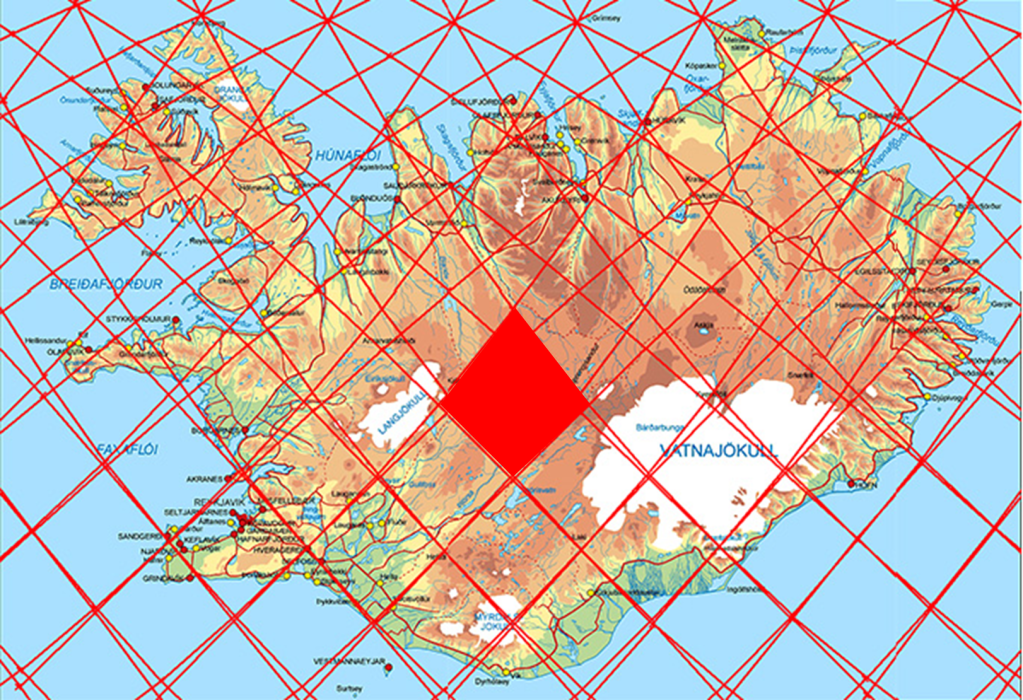
Large rolls operate at depth, slowly moving material between the core–mantle boundary and the base of the upper mantle. Above them, upper-mantle rolls commonly span roughly 1.5° of latitude (a practical scale for near-surface circulation) and are more responsive to lithospheric structure and localized stress. Together they make up a continuous circulation that links the deepest parts of the planet to its outer skin.

Heat Can Be a Two-Way Street

Classical descriptions emphasize heat escaping from the core toward the surface. The convection rolls model adds an important nuance: thermal radiation from radioactive elements found in upper layers heat the core. Rather than purely one-directional cooling, the interior operates with a dynamic thermal exchange — a feedback loop that helps sustain the system’s long-term behavior.

Where Basalt Really Comes From in Subduction Zones

The model revises the common view of arc magmatism. Instead of seeing basalt solely as a product of slab dehydration and consequent melting of the wedge above the slab, the convection rolls framework places the basalt source below the subducting plate. Deep upwelling associated with large rolls can rise beneath the slab and feed volcanism through both plates, making arc volcanism a surface expression of deeper roll-bound flows.

Rotation, Slab Dip, and Global Asymmetry

Earth’s rotation subtly modifies how descending slabs behave: westward-trending slabs are driven steeper into the mantle, while eastward-flowing slabs tend to be pulled out into shallower attitudes. This rotational influence produces systematic, global patterns in subduction geometry and has not been explicitly accounted for in simpler models of slab descent.

Ridges, Rolls, and a Global Geometric Pattern

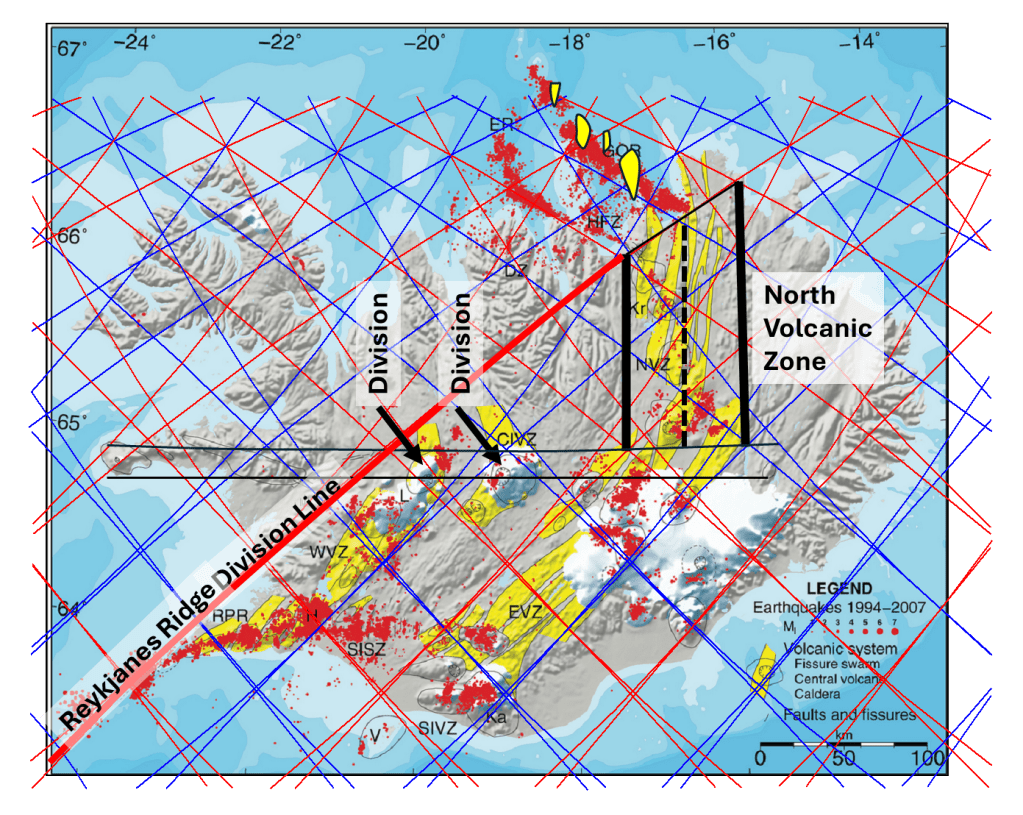
Large mid-ocean ridges are not random. They align with the geometry of underlying rolls. Notably, the Reykjanes Ridge and Juan de Fuca Ridge follow the same formula and appear oriented 90° apart; by rotating one segment 90° they can be connected end-to-end to form a continuous upwelling track. The Mid-Indian Ridge also obeys the same relation. These systematic alignments support the idea that ridges are surface manifestations of deep convection boundaries.

The Curvature Problem — Why Rolls Sway and Why the Latitude of 32° Matters

One of the most important insights of the model is geometric: convection rolls “sway” because of Earth’s curvature. Imagine a roll whose overall horizontal flow is aligned perfectly north–south. On the spherical Earth, the east–west diameter of that roll (measured along a latitude circle) will vary with latitude. There exists a latitude where the east–west span of the roll equals the Earth’s radius when the roll is north–south aligned.

When you project latitude and longitude on a map with equal linear spacing (so that degrees of latitude and longitude represent equal lengths), a roll at that special latitude appears circular. Solving the geometric constraint for Earth gives the remarkable result that the latitude of exact north–south alignment is 32° N and 32° S. In other words, the roll geometry locks into a configuration at ±32° that allows a circular cross-section in that equal-length projection.

Why is this important? If the roll shapes are constrained by this curvature condition, then the entire system of rolls — their position and shape globally — can be derived from that constraint plus the roll spacing and boundary conditions. In practice this means there is a mathematical route to map every convection roll on Earth, leaving no gap in the global circulation. The calculation is nontrivial (a mathematical challenge involving spherical geometry and roll dynamics), but it yields a closed, self-consistent architecture: nested large rolls in the lower mantle and smaller 1.5° rolls in the upper mantle that tile the globe coherently. This solution was explored in the WGC 2020 paper and is a central pillar of the mantle convection rolls model.

A Planet-Wide Circulation System

One of the most intriguing implications of the convection rolls model is that it demonstrates how mantle material can circulate globally, not just vertically.

Because the rolls are continuous and curved along Earth’s spherical geometry, material can move both vertically and horizontally through the system. Starting from a point on the equator, an imaginary particle of mantle material could follow the flow paths around the planet and, after a full cycle, return to the same point.

This means that Earth’s interior is not a collection of isolated convection cells but a closed, interconnected circulation network. Over geological time, this circulation distributes heat and matter across the entire globe, linking distant regions in one coherent system.

Such continuous flow also provides a physical basis for the observed thermal balance of the planet. Global circulation allows heat to move in all directions — upward, downward, and sideways — maintaining a long-term equilibrium between core temperature and surface heat loss. In this way, the mantle convection rolls model not only explains motion but also the stability of Earth’s deep interior over billions of years.

The Gutenberg Layer: A Shared Zone Between Two Worlds

At the base of the mantle, around 2,900 km depth, lies the Gutenberg layer — traditionally described as the mantle-core boundary. Within the convection rolls model, this layer gains new significance.

Mathematically, it represents the intersection zone where the outermost part of the outer-core convection rolls meets the lowermost part of the lower-mantle rolls. Rather than being a simple boundary, it is a common zone shared by both systems — a transition and interaction region that couples two distinct convective domains.

This interpretation provides another alignment between mathematics and measurement: the calculated thickness of the intersection region in the model matches the observed thickness of the Gutenberg layer. It strengthens the plausibility of the model by showing how independent approaches — geometric derivation and seismic observation — converge on the same structural result.

The Gutenberg layer thus functions as a transfer zone, channeling heat and momentum from the core’s deep convection into the overlying mantle rolls. It marks the physical connection point in the great internal circulation engine, where deep energy exchange maintains the planet’s long-term thermal rhythm.

Also, how does deep, ductile mantle reach the surface through a brittle crust? Borrowing an idea from engineering — the Munroe effect (shaped-charge focusing) — the model argues that concentrated stress and heat can create focused upwellings or “jets” capable of piercing the crust. These focused pathways explain how mantle material can erupt or cool near the surface while the larger convection rolls remain intact.

The Ring of Fire as a Secondary, Mathematically Constrained Feature

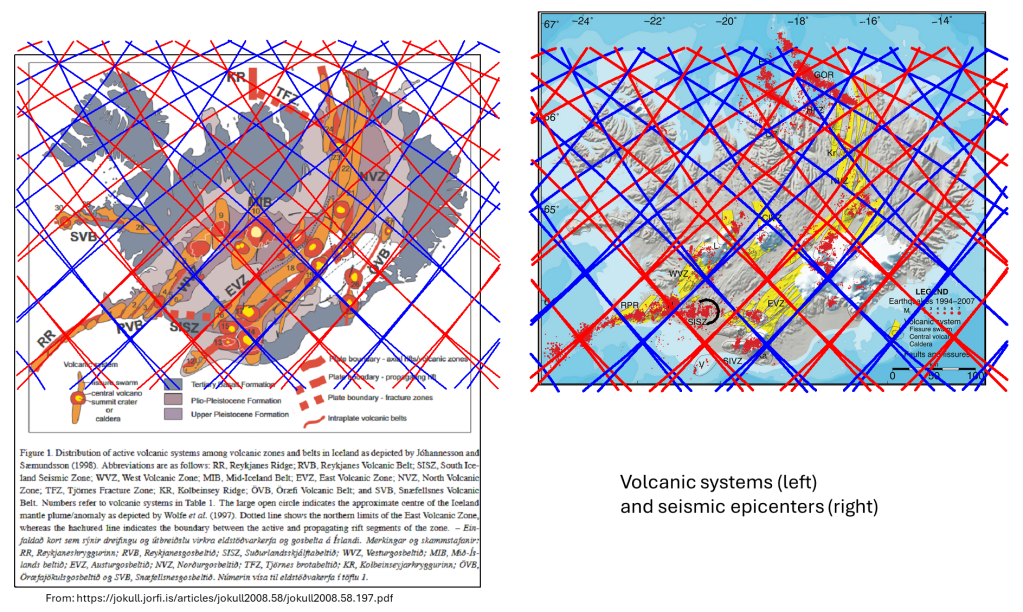
From the roll geometry follow the major division lines between adjacent cells. Where several division branches intersect and curve around basins, an elliptical band of subduction and volcanism is produced — the Ring of Fire. In this model the Ring is not a single primary engine but a secondary feature dictated by the layout of roll boundaries. Key subduction loci (equatorial Indonesia, South America) and important continental tectonic centers (San Andreas, Yellowstone) fall out naturally from the geometry.

Toward a Unified, Testable Framework

Taken together, these ideas form a holistic portrait of Earth as a coherent, circulating system:

  • Nested rolls (deep and shallow) set global and regional patterns.
  • Heat flows both ways and can be focused into pathways that puncture the crust.
  • Basaltic sources beneath subducting plates and rotationally modulated slab dips follow from the same dynamics.
  • The spherical geometry of Earth forces roll shapes to sway and locks the system into a derivable global tessellation — with ± 32° as a key anchor.
  • Circulation through the entire planet maintains long-term thermal balance and explains the core-mantle coupling at the Gutenberg layer.

This framework is intentionally predictive: ridge alignments, slab dips, arc positions, and anomalous volcanic centers are all observable consequences. The mathematical derivation and case studies are discussed in more detail in the WGC 2020 paper and the Stanford 2023 presentation.

References & Further Reading

  • Comparing Large-Scale Geothermally Related Topographic and Bathymetric Features and the Mantle Convection Rolls Model, Stanford 2023.
  • A Comprehensive Model of Mantle Convection Rolls, Proceedings World Geothermal Congress, 2020.