Blog

Uncategorized

Circular aspects of the Ring of Fire

Describing The Ring of Fire according to the map below, the San Andreas Fault and Yellowstone play the main roles. Accordingly, The Ring of Fire covers a rather wide area, mathematically confined. The San Andreas Fault has a section moving continually, as no pressure accumulates due to the fact that the drift direction of the Pacific Ocean Tectonic Plate is exactly parallel to the fault alignment. Just to add one fact, the sliding effect is due to the fact that the Pacific Plate drifts slightly away from the North American Plate at that point, but the North American Plate moves towards the point, so the combined result is a smooth, perpendicular meeting point. This is the most important thing to understand in an attempt to understand the preconditions of the Ring of Fire.

Yellowstone is therefore also a key point of the Ring of Fire. For a manifistation of that statement, we should have a look at a basic geological map of the Yellowstone Caldera:

Calderas tend to be regular, and therefore an elliptical form is used to aproximate the outlines of Yellowstone. Then the major and minor axis of the ellipse become apparent, and they are perpendicular and parallel, respectively, to the edge of the Ring of Fire at that location. The minor is aligned in the same way as San Andreas Fault. It is not necessary to add a detailed map of San Andreas Fault complex here, because everyone knows that it is logically parallel to the Ring of Fire.

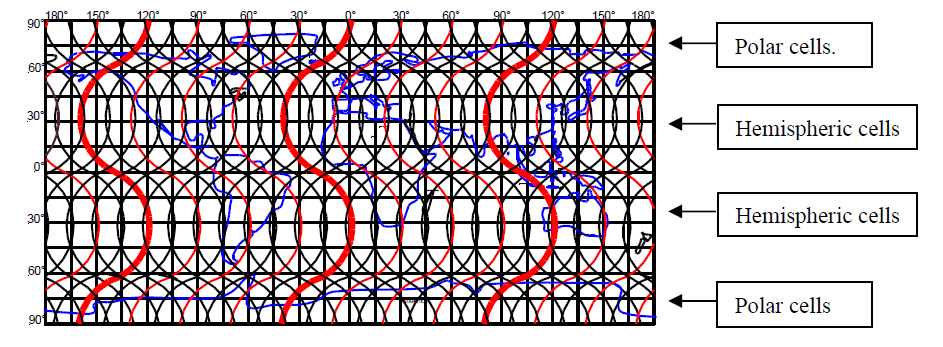
Taking this a bit further, the Pacific Tectonic Plate drifts as a whole in one direction. On the contrary, the adjacent plates of America and Eurasia rotate towards the Pacific. The Ring of Fire also includes other plates than the Pacific Ocean Tectonic Plate, as it is defined. Other factors determine its scope too, and there we have the pattern shaped by convection rolls. The different layers of rolls have intersection points, coinciding with the outer and inner edges of the Ring of Fire. That provides the mathematical base for the elliptical form of the Ring of Fire. The way to realize this is simply to trace the two concentric yellow ellipses marking the Ring of Fire, and see how many intersection points each of them coincide with. The width of the Ring of Fire therefore always remains mathematically the same in proportion with the grid formed by latitudes and longitudes.

This description of the Ring of Fire is presently of a secondary nature, because first you have to have knowledge about the Mantle Convection Rolls Model, and then about the Ring and Fire and how it is related to the said model. Besides that, the tectonic drift vectors are not always presented as on the map above. A solid reference frame, and a view from space with GPS should describe tectonic drift in the best way. And it should be noticed that Yellowstone, according to this analysis, is a part of the Ring of Fire. More about this in my paper: https://pangea.stanford.edu/ERE/db/GeoConf/papers/SGW/2024/Thorbjarnarson.pdf

Uncategorized

Prolonged Dyke on the Reykjanes Peninsula

April first, 2025, the dyke responsible for the recent eruptions got active again. New intrusion of magma resulted in an extension to the north-east. It was a surprise, but the alignment can be explained according to the framework of convection rolls underneath.

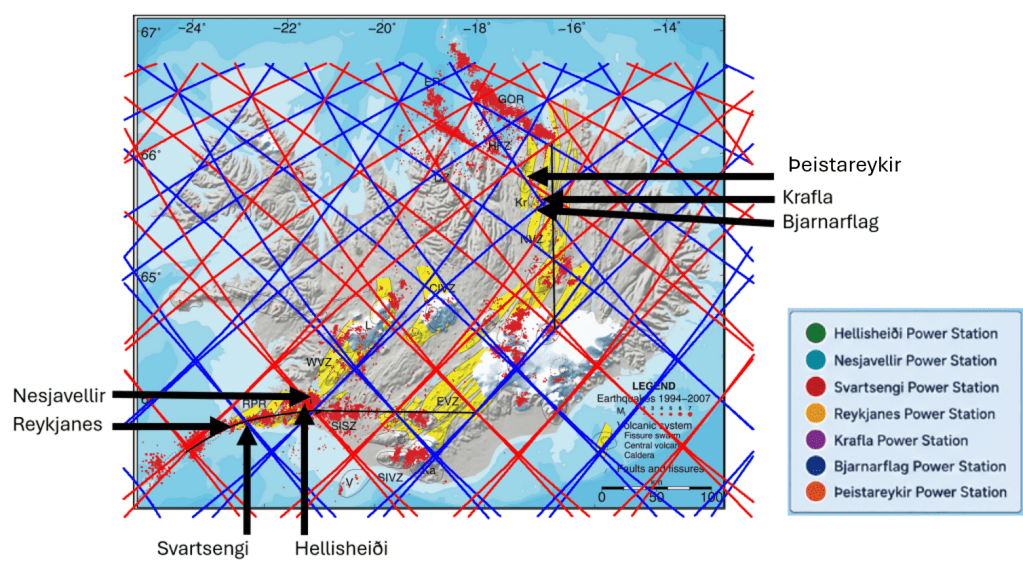
By showing the context this becomes understandable. The elongation of the dyke took place within an area outside the seismic zone of Reykjanes. The central axis of the seismic zone is marked with a black line, connecting with the straight black line representing the South Iceland Seismic Zone (SISZ). The north-south oriented earthquake faults of the Reykjanes Oblique Zone affect the orientation of the aggregate of focal loci at the southernmost end of the whole dyke. The longer, and new section of the dyke follows the surrounding framework exactly. The tectonic drift vectors can not explain the orientation, but local tension is coherent with the shape of the polygon marked with red lines. The Reykjanes Ridge is responsible for the bending of the Reykjanes Oblique Zone. When it comes to the SISZ, the axis is unafected by the ridge within the polygon, so the central axis becomes a straight line. The same features are found in the Borgarfjörður region of West Iceland.

Uncategorized

The Mantle Convection Rolls

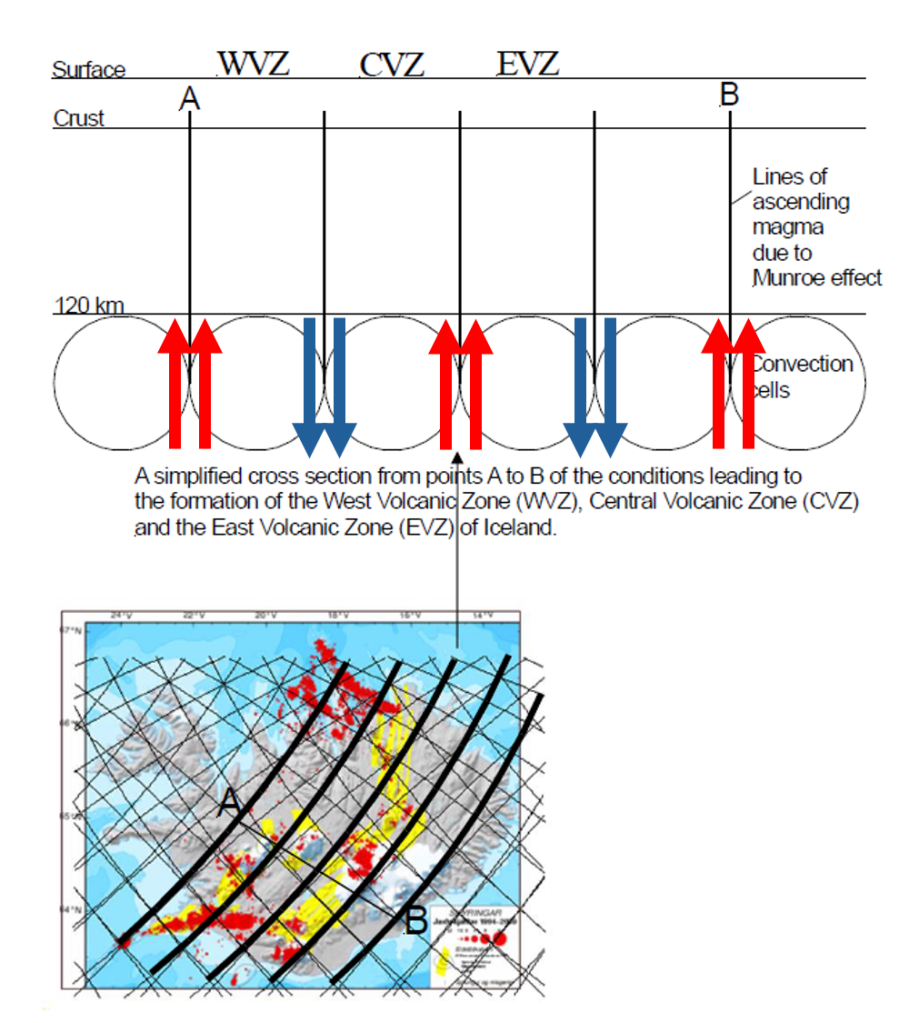
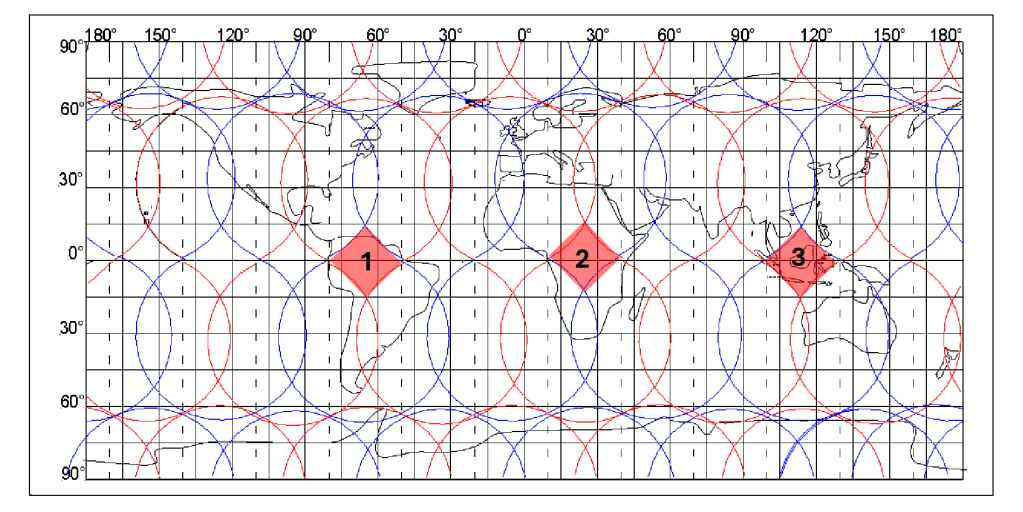
Geology can be difficult to comprehend, and there are many examples of misunderstanding the basic principles behind the processes gradually changing our planet. It is generally acknowledged that we still have a scientific frontier when it comes to tectonic drift, explaining location of volcanoes, geothermal areas and seismic zones. Here, an attempt is made to solve the problem and explain many of the remaining questions by analyzing the currents within the mantle. A few things are generally known, because they can be measured with confidence. That includes the thickness of layers, or depth of discontinuities, and the chemical properties of the mantle. We also know that the thermal gradient is adiabatic below 120 km depth. It is found that above 120 km the mantle does not flow, no convection takes place there. On the contrary, below 120 km convection does take place. As the thermal gradient is adiabatic, the mantle material is always on the verge of becoming stagnant. These conditions can be imitated in laboratories, and it is then discovered that the convection leads to formation of convection rolls, with the same height and width. This can be used to make a model of convection rolls within the Earth. The rotation of the Earth must be considered, but there are ways to do that according to physics, and thereby the location of convection rolls can be found. After doing this, surface features can be compared to the modelled convection rolls, and it turns out that everything fits. All over the world, volcanoes, geothermal sites, seismic zones, subduction zones and other features can be readily explained. This means that in the future, utilization of various resources will become much more systematic than today. This will improve our understanding of tectonics and the basic forces leading to tectonic drift. And it is easy in a way, because the convection rolls have been located very accurately. The different layers affect each other, and the surface, often in ways that makes it difficult at first to see the relationship between cause and effect. But with the comprehensive version of the model at hand, the role of each layer can be studied. With the three papers already published, examples about mid-ocean ridges, subduction, volcanic zones and seismic areas have been provided. Just take the time to learn what our planet is like. Icelandic geology made it possible to start this job, because Iceland is like a natural laboratory. Global aspect is also important, though, and by combining knowledge about the Earth in general and Iceland in particular, the publication of these papers could be realized.

Uncategorized

Nine famous sites along a Reykjanes Ridge Roll

The Reykjanes Ridge is the most prominent geological feature of Iceland. Extrapolating its main trend along the middle of the Atlantic Ocean, it is found that most of the famous spas in Iceland are found at the edges of the two lines marking its location.

Looking into this more closely, the Blue Lagoon is found on a line perpendicular to the convection roll. Krauma of Deildartunguhver, the most powerful hot spring in the world, is found on crossings of a small polygon. The new Forest Lagoon near Akureyri is also on a perpendicular line, and the same is true for Geosea of Húsavík. At the other side of Geosea is the Myvatn Nature Baths site, and in the center of the country, Hveravellir is found near the upper convection roll extending from the north. Geysir is found just outside the realms of the roll, but on a perpendicular line. Laugarvatn is located directly ong the line, and Reykjadalur on the main crossings.

This is amazing

The eastern edge of this area can be traced most easily. From the coastline to Reykjadalur the so-called Hlíð marks its edge. But the northern ridge is shaped along a different pair of convection rolls, which happens to coincide with the Reykjanes pair at the 64th parallel. Then we get this drawing:

It fits even better to many of the geothermal sites, except the Myvatn Nature Baths, of course. These two pairs form the two ridges south and north of Iceland. At the latitude where the effect of those two is combined, the division line of drift shifts eastwards.

And the tenth area should be pointed out, namely Skagafjordur and the Fljot area of northern Iceland. Fissures associated with the Kolbeinsey Ridge are found on land, and that supports the idea that convection rolls creating the ridges are found at these locations underneath Iceland.

To understand better the relationship between the two ridges, and the two relevant pairs of convection rolls, one has to learn about the intersection zone of Iceland. The Reykjanes Ridge pair is the upper most one south of Iceland, but is subducted at the latitude of Iceland. The pair for Kolbeinsey Ridge is found just below the 120 km discontinuity.

This is not to be confused with subduction of the crust, as the southern convection rolls are overlaid by the northern ones around the 64th parallel. The section is shown here:

The terms, MORB-hemispheric and MORB-polar describe the Reykjanes Ridge and Kolbeinsey Ridge pairs of mantle convection rolls, respectively.

Uncategorized

Theoretical Distribution of Volcanic Activity in Iceland

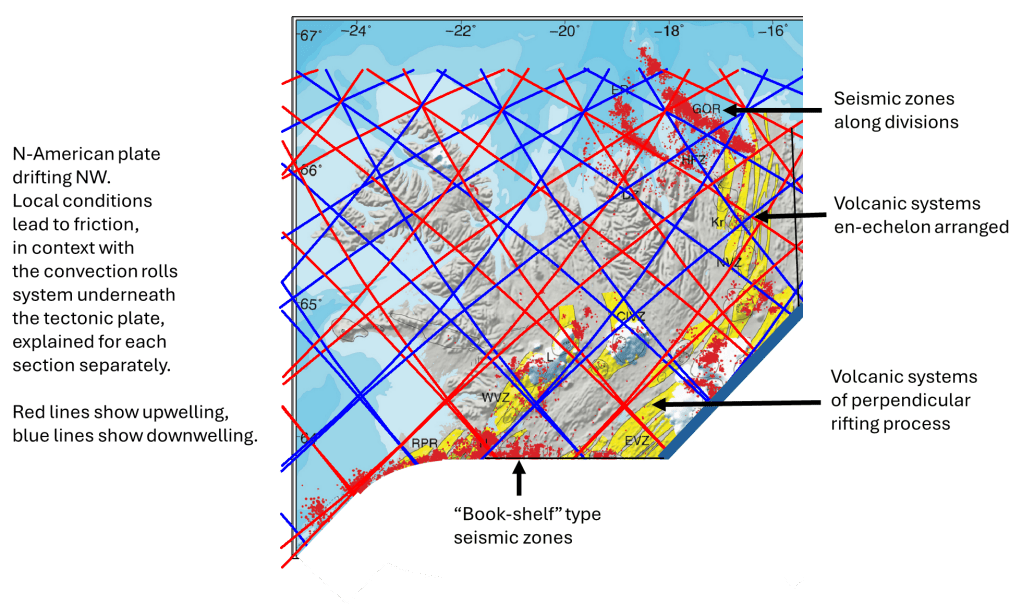
Three factors can be pointed out when looking at the basic features of Iceland. First, the ridges south and north of the country, second, the volcanic zones, third, the elliptical abyss around it. The elliptical form is disrupted by the two ridges, and the said two ridges are not connected due to the fact that a main volcanic zone, called the East Volcanic Zone (EVZ) appears 3° farther to the east than the Reykjanes Ridge. Theoretically, the two ridges can be extrapolated to a central point of Iceland. Doing so, the point where the join each other appears to be the central point of the elliptical form of the abyss.

The drawing, superimposed on a Google Map and a map with basic information about the volcanic zones, shows this quite clearly in a very simple way. The volcanic zones are marked red with a degree of tranparency, and theoretical extrapolation of ridges with yellow line. This mathematical outline of the Icelandic geological framework is of course quite unique, but can all the same be compared with a range of mathematical coherence in other areas. The distribution of land mass and ocean along equator is probably the most amazing mathematical sequence, where 30° separate the main features repeatedly. This can be explained according to the Mantle Convection Rolls Model, as the convection rolls follow mathematical rules and affect the surface accordingly.