
The tectonic structure surrounding Iceland can be viewed as the interaction of four related but distinct components. These are: (1) the mantle convection-roll system and its regularly spaced flow lines, (2) the overlap zone between the equatorial and polar parts of that system, expressed particularly through the Greenland–Iceland–Faroe Ridge Complex, (3) the large tectonic ellipse surrounding the Icelandic shelf, and (4) the active ridge–transform–volcanic-zone system that transfers plate separation through Iceland.

These components should not be regarded as different descriptions of the same structure. Each appears to have a different geometrical and tectonic function. The convection-roll system defines large-scale mantle-flow trajectories; the overlap zone creates a special structural domain around Iceland; the tectonic ellipse appears to delimit a region in which ridge behaviour changes; and the active volcanic and transform zones accommodate the actual plate separation through Iceland.
Taken together, these four elements provide a coherent geometrical framework for the unusually complex tectonics of Iceland and its surrounding oceanic ridges.
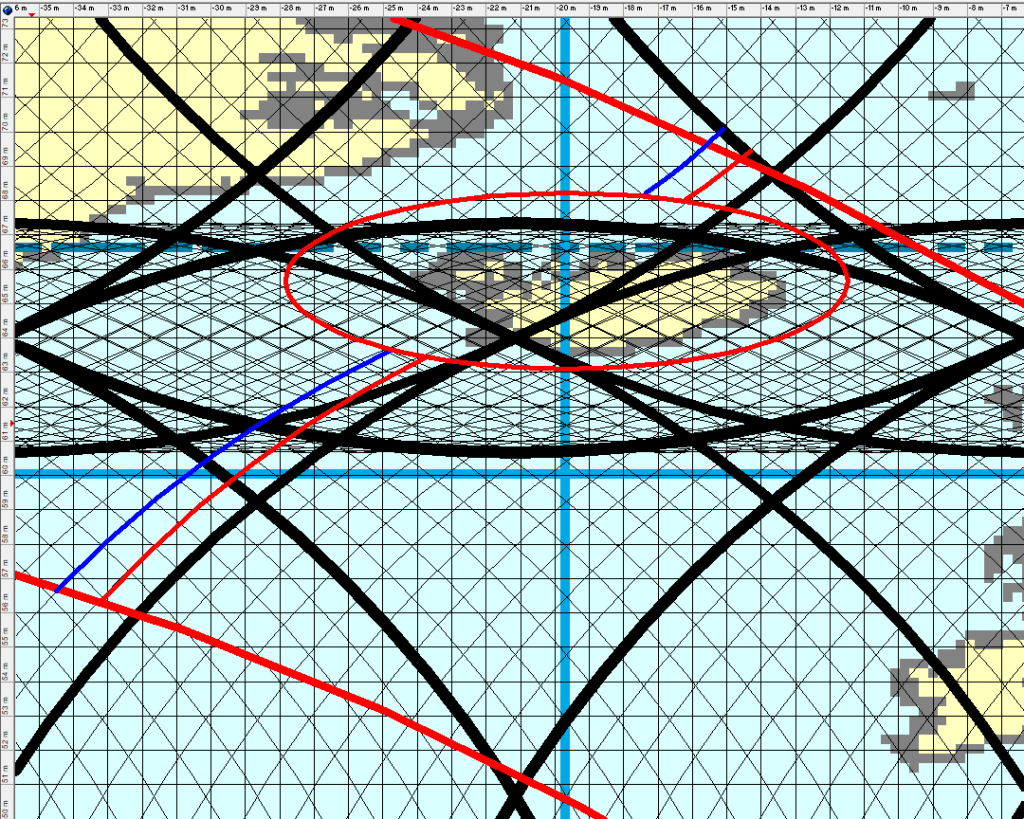
compared with the convection-roll system and the elliptical form of the Icelandic Plateau.
1. The Mantle Convection-Roll Framework
In the convection-roll model, tectonic structures are related to regularly spaced mantle-flow trajectories described by circular equations. Two sets of equations are important in the Iceland region.
The equatorial system is represented by:
[(x-C_n)^2+(y-32)^2=35.34^2]
whereas the polar system is represented by:
[(x-C_n)^2+(y-96)^2=35.34^2]
The values of (C_n) occur at intervals of approximately 1.5°. Consequently, the system consists not merely of individual lines but of repeated 1.5°-wide flow domains, each of which can be regarded as containing an upwelling side and a corresponding downstream or descending side.
This distinction is important when considering the oceanic ridges north and south of Iceland. A ridge axis does not necessarily have to coincide exactly with the calculated upwelling line. Instead, the ridge may occupy a particular position within the flow cell and may migrate laterally across it. The Reykjanes and Kolbeinsey ridges provide a striking example, as south of Iceland, the relevant upwelling trajectory is represented by approximately
[C_n=-7.66]
whereas the adjacent downstream line lies at
[C_n=-9.16]
North of Iceland the corresponding pair is
[C_n=-37.66]
and
[C_n=-39.16]
The difference is 1.5° in both cases. Furthermore, the northern and southern corresponding trajectories are separated by exactly 30°:
[-37.66-(-7.66)=-30^\circ]
and
[-39.16-(-9.16)=-30^\circ]
Thus, the two oceanic ridge systems occupy equivalent positions within two geometrically corresponding mantle-flow domains.
This suggests that the relevant tectonic unit is not simply the individual upwelling line but the entire convection-roll cell.
2. The Polar–Equatorial Overlap Zone and the Greenland–Iceland–Faroe Ridge
The second component is the overlap between the equatorial and polar parts of the convection-roll system.
The two equation families intersect systematically around 64°N. Their corresponding upwelling trajectories meet near approximately 64°N, 22.7°W, while the associated downstream trajectories meet approximately 1.5° farther west, near 64°N, 24.2°W. This creates a structurally distinctive overlap zone around Iceland.
The Greenland–Iceland–Faroe Ridge Complex appears to be particularly closely related to this geometry. The Greenland–Iceland Ridge to the west and the Iceland–Faroe Ridge to the east together define a broad WNW–ESE to E–W transverse structure across the North Atlantic. Their orientation differs fundamentally from the approximately N–S to NE–SW orientation of the active Mid-Atlantic spreading system.
This transverse ridge system can therefore be interpreted primarily in relation to the overlap of the equatorial and polar convection-roll systems. The Greenland–Iceland–Faroe Ridge should consequently not be treated simply as an extension of the active spreading ridges. It represents a different structural element. The overlap zone provides a possible explanation for why the Iceland region contains an anomalously broad and thickened crustal domain crossing the otherwise longitudinal Mid-Atlantic spreading system.
In this interpretation, the Greenland–Iceland–Faroe Ridge Complex is primarily associated with the interaction between two large-scale mantle-flow systems, whereas another geometrical feature—the Icelandic tectonic ellipse—controls the outer extent of a somewhat different tectonic regime.
3. The Tectonic Ellipse Surrounding Iceland
The third component is the large ellipse surrounding the Icelandic shelf. This ellipse should be distinguished from the mantle-flow trajectories themselves. Its centre is not located at the polar–equatorial intersection around 64°N and 22–24°W. Instead, the central tectonic point associated with the Icelandic shelf ellipse lies near approximately 65.6°N, 19.7°W.
The flow-line intersections then describe the geometry of the convection-roll system, whereas the shelf ellipse appears to define a tectonic domain surrounding Iceland. Iceland lies between an inner and an outer elliptical boundary. The Greenland–Iceland–Faroe Ridge crosses this domain approximately along its WNW–ESE structural orientation, but the most revealing evidence for the significance of the ellipse may be found where the active oceanic spreading ridges cross its northern and southern margins.
At both locations, the character of the ridge system changes, and this suggests that the ellipse may function as a tectonic regime boundary rather than simply describing the shape of the Icelandic shelf.
Outside the ellipse, the oceanic ridges can follow mathematically regular convection-roll trajectories for considerable distances. Inside it, the geometry becomes more complex. The spreading system divides into oblique volcanic zones, transform zones and multiple active rift axes. The ellipse therefore appears to mark the transition between two different modes of tectonic organisation.
4. Reykjanes Ridge: Entry into the Icelandic Tectonic Domain
Southwest of Iceland, the Reykjanes Ridge follows the mantle-flow geometry over a long oceanic distance.Its position is related to the flow domain between (C_n=-7.66) and (C_n=-9.16). The former represents the calculated upwelling trajectory, while mantle flow within the model is directed westward across the cell toward the latter.
An important feature of the southern Reykjanes Ridge is that the ridge axis itself shows a tendency to migrate westward within this flow domain. Instead of remaining strictly centred on the upwelling trajectory, it approaches the downstream side of the cell. Near the inner boundary of the tectonic ellipse, this behaviour becomes particularly important.
The ridge changes orientation. The more regular oceanic ridge system gives way to the oblique spreading structure that continues toward Iceland as the Reykjanes Oblique Rift and the volcanic systems of the Reykjanes Peninsula. The change is therefore not merely a bend in an otherwise uniform ridge.
It represents a transition from an oceanic ridge following a relatively regular mantle-flow trajectory into the more complicated tectonic regime surrounding Iceland.
Farther northeast, plate separation is transferred through the South Iceland Seismic Zone. This approximately E–W transform-related zone links the western volcanic systems to the active volcanic zones farther east. The sequence can therefore be expressed schematically as:
Reykjanes Ridge → elliptical boundary → Reykjanes Oblique Rift → South Iceland Seismic Zone → Eastern Volcanic Zone.
An important point is that the physical transition is not necessarily confined to a single sharp line. Changes in ridge morphology, crustal thickness, magmatic productivity and tectonic structure occur over a substantial distance. The ellipse may therefore identify the boundary of a broader transition zone rather than a single mechanical discontinuity.
5. Kolbeinsey Ridge: The Northern Equivalent
A remarkably similar relationship occurs north of Iceland. Much of the Kolbeinsey Ridge can be approximated by the polar-system trajectory with
[C_n=-39.16]
This is particularly significant because (-39.16) is not the calculated upwelling line. The corresponding upwelling trajectory lies one flow interval farther east, at approximately
[C_n=-37.66]
Thus, the Kolbeinsey Ridge occupies a position toward the downstream side of the same type of 1.5° mantle-flow cell seen south of Iceland. In this respect, the Kolbeinsey Ridge appears to display over much of its length the same tendency that becomes particularly clear on the southern Reykjanes Ridge: the spreading axis is displaced westward from the calculated upwelling trajectory toward the downstream part of the convection-roll cell.
As the Kolbeinsey Ridge approaches Iceland, however, its behaviour changes. Near the northern boundary of the Icelandic shelf ellipse, the ridge begins to assume a much more nearly N–S orientation. It subsequently enters the complex Tjörnes Fracture Zone, through which plate separation is transferred eastward into the Northern Volcanic Zone.
The northern sequence is therefore broadly comparable to the southern one:
Kolbeinsey Ridge → elliptical boundary → near-N–S ridge segment → Tjörnes Fracture Zone → Northern Volcanic Zone.
The correspondence is particularly important because the observed change at the northern elliptical boundary is not restricted to geometry. Geochemical studies along the Kolbeinsey Ridge indicate changes in mantle-source and basaltic characteristics in this general region. The Iceland-related geochemical influence decreases northward, and changes occur between the southern Kolbeinsey Ridge and the more northerly ridge segments toward the Jan Mayen region.
Thus, whereas the southern elliptical boundary is expressed very clearly through a change in ridge orientation and tectonic style, the northern boundary may be expressed particularly strongly through petrological and geochemical changes. The manifestations are different, but both indicate a change in tectonic regime.
6. The Transform Zones as Lateral Transfer Systems
The South Iceland Seismic Zone and the Tjörnes Fracture Zone occupy corresponding positions within the overall system. Neither is simply a continuation of an oceanic ridge, instead both transfer plate separation laterally between offset spreading systems.
In the south, the Reykjanes system is connected through the South Iceland Seismic Zone to the volcanic zones farther east, but in the north, the Kolbeinsey system is connected through the Tjörnes Fracture Zone to the Northern Volcanic Zone. This creates an approximate large-scale symmetry:
South:
Reykjanes Ridge → oblique volcanic belt → SISZ → Eastern Volcanic Zone
North:
Kolbeinsey Ridge → oblique/fractured transition → TFZ → Northern Volcanic Zone
The geometry is quite symmetrical. Both transform zones perform the same fundamental function: they allow oceanic spreading axes outside the Icelandic shelf domain to connect with the displaced volcanic axes within Iceland.
7. The Northern and Eastern Volcanic Zones as the Internal Connection
The Northern Volcanic Zone and Eastern Volcanic Zone complete the system. Once the oceanic spreading axes enter the Icelandic tectonic domain, their plate-separation function is no longer carried by one continuous Mid-Atlantic ridge axis. Instead, spreading is distributed between volcanic zones and transform systems.
The Northern Volcanic Zone receives the plate-boundary displacement transferred through the Tjörnes Fracture Zone, and the Eastern Volcanic Zone receives a substantial part of the displacement transferred eastward across South Iceland. Together, these volcanic zones form the active internal connection between the northern and southern oceanic ridge systems.
The resulting geometry can be represented as a large tectonic pathway:
Kolbeinsey Ridge
Tjörnes Fracture Zone
Northern Volcanic Zone
Central Icelandic tectonic domain
Eastern Volcanic Zone
South Iceland Seismic Zone / Reykjanes system
Reykjanes Ridge
The Mid-Atlantic plate boundary therefore remains continuous in a kinematic sense, although its surface expression changes profoundly when it enters the Icelandic elliptical domain.
8. Four Components, Four Different Functions
The resulting model becomes clearer if the four components are assigned distinct functions.
1. The convection-roll system
This defines the large-scale mantle-flow geometry. Outside the Icelandic shelf domain, both the Reykjanes and Kolbeinsey ridges follow corresponding convection-roll cells for long distances and can therefore be approximated mathematically.
2. The polar–equatorial overlap zone
This produces a special mantle-structural domain around Iceland. The Greenland–Iceland–Faroe Ridge Complex appears to be particularly strongly related to this overlap and its WNW–ESE transverse geometry.
3. The Icelandic tectonic ellipse
This defines the region within which tectonic behaviour changes. At its margins, the relatively regular oceanic ridge system begins to reorganise. South of Iceland this is expressed especially clearly by changes in ridge orientation and physical structure. North of Iceland the transition is also reflected in petrology and mantle-source characteristics.
4. The volcanic and transform system within Iceland
This accommodates active plate separation inside the elliptical domain.
The Reykjanes Oblique Rift, South Iceland Seismic Zone, Eastern Volcanic Zone, Northern Volcanic Zone and Tjörnes Fracture Zone together replace the simpler ridge-axis geometry characteristic of the surrounding ocean basin.
9. A Coherent Tectonic Interpretation
Seen in this way, Iceland is not simply an enlarged section of the Mid-Atlantic Ridge, nor can its structure be explained by one geometrical feature alone. The oceanic ridges north and south of Iceland show a long-distance relationship with calculated mantle convection-roll trajectories. Their axes may be displaced within individual flow cells, particularly toward the downstream side, but their overall geometry remains mathematically recognisable.
When these ridges approach the Icelandic shelf ellipse, however, their behaviour changes. The Reykjanes Ridge changes orientation and enters the oblique Reykjanes volcanic system before plate motion is transferred through the South Iceland Seismic Zone.
The Kolbeinsey Ridge changes toward a nearly N–S orientation and enters the Tjörnes Fracture Zone before connecting with the Northern Volcanic Zone. Within Iceland, the Northern and Eastern volcanic zones maintain the active spreading connection. Crossing this approximately N–S active plate-boundary system is the Greenland–Iceland–Faroe Ridge Complex, which appears to belong primarily to another component of the model: the overlap between the polar and equatorial convection-roll systems.
The tectonic ellipse then provides the larger boundary within which these different structural systems interact. The resulting picture is therefore hierarchical rather than based on a single tectonic cause:
mantle convection-roll geometry provides the regional framework;
the polar–equatorial overlap produces the transverse Greenland–Iceland–Faroe structural domain;
the tectonic ellipse defines the Icelandic regime boundary;
and volcanic zones and transform belts accommodate active plate separation within that boundary.
This arrangement also explains why the Reykjanes and Kolbeinsey ridges can be mathematically predictable over long oceanic distances while becoming structurally much more complicated as they enter the Icelandic region. The mathematical mantle-flow geometry remains present, but within the tectonic ellipse it interacts with a second-order regional structure that redistributes spreading into volcanic zones, oblique rifts and transform systems.
In this interpretation, the unusual tectonics of Iceland are not an exception to the larger mantle-flow geometry. Rather, Iceland represents a region where several geometrical and tectonic systems overlap, and where their interaction becomes visible at the surface.


