
The African Plate is characterized by several unusually long boundary segments with predominantly N–S or E–W orientations. To the north it is bounded by the Mediterranean region, to the west by the Mid-Atlantic Ridge system, to the east by the East African–Red Sea tectonic system, and to the south by the Antarctic Plate. Within the geometrical framework considered here, these boundaries can be analysed as a sequence of segments related either to the mantle-convection-roll division system, to the elliptical boundaries of the tectonic rings, or to transitions between the two.
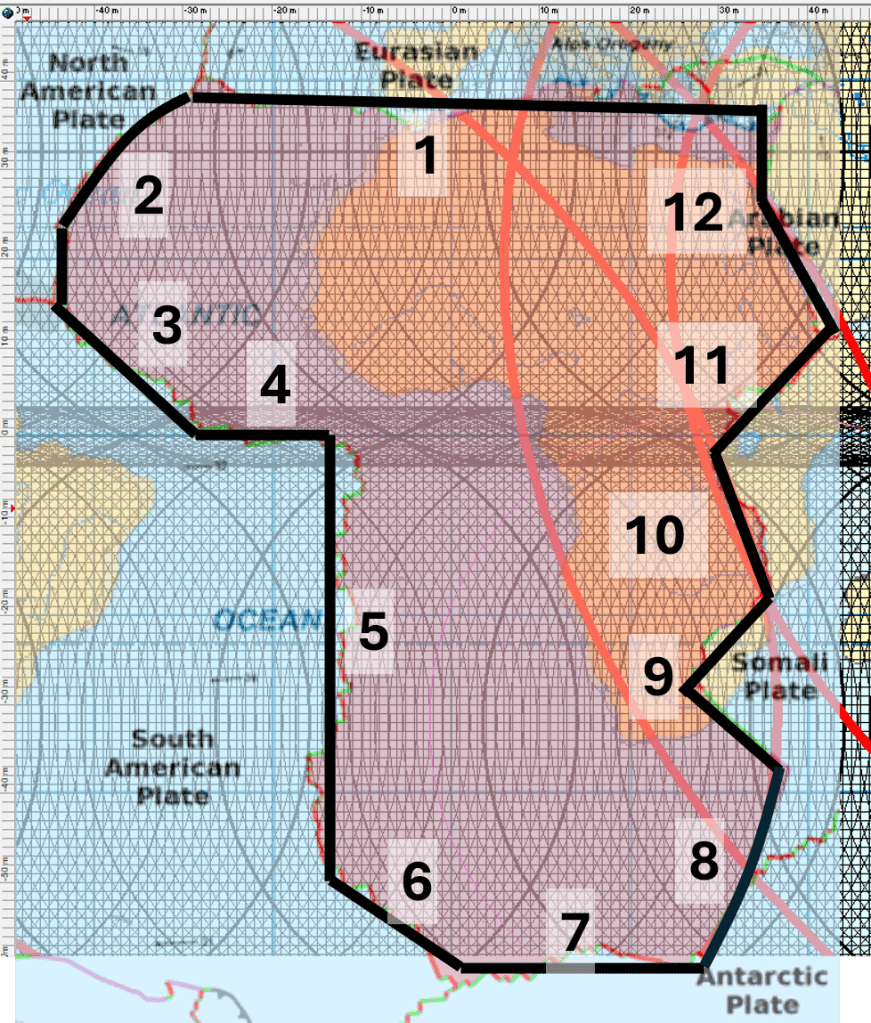
1. The Mediterranean and the Gibraltar sector
The Mediterranean plate-boundary system has a pronounced E–W orientation, and this general direction continues westward through the Gibraltar region into the Atlantic, along the boundary between Africa and Eurasia. The endpoints of this broad E–W system are not regarded here as arbitrary. Its eastern end is located close to a major lower-mantle convection-roll division north of the northern end of the Red Sea, while the western end approaches an important N–S axis in the Atlantic. The Mediterranean system can therefore be viewed, in this model, as an E–W connection between two larger N–S structural elements.
2. Transition to the next N–S axis
The boundary then connects with the next major N–S structural axis farther west. Part of this section has a pronounced N–S component before reaching the plate-boundary system extending from the Caribbean region into the central Atlantic. The longitudinal separation between the principal structural lines is approximately 15°. This 15° spacing is important within the convection-roll model because it represents a secondary subdivision of the larger lower-mantle geometry.
3. Southeastward segment
The next section trends toward the southeast, approximately parallel to the calculated direction of the convection-roll system. Again, the longitudinal displacement is about 15°, but in this case the shift is from west to east. The bend occurs approximately on the same longitude as the transition between Sections 1 and 2, producing a repeated geometrical relationship between the major N–S axes and the oblique plate-boundary segments.
4. Equatorial E–W segment
At the equator, the boundary turns into an almost directly E–W segment. This part extends for approximately 15° of longitude. Its position directly along the equatorial reference line makes it particularly significant in the convection-roll framework, in which the equator provides the simplest geometrical expression of the major and subsidiary mantle divisions.
5. Long N–S oceanic boundary
A particularly long section of the African Plate boundary then trends approximately N–S. This segment follows a calculated central line within the convection-roll system, located midway between two principal lower-mantle division lines. It is therefore not associated directly with one of the major lower-mantle boundaries, but with the geometrically defined centre of the interval between them.
6. Southeastward turn toward the Antarctic triple-junction region
The boundary then turns toward the southeast, continuing to the region where the South American, Antarctic and African plates meet. Within the convection-roll model, this junction is also located close to an intersection of major lower-mantle division lines. The plate triple junction and the calculated mantle intersection therefore occupy approximately the same structural region.
7. E–W boundary toward the Atlantic ellipse
From this intersection, the plate boundary again assumes an approximately E–W orientation. It extends from the lower-mantle convection-roll intersection toward the inner elliptical boundary of the Atlantic tectonic ring. This section therefore forms a direct geometrical link between the convection-roll framework and the younger elliptical tectonic system.
8. Along the inner Atlantic ellipse
The boundary then turns toward the NNE and follows the inner ellipse of the Atlantic tectonic ring for a considerable distance. Here the elliptical geometry becomes the dominant structural relationship. This is an important contrast with the preceding sections, where the plate boundary was more closely associated with the convection-roll divisions.
9. Excursion into the African continent
Farther north, the boundary bends into the African continent before turning back toward the inner Atlantic ellipse. It returns to the region where the inner Atlantic ellipse and the inner ellipse of the Indian Ocean tectonic ring approach one another and become closely associated. This is the same broad geometrical interaction zone discussed in connection with the East African Rift and Lake Malawi.
10. African–Somali Plate boundary
Along this section, the boundary of the African Plate coincides with the boundary of the Somali Plate. The plate boundary occupies the narrow region associated with the two inner tectonic ellipses. This section is therefore especially important because the same geometry can be analysed from either side: as the eastern boundary of the African Plate or as the western boundary of the Somali Plate.
11. From the inner to the outer Atlantic ellipse
Farther north, the plate boundary leaves the inner Atlantic-ring boundary and crosses toward the outer Atlantic ellipse. Its orientation corresponds approximately to the direction of the underlying convection-roll system. The segment terminates at the Afar Triple Junction. This provides another clear example of a plate boundary transferring between two elements of the model: inner tectonic ellipse, convection roll alignment, outer tectonic ellipse.
12. The Red Sea
From Afar, the boundary continues northward along the Red Sea. In the present geometrical interpretation, the Red Sea follows the outer ellipse of the Atlantic tectonic ring. Near its northern end, the boundary develops a more pronounced N–S orientation, marking another transition between the elliptical tectonic geometry and the principal directional structure of the convection-roll system.
The African Plate as a large-scale geometrical structure
The African Plate provides a particularly useful continental-scale example because its boundary includes several fundamentally different types of tectonic environment: mid-ocean spreading ridges, continental rifts, convergent margins and complex transition zones. Despite these differences, the boundary can be divided into a sequence of relatively simple geometrical segments. Some are predominantly N–S or E–W, some follow calculated convection-roll divisions or intermediate lines, and others follow the inner or outer ellipses of the Atlantic and Indian Ocean tectonic rings.
A recurring feature is the approximately 15° longitudinal spacing between several major structural elements. The boundary repeatedly shifts from one such element to another before continuing along a new N–S, E–W or oblique direction.The African Plate is therefore not interpreted here as following one single geometrical structure. Rather, its outline appears to result from the interaction of an older mantle-convection framework with the younger elliptical tectonic-ring system.
The African Plate provides a particularly clear continental-scale example of how plate boundaries may alternate between mantle-convection divisions, equatorial and meridional structural axes, and the elliptical boundaries of the Atlantic and Indian Ocean tectonic rings.


