
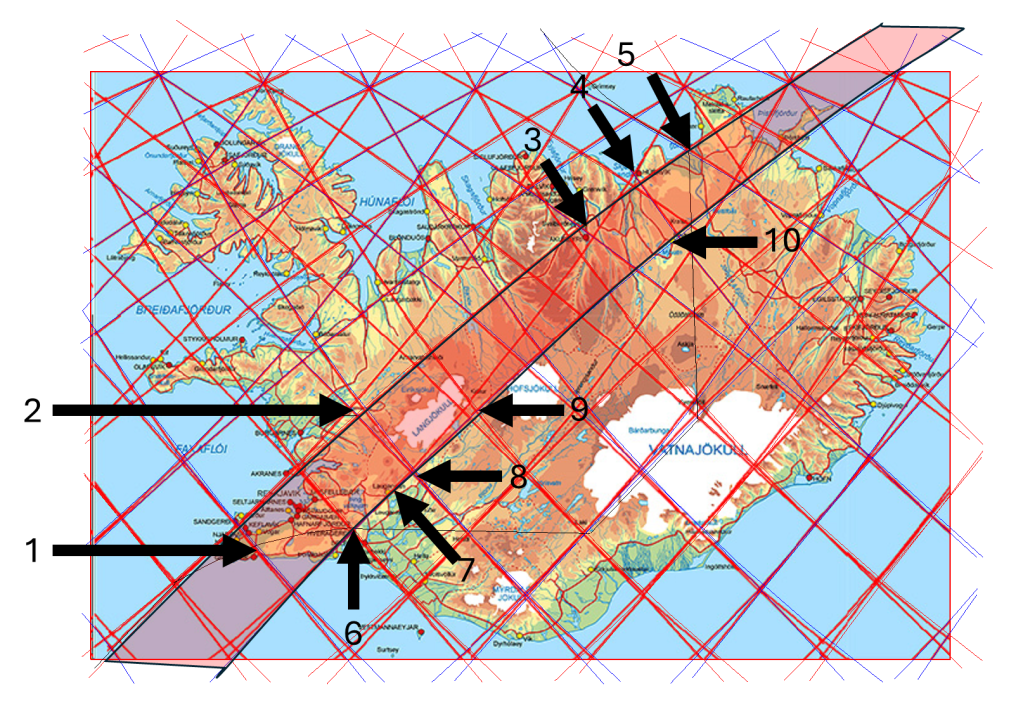
A number of Iceland’s most well-known geothermal and bathing sites appear to follow a striking spatial pattern. They can be interpreted as lying along a convection roll situated on the eastern side of the Reykjanes Ridge.
These sites form two parallel groupings:
- Sites 1–5: located along the same line as the rift system (ridge axis continuation)
- Sites 6–10: located slightly to the east, marking the adjacent sites of the same convection structure
This arrangement suggests a relationship between deep mantle flow, rift geometry, and surface permeability.
Sites Along the Rift-Aligned Division Line (1–5)
These sites are found along a line that can be calculated by extrapolating the main structure of the Reykjanes Ridge.
1. Blue Lagoon


7
The Blue Lagoon is located directly within the Reykjanes rift system. It sits on the inferred convection roll, but more specifically at the intersection with a division line perpendicular to the roll.
This is significant:
- The heat source reflects deep upwelling along the ridge-parallel structure
- The surface expression is controlled by fractures oriented across that structure
It demonstrates how geothermal systems depend on both mantle heat supply and crustal pathways.
2. Deildartunguhver / Krauma


This area represents one of the strongest geothermal outputs in Iceland.
- Deildartunguhver is a major source of hot water
- Krauma utilizes this heat for bathing
Its position suggests a direct connection to the main upwelling zone, where heat is transferred efficiently from depth.
3. Skógaböðin


Located near Akureyri, this site taps geothermal water from depth.
The water source appeared unexpectedly during the excavation of a tunnel through a nearby mountain—an observation that fits well with the idea of a linear geothermal corridor aligned with the ridge.
4. GeoSea


GeoSea represents a coastal manifestation of geothermal flow.
Hot water flows from the mountain and mixes with seawater, showing how geothermal systems can extend laterally from the division line between mantle convection rolls.
5. Skógalón í Öxarfirði


This remote site is less well known but important.
Its position suggests it may trace the northern continuation of the same division line.
Sites Along the Eastern Parallel Division Line (6–10)
These sites lie 1.5° east of the main division line of the Reykjanes Ridge, reflecting a parallel effect of the same convection roll, combined with the additional effect of perpendicular lines.
6. Reykjadalur (and nearby lagoon being constructed)


Reykjadalur is a clear example of active hydrothermal circulation.
It lies along a fracture-controlled area, likely aligned with a division line perpendicular to the main convection roll.
7. Laugarvatn Fontana


This site had a natural steam bath for a long time, but has now been developed further into a spa called Fontana.
It is on the parallel line, not being assisted by any perpendicular line.
8. Geysir


Although not developed as a bathing site, Geysir could function as one.
It is particularly important because:
- It sits within a well-defined geothermal area.
- It is associated with a perpendicular line, slightly east of the main Reykjanes Ridge convvection roll.
This reinforces the idea that geothermal sites often occurs at structural intersections.
9. Hveravellir


Hveravellir lies in the central highlands and is key to the overall pattern.
It effectively links southern and northern geothermal sites, supporting the idea of a continuous structure.
10. Mývatn Nature Baths


This site lies within one of Iceland’s most active volcanic systems, that of Krafla.
It represents a major hub of geothermal activity.
Overall Interpretation
This arrangement suggests:
- A primary convection rolls division line aligned with the Reykjanes rift
- A secondary row of geothermal sites 1.5° to the east
- Frequent control by perpendicular divisions of other layers
The most important takeaway is:
Geothermal sites are not simply located above heat sources—they occur where heat, and permeability intersect, often at intersecting structures.
All the sites, except Laugarvatn, illustrate this especially well, as they appear linked not only to the onvection structure but also to cross-cutting, perpenidculary aligned, division lines.


