
Tectonic drift is measured quite accurately, and the relevant main division line through Iceland is marked here.
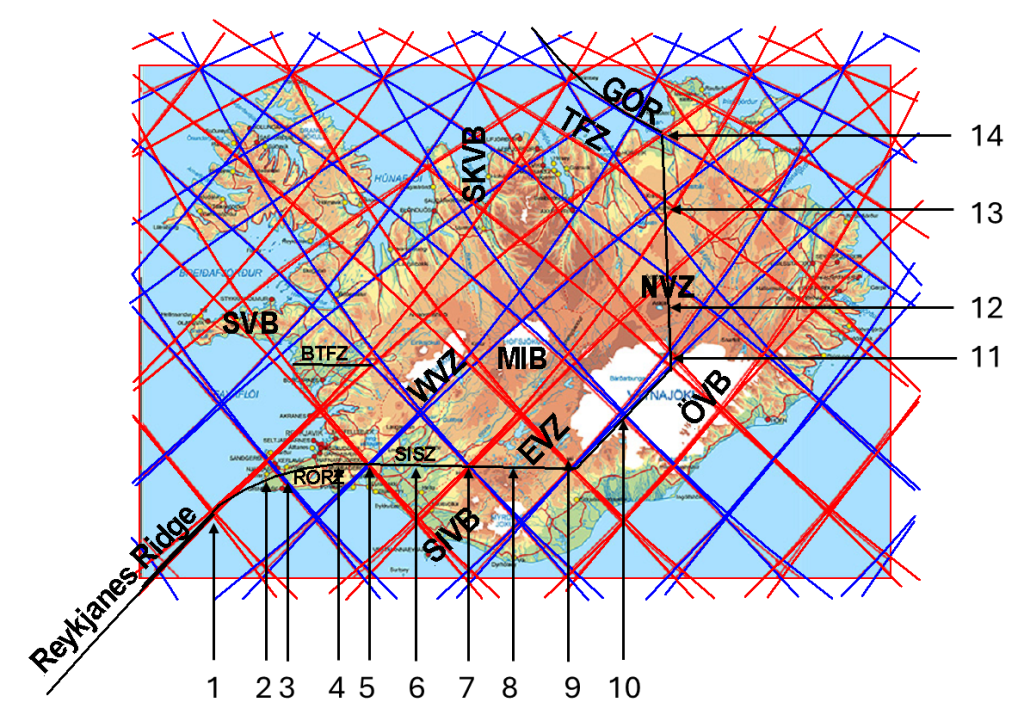
The division between the North American and Eurasian plates in Iceland has a chain of geologically significant landmarks. These sites, when viewed together, outline the structure of the plate boundary and reveal a coherent tectonic pattern that aligns with large-scale mantle flow processes.
1. Njörður volcanic site (offshore)


To the west, the system begins offshore at the Njörður volcanic site, an area characterized by frequent earthquakes. This location acts as a shifting point in the tectonic framework. South of it lies the typical structure of the Mid-Atlantic Ridge, which can be traced according to a regular geometric pattern as it extends southwestward. At Njörður, however, the ridge bends more sharply toward Iceland, marking a transition from a classic mid-ocean ridge into a more complex on-land system with volcanic systems, grouped into volcanic zones.
2. Reykjanes Peninsula – Bridge Between Continents

The next key landmark is the Bridge Between Continents, a man-made structure that directly reflects geological reality. It sits at the northern edge of a rift valley and marks the visible boundary between the plates. Interestingly, the bridge itself is located on the North American Plate, illustrating how the plate boundary is not a single line but a zone of deformation.
3. Svartsengi / Blue Lagoon volcanic system


7
In this region, magma actively ascends from depth, accumulating in a shallow magma chamber beneath the Blue Lagoon. From there, it propagates into dikes aligned southwest–northeast, consistent with the regional stress field. These intrusions periodically reach the surface, producing fissure eruptions characteristic of the Reykjanes volcanic zones.
4. Þríhnúkahellir and Bláfjöll

7
Further inland lies the volcanic area of Þríhnúkahellir and Bláfjöll. This region provides rare access to the interior of a magma chamber and represents a structurally distinct volcanic system within the broader plate boundary zone.
5. Hveragerði


The town of Hveragerði, often called the “hot spring town” or “flower town,” sits directly within a geothermal field. Its numerous hot springs and greenhouse agriculture reflect high heat flow and shallow geothermal activity.
6. South Iceland Seismic Zone
Between Hveragerði and Hekla lies the South Iceland Seismic Zone, a region of intense seismic activity. This transform-like zone accommodates lateral motion between segments of the plate boundary and is clearly detectable through geophysical measurements.
7. Hekla


Hekla is one of Iceland’s most famous volcanoes. Its frequent eruptions and mixed eruptive style make it a key marker within this tectonic alignment.
8. Landmannalaugar


The geothermal area of Landmannalaugar is known for its rhyolitic formations, hot springs, and complex volcanic history, representing a more evolved magmatic system.
9. Laki (Lakagígar)


5
The Laki fissure system produced the devastating 1783 eruption, one of the largest lava outpourings in recorded history, with profound climatic and societal impacts.
10. Grímsvötn


7
Grímsvötn is a powerful subglacial volcanic and geothermal system beneath Vatnajökull, known for frequent eruptions and strong geothermal activity.
11. Kverkfjöll


7
At Kverkfjöll, geothermal heat interacts directly with glacial ice, forming a complex volcanic environment. Within your framework, this site fits particularly well into the broader convection-roll pattern.
12. Askja


The Askja caldera lies near the central axis of the North Volcanic Zone. It represents a major կենտրոն point in the tectonic and magmatic system.
13. Krafla


7
The Krafla volcanic system sits within a structurally complex region, where multiple smaller tectonic segments intersect, forming what can be interpreted as a hub within the larger pattern.
14. Öxarfjörður

Finally, at Öxarfjörður, geothermal activity reaches the coastline. This marks the northern continuation of the system and again aligns with the broader structural framework.


