Uncategorized

Should the Volcanic Zones of Iceland be Redefined?

Each of Iceland’s volcanic systems shows a double character, meaning that the volcanic zone or belt tends to appear as a pair of structurally or spatially related units — in most cases corresponding to two adjacent polygons within the framework of the convection roll system. Since mantle convection rolls occur as paired structures, the volcanic systems that form above them naturally reflect this geometry. In this way, nearly every volcanic zone or belt in Iceland can be divided into two complementary parts.

West Volcanic Zone (WVZ) – The WVZ displays a continuous rifted region along its southwest portion, including the famous Þingvellir rift valley, and a secondary, wider area toward the northeast. Although the polygon northeast of the WVZ, here marked with a question mark, is commonly considered part of the same zone, its characteristics suggest it may instead be linked more closely with the Mid Iceland Belt.

East Volcanic Zone (EVZ) – The EVZ is sometimes defined as covering five polygons, but here only two, where active spreading takes place.

South Iceland Volcanic Belt (SIVB) – The SIVB also follows a paired pattern, the two polygons being quite different though, with Katla and Eyjafjallajökull in the southern one, and long fissures covering the northern one. Hekla is found between them, marking the division between spreading and non-spreading along the 64th latitude.

Westman Islands (WI) – The WI system is an exception, as it currently appears confined to a single polygon. However, if the general two-part pattern holds true, there should be a counterpart polygon located southwest of the islands. This hypothetical extension, designated as WI(2), would complement the known island polygon WI(1), completing the expected double structure. That is one part of science, right? Let’s go there and check it out!

Reykjanes Oblique Rift Zone (RORZ) – The RORZ demonstrates its double character both geographically and structurally. The Reykjanes Peninsula forms the onshore part of the system, while the offshore segment of the rift continues as a second polygon on the seafloor. These two parts together define the complete oblique rift zone.

Mid Iceland Belt (MIB) – The MIB is another exception to the general rule, as it occupies only one polygon in present definitions. However, given its central location and the symmetry of the convection roll system, it is logical to expect a complementary polygon in close proximity. The missing half of the MIB is therefore indicated by one of the question marks on the map. It is mainly up to petrologists to answer that question.

Skagafjörður Volcanic Belt (SKVB) – It volcanically extinct, and neglected, and even here I do not define the two parts 🙂

North Volcanic Zone (NVZ) – The NVZ can be divided into two principal parts: the northern portion associated with the Theistareykir–Krafla systems, and the southern portion extending toward Askja. These two subdivisions mark distinct volcanic corridors following separate polygons but functioning as a single rifting system.

Grímsey Oblique Belt (GOB) – The GOB likely mirrors the Reykjanes Oblique Rift Zone in both form and behavior. Its paired geometry supports its classification as an oblique twin to the RORZ.

Öræfajökull Volcanic Belt (ÖVB) – The double character of the ÖVB is particularly pronounced, as it clearly spans two distinct polygons: one centered on Öræfajökull and the other on Snæfell to the north. The two volcanic centers form a strongly defined pair, consistent with the structural control of the convection rolls beneath.

Snæfellsnes Volcanic Belt (SVB) – The SVB, is very similar to the ÖVB, and is divided into two parts here, although it actually extends over parts of 3 different polygons, it should not break the main rule of duality of each volcanic zone or volcanic belt.


In summary, the double character of Iceland’s volcanic systems reflects the paired arrangement of mantle convection rolls beneath the crust. Each volcanic zone or belt typically spans two adjacent polygons, forming a conjugate structure that mirrors the flow patterns of the underlying mantle. The only exceptions — MIB and WI — highlight potential locations where the complementary polygon remains unrecognized, indicated on the map by the two question marks.

Uncategorized

Reykjanes Eruption – where is the origin?

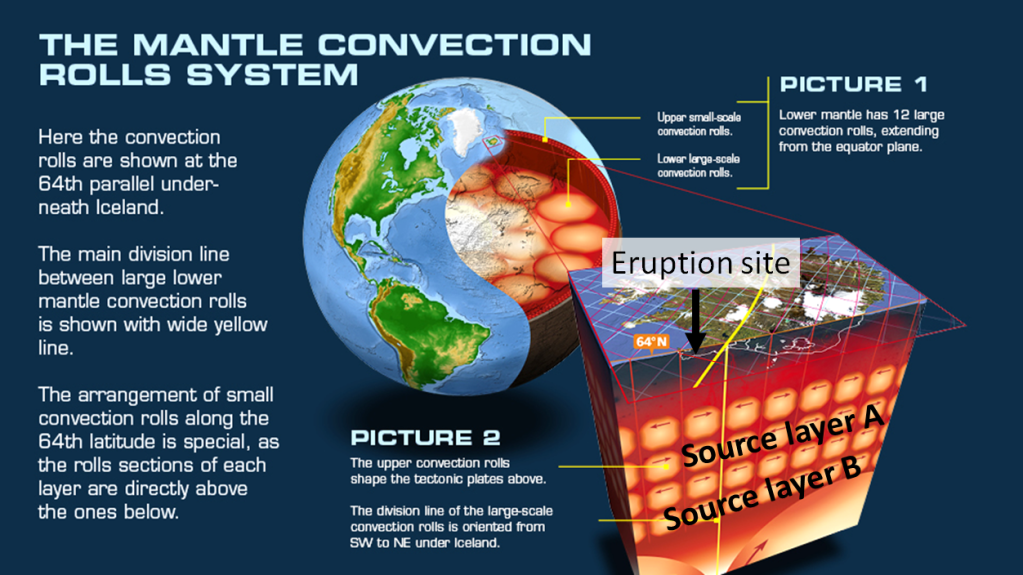
The tenth eruption on the Reykjanes Peninsula started suddenly on the Sundhnúkagígar fissure. All those eruptions are thought to be connected and considered to be one volcanic event, based on rather constant flow of magma from the interior. The model used here adds an explanation of the geophysical settings of the deep roots of the volcanic site. Two convection rolls division lines coincide under the point where the magma ascends. The lines cross the outer limits of the seismic zone at this location, providing a weakness in the crust.

Convection rolls model and site of ascending magma at Reykjanes Peninsula.

To understand how the system works according to the model, this drawning can be studied. The two layeres, with division lines between convection rolls found under the point of ascending magma, are marked here as source layer A and source layer B. Layer A is found at the depth of about 260 km, and layer B at 530 km depth (530-670 km). This means that magma of different types should be found, both from layer A and B. Besides that, the hot magma from below does partially melt the ductile part of the tectonic plate (commonly referred to as upper mantle found below the brittle crust).

The petrology of the lava should therefore be compared with these modelled preconditions of the eruptions. The three eruptions on Fagradalsfjall volcano and the seven eruptions on the Sundhnúkar fissure are originated from the same source, according to the findings in the article: The Fagradalsfjall and Sundhnúkur Fires of 2021–2024: A single magma reservoir under the Reykjanes Peninsula, Iceland? ( https://www.researchgate.net/publication/381756298_The_Fagradalsfjall_and_Sundhnukur_Fires_of_2021-2024_A_single_magma_reservoir_under_the_Reykjanes_Peninsula_Iceland

The authors of the article (Valentin R. Troll. Frances M. Deegan, Thor Thordarson, Ari Tryggvason, Lukáš Krmíček, William M. Moreland, Björn Lund, Ilya N. Bindeman,
Ármann Höskuldsson and James M. D. Day), come to this conclusion: “Whole rock and mineral geochemical data show that the
2023 SVL eruption produced lava compositions that, for the most
part, continue the trends established by the lavas of the late 2021 to
2023 Fagradalsfjall Fires (Figures 4 and 5). A first-order observation
is therefore that all of the recent FVL and SVL magmas are derived
from a similar magma source (excluding perhaps the early parts of
the 2021 Geldingadalir eruption), or a similar combination of sources,
which are different to the source(s) of previous magmas erupted on
the RP…”

Considering that, according to the model of convection rolls, it is quite likely that the uppermost division lines, oriented SW-NE, often provide magma from the mantle. This time it is probably not the case, as it seems likely that the source is from those deeper layers, because the relevant division lines are found exactly under the magma source location, which might explain different composition of the lava samples considered in the said article.

Uncategorized

The Ring of Fire is Circular for a Reason

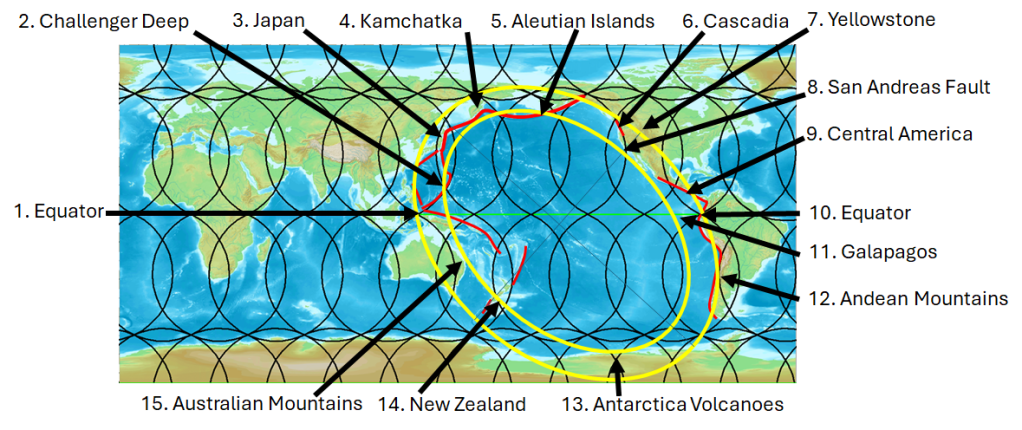
The Ring of Fire is in fact circular, and 15 main parts of it are pointed out on the map below. The shape of the Ring of Fire is indeed circular, because the volcanoes of Antarctica fit into the area in between two elliptical shapes drawn with its outer limits marked by two points on equator, at the coast of Indonesia and South America, respectively. The two points are characterized by subduction zones. Let us examine this most active area in the World, in terms of seismic and volcanic activity. Looking at the arrows and lines, it is easy to understand how reality fits with the model.

  1. The first point pointed out on the map is the subduction zone of the Philippian Plate at the coast of Indonesia. It is a triple point where both the Philippian Plate and Pacific Plate meet with Indonesia. The South American counterpart on the equator is found exactly 150° west of this point. It fits to the width of five large-scale convection rolls.
  2. The Challenger Deep is the lowest point on Earth. It coincides with the inner margin of the Ring of Fire as drawn here. The convection rolls of different layers coincide with the area.
  3. Honshu Island of Japan clearly coincides with the convection rolls model, and is also within the elliptical area of the Ring of Fire.
  4. Kamchatka has been examined in other posts here, and the volcanic zone follows the alignment of convection rolls. It falls into the elliptical zone in similar way as Honshu Island.
  5. The Aleutian Islands form an arc from east to west. The easternmost part seems to follow the path of a division line between convection rolls. The central part crosses a large-scale convection roll, and the western part connects with Kamchatka. This arrangement indicates why most areas fall within the form of two ellipses, with short segments originated from convection rolls division lines.
  6. Cascadia is mentioned in two of the main articles found on this site. Subduction and divergent boundaries are found in the area.
  7. The Yellowstone National Pard is specially interesting, because usually it is not mentioned as a part of the Ring of Fire. As presented here, it is strongly related to it in two different ways. First, it is found on the circular line connecting the two points on equator. Second, it is found on the straight line of the mathematical minor of the elliptical forms, in continuation of the Central San Andreas Fault. New Zealand is on the other side of the Ring of Fire, where the other end of the said minor is found. With a little bit of logic at hand, it is then possible to analyze what kind of stress point this is, and thereby what causes the extraordinary activity level of Yellowstone Park. The usual saying, that it is a hot spot, is not enough. Of course it is a hot spot. But the settings of the Ring of Fire do indicate a complex origin of the volcanic and geothermal activity found there.
  8. The San Andreas Fault is found on the inner margin of the Ring of Fire and is used here to find that inner margin. The inner elliptical shape is not as clearly marked as the outer ring found by intersecting two obvious points on equator.
  9. Central America has some interesting features, especially volcanic activity where petrological evidence can be used to examine the explanatory value of the convection rolls model.
  10. This point has already been mentioned as the counterpart of point 1.
  11. The Galapagos Islands are found on equator in between the elliptical forms of the Ring of Fire.
  12. The Andean Mountains fit very well to both Convection Rolls Model, and the modelled Ring of Fire.
  13. The volcanoes of Antarctica are more seldom mentioned in geological literature than many others, but they are of course just as important for geological studies. The location of those volcanoes fits exactly into the circle. It indicates that the circularity is actually a precondition of the subduction zones system.
  14. New Zealand has been mentioned as a counterpart of San Andreas and Yellowstone, being on the mathematical minor of the circle.
  15.  The Australian Mountains are not mentioned as a part of the Ring of Fire, but they are found within its realms, and it is said that they are still gradually growing higher.

In this way, it can be explained that the Ring of Fire is a wholistic area. It is correct to describe it as a ring, and should be studied more extensively .

The circular form of the Ring of Fire.