The surface of our planet bears the unmistakable marks of forces that operate deep within its interior. Mountains, rift valleys, volcanic arcs, and ocean basins are not random accidents of nature but the result of systematic and persistent geological processes. Among these, the concept of mantle convection, where heat from Earth’s interior drives circulating rolls of plastic mantle, offers a coherent way to understand the global distribution of geological features. When we examine the Atlantic Ocean, the Pacific Ring of Fire, and particularly Iceland’s unique geology, we can see a consistent pattern that points to convection rolls as a guiding force in shaping the planet’s surface.
The Mid-Atlantic Ridge: A Symmetrical Rift
The Mid-Atlantic Ridge is one of the most striking linear features on Earth. Stretching north to south, it runs down the center of the Atlantic Ocean like a seam on a baseball. Along this ridge, tectonic plates are moving apart, and new crust is being created as magma rises to fill the gap. What is remarkable is the symmetry of this system. The forces that shape the eastern Atlantic margins, along Europe and Africa, are mirrored in the geological structures along the western margins, facing the Americas.
This symmetry suggests that the same deep mantle processes operate beneath both sides of the Atlantic. The ridge itself acts as the surface expression of an underlying upwelling zone, hot material rising in a systematic manner from below. The spreading, volcanism, and earthquakes observed along the Mid-Atlantic Ridge are thus not isolated features but the predictable result of convection-driven divergence.
To fully comprehend the effect of convection rolls, it is important to recognize that Earth’s interior is not a single uniform system but a set of layers, each with its own convection dynamics. Convection rolls in different layers may be oriented in different directions, creating complex interactions between them. On top of this, the large-scale convection rolls of the lower mantle are often overlain by smaller rolls in the upper mantle and asthenosphere. These smaller rolls add detail and local variation to the broader global pattern. As a result, surface expressions such as mid-ocean ridges appear at once holistic, reflecting the influence of large-scale mantle circulation, and discontinuous, because smaller-scale convection rolls introduce irregularities and segmentation. This layered and multi-scale system helps explain why Earth’s geological features can seem both systematic and fragmented at the same time.
The Pacific Ring of Fire: A Continuous Arc
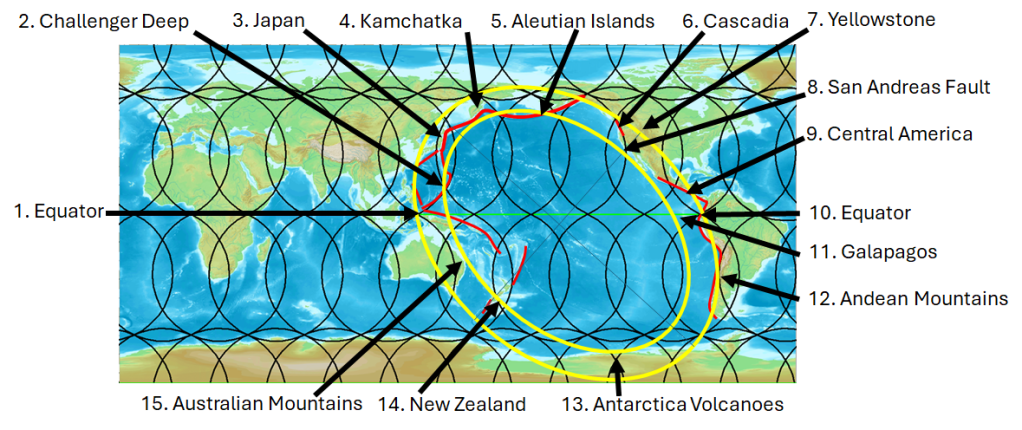
Moving to the Pacific, we encounter an entirely different yet equally systematic phenomenon: the Ring of Fire. This chain of volcanoes and seismic zones encircles the Pacific Ocean, from the Andes in South America, up through North America’s Cascades, across the Aleutians, and down through Japan, the Philippines, and New Zealand.
At first glance, the Ring of Fire may seem irregular, since the volcanoes and trenches occur in different geological settings. Yet when viewed through the lens of mantle convection, it becomes clear that similar forces are at work around the entire Pacific rim. Subduction zones, where one plate dives beneath another, are surface expressions of downwelling limbs of convection rolls. The arcs of volcanoes, aligned in systematic chains, form where mantle material melts and rises due to the descending slabs. Just as the Mid-Atlantic Ridge reflects upwelling, the Ring of Fire reflects downwelling and lateral flow. Both belong to the same fundamental system.
Convection Rolls as a Global Framework
The systematic appearance of these geological features, ridge in the Atlantic, arcs around the Pacific, points strongly toward convection rolls as the underlying framework. Instead of imagining Earth’s mantle as chaotic or localized in its motions, we can view it as a series of organized rolls, like giant conveyor belts. These rolls transport heat from the deep interior to the surface, and in the process, they drag along the tectonic plates. It is important to point out that the rolls working against the drift of the plates above tend to be neutral due to slip effect, and the rolls acting in the same direction accelerate or maintain the drift due to no-slip effect. This horizontal drift can only be maintained with ridges and subduction zones, which in turn fit into the pattern of the convection rolls system.
By adopting this perspective, the global distribution of active regions becomes much more comprehensible. Features that might otherwise appear disconnected, the Andes, the East Pacific Rise, the Aleutians, or the Mid-Atlantic Ridge, can be seen as parts of the same coherent system.
Iceland: A Natural Laboratory
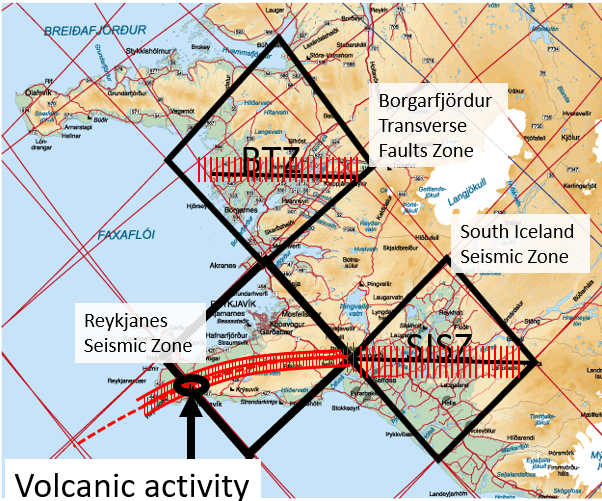
Among all the regions where convection manifests at the surface, Iceland stands out as one of the most revealing. Straddling the Mid-Atlantic Ridge, Iceland is literally being pulled apart by the diverging North American and Eurasian plates. The island is intensely volcanic, with eruptions occurring regularly, and geothermal energy bubbling up in hot springs and geysers.
What makes Iceland particularly interesting is the systematic pattern observable in its geology. Studies reveal repeated occurrences of features at roughly 1.5° intervals from east to west. These intervals are not random. They suggest that convection rolls beneath Iceland influence where magma rises and where fissures open. Instead of a single point source or isolated plume, Iceland’s structure implies a rolling system of upwellings and downwellings, each spaced in a consistent rhythm.
This pattern is like a fingerprint of convection rolls imprinted directly onto the surface. It provides one of the clearest local examples of how mantle dynamics can create systematic geological structures.
Extrapolation to Global Geology
If such a system can be identified beneath Iceland, it is logical to extend the same reasoning to other parts of the world. Iceland is not unique in experiencing volcanism or tectonic spreading. It is simply an especially visible case because the ridge rises above sea level there. The same processes occur all along the Mid-Atlantic Ridge, hidden under the ocean. Likewise, the arcs and trenches of the Pacific reveal similar spacing and repetition when studied carefully.
By extrapolating the system of convection rolls outward, one can explain the arrangement of many other active geological areas worldwide. The Mediterranean volcanism, the East African Rift, the Philippine arcs, and even intraplate hotspots may be understood within the same framework. They all represent surface manifestations of a deeper and more systematic circulation of Earth’s mantle.
A Unified Perspective
The strength of this convection-roll model lies in its ability to unify diverse geological observations into a coherent picture. Rather than treating each volcanic chain, rift, or trench as a separate phenomenon requiring a unique explanation, we can see them as interconnected parts of a global circulation system.
In the Atlantic, this system explains the symmetry of spreading ridges. In the Pacific, it accounts for the continuous arc of subduction and volcanism. In Iceland, it reveals itself in the regular spacing of geological features. On a global scale, it provides a logical framework for understanding why geologically active regions appear where they do.
Conclusion
The Earth’s surface is a complex mosaic of geological features, but beneath that complexity lies order. The Mid-Atlantic Ridge’s north–south orientation, the continuous Ring of Fire around the Pacific, and the repeated spacing of structures in Iceland all point toward the same conclusion: convection rolls in the mantle are shaping our planet in a systematic way. By recognizing this pattern and extrapolating it globally, we gain not only a deeper understanding of Earth’s past but also a predictive framework for studying its geological future.
The study of Earth’s interior is far from complete, but each new observation strengthens the view that mantle convection is not a chaotic process but an organized system of rolls. These rolls, moving slowly over millions of years, have carved the face of the planet, lifted mountains, opened oceans, and lit volcanic arcs. From the symmetry of the Atlantic to the fiery arcs of the Pacific, and from the rhythmic geology of Iceland to the restless rifts of Africa, the logic of convection rolls offers a powerful lens through which to read the Earth’s grand design.


but exactly on a division line between smaller convection rolls.