Uncategorized

Examining how the Earth works

A Holistic Model of Energy Flow Within the Earth

The internal energy flow of the Earth can be approached through a set of simple but physically meaningful preconditions that together form a coherent conceptual model.

The first precondition is that radioactive decay supplies an energy output comparable to the total heat flux emitted by the Earth. This assumption is supported by geochemical evidence suggesting that the abundance of radioactive isotopes—particularly uranium-238, thorium-232, and potassium-40—in primitive meteorites is broadly consistent with the inferred composition of the Earth. If so, radioactive decay could account for the entirety, of Earth’s present-day heat loss.

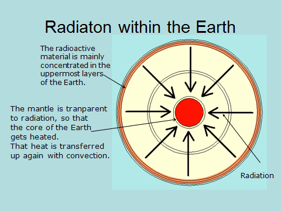
The second precondition is that the mantle is partially transparent to thermal radiation, particularly the radiation produced by these radioactive elements, along with the outer core. Under this assumption, a portion of the radiative energy generated within the mantle can propagate downward and be absorbed by the inner core. In this framework, the inner core is not merely a passive reservoir of residual heat, but an active participant in a dynamic energy exchange system.

Energy received by the inner core is then redistributed through convection within the outer core, which acts as an efficient transport mechanism. This convective motion transfers heat upward toward the mantle across the core–mantle boundary (CMB), a region that plays a critical role in coupling deep Earth processes. From there, heat continues to move through the mantle by a combination of convection and radiation, ultimately reaching the base of the lithosphere.

Within the tectonic plates, heat is transported toward the surface through conduction and localized magma flow, giving rise to volcanic and tectonic activity. In this way, the model provides a continuous pathway for energy: from radioactive sources, through radiative transfer and convection, to surface expression.

A central point of debate concerns the radiative properties of the mantle. Conventional models often assume that the mantle is largely opaque to thermal radiation, which limits the role of radiative heat transfer. However, this assumption remains uncertain, particularly under the extreme temperatures and pressures of the deep mantle. If the mantle is more transparent than typically assumed, radiative energy transfer could play a significantly large role in Earth’s internal energy budget.

Another debated issue is whether the inner core is growing over time. Some models suggest gradual solidification of the core, while alternative perspectives argue that the core maintains relatively stable proportions and temperature through long-term dynamic equilibrium. If such stability holds, it would support a model in which energy input—potentially via radiative transfer—is balanced by outward heat flow.

To explore the implications of this framework, convection rolls can be introduced into mantle layers as a simplified representation of large-scale flow. These structures provide a useful basis for comparison with observed surface patterns, such as tectonic plate boundaries, volcanic distributions, and heat flow variations. Preliminary comparisons, shown here, suggest that such models may reproduce certain large-scale features of the Earth’s surface, indicating that the approach is worthy of further investigation.
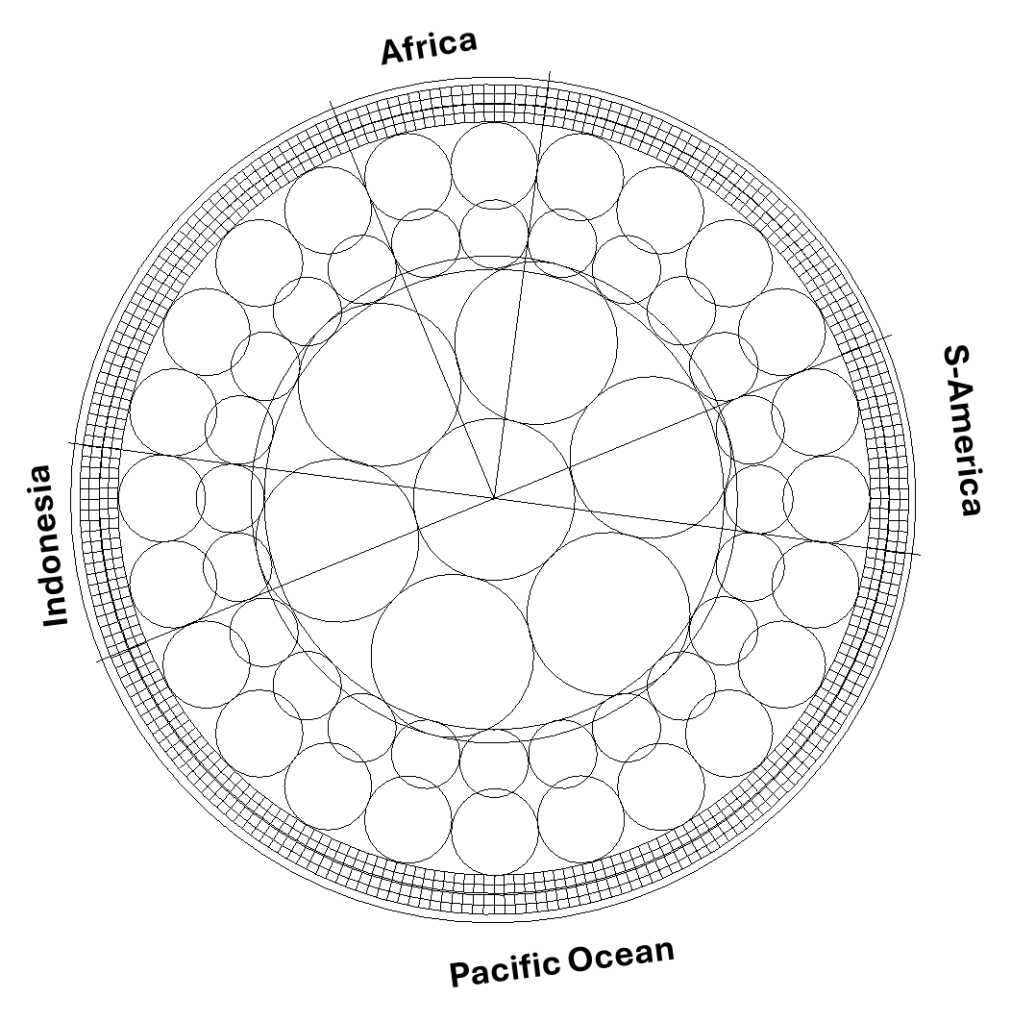
Basic convection rolls model, equatorial section

Conclusion

This holistic model proposes a testable alternative framework for understanding Earth’s internal energy flow. Its validity depends on key assumptions—such as the radiative transparency of the mantle and the long-term stability of the core—which can, in principle, be evaluated through observation, experiment, and modeling. The consistency between the mantle convection roll model and observed surface features has been rigorously tested here and shows strong agreement.
Uncategorized

Energy Balance of the Earth’s Interior

Introduction

The long-term stability of Earth’s internal temperature presents one of the most fundamental challenges in geophysics. If the mantle behaves adiabatically below approximately 120 km depth, as seismic and experimental evidence suggests, then its temperature should remain nearly constant through time. Under these conditions, the balance between internal heat generation and total surface heat loss must be remarkably precise.

In Earth’s early history, the quantity of radioactive elements such as uranium, thorium, and potassium was significantly higher, producing far greater radiogenic heat than at present. This excess energy would have been released through more vigorous mantle convection, enhanced volcanic and tectonic activity, and greater rates of heat transfer through the lithosphere. The total surface heat flow during that period must therefore have exceeded today’s ~47 terawatts (TW). Although the magnitude of these variations can be estimated from isotopic decay rates and thermal evolution models, the exact contributions of each geological process remain uncertain.

Despite these temporal fluctuations in radiogenic power and heat loss, the average mantle temperature appears to have remained nearly constant throughout Earth’s history. This implies a long-term self-regulating thermal system, in which higher heat production automatically enhances convective and radiative efficiency, maintaining near-adiabatic conditions and preventing significant temperature drift over geological time.

This stability suggests that the Earth’s internal heat budget operates as a closed but dynamic system, governed primarily by the amount and distribution of radiogenic elements and by the efficiency of internal heat transport processes.


Geoneutrino Constraints and Radiogenic Uncertainty

Recent geoneutrino measurements provide valuable insight into radiogenic heat production. These antineutrinos, emitted during the decay of uranium and thorium, allow researchers to estimate total radiogenic power. Current analyses suggest roughly 20 TW of heat is generated radiogenically, but this value carries large uncertainties due to limited detector coverage—most instruments are located on continental crust—and the need to extrapolate mantle contributions from sparse data.

If mantle concentrations of radioactive elements are higher than currently assumed, the true global radiogenic power could approach or even match the 47 TW of measured total surface output. This would reconcile the apparent imbalance between heat production and heat loss. Thus, the prevailing 20 TW estimate should be regarded as a lower bound, pending improved geoneutrino constraints from oceanic and deep-mantle observation sites.


Reconsidering Heat Transport in the Mantle

The conventional model envisions mantle convection as a primarily upward heat-transport system, carrying thermal energy from the interior toward the lithosphere. While this captures the dominant mechanism, it neglects a complementary and critical component: thermal radiation, which can transmit energy in any direction permitted by local gradients, including downward toward the core.

At the extreme pressures and temperatures near the core–mantle boundary, the mantle’s mineral phases cannot retain stable crystalline structures. The intense radiation field continuously destabilizes any emerging crystals, preventing their persistence and leaving the material in a vitreous, radiation-permeable state. Under these conditions, thermal radiation from the overlying mantle can pass almost undisturbed. Consequently, a portion of the mantle’s internal energy, instead of being entirely convected upward, is radiated downward into the core, effectively heating the core from above.

In contrast, convection transfers heat upward through the large-scale motion of mantle material: hotter, less dense regions rise, while cooler, denser regions sink. These convection rolls maintain global circulation and determine the spatial distribution of surface heat flow. Their geometry, wavelength, and coupling between different mantle layers provide the mechanical framework through which this energy is released.

Together, these two complementary processes—radiative transfer downward and convective transport upward—define the mantle’s dual role in Earth’s thermal system. The lower mantle acts as a radiatively transparent medium, facilitating energy exchange between the mantle and core, while the upper mantle remains convectively active, ensuring efficient heat release toward the surface. This dual mechanism explains how the mantle can sustain an adiabatic thermal gradient over geological timescales, maintaining both the activity of the core and the global tectonic system.


Implications for Earth’s Thermal Evolution

If downward-directed radiation continuously supplies heat to the outer core, then the core’s thermal history may be influenced not only by its own decay heat and latent crystallization, but also by a persistent influx from the mantle. This would help maintain the geodynamo over billions of years and explain why the core remains partially molten despite the decline in radiogenic elements.

The result is a self-regulating thermal system: radiative transfer prevents the mantle from cooling too rapidly, while convective circulation stabilizes surface heat loss. The two mechanisms together preserve a long-term thermal equilibrium that is more intricate and stable than models based solely on convection and conduction.

In this framework, Earth’s internal energy balance is dynamically self-sustaining, with the mantle acting simultaneously as the conveyor and the moderator of heat flow. Recognizing the interplay between radiative and convective processes is therefore essential for understanding the persistence of Earth’s internal heat, the endurance of its magnetic field, and the continuing vitality of plate tectonics.