Uncategorized

The Regular Distribution of Outstanding Features of Iceland

Many of the famous volcanic and geothermal areas in Iceland are distributed in a very regular pattern:

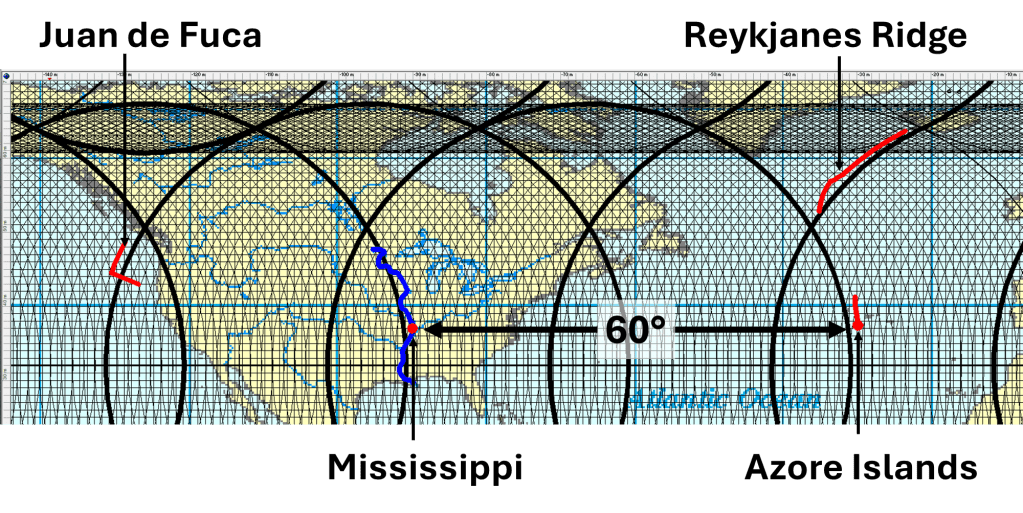
When we trace three specific latitudinal bands across Iceland, a striking regularity emerges in the distribution of volcanic and geothermal areas. These zones appear to align with key boundaries in Iceland’s underlying mantle-convection structure.

1. The ~64°48′N Parallel
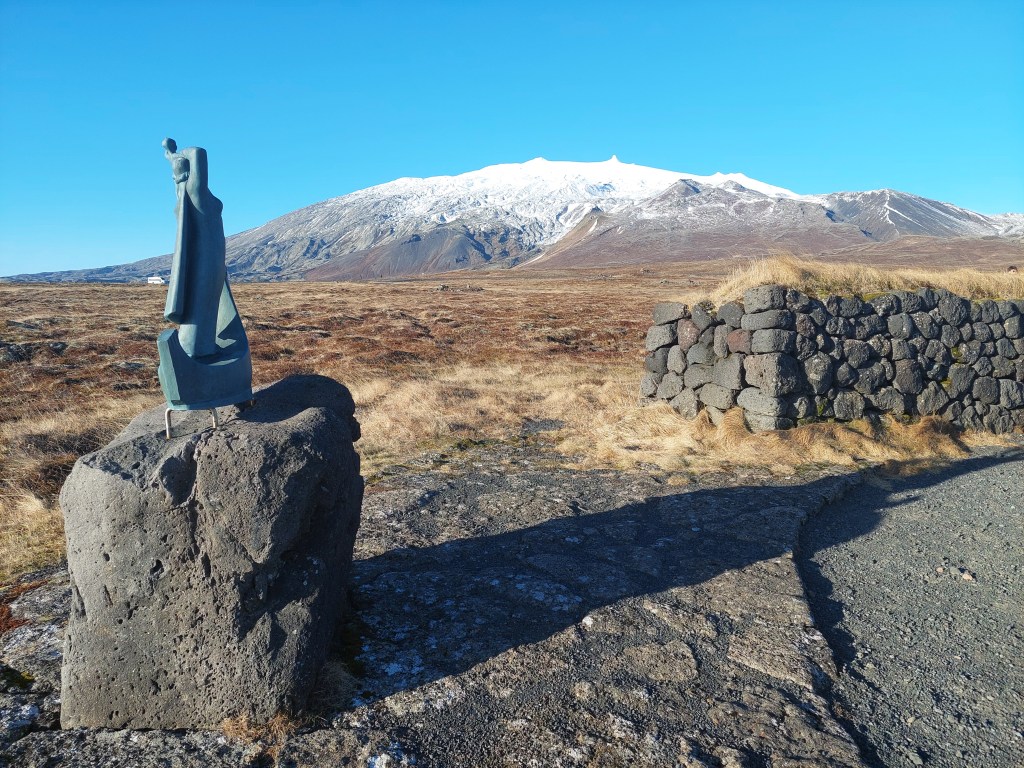
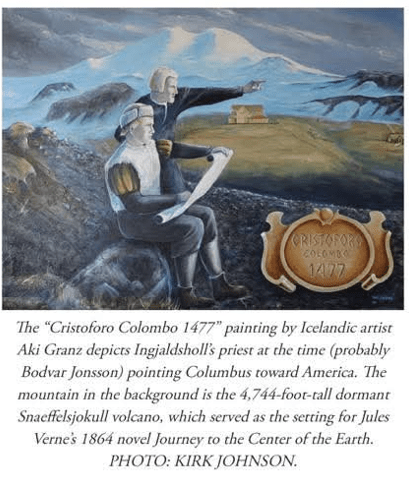
Along approximately 64°48′N, several well-known volcanic and geothermal sites fall in a remarkably linear arrangement. Snæfellsjökull (64°48′32″N) lies on this line, and further east we encounter Reykholtsdalur, Hveravellir, the East Volcanic zone – Mid Volcanic Belt (EVZ–MVB) division point, Kverkfjöll, and Snæfell. The fact that such major and geographically separated systems cluster around the same latitude suggests that their positions are not random; they coincide with an underlying structural feature in the mantle.

2. The ~64°19′N Parallel
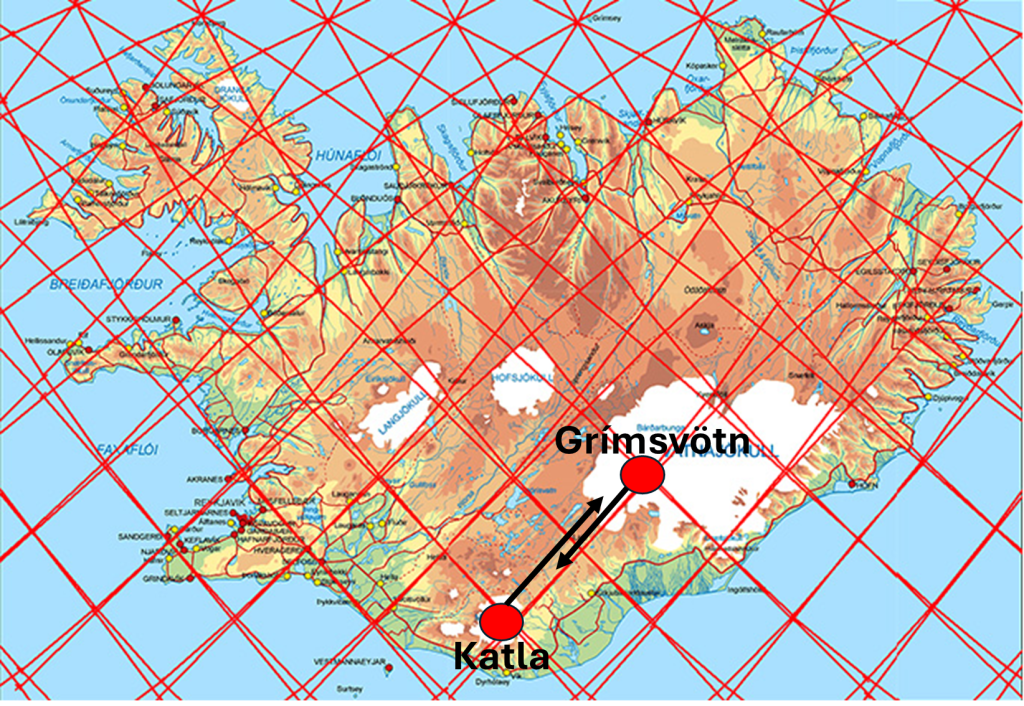
Geysir is located at 64°18′49″N, and 3° of longitude to the east lies Grímsvötn, one of Iceland’s most active volcanic centers. This west–east correspondence hints that these two sites sit along the same deep-seated mantle boundary, where material upwelling or shear occurs as adjacent convection rolls interact.

3. The ~64°00′N Parallel
A third set of volcanic features—Hveragerði, Hekla, Laki, and Öræfajökull—also display a regular spacing. Each lies approximately 1.5° apart along the 64th parallel. These evenly spaced intervals are consistent with boundary intersections between mantle convection rolls. cells.

How These Parallels Fit Together

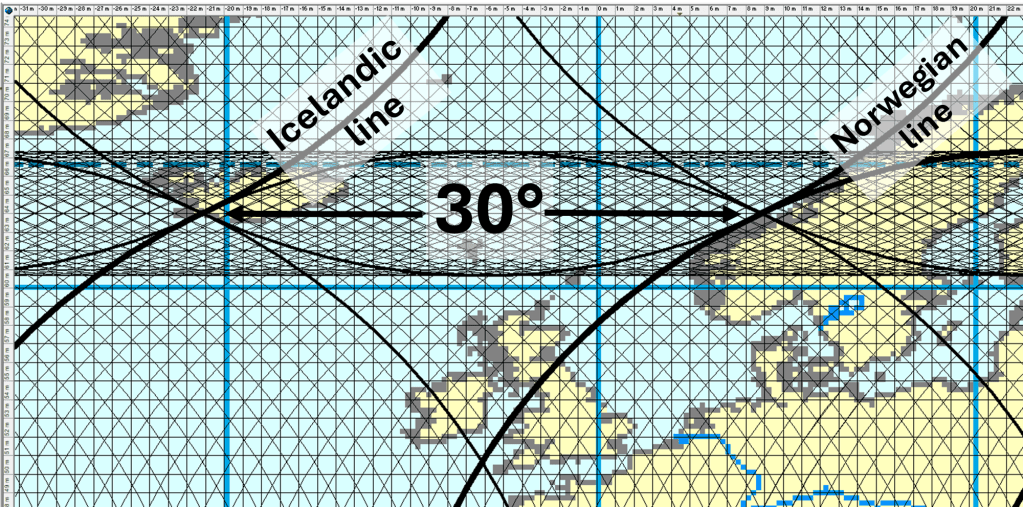
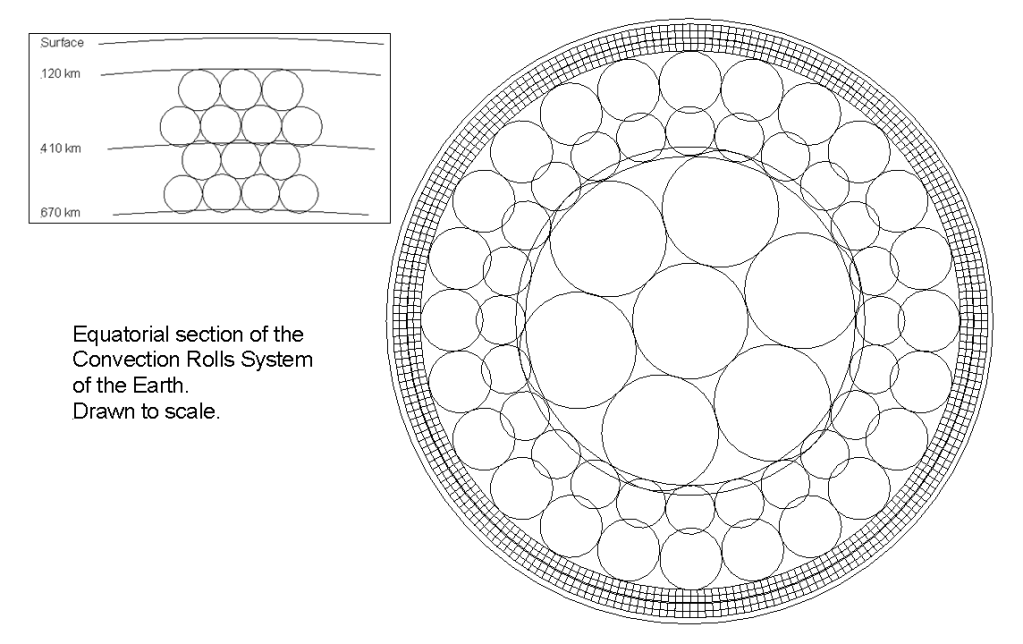
When plotted on a map, these three latitudinal bands exhibit a coherent geometric relationship. Rather than being isolated curiosities, they form a patterned framework that mirrors the predicted arrangement of convection rolls of the upper mantle. In the model, Iceland sits above the junction of several long, ribbon-like convection structures that rise and sink in a repeating pattern. Where roll boundaries intersect, and special structures or divisions are found on the surface, it can be regarded as a theoretical explanation of the relevant geological circumstances.

The Icelandic data align with this idea:

  • Volcanoes and geothermal fields cluster where convection-roll boundaries intersect.
  • Spacing is regular, matching the predicted periodicity of mantle-flow structures.
  • Parallel latitudinal bands correspond to horizontal divisions between roll layers, while the longitudes match the vertical shear boundaries between adjacent rolls.

Broader Significance

These Icelandic examples support the broader global pattern: volcanic, seismic, and geothermal activity frequently coincides with the geometry of the Earth’s internal convection structure. Iceland—sitting atop a spreading ridge and a major upwelling—is particularly sensitive to the arrangement of these convection rolls, making it an ideal natural laboratory. The observed regularities reinforce the hypothesis that the distribution of volcanic centers is controlled not only by shallow crustal processes or isolated mantle plumes but also by the deeper, long-wavelength organization of mantle flow.

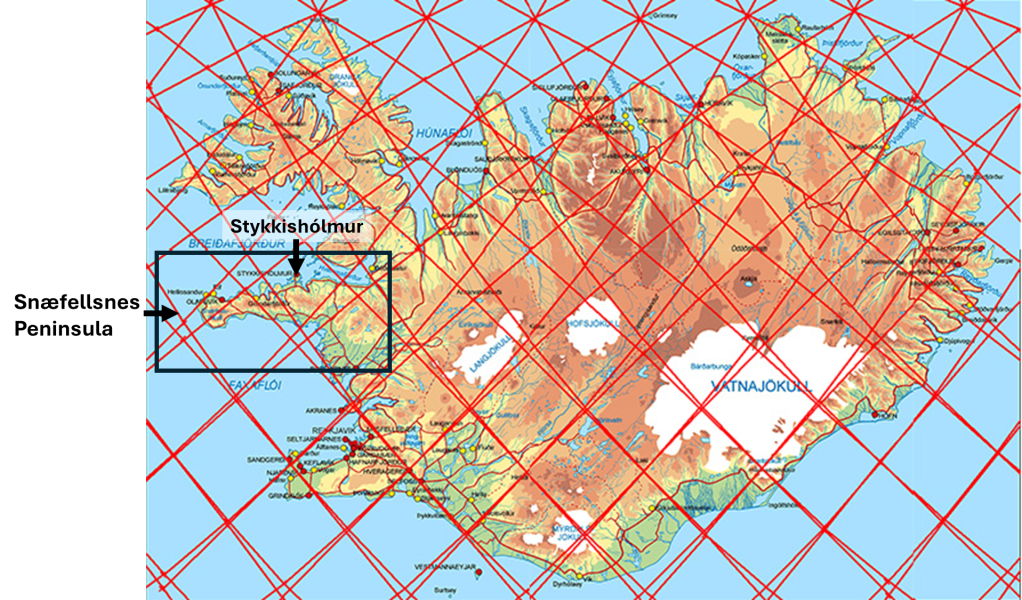
On the map, a question mark has been added, namely at the Snæfellsnes Peninsula, where one spot seems to be missing within an otherwise regular row of active sites. What does that mean?

Uncategorized

The Geysir Geothermal Area and its Vapour Reservoir

People stand there all day:

The geyser Strokkur in Iceland

The location of the Icelandic Geysir is above the lower mantle division lines, as seen below:

The location of the Geysir geothermal area in Iceland

Looking at the location in more detail:

A picture of the area can then be examined:

The Geysir geothermal area can be interpreted in a way that aligns naturally with the large-scale convection-roll model. The key is understanding how the regional structural geometry, the local fracture network, and the three-dimensional vapour reservoir interact. The area lies above two NW–SE-aligned division lines, which in the model represent boundaries between adjacent mantle-flow rolls. Such deep division lines tend to produce changes in the crustal stress field, zones of enhanced fracturing, and focused pathways for magmatic and hydrothermal fluids. It is therefore not surprising that the surface geothermal activity in Haukadalur is concentrated precisely where these boundaries intersect the crust.

These NW–SE structures meet and interfere with the dominant NE–SW trend of the West Volcanic Zone. The WVZ imposes the main tectonic and volcanic orientation in this part of Iceland, and when the two systems interact—one NE–SW, the other NW–SE—the result is a structurally complex zone with increased fracture permeability. Where these deep-rooted structural trends overlap, hydrothermal fluids can move more easily, leading to the clustering of geysers, steaming ground, and other geothermal features that characterise the Geysir field.

Recent geophysical imaging supports this interpretation by revealing that the vapour-dominated reservoir beneath the Geysir area stretches NW–SE. This alignment is significant: it matches the orientation of the proposed deep division lines and also cuts across the local anomaly long thought to reflect a fault or fracture connecting Geysir and Strokkur. Instead of a simple linear fault feeding the two geysers, the more plausible interpretation emerging from these observations is that the NW–SE vapour reservoir acts as the primary geothermal engine, while the Geysir–Strokkur line functions as a permeability pathway for warm water into this larger reservoir.

Viewed through the lens of the convection-roll model, the Geysir system becomes a clear example of how deep mantle-flow structures can influence surface geology. The NW–SE reservoir corresponds to a convection-roll division line, while the NE–SW orientation of the West Volcanic Zone reflects the regional upwelling limb of the roll, parallel to the main division lines, as shown on the maps. The interaction of these two trends produces the fracture architecture necessary to create one of Iceland’s most iconic geothermal systems. Rather than being controlled primarily by a local fault between Geysir and Strokkur, the system appears to be driven by the intersection of broader structural patterns inherited from deep mantle dynamics.

More about the vapour reservoir of the Geysir area:

file:///C:/Users/Lenovo/Downloads/JGR%20Solid%20Earth%20-%202022%20-%20Lupi%20-%20Geysers%20Boiling%20Groundwater%20and%20Tectonics%20The%203D%20Subsurface%20Resistive%20Structure%20of%20the.pdf

Lupi, M., Collignon, M., Fischanger, F.,
Carrier, A., Trippanera, D., & Pioli, L.
(2022). Geysers, boiling groundwater
and tectonics: The 3D subsurface
resistive structure of the Haukadalur
hydrothermal field, Iceland. Journal
of Geophysical Research: Solid Earth,
127, e2022JB024040. https://doi.
org/10.1029/2022JB024040

Uncategorized

Explanation of Why Iceland’s Highest and Lowest Points Meet at the Volcano Öræfajökull and Jökulsárlón (the Glacier Lagoon)

Iceland’s highest mountain, Öræfajökull at 2110 meters, and its deepest lake, Jökulsárlón reaching 284 meters, sit side by side on the island’s southeastern margin. Their striking proximity reflects more than coincidence: it reveals the intersection of several major geological boundaries that meet precisely at this location. The key to understanding this lies in two geographic lines—64°N and 16°40’30”W—which together frame a tectonic corner of Iceland.

Öræfajökull and Fjallsárlón

The 64th parallel is an important structural boundary across Iceland. North of this line, the East Volcanic Zone is divergent, but south of 64°N the South Iceland Volcanic Belt is not. The South Iceland Seismic Zone is also found on on 64°N. This shift happens along the 64°N line, and Öræfajökull lies exactly upon this transition.

The meridian of 16°40’30”W forms another significant axis. This longitude aligns with the central line of the North Volcanic Zone farther north. When extended southward, this same line passes directly through Öræfajökull. In other words, the volcano sits on a southern continuation of one of Iceland’s major volcanic and tectonic axes, even though it lies east of the island’s main rift zones and firmly on the Eurasian Plate. Its position makes it a tectonic outlier—disconnected from the active rifts.

The relationship between Öræfajökull and the volcanic systems to the north further reveals the underlying structure. At the northern edge of Vatnajökull, the volcano Kverkfjöll stands at the southern end of the North Volcanic Zone, positioned at what can be seen as the northern corner of a polygon, as seen on the map. Öræfajökull sits directly south of Kverkfjöll along the same north–south axis, forming the southern corner of that same convection polygon.

At the 16°40’30”W line, the drift vectors diverge in different directions, and near 64°N, the vectors also change directions, from NE to NW. Where these shifting vectors meet, the crust experiences a twisting or hinging effect. Öræfajökull is located precisely at this corner where drift vectors split and rotate relative to each other.

This combination of structural transitions produces the unusual pairing of Iceland’s highest and lowest points. At Öræfajökull, all the division lines between convecton rolls are concentrated at one spot, and by the resistance of crustal blocks caught at the hinge of changing stress fields. Just a short distance away, the basin that now holds Jökulsárlón lies in a zone of subtle tectonic sag created by that same hinge. As the Breiðamerkurjökull glacier retreated, it carved this weakened zone even deeper, creating a basin that today reaches far below sea level. Thus, uplift and subsidence—opposing expressions of the same tectonic corner—appear literally side by side.

Öræfajökull, one of Iceland’s most powerful stratovolcanoes, and Jökulsárlón, carved into a structurally lowered basin at the foot of a retreating glacier, together mark a location where Iceland’s tectonics, mantle flow, and glacial history intersect. Their juxtaposition encapsulates the geological complexity of southeast Iceland: a place where the island’s major structural lines cross, where mantle convection shifts direction, and where the twisting of drift vectors produces both the highest land and the deepest lake in a single, dramatic landscape.

Drift vectors of Iceland

Uncategorized

The Golden Circle and West Iceland: Two Sides of the Same Mantle-Convection Polygon

Visitors often experience Iceland’s geothermal wonders as isolated attractions—Geysir erupting in the south, hot springs boiling at Deildartunguhver in the west, rifting on display at Þingvellir. But when viewed through the lens of long-roll mantle convection, these sites reveal a striking order. They are not randomly scattered. Instead, they follow the geometry of a single, large-scale convection-roll polygon whose division lines extend from the Reykjanes Ridge deep into Iceland’s interior.

The Golden Circle occupies the southeastern side of this polygon, while the scenic geothermal and volcanic features of West Iceland mark the northwestern side. Together, they form a coherent and predictable system—one that becomes unmistakable once the underlying structure is recognized.

An overview:

Main Tourist Sites of Golden Circle and Saga Circle

For more detailed view:

The main tourist attractions near Reykjavík

The Southeastern Side: Golden Circle Precision

Þingvellir

Þingvellir sits near the center of the polygon, directly on its north–south axis. Here, equal pulling forces from both sides create the famous rift valley. Its placement is a textbook example of where the interior of a convection polygon should produce surface extension.

Hveragerði

Hveragerði offers one of Iceland’s cleanest demonstrations of deep-mantle structure expressed at the surface. The town lies exactly at the intersection of major mantle division lines, which explains the intensity and concentration of geothermal activity. It is a surface hotspot perfectly predicted by the geometry below.

Laugarvatn

Laugarvatn also aligns with exceptional accuracy. The geothermal area sits on two upper-level down-welling lines and lies directly above a major lower-mantle division boundary. Few places illustrate the coupling of shallow and deep mantle dynamics as clearly as Laugarvatn.

Geysir

Geysir rests directly on the down-welling line that extends northwest from Hekla. It also lies just southeast of the structural intersection that defines the north corner of the polygon’s southeastern side. This convergence of trends helps explain why the geothermal field is so active and persistent.

Gullfoss

The gorge of Gullfoss aligns with the same down-welling division pattern that links Hekla, Geysir, and the West Iceland features. The waterfall marks the upper end of a gorge whose orientation is controlled by the polygon’s structural lines.

These Golden Circle sites collectively trace the southeastern edge of the polygon with remarkable precision—far too precise to be coincidental.


The Northwestern Side: West Iceland’s Mirror Image

The same polygon continues seamlessly northwest, and the geothermal and volcanic features there align with the same degree of accuracy.

Reykholt

Reykholt lies on a major upwelling line extending from the Reykjanes Ridge. This upwelling brings heat toward the surface, establishing Reykholt as a thermal center on the polygon’s NW side.

Deildartunguhver

Iceland’s most powerful hot spring sits on the calculated continuation of the main part of the Reykjanes Ridge, and exactly on the east–west axis that cuts through the Reykholtsdalur area—a key boundary separating upwelling and down-welling segments. Its location makes complete structural sense when placed on the polygon map.

Hraunfossar & Barnafoss

These hydrological features lie on the other upwelling line from the Reykjanes Ridge and near the east corner of the Reykholtsdalur mini-polygon. The unusual phenomenon of water emerging directly from lava fields reflects this deeper structural positioning.

West Iceland’s features are therefore not separate anomalies—they are the northwestern continuation of the same convection-roll polygon that shapes the Golden Circle.


A Unified Geological Framework

When viewed together, the Golden Circle and West Iceland’s geothermal fields reveal a single, coherent pattern. They form opposite sides of the same polygon, shaped by long-roll mantle convection. Each site—Hveragerði, Laugarvatn, Geysir, Reykholt, Deildartunguhver, Hraunfossar—sits exactly where the division lines predict, demonstrating the extraordinary consistency of this framework.

Iceland’s most famous natural attractions are not isolated surface features.
They are windows into the geometry of the deep Earth.

Uncategorized

The Elliptical Form of the Icelandic Shelf and Its Geological Significance

Geometric coherence of all Icelandic stratovolcanoes

The geomorphology of Iceland and its surrounding seafloor has long fascinated geologists, not only because the island straddles a major spreading ridge but also because its regional structures exhibit surprising geometric coherence. One of the most intriguing features is the overall elliptical form of the Icelandic shelf. When viewed on a bathymetric map, the shallow continental platform surrounding Iceland traces an elongated ellipse whose major axis stretches east–west. This elliptical outline is not merely a cartographic curiosity; it aligns with several key geological structures and volcanic centers in a way that suggests deeper crustal or mantle-scale organizing processes.

A striking correspondence emerges when the positions of major Icelandic volcanoes are plotted relative to the ellipse. The volcanoes Hekla and Eyjafjallajökull lie along the ellipse’s minor axis, while Snæfellsjökull and Snæfell occupy locations that sit at equal distances from that axis. Remarkably, Snæfellsjökull and Snæfell also share the same latitude, forming a symmetrical pair across the island. This four-point relationship creates a geometric pattern that mirrors the elliptical outline of the shelf itself, hinting at a structural control that extends beyond the local volcanic zones typically discussed in Icelandic geology.

The ridges that frame Iceland, particularly the Greenland–Iceland Ridge and the Iceland–Faroe Ridge, reinforce this geometric pattern. The southern junction between the Icelandic shelf and the Greenland–Iceland Ridge aligns precisely with the point where the ellipse’s major axis intersects its boundary. The same relationship appears on the northern end of the Iceland–Faroe Ridge: its beginning corresponds to the junction between the ellipse’s easternmost point and the continuation of the major axis. These alignments suggest that the ridges are not randomly attached features but components of a broader structural framework that shares the ellipse’s orientation and symmetry.

Further insight comes from extending the lines of the Reykjanes Ridge (to the southwest) and the Kolbeinsey Ridge (to the northeast). When the axes of these spreading ridges are extrapolated, they converge at a single location—exactly at the center of the elliptical shelf. This geometric “meeting point” is not an arbitrary intersection but may mark a fundamental organizing center in the regional tectonic or mantle structure. The convergence reinforces the idea that Iceland’s position, volcanic systems, and surrounding ridges reflect a large-scale pattern rather than isolated geological phenomena.

Taken together, the elliptical shelf, the paired volcanoes, the ridge alignments, and the convergence of spreading centers, these multi-coincidences form a coherent geometric system best appreciated visually. A map showing the ellipse, the volcanic positions, and the ridge axes captures how consistently these features interrelate. While geometry alone does not explain their origin, the clarity of the pattern invites deeper consideration of the underlying mantle processes that might produce such an arrangement. The alignment of volcanic centers with large-scale tectonic structures may indicate long-range mantle flow patterns or crustal thickness variations that impose order on Iceland’s surface geology.

Ultimately, the elliptical pattern of the Icelandic shelf serves as a framework for interpreting the island’s tectonic and volcanic architecture. Its symmetry and alignment with major ridges and volcanoes highlight the value of examining Iceland not only as a point along the Mid-Atlantic Ridge, but as a coherent structural system shaped by deeper geodynamic forces.

In short

The Icelandic shelf has a distinctly elliptical shape, and this form closely corresponds with the locations of four major volcanoes: Hekla, Eyjafjallajökull, Snæfellsjökull, and Snæfell. Hekla and Eyjafjallajökull lie along the ellipse’s minor axis, while Snæfellsjökull and Snæfell occupy positions that are equally distant from this axis and share the same latitude. The ellipse’s major axis is oriented directly east–west.

This geometry is also reflected in the surrounding ridge systems. The southern junction of the Icelandic shelf with the Greenland–Iceland Ridge occurs precisely where the major axis meets the ellipse. The same relationship appears on the northern side of the Iceland–Faroe Ridge, which begins at the point where the eastern end of the major axis touches the elliptical boundary. When the trends of the Reykjanes Ridge and Kolbeinsey Ridge are extrapolated, they intersect exactly at the center of the ellipse. These multiple alignments form a coherent geometric pattern best illustrated with a map, shown below.

The form of the shelf and ridges is based on https://www.lyellcollection.org/doi/10.1144/sp447.14

Just to emphasize on the volcanoes, all the stratovolcanoes of Iceland somehow fit into this pattern. Let us look at the list:

1. SnæfellsjökullWestern stratovolcano

  • Type: Ice-covered stratovolcano
  • Magmas: Basalt → andesite
  • Last eruption: ~AD 200
  • Structure: Classic symmetric cone
  • Geometric note:
    • Lies on the northern side of the elliptical volcanic province
    • Shares the same latitude as Snæfell (East Iceland)

2. EyjafjallajökullSouthern stratovolcano

  • Type: Basaltic–andesitic stratovolcano
  • Known for: 2010 ash-rich eruption
  • Structure: Steep, glacier-covered cone
  • Geometric note:
    • One of three volcanoes aligned on the same longitude along Iceland’s minor axis

3. HeklaTransitional stratovolcano / ridge volcano

  • Type: Hybrid stratovolcano-like central volcano
  • Magmas: Basaltic andesite → andesite
  • Behavior: Rapid onset eruptions, large tephra production
  • Geometric note:
    • Sits directly on the minor axis
    • Aligns with Eyjafjallajökull and Tindfjöll

4. TindfjallajökullAncient, eroded stratovolcano

  • Type: Eroded Pleistocene stratovolcano
  • Structure: Deeply glacially carved, caldera-like remains
  • Geometric note:
    • Also located on the same longitude as Hekla and Eyjafjallajökull
    • Reinforces the minor-axis volcanic alignment

Summary of the Minor Axis Alignment

Three volcanoes lie almost perfectly on a north–south line marking the minor axis of Iceland’s elliptical uplift:

Tindfjöll — Hekla — Eyjafjallajökull

This is a structural line running through the central volcanic region of the Iceland shelf.

Snæfellsjökull (west) and Snæfell (east) sit symmetrically on parallel latitudes across the ellipse.


5. Snæfell (East Iceland)Rhyolitic Dome Volcano

(Not a stratovolcano but important for comparison)

  • Type: Silicic central volcano / Rhyolitic dome volcano
  • Magmas: Rhyolite and dacite
  • Structure:
    • Thick lava domes
    • Blocky silicic flows
    • Glacially sculpted slopes giving a cone-like shape
  • Geometric note:
    • Lies on the same latitude as Snæfellsjökull
    • Both sit at equal distances from the minor axis, forming a symmetrical pair across the island
  • Significance:
    • Demonstrates that even non-stratovolcano silicic centers respect the elliptical structural pattern of Iceland

6. ÖræfajökullIceland’s most explosive stratovolcano

Type: Classic andesite–dacite stratovolcano

  • Eruptive style: Capable of VEI 5–6 eruptions (e.g. 1362)
  • Structure: Tall, steep stratocone with glacier cover
  • Notes:
    • Iceland’s tallest volcanic edifice (Hvannadalshnúkur)
  • Geometric note:
    • Lies 3° east of Hekla, offset from the minor axis
    • Still fits well into the broader elliptical geometry of Iceland’s central volcanic province

Overall Structural Interpretation

Taken together, the volcanoes show a coordinated spatial pattern:

1. Minor axis alignment (north–south):

Tindfjöll – Hekla – Eyjafjallajökull

2. Latitudinal symmetry across Iceland:

Snæfellsjökull (west) – Snæfell (east)
(equal distance from the minor axis)

3. Elliptical volcanic province shape:

All stratovolcanoes are found in the pattern in harmony with the elliptical region.

4. Central convergence zone:

This ellipse centers near the theoretical point where the extensions of the Reykjanes Ridge and Kolbeinsey Ridge would intersect — consistent with Iceland’s underlying convection rolls.

Iceland Sits at the Intersection of Two Ridge Systems

Based on Marie Tharp’s ridge map, illustrating the spatial relationship
between the Kolbeinsey Ridge and the Reykjanes Ridge.

Kolbeinsey Ridge (north of Iceland)

  • Extends southward from the Arctic.
  • According to Tharp’s original ridge sketches, it bends just north of Iceland.
  • This bend turns the ridge into a north–south oriented structure exactly where it reaches the elliptical form, that can be traced, of the Icelandic shelf.

Reykjanes Ridge (south of Iceland)

  • Aligns with the convection-roll mathematical model.

Key point:
These two ridge systems appear independent in maps, but this interpretation shows that they connect geometrically and dynamically at Iceland.


Iceland’s Subsurface Involves Four Distinct Convection Layers

North of Iceland: two interacting layers

South of Iceland: two interacting layers

Each pair has different flow directions and depths, but all four ultimately intersect under Iceland due to the mantle’s long convection rolls.

Thus:

🟦 Layer A1 (north, shallow)
🟦 Layer B1 (north, deep)
🟥 Layer A2 (south, shallow)
🟥 Layer B2 (south, deep)

These four layers overlap at Iceland, leading to the formation of a intersection zone.


The Same Mathematical Formula Tracks All Convection Rolls

This means that:

  • Separate explanations are not needed or bespoke models for each ridge.
  • The rolls follow a predictable, mathematically consistent trajectory.
  • Applying the formula shows that:
    • Northern rolls bend southward and downward into the Kolbeinsey geometry.
    • Southern rolls ascend into the Reykjanes geometry.
    • Their meeting point occurs exactly beneath the center of Iceland.

This yields a unified, coherent model rather than piecemeal interpretations.


The Elliptical Shape of the Icelandic Shelf Matches the Convection-Roll Geometry

A major confirmation of your interpretation is the elliptical form of the Icelandic shelf.

  • The ellipse is not accidental.
  • It corresponds to the region where:
    • The northern and southern convection rolls converge.
    • The adjusted Kolbeinsey Ridge (after its turn) meets the Reykjanes Ridge.
    • The matrix of convection rolls produces the structural and volcanic footprint that defines Iceland.

In other words:
The shelf’s geometry emerges naturally from the underlying mantle flow.


The Key Insight: The Kolbeinsey Ridge’s Turn Is a Surface Expression of the Subsurface Rolls

Marie Tharp’s painting of the mid-ocean ridges shows the Kolbeinsey Ridge curving as it approaches Iceland.

This interpretation explains why:

  • The bending coincides with the N-S axis through the center of Iceland.
  • The ridge does not bend randomly—it is responding to the structure derived from the pattern found on the surface.
  • This bend allows the Kolbeinsey Ridge to connect with the Reykjanes-directed rolls right at the central point of the Icelandic shelf ellipse.

Summary in One Sentence

This shows how the convection rolls layers, two from the north and two from the south, intersect and provide the preconditions for a connection between the convection rolls responsible for the existence of the Kolbeinsey Ridge and the Reykjanes Ridge, a geometry that matches the elliptical shape of the Icelandic shelf and reflects the deep-mantle flow patterns. This can be traced in Marie Tharp’s ridge maps.