Uncategorized

The location of the Geysir hotspring area

The hotspring area of Geysir is found within the realms of an old volcanic system. It has existed for thousands of years (http://www.geysircenter.is/?c=webpage&id=102&lid=98&option=links) but Geysir as we know it for the last few centuries is first mentioned in 1294 when it was reactivated by a big earthquake.

According to the analysis of convection rolls, Geysir is located where it is due to the tectonic effects of the polygon surrounding the Southern Lowlands of Iceland. The outer boundary of the polygon of the NE-side, close to the north corner, is under the hot springs. Here you can see the outlines of the polygon marked with red lines:

Geysir

Besides that, the horizontal pressure within the polygon has created a secondary tectonic alignment, and the relevant fractures cross the area. Here these fractures are marked with red:

Geysir 02

The Google Earth map shows the fractures clearly. The polygon has the alignment of N41°E and the derived tectonic alignment has the direction N54°E. It is 1/4th of the angle between convection roll alignment and EW axis, formed  with this regularity due to stability conditions within the ductile part of the tectonic plate.

Besides this, the EW tectonic alignment is also apparent in the slopes of the mountain Bjarnarfell west of the Geysir area.

All this ensures a steady flow of underground water through the Geysir area at the depth necessary to bring heat to the surface.

The two geysers, Geysir and Strokkur are aligned along a tectonic line which can also be calculated (N30.9E) which is 1/4th of the angle between convection roll alignment and NS axis. It suggests that the two geysers are connected with an underground fracture.

Geysir 03

The Geysir Hotspring Area

These rules of tectonic line arrangement are found all over the world, and become quite explicit at hot spring areas like Geysir.
Uncategorized

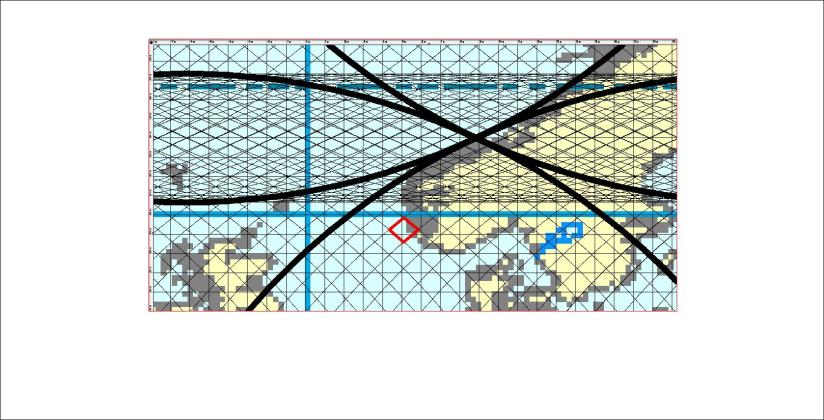
The Glacier Lagoon and the 64th parallel

The lowest and highest points of Iceland are found side by side in the SE. The area is far from the rift zone, still the convection cells below at 120 km depth are divergent, creating tension to the east and west. The effect of this tension should be noticed at the surface, explaining the unusual lowering of the bedrock which is found just east of Öræfajökull forming the Glacier Lagoon.

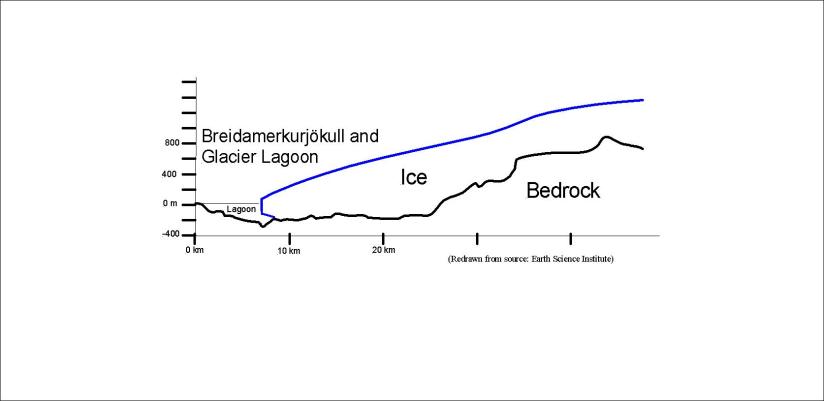
A section of the Glacier Lagoon and the glacier tongue Breiðamerkurjökull looks like this:

Jökulsárlón - þverskurður

This shows us that in the future the Glacier Lagoon will probably become about four times longer than it is today. The expansion of it should also slow down soon as can be reckoned from the drawing.

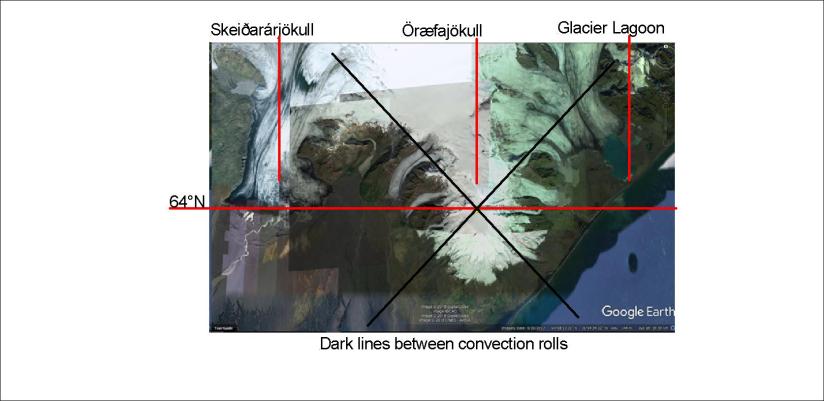
The Glacier Lagoon is in the range of influence of the 64th parallel, just as the edge of Skeiðarárjökull and the top of Öræfajökull. The forces of the convection cells at this parallel make us surprised, and as can be seen from the comparison on Google Earth map, the coastline follows the direction of convection rolls underneath, as well as the edges of the glacier.

The guides of the boats on the lagoon often mention the coincidence that the highest and lowest points of Iceland are found side by side, as the lagoon is over 300 meters deep while Öræfajökull is 2110 meters high. But there are reasons for everything!

Öræfajökull - Jökulsárlón - 64N

This can be compared with a former post about the Vatnajökull polygon.

Uncategorized

What is happening today close to Grímsey – calculated!

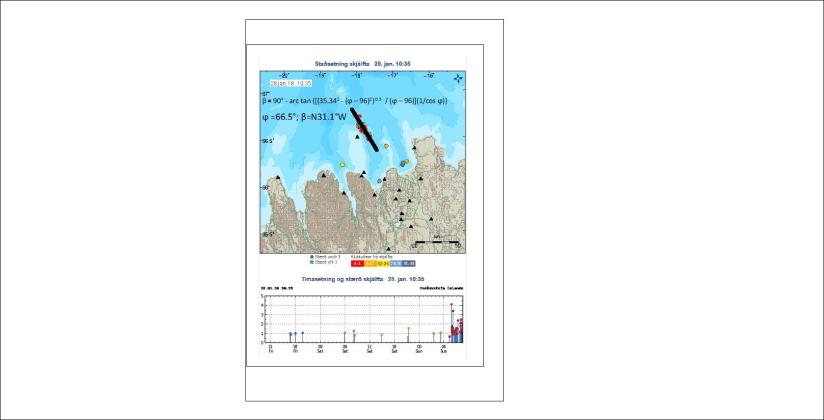
I had a look at the site of Veðurstofa Íslands (Met Office) and saw a good example of earthquakes lined up in a familiar way.

As the tectonic framework is mainly derived from mantle currents, the alignment of earthquakes can sometimes be calculated:

Grímsey - blogg

I have inserted the formula for the convection cell alignment and the relevant line for the direction. Sure it fits!

Uncategorized

The reference to North in the name of Norway

It is said that the name Norway is actually shortening of Norðurvegur, that is Northern Way. It refers to a sailing route between the island Karmoy and the mainland of Norway. The whole area is actually aligned N-S, as can be seen here:

Karmoy

The N-S oriented tectonics have their origins in the symmetry of the relevant polygon.

Here it is marked with red:

Karmoy polygon

The coasts of Karmoy are at the central axis of the relevant polygon.


Uncategorized

Is it useful to be able to calculate the direction of tectonic features?

The answer is yes! When the most likely and most active tectonic alignment can be predicted mathematically, money can be saved and money can be earned by making use of the predictive qualities of calculations instead of rather random or intuitive research, often with expensive drilling equipment or hiring expensive experts etc. Here is one example from the Snæfellsnes Peninsula in Iceland:

Snæfellsnes - formula

The fault found is marked with red, and calculated tectonic direction is drawn with black line. They obviously fit together.

Whereas tectonic features can be predicted and compared with the Convection Cell Model, hopefully this will help avoiding the waste of money and make geological research more effective in the future.