
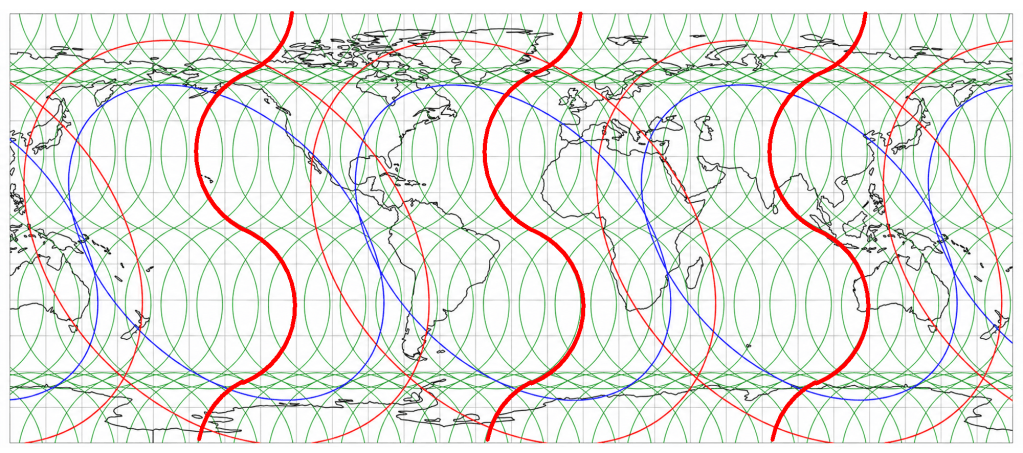
The accompanying illustration compares the proposed system of lower-mantle convection rolls with the three global tectonic rings. According to the Convection Rolls Model, the lower-mantle rolls occupy two superimposed layers extending from approximately 670 km to 2,900 km depth, with their projected patterns partly overlapping. The general concept of mantle convection is familiar from introductory geology textbooks, which commonly illustrate the circulation of mantle material by means of paired convection cells. Similarly, the concept of a tectonic ring is familiar through the widely recognized Pacific Ring of Fire. A comparison of these two features suggests that they may represent related expressions of recurring geometrical patterns within the Earth.
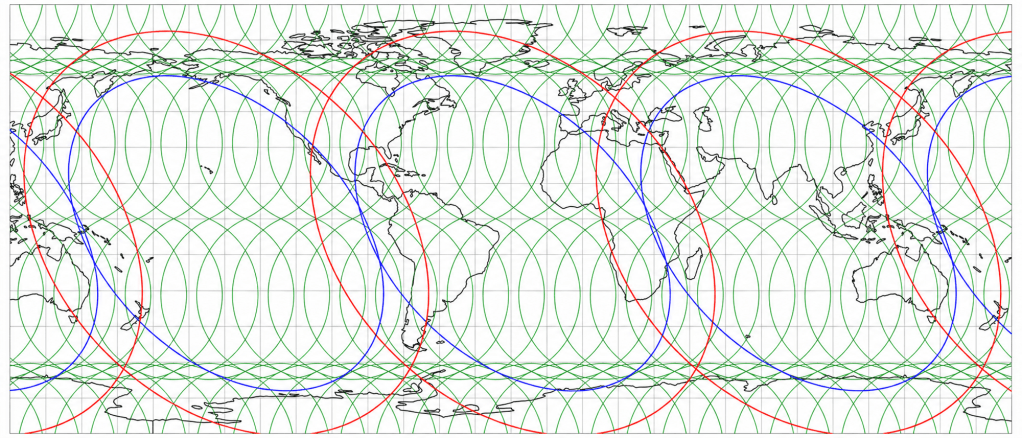
At first glance, the mirrored arrangement of the green lines may appear confusing. This is because the illustration represents a three-dimensional convection system in two dimensions, with the patterns of two vertically superimposed layers projected onto a single geographical plane. Each lower-mantle convection roll extends approximately 15° from east to west, and the rolls are arranged side by side within their respective layers. The smaller convection rolls of the upper mantle, extending between approximately 120 and 670 km depth, are considerably more numerous. They are represented in the model by four layers of rolls, each approximately 1.5° wide. These smaller rolls are not included in the present illustration.
The Mid-Atlantic Ridge can be traced through the central region of the Atlantic tectonic ring, while the mid-ocean ridge system of the Indian Ocean occupies a corresponding position within the Indian Ocean ring. The Pacific Ocean requires particular consideration because of its extensive convergent plate boundaries along both its eastern and western margins, together with the divergent boundary represented by the East Pacific Rise.
The two-sided nature of the Pacific tectonic system is particularly relevant when considering the geometrical relationships of Antarctica. The Antarctic elliptical structure has two principal axes, each with two endpoints. These four directions appear to correspond to four major branches of the proposed global tectonic framework. One endpoint of the minor axis extends towards New Zealand, while the opposite endpoint points towards the Mid-Atlantic Ridge. Similarly, one endpoint of the major axis is associated with the East Pacific Rise, whereas the other corresponds to the region of the Indian Ocean ridge system and its triple junction.
In the proposed model, the three tectonic rings are represented by elliptical structures. The inner ellipse spans approximately 120° of longitude along the equator and has a major-to-minor axis ratio of 3:2. Its major axis is oriented NW–SE, at an angle of 45° to the north–south and east–west directions. On an equirectangular map, where each degree of longitude and latitude is represented by an equal unit of length, this orientation corresponds to a slope of −1.
The model proposes that the stresses generated by mantle convection provide the mechanical conditions necessary for the formation of these regularly arranged elliptical tectonic structures. Their dimensions are related to the 15° spacing of the lower-mantle convection rolls, which influence the smaller convection systems within the transition zone and asthenosphere. The width of the tectonically active zones may exceed the 15° width of an individual lower-mantle roll because of the additional effects of the smaller convection rolls in the overlying mantle.
The present distribution of geological activity and the dynamics of plate motion can be compared with this geometrical framework. Several relevant relationships have already been identified in connection with Antarctica. The Gulf of California and the Red Sea, for example, provide an interesting comparison because both occur at similar latitudes and are associated, in this interpretation, with the margins of elliptical tectonic structures.
Other examples can be identified throughout the world. New Zealand, Japan and Kamchatka are associated with the western Pacific tectonic system. The East African Rift, the volcanically active parts of the Mediterranean region and Iceland can be examined in relation to different sections of the Atlantic tectonic ring. Similarly, the western margin of South America follows a major convergent boundary associated with the Pacific tectonic ring.
Many of these locations have already been examined in previous articles. Comparing their geological characteristics with the proposed geometrical framework may help explain relationships between divergent boundaries, convergent boundaries, volcanic activity and the underlying mantle convection system.
It is important, however, to distinguish between the geometrical relationships demonstrated by the model and the dynamic processes that may produce them. The geometrical arrangement provides a framework within which present-day geological structures can be compared, while plate motions continuously modify the position and character of tectonically active zones. The proposed system is therefore not intended to represent a static Earth, but rather a recurring geometrical organization within an evolving tectonic environment.
The most immediately recognizable feature of the illustration is the large-scale division of the Earth’s tectonic framework into three principal systems associated with the Atlantic, Pacific and Indian Oceans. These are represented by the three global tectonic rings, whose geometrical relationships can be examined alongside the proposed system of mantle convection rolls.
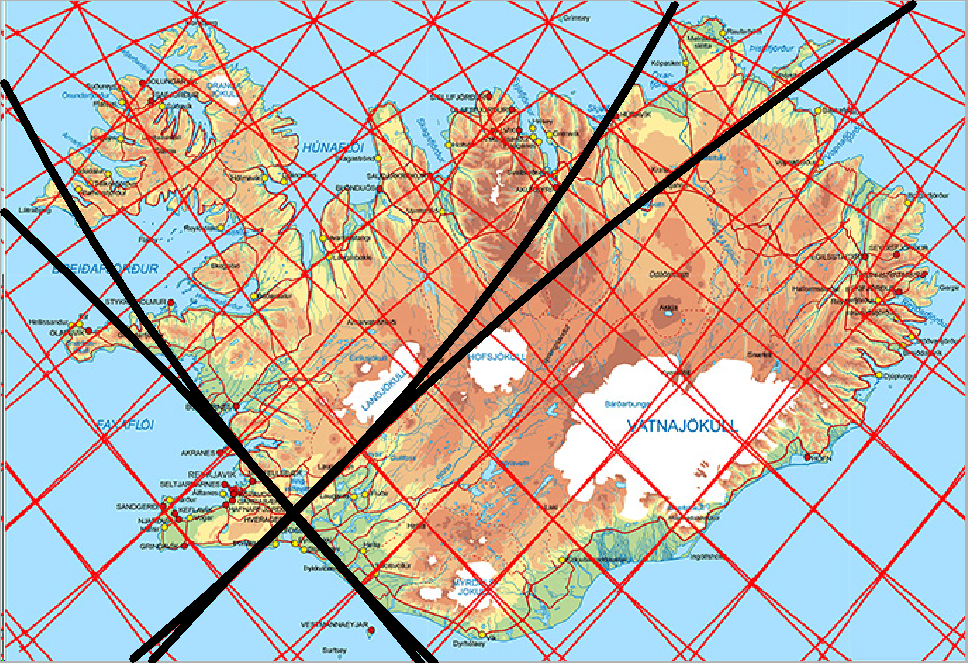

The mountain Reykjafell and the town of Hveragerði.
Convection and tectonic rings relationship:
Mechanical Analysis of the Relationship Between Mantle Convection Rolls and Elliptical Tectonic Rings
1. Principal findings
The proposed relationship between mantle convection rolls and the three global tectonic rings can be examined using the mechanics of viscous flow, shear stress, and deformation of the overlying lithosphere.
The objective is to determine whether the interaction of two superimposed systems of mantle convection rolls, arranged at 15° intervals, can generate an elliptical stress field with two characteristic geometrical properties:
- A major axis oriented NW–SE, at 45° to the coordinate axes of the world map.
- A major-to-minor axis ratio of 3:2.
The mathematical analysis produces two important preliminary results.
First, a 45° orientation can arise naturally from a shear-stress field, provided the two horizontal normal stresses are equal and the shear component is nonzero.
Second, an elliptical field with an axis ratio of 3:2 can be represented mathematically by a specific combination of isotropic and directional components. This gives a quantitative condition that a mechanical model would have to reproduce.
Neither result, by itself, establishes that mantle convection generates the proposed tectonic rings. However, both provide precise conditions against which the model can be tested.
2. Derivation of the 45° orientation
Consider a horizontal plane within the lithosphere or upper mantle, with the \(x\)-axis directed eastward and the \(y\)-axis northward.
The horizontal stress tensor can be expressed as
\[ \boldsymbol{\sigma}= \begin{pmatrix} \sigma_{xx}&\tau_{xy}\\ \tau_{xy}&\sigma_{yy} \end{pmatrix} \]
where \(\sigma_{xx}\) and \(\sigma_{yy}\) represent normal stresses and \(\tau_{xy}\) represents shear stress.
The orientation of the principal stress axes is determined by
\[ \tan(2\theta)= \frac{2\tau_{xy}}{\sigma_{xx}-\sigma_{yy}} \]
Suppose that the interaction of the two convection-roll systems produces approximately equal normal stresses in the east–west and north–south directions:
\[ \sigma_{xx}=\sigma_{yy} \]
If the shear stress is nonzero, the principal directions are then
\[ \boxed{\theta=\pm45^\circ} \]
Thus, the axes of the stress tensor become aligned NE–SW and NW–SE.
This result is significant because it shows that a 45° orientation does not necessarily have to be imposed as an initial geometrical condition. It can arise from the mechanics of a shear-dominated system.
However, the important question remains whether the proposed arrangement of mantle convection rolls actually generates the required stress components.
In particular, equal and opposite shear stresses from two perfectly symmetrical layers could cancel. A persistent diagonal stress field would therefore require a suitable asymmetry, coupling, or phase relationship between the two systems.
3. Derivation of the elliptical axis ratio
To investigate the proposed elliptical geometry, consider a simplified quadratic scalar field:
\[ \Phi(x,y)=A(x^2+y^2)+2Bxy \]
This field represents a possible mathematical description of the spatial distribution of a mechanical potential or another scalar quantity related to deformation. It is not yet a stress field derived from the equations of mantle flow.
The term \(A(x^2+y^2)\) is rotationally symmetric, while the term \(2Bxy\) introduces directional anisotropy.
For \(A>|B|\), the contours of constant \(\Phi\) are ellipses.
When \(B>0\), their major axes lie NW–SE, with a slope of −1 on the rectangular coordinate grid.
The axis ratio is
\[ \frac{a}{b}= \sqrt{\frac{A+B}{A-B}} \]
For the proposed inner tectonic ellipse,
\[ a=77.7^\circ,\qquad b=51.8^\circ \]
and therefore
\[ \frac{a}{b}=1.5 \]
Substituting gives
\[ 2.25=\frac{A+B}{A-B} \]
Solving for the relative anisotropic component:
\[ \boxed{\frac{B}{A}=\frac{5}{13}\approx0.3846} \]
This means that, within this particular quadratic representation, the directional coupling coefficient must be approximately 38.46% of the isotropic coefficient.
An especially simple illustration is obtained by setting \(A=13\) and \(B=5\):
\[ \Phi(x,y)=13x^2+10xy+13y^2 \]
Rotating the coordinate axes by 45° transforms this expression into
\[ \boxed{\Phi(u,v)=8u^2+18v^2} \]
where \(u\) runs NW–SE and \(v\) runs NE–SW.
The corresponding axis ratio is exactly
\[ \frac{a}{b}=\sqrt{\frac{18}{8}}=1.5 \]
This reproduces the proposed 3:2 geometry.
The result provides a useful quantitative target: a future mechanical calculation must explain how the interaction between the convection rolls could produce the required anisotropy, rather than simply assuming it.
4. Transmission of stresses between the two mantle layers and the lithosphere
The next question concerns the physical transmission of forces.
In the proposed model, two vertically superimposed systems of lower-mantle convection rolls have characteristic horizontal spacing of 15°. Their interaction may produce variations in horizontal velocity and shear stress, which can be transmitted through the overlying mantle.
For a simplified Newtonian viscous layer, the transmitted shear stress can be approximated by
\[ \tau=\eta\frac{\Delta v}{h} \]
where:
- \(\eta\) is the dynamic viscosity.
- \(\Delta v\) is the relative horizontal velocity between adjacent layers.
- \(h\) is the thickness over which the velocity difference occurs.
Consider an illustrative case in which
\[ \eta=10^{20}\ \mathrm{Pa\,s} \]
\[ \Delta v=0.05\ \mathrm{m/yr} \]
\[ h=100\,000\ \mathrm{m} \]
The resulting shear stress is approximately
\[ \boxed{\tau=1.58\ \mathrm{MPa}} \]
This is a potentially significant stress magnitude. However, it is only a scale estimate. The assumed velocity difference, viscosity and effective shear-layer thickness have not been derived from the proposed convection system.
Furthermore, the lower-mantle rolls do not act directly on the lithosphere. Their influence must be transmitted through the intervening mantle, whose viscosity, circulation and boundary conditions affect the resulting forces.
A more complete mechanical model must therefore describe the stress transmitted to the base of the lithosphere as a function of the velocity fields in the different mantle layers.
The horizontal force balance in a simplified thin-sheet representation of the lithosphere can be expressed as
\[ \boxed{ \nabla_h\cdot(H\boldsymbol{\sigma}_h) +\boldsymbol{\tau}_b +\mathbf f_{\mathrm{edge}}=0 } \]
where \(H\) is lithospheric thickness, \(\boldsymbol{\sigma}_h\) is horizontal stress, \(\boldsymbol{\tau}_b\) is basal traction transmitted by mantle flow, and \(\mathbf f_{\mathrm{edge}}\) represents other forces or boundary effects.
The important distinction is that the stress field must be calculated from the imposed mantle flow and the response of the lithosphere. The desired ellipse cannot be prescribed as part of that calculation if the objective is to explain its formation.
5. Can a system of 15° convection rolls produce tectonic structures at 120° intervals?
The proposed lower-mantle system contains 24 regularly spaced units around the equator:
\[ 360^\circ/15^\circ=24 \]
The three tectonic rings have centers separated by 120°:
\[ 360^\circ/120^\circ=3 \]
Consequently,
\[ \boxed{120^\circ=8\times15^\circ} \]
This is an exact geometrical relationship within the proposed model.
However, the mechanical implications require closer examination.
A perfectly regular system of identical convection rolls with 15° spacing produces a forcing pattern that repeats every 15°. Superimposing two such patterns, even with a fixed phase difference, does not automatically generate a larger structure repeating only every 120°.
To obtain three tectonic systems, the model requires an additional organizing mechanism.
One possibility is the collective interaction of groups of eight lower-mantle rolls. Another is a larger-scale pattern arising through nonlinear interactions, instability, or the boundary conditions imposed by the lithosphere.
These possibilities are mechanically conceivable, but none follows uniquely from the 15° spacing.
The relationship between 15° and 120° should therefore be treated as a geometrical constraint that the mechanical model must explain, rather than as an established mechanism for the formation of three tectonic rings.
6. Important constraints on the proposed elliptical geometry
Two additional questions arise when the mathematical result is compared with the geometry used in the model.
Different proportions of the inner and outer ellipses
The inner ellipse has
\[ \frac{a}{b}=\frac{77.7}{51.8}=1.500 \]
The outer ellipse has
\[ \frac{a}{b}=\frac{96.5}{71.0}\approx1.359 \]
The two boundaries therefore have different proportions.
This is important because the contours of the simple quadratic field derived in Section 3 would all have the same axis ratio.
Consequently, one constant quadratic field cannot reproduce both boundaries exactly.
A more realistic model would require either spatially varying anisotropy, more complex stress distribution, or different mechanical criteria for the inner and outer boundaries.
The existence of a tectonically active belt between the two ellipses also introduces another condition: the model must explain why deformation becomes concentrated within that belt rather than being distributed continuously across the entire region.
Geographical versus physical orientation
The 45° orientation has so far been defined on an equirectangular map, using equal numerical units for longitude and latitude.
That is appropriate for constructing the proposed geometrical model, but it is not equivalent to a constant geographical bearing on the spherical Earth.
For example, a line having a slope of −1 on the map makes an angle of approximately 40.3° west of north, rather than 45°, when evaluated locally at latitude 32°N.
A physical calculation of stress and deformation must use distances on the spherical Earth, or an appropriate local coordinate system, and then transform the results back onto the world map.
This distinction matters when comparing the proposed ellipse axes with measured tectonic stress orientations.
7. The physical significance of mantle rotation
A further limitation concerns the original derivation of the circular convection-roll geometry.
The proposed radius
\[ R=35.341^\circ \]
was developed through an analogy with the Coriolis effect and inertial circulation.
For ordinary mantle-convection conditions, however, standard geodynamics treats mantle motion as extremely slow, highly viscous Stokes flow. Direct Coriolis forces are generally considered negligible compared with viscous and buoyancy forces.
ScienceDirect
+1
This can be illustrated by comparing the characteristic Coriolis and viscous force densities:
\[ \frac{F_{\mathrm{Coriolis}}}{F_{\mathrm{viscous}}} \sim \frac{2\rho\Omega L^2}{\eta} \]
Using representative values of mantle density, rotation rate, characteristic length and viscosity,
\[ \rho=4500\ \mathrm{kg/m^3},\quad L=1000\ \mathrm{km},\quad \eta=10^{21}\ \mathrm{Pa\,s} \]
gives
\[ \boxed{ \frac{F_{\mathrm{Coriolis}}}{F_{\mathrm{viscous}}} \approx6.6\times10^{-10} } \]
Under these assumptions, the direct rotational force is negligible.
This does not prevent the proposed circular geometry from being investigated as a geometrical hypothesis. It does mean that the radius of 35.341° cannot presently be regarded as a mechanically demonstrated consequence of the Coriolis effect in the mantle.
An alternative physical derivation, or independent observational evidence for the proposed geometry, would be needed.
8. Proposed numerical investigation
The mathematical results suggest a practical route for testing the model.
The starting point would be a three-dimensional viscous-flow model of two interacting mantle layers. The proposed circular geometry, 15° spacing and possible phase differences could be used as initial or prescribed conditions.
The governing equations would include the Stokes momentum balance and conservation of mass:
\[ -\nabla p+ \nabla\cdot(2\eta\mathbf D) +\rho\mathbf g=0 \]
\[ \nabla\cdot\mathbf u=0 \]
where \(\mathbf u\) is the velocity field and \(\mathbf D\) is the strain-rate tensor.
The calculated mantle flow could then be coupled to a deformable upper layer representing the lithosphere.
The resulting stress field would be examined for the following predictions:
| Property | Target from the proposed model |
|---|---|
| Principal directions | NW–SE and NE–SW |
| Inner ellipse axis ratio | 1.500 |
| Outer ellipse axis ratio | 1.359 |
| Tectonic ring center spacing | 120° |
| Mantle-roll center spacing | 15° |
| Location of deformation | Concentration within elliptical belts |
The decisive test would be whether these properties emerge from plausible flow velocities, viscosity distributions and boundary conditions without imposing the elliptical geometry beforehand.
Successful reproduction of the geometry would then need to be followed by comparison with independently measured plate velocities, stress orientations, seismicity and mantle structure.
9. Conclusions
The preliminary analysis establishes that a two-dimensional stress or deformation system can possess the fundamental geometrical characteristics proposed for the tectonic rings.
A shear-stress tensor with equal horizontal normal stresses has principal directions inclined at 45° to the coordinate axes. This provides a possible mechanical explanation for a diagonal structural orientation.
Furthermore, a quadratic scalar field of the form
\[ \Phi(x,y)=A(x^2+y^2)+2Bxy \]
reproduces an NW–SE elliptical geometry with an axis ratio of 3:2 when
\[ \boxed{\frac{B}{A}=\frac{5}{13}} \]
These are exact mathematical results within their respective assumptions.
Nevertheless, several essential mechanical relationships remain undetermined. In particular, it has not yet been demonstrated that the interaction between the proposed lower-mantle convection rolls creates the necessary shear-stress components, generates a persistent 45° orientation, or produces the required anisotropy.
The regular correspondence between eight 15° units and the 120° separation of the tectonic rings also requires an explanation involving the collective organization of mantle flow.
Finally, the difference between the proportions of the inner and outer ellipses indicates that a simple, spatially uniform quadratic model is insufficient to describe the full tectonic structure.
The principal conclusion is therefore that the proposed geometry is mathematically compatible with certain anisotropic mechanical fields, but its formation has not yet been derived from mantle convection.


