
Starting from the possible sixfold division around Antarctica, it is possible to examine how this geometry relates to the tectonic plates and major tectonic systems outside the Antarctic region.
The Pacific Ring of Fire is particularly important in this respect because its geometry can be analysed in considerable detail. When examined in relation to the Mantle Convection Roll model, its overall form becomes even more clearly defined.
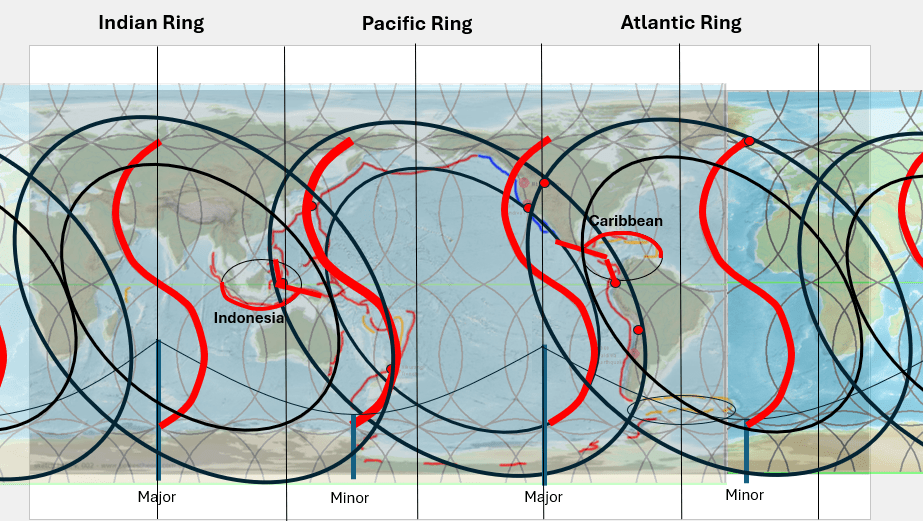
shown in relation to the 60° sector division around Antarctica.
The three overlapping systems each span approximately 120° between their inner boundaries,
providing a possible geometric connection between the pole-centred Antarctic structure
and the major tectonic systems surrounding the globe.
Several key locations show remarkably simple angular relationships when measured from the geographic South Pole. For example, the angle between the directions towards the Alpine Fault in New Zealand and Yellowstone is approximately 90°. This corresponds with another geometric relationship already identified: the Alpine Fault lies close to the continuation of the minor axis of the Antarctic ellipse, whereas Yellowstone lies close to the continuation of its major axis.
Thus, two major parts of the Ring of Fire can be related directly to the two perpendicular axes of the Antarctic geometry. The Ring of Fire also extends southward into the Antarctic tectonic system. This makes it possible to examine its geometry not only as a Pacific feature, but as part of a larger global arrangement.
From 90° and 45° to 60° and 120°
The two principal axes associated with the geometry of the Ring of Fire are themselves inclined by approximately 45° relative to one another in the larger construction used here. Once the possible 60° sector division around Antarctica is introduced, another question naturally follows:
How does the geometry of the Ring of Fire relate to 60° and 120° angular divisions? An interesting relationship appears at the equator, as the outer limits of the Pacific Ring of Fire, measured approximately from Indonesia to the western margin of South America, span about 150° of longitude.
However, the inner margins of the Ring of Fire lie approximately 15° inward from each outer margin.
Therefore we get; 150° − 15° − 15° = 120°, so the effective width of the inner Ring of Fire is consequently about 120°.
This is particularly significant because 120° is exactly one third of a complete circle: 360° / 3 = 120°.
It therefore becomes possible to construct three comparable great tectonic ring systems around the Earth, each displaced by approximately 120° from the next.
These may provisionally be called:
1. The Pacific Ring of Fire
2. The Indian Ocean Ring
3. The Atlantic Ring
The Pacific Ring is by far the most conspicuous of the three because the tectonic boundaries around the Pacific are exceptionally well developed: long subduction zones, major transform systems, volcanic arcs and associated seismic belts together produce the familiar Ring of Fire.
The other two proposed rings are less visually obvious. Their boundaries are interrupted by continents, ocean basins and tectonic systems of different ages, and they have not generally been considered as parts of equivalent circular structures. Nevertheless, when their positions are examined in the same geometric framework, substantial agreement with known geological features becomes apparent.
Three overlapping 120° systems
The important point is that these three rings should not necessarily be imagined as three completely separate circles placed side by side, and they overlap.
If three equivalent rings are arranged around the globe so that the inner margins of neighbouring rings meet or intersect at the principal division points, a repeating global pattern is produced. In this construction, each ring occupies approximately a 120° internal sector, while the outer tectonic expression may extend farther and overlap with the neighbouring ring.
This overlap may be geologically important. The Pacific Ring of Fire itself becomes easier to understand when viewed in this way.
Kermadec–Tonga and the overlap with the Indian Ocean Ring
One of the most interesting examples is the Kermadec–Tonga system. Kermadec–Tonga lies noticeably inside the broader geometrical outline of the Pacific Ring of Fire rather than simply following its outermost boundary. In a model based only on a single Pacific ring, this position appears somewhat anomalous.
However, if the Indian Ocean Ring overlaps the Pacific Ring, the position of Kermadec–Tonga becomes much more natural. It lies within the zone where the two systems interact.
Thus, what may initially appear to be an irregularity in the Pacific Ring may instead represent the superposition of two larger tectonic geometries:
Pacific Ring + Indian Ocean Ring.
This would also help explain why the southwest Pacific is tectonically much more complicated than a simple elliptical outline would suggest. The region around New Zealand, Kermadec, Tonga, Fiji and the neighbouring back-arc systems lies precisely where different large-scale tectonic systems would be expected to overlap.
In this interpretation, the complexity is therefore not necessarily evidence against the larger geometry. It may actually be one of its consequences.
Antarctica as the geometric reference
Antarctica provides an unusually useful reference system for examining these relationships because several different geometries appear to be centred on, or organized around, the South Polar region.
At least three levels can be distinguished:
A global rather than a regional geometry
The important point is not simply to draw three circles on a map and search for features that happen to lie upon them. The relevant question is whether independently mapped geological structures repeatedly coincide with the predicted boundaries, axes, intersections and overlap zones.
The Pacific Ring of Fire provides the clearest test because its tectonic structure is so well mapped. Its inner and outer margins can be distinguished, its major axes can be compared with Antarctic geometry, and key locations such as the Alpine Fault, Yellowstone and Kermadec–Tonga provide additional geometric constraints.
If the same construction can then be followed through the Indian Ocean and Atlantic regions, using independently mapped ridges, subduction zones, continental margins, transforms and other major tectonic boundaries, the comparison becomes considerably more significant.
The proposed relationship can therefore be summarized as:
Antarctic 60° sectors
→ pairs of sectors forming 120° divisions
→ three overlapping tectonic rings around the Earth.
The three proposed systems are:
Pacific Ring of Fire — Indian Ocean Ring — Atlantic Ring.
Of these, the Pacific Ring is presently the clearest geological expression. The Indian Ocean and Atlantic rings require more detailed examination, but their predicted positions already coincide with several major tectonic structures.
Perhaps most importantly, viewing the three rings together does not weaken the familiar geometry of the Pacific Ring of Fire. It may actually make it more complete, because features such as the inward position of the Kermadec–Tonga system can be interpreted as the result of overlap between neighbouring global tectonic systems rather than as departures from the general pattern.


