
Recent work on the East Antarctic Fan-shaped Basin Province (EAFBP) has added an important new element to the large-scale tectonic interpretation of Antarctica. The newly described subglacial basin system in East Antarctica appears, in map view, as a broad fan-shaped arrangement of basins extending across a major sector of the Antarctic continent. When this pattern is placed into the wider geometric context of the Antarctic Plate, it becomes especially interesting. It falls within one of the principal quadrants of the Antarctic tectonic framework and appears to support the broader view that Antarctica has been structurally organized around the South Pole.
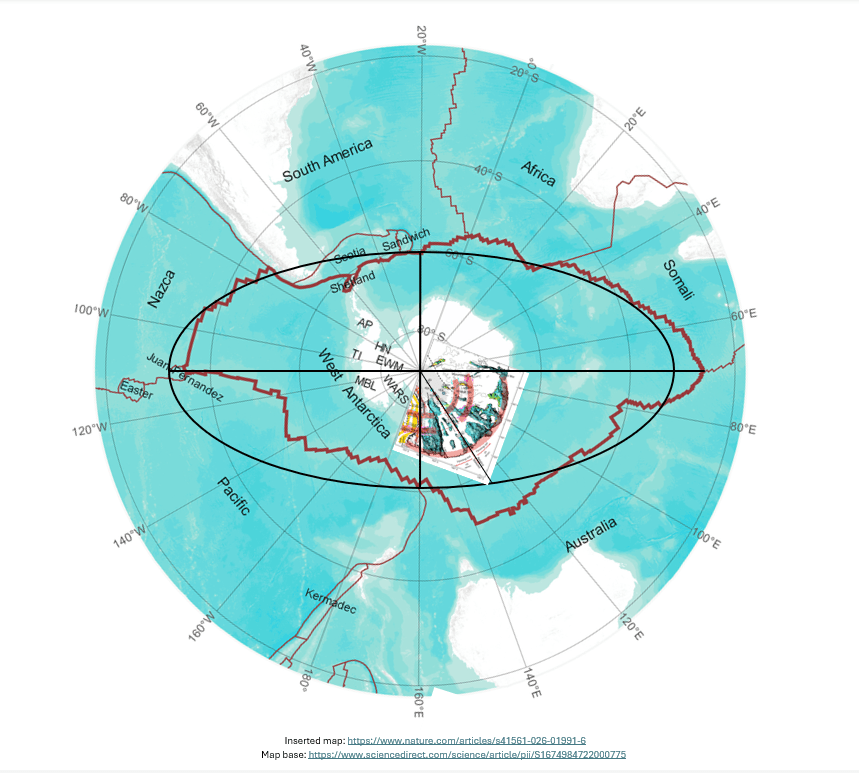
with the elliptical form imposed.
In the interpretation proposed here, the fan-shaped basin province should not primarily be understood as the result of “rotational extension” in the conventional tectonic sense. That description may be useful as a secondary geometric effect, because the basin pattern does indeed resemble a system opening around a polar pivot. However, the deeper cause is interpreted differently. The main driving mechanism is proposed to be the mantle convection roll system, whose geometry is itself controlled by the rotation of the Earth. In that framework, the tectonic structures observed at the surface are not independent phenomena, but rather the upper expression of a mechanically organized global flow system.
The significance of the EAFBP is therefore not only that it reveals a remarkable basin province beneath the East Antarctic Ice Sheet, but also that it provides an additional geometric marker that can be compared with the larger Antarctic pattern. The province occupies, broadly, the sector from about 70°E to 160°E, which corresponds closely to one of the major 90-degree quadrants previously identified in the Antarctic tectonic geometry. When an elliptical form is imposed on a base map of the Antarctic Plate, this fan-shaped province falls neatly into the relevant eastern quadrant. That agreement is striking, because it suggests that the basin province is not randomly located, but is related to the same organizing framework that also defines the larger Antarctic shape.
This supports the idea that Antarctica has been shaped in a fundamentally pole-centred way. The continent is not simply a passive remnant of Gondwana later modified by local tectonic events. Rather, its large-scale geometry appears to reflect long-term organization around the South Pole, with sectors, axes, and boundaries corresponding to the underlying structure of the mantle flow field. In this view, the approximately elliptical form associated with Antarctica is not merely descriptive. It expresses a real structural order connected to the way mantle flow has been organized beneath the plate over geological time.
A key point in this interpretation is that the Earth’s rotation influences the structure of the mantle convection system. The convection rolls are not assumed to form arbitrarily. Instead, they are organized into a systematic pattern shaped by planetary rotation, including stronger and more coherent flow components associated with the equatorial zone and weaker components toward the poles. This difference in flow intensity has major tectonic consequences. Around Antarctica, it implies that the main continental mass remained largely within the high-latitude, polar part of the system, whereas Australia came to occupy a more marginal position relative to the Antarctic-centered framework.
That distinction may help explain why Australia separated from Antarctica. In this interpretation, Australia lay outside the principal polar ring, whereas most of the remaining Antarctic continental mass remained within the zone bounded near 64°S. The mantle currents extending outward from the equatorial regions are interpreted as significantly stronger than those active near the poles. As a result, Australia was subjected to a stronger northward-directed pull by the mantle flow system, while the Antarctic remainder stayed more closely tied to the polar domain. The eventual separation of Australia is therefore interpreted not simply as a local rifting event, but as the consequence of a broader contrast between strong equatorward mantle flow and weaker polar circulation.
This also gives a broader meaning to the structural boundaries found near 64°N and 64°S. These latitudes are interpreted as significant because they mark transitions between different parts of the mantle convection roll system. In other words, the tectonic and geometric organization seen near those latitudes reflects a deeper change in the style or strength of mantle flow. In the Antarctic case, the continental mass within the polar zone remained organized around the pole, while the portion extending beyond that structural limit—most notably Australia—became increasingly subject to the stronger traction of lower-latitude flow.
From this perspective, the fan-shaped basin province described in East Antarctica may be viewed as a valuable new observational constraint. Its geometry is real and important, but its significance lies less in the idea of self-contained rotational extension and more in the fact that it records how the Antarctic lithosphere responded to the larger mantle-flow architecture. The fan shape may therefore be seen as a surface expression of stress and deformation imposed by the convection system, rather than as the primary driving mechanism. “Rotational extension,” if used at all, should thus be treated as a descriptive term for the resulting geometry, not as the fundamental explanation.
The broader conclusion is that Antarctica appears to have evolved as a pole-centred tectonic system, shaped by mantle-flow organization around the South Pole and ultimately governed by the rotational dynamics of the Earth. The newly recognized EAFBP fits well into this framework. When inserted into a base map of the Antarctic Tectonic Plate with the elliptical form imposed, it strengthens the case that Antarctic tectonics is best understood not as a set of isolated regional events, but as part of a coherent global geometric system.
Suggested reference note: This interpretation can be discussed in relation to the 2026 Nature Geoscience paper on the East Antarctic Fan-shaped Basin Province, together with relevant studies on Antarctic tectonic structure, Dronning Maud Land, Prydz Bay, and the tectonic evolution of the Antarctic–Australian sector.


