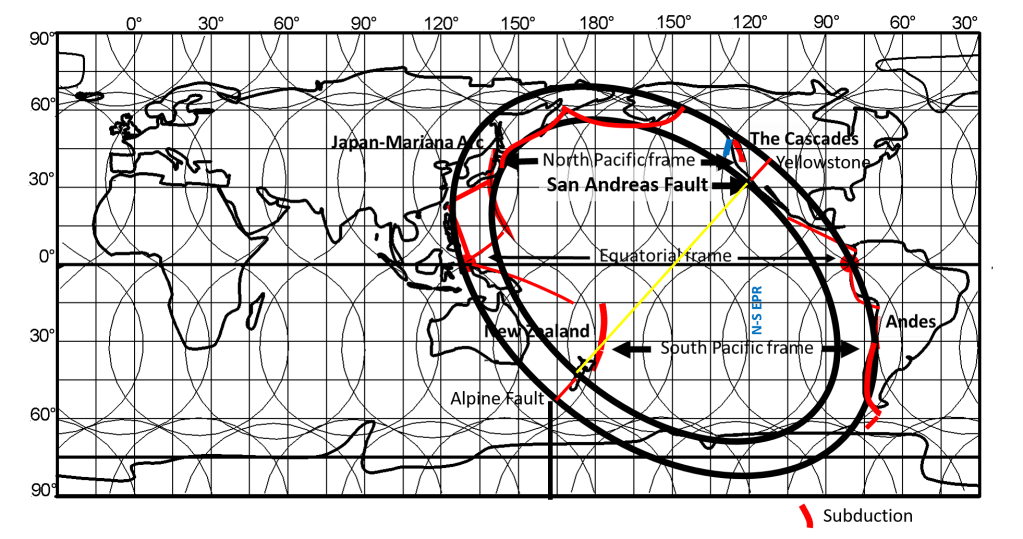
The tectonic settings of the San Andreas Fault in California and the Alpine Fault in New Zealand are comparable in several respects. When the elliptical geometry of the Ring of Fire is constructed, the two faults appear approximately opposite one another on either side of the Pacific, with their positions related to the minor axis of the ellipse. A closer comparison, however, reveals several additional geometric relationships.
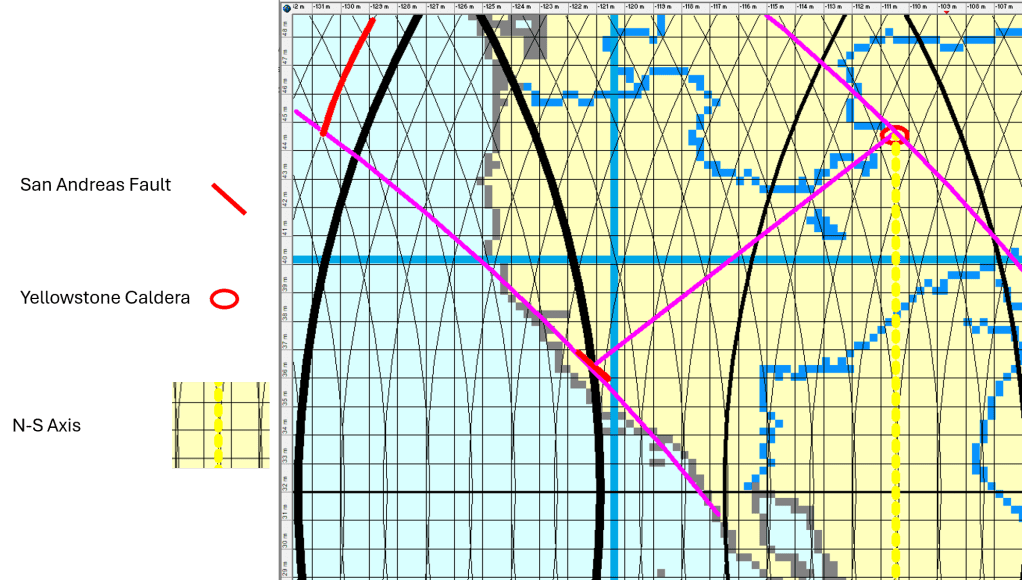
As shown on the maps below, the central parts of both faults coincide with major lower-mantle boundaries predicted by the Mantle Convection Roll system. In the case of the San Andreas Fault, the inner boundary of the Ring of Fire ellipse also closely coincides with the creeping section of the fault. The San Andreas Fault therefore provides one of the clearest examples of the proposed geometric position of the inner boundary of the Ring of Fire. The midpoint of the creeping section, at approximately 36.38°N, 120.98°W, lies on one of the principal boundaries of the lower-mantle roll system.
The northwestern continuation of the San Andreas system is also noteworthy, as it trends toward the southern end of the Juan de Fuca Ridge. From the central part of the San Andreas Fault, a line can then be drawn toward the Yellowstone Caldera. Yellowstone also lies on a north–south axis that, in the geometry developed here, represents a continuation from the major axis of the Antarctic ellipse. This N–S axis also corresponds to a central axis within the Mantle Convection Roll system.
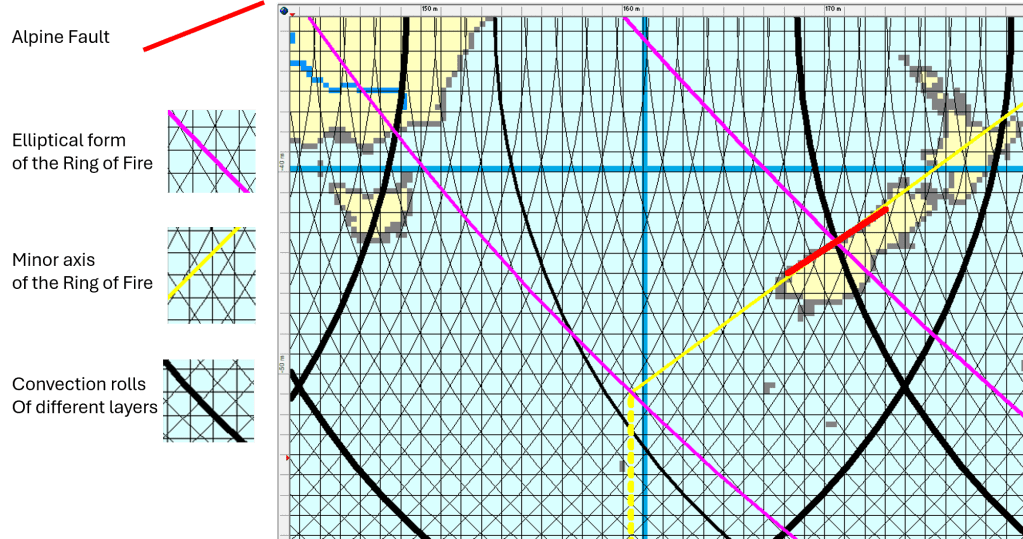
A closely comparable arrangement is found at the Alpine Fault. The central part of the fault lies on a principal lower-mantle boundary, in much the same way as the central part of the San Andreas Fault. The orientation of the Alpine Fault is also approximately parallel to the line connecting the San Andreas Fault with Yellowstone. A second parallel line can therefore be drawn from the central Alpine Fault toward an N–S axis extending from the minor axis of the Antarctic ellipse. This produces a geometric counterpart to the San Andreas–Yellowstone relationship.
The intersection between this N–S continuation of the Antarctic minor axis and the minor axis of the Ring of Fire ellipse defines, in this construction, the outer boundary of the Ring of Fire ellipse. The distance from the Alpine Fault to this intersection is shorter than the corresponding San Andreas–Yellowstone distance. This difference is related to the fact that the four N–S axes used in this geometry are systematically displaced approximately 1.5° eastward from the corresponding system centres of the Mantle Convection Roll model.
The distance between the San Andreas Fault and Yellowstone corresponds to one complete lower-mantle convection-roll interval, equivalent to ten smaller roll intervals. In the Alpine Fault case, the corresponding distance amounts to eight such intervals. According to this geometry, the inner and outer boundaries of the Ring of Fire are therefore not perfectly symmetrical.
Zooming in: The comparison consequently reveals a considerable number of mutually consistent geometric relationships between the San Andreas and Alpine faults: their opposing positions relative to the minor axis of the Ring of Fire, the location of their central sections on major lower-mantle boundaries, the parallel orientation of the faults and their associated connecting lines, and the regular spacing produced by the Mantle Convection Roll system. The following maps are presented to illustrate these relationships and allow the two regions to be compared directly.
Hvað