
Comparing the geometry of Indonesia and the Caribbean reveals a remarkable degree of similarity. Although these two tectonic systems are located on opposite sides of the Pacific realm, many of their large-scale structural relationships appear comparable.
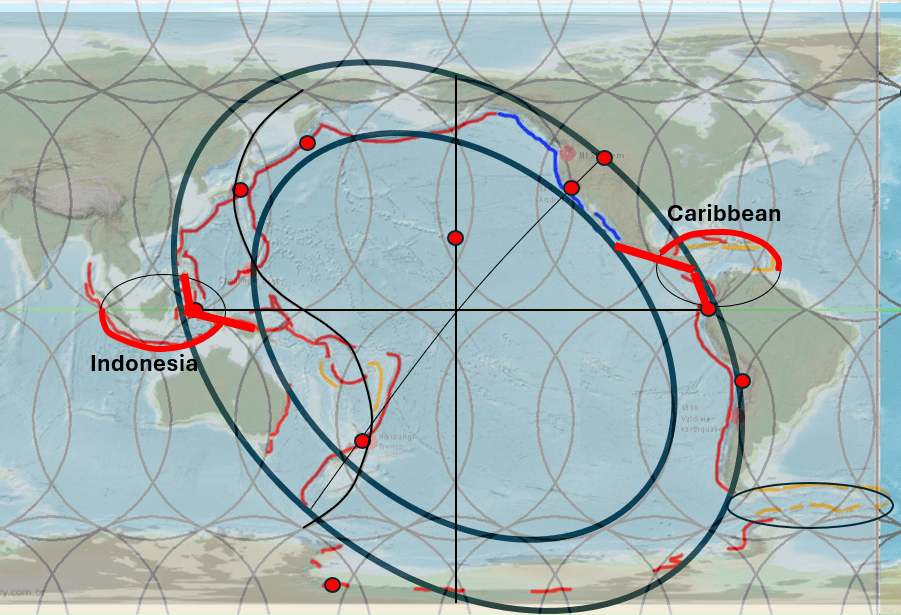
Comparable Subduction and Transform Geometry on Opposite Sides of the Ring of Fire
First, both systems are closely associated with the equatorial region. The Indonesian arc faces southward, with one important eastern endpoint located near the coast of Sumatra. Another major subduction-related crossing appears roughly 30° farther east along the equatorial zone, connected with the subduction framework surrounding the Philippine Plate.
A similar arrangement can be observed in the Caribbean region, although shifted slightly north of the equator. The Caribbean basin is associated with another pair of crossings of lower-mantle flow structures, where subduction-related zones occur at points approximately 30° apart, comparable to the Indonesian case. The Caribbean arc also extends outward in a manner resembling the Indonesian arc.
The Central American Trench stretches from the inner part of the Ring of Fire toward its outer margin, where the division line appears to turn toward the key region of the Peru–Chile Trench near the equatorial framework. This geometry resembles the relationship between the New Guinea Trench and the continuation of the Philippine Trench on the Indonesian side of the Pacific.
In this way, many aspects of the Indonesian and Caribbean plate-boundary systems appear strikingly similar, although effectively rotated by 180° relative to one another.
Considering that these two tectonic regions connect the Pacific Ocean with the Indian Ocean and the Atlantic Ocean respectively, the broader function of this arrangement becomes important to examine. The fundamental span of a 30° convection-roll unit, together with an additional extension east of the eastern crossing points, may help explain the tectonic importance of these paired regions on opposite sides of the Ring of Fire.
South of Indonesia, subduction is the dominant tectonic process, whereas in the Caribbean region transform motion and tectonic transition play a larger role, especially along the northern boundary of the Caribbean Plate. Even so, both systems appear to participate in a broader structural unity within the Ring of Fire.
The anticlockwise rotational tendency associated with the North American sector of the Ring of Fire is consistent with the northward-facing curvature of the Caribbean arc and the southward-facing curvature of the Indonesian arc. At the same time, the long-term expansion of the Atlantic Ocean on one side and the Indian Ocean on the other appears to be buffered near equatorial latitudes by these major subduction and transform systems situated between the large ocean basins.
The similarities are therefore sufficiently striking that they may partly reflect an underlying large-scale geometric organization. At the same time, this comparison leaves many important questions unanswered and suggests several directions worthy of further investigation. Further information: https://pangea.stanford.edu/ERE/db/GeoConf/papers/SGW/2024/Thorbjarnarson.pdf
All of these characteristics of the two archipelagic systems are, of course, well known. They can first be summarized as follows:
- Both archipelagos are associated with the Ring of Fire.
- Both archipelagos are located close to the equator.
- Both archipelagos have a predominantly east–west orientation.
However, when compared within the framework of the mantle convection rolls model, several additional observations can be made:
- When the tectonic features of Central America are included, the overall mathematical framework becomes directly comparable to that of Indonesia.
- The width of both archipelagic systems is comparable when measured in degrees of longitude along their respective latitudes.
- The relative position of both archipelagos appears comparable in the context of the large-scale convection-roll geometry proposed in the mantle convection rolls model.


