
It is well known that the African Tectonic Plate has been drifting relatively slowly compared with many of the surrounding plates. On the opposite side of the globe, the Pacific Plate also appears exceptional in several respects. At its center lies Hawaii, one of the most volcanically active regions on Earth.
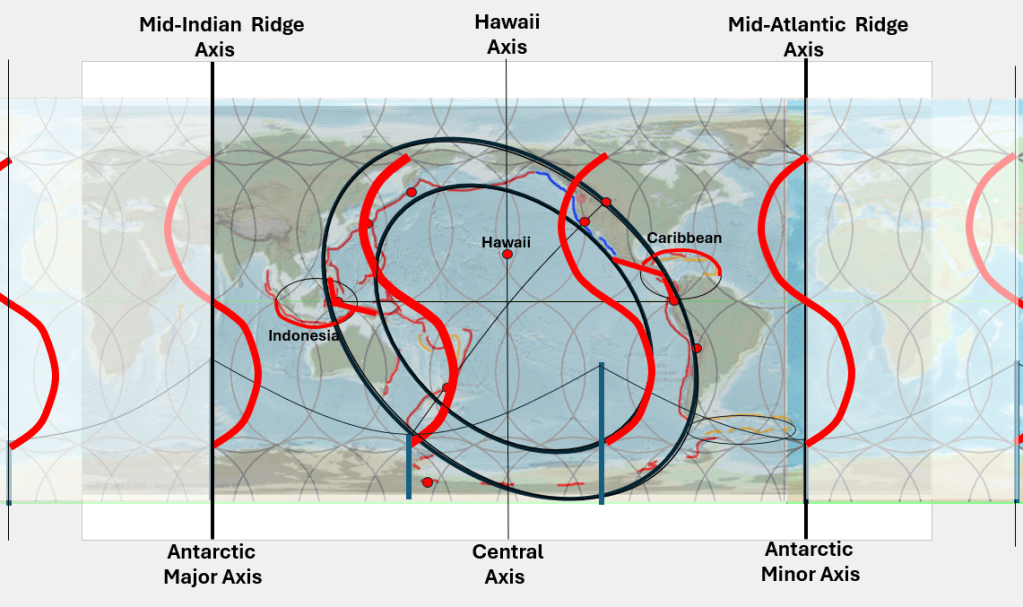
of the Mid-Atlantic Ridge and Mid-Indian Ridge relative to Hawaii.
The S-shaped red lines show the location of the divisions, according to the mantle convection rolls model, associated with the minor and major axes of Antarctica. When the globe is viewed from a Pacific-centered perspective, with Hawaii near the middle of the map, an interesting geometric relationship appears. The theoretical central axes of the Mid-Atlantic Ridge and the Mid-Indian Ridge lie at equal distances from Hawaii. This relationship can best be illustrated with a world map centered on the Pacific Ocean.
In such a representation, the three major mid-ocean ridge systems — the Mid-Atlantic Ridge, the Mid-Indian Ridge, and the East Pacific Rise — together with the principal subduction zones of the western Pacific, appear geometrically connected with the endpoints of the major and minor axes of the elliptical form associated with the Antarctic Tectonic Plate.
Within this framework, Hawaii occupies a particularly central position. It lies midway between the axial region of the Pacific spreading system, represented by the East Pacific Rise, and the extensive subduction systems of the western Pacific Ring of Fire. Seen in this way, Hawaii becomes part of a broader large-scale geometric arrangement linking the Pacific basin, Antarctica, and the global mid-ocean ridge network.
This concept can be illustrated effectively with a Pacific-centered world map, where Africa appears on both outer edges of the projection, emphasizing the symmetry and large-scale relationships of the global tectonic system.


