
The difference between a typical mid-ocean ridge and Iceland can be described as a contrast between a purely divergent process and a more resistant one.
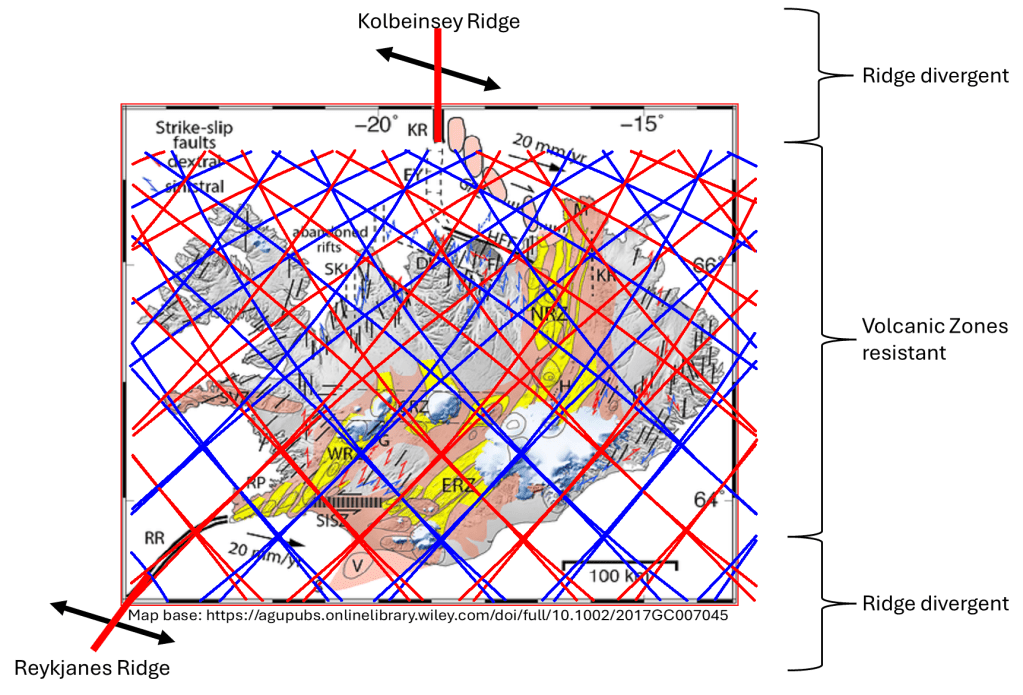
The two ridges to the north and south of Iceland are clearly related, forming parts of what is generally known as the Mid-Atlantic Ridge. However, they are given specific names: the Reykjanes Ridge in the south and the Kolbeinsey Ridge in the north. Iceland is often said to lie on the Mid-Atlantic Ridge, but this can sound misleading, as it is actually situated between these two ridge segments.
If we consider the nomenclature of these sections individually, we can divide the system into three parts from north to south: the Kolbeinsey Ridge, Iceland, and the Reykjanes Ridge. The volcanic zones of Iceland perform the same role in terms of tectonic drift and divergence as the ridge crests do along the mid-ocean ridges. However, these zones are much broader than the narrow rift valleys typically found at ridge tops. This is especially evident in southern Iceland, where two parallel zones, the East and West Volcanic Zones, are present, along with a third adjacent system, the Öræfajökull Volcanic Zone. In northern Iceland, the North Volcanic Zone is currently singular, but a few hundred thousand years ago it was accompanied by a parallel structure, the Skagafjörður Volcanic Belt.
These differences can be better understood by considering mantle flow. At mid-ocean ridges, the sharp, narrow divisions at the ridge crest suggest that tectonic plates diverge with relatively little resistance. In contrast, the development of wide volcanic zones in Iceland indicates a different process occurring at depth.
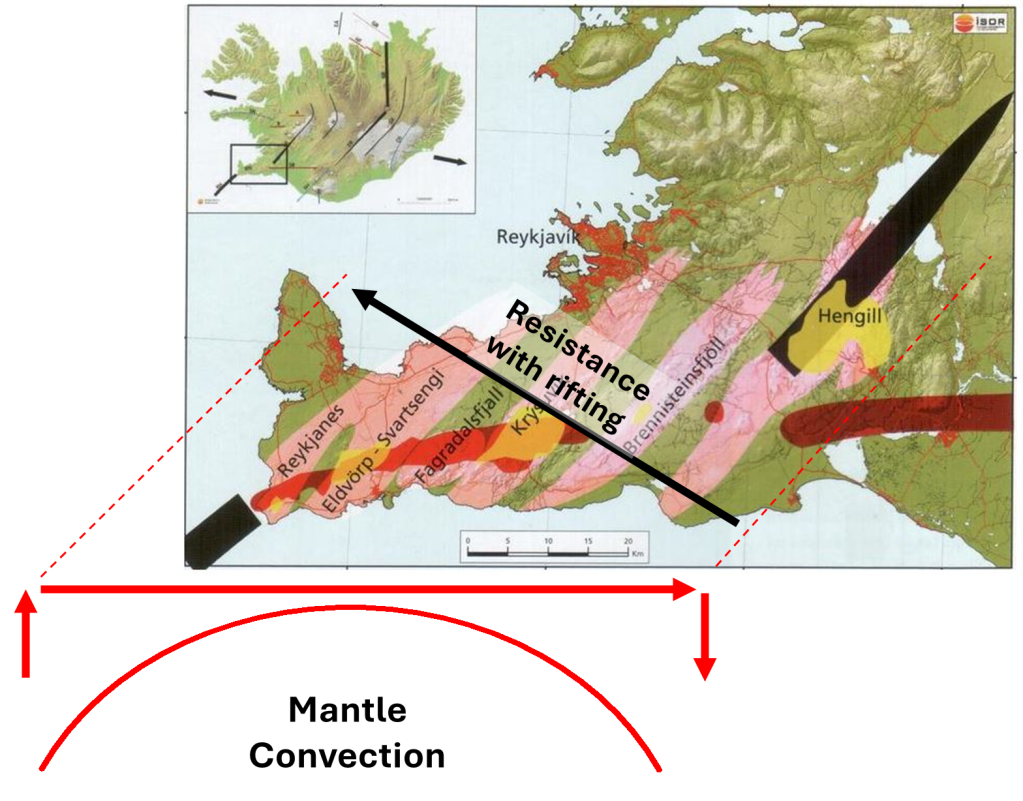
This type of rifting appears to result from resistance: the surface plate motion is not fully aligned with the underlying mantle flow. While the large tectonic plate moves in one direction, local mantle convection may flow in the opposite direction. This interaction creates resistance, and it is this resistance that leads to broader and more complex rifting zones.

