Uncategorized

Energy Balance of the Earth’s Interior

Introduction

The long-term stability of Earth’s internal temperature presents one of the most fundamental challenges in geophysics. If the mantle behaves adiabatically below approximately 120 km depth, as seismic and experimental evidence suggests, then its temperature should remain nearly constant through time. Under these conditions, the balance between internal heat generation and total surface heat loss must be remarkably precise.

In Earth’s early history, the quantity of radioactive elements such as uranium, thorium, and potassium was significantly higher, producing far greater radiogenic heat than at present. This excess energy would have been released through more vigorous mantle convection, enhanced volcanic and tectonic activity, and greater rates of heat transfer through the lithosphere. The total surface heat flow during that period must therefore have exceeded today’s ~47 terawatts (TW). Although the magnitude of these variations can be estimated from isotopic decay rates and thermal evolution models, the exact contributions of each geological process remain uncertain.

Despite these temporal fluctuations in radiogenic power and heat loss, the average mantle temperature appears to have remained nearly constant throughout Earth’s history. This implies a long-term self-regulating thermal system, in which higher heat production automatically enhances convective and radiative efficiency, maintaining near-adiabatic conditions and preventing significant temperature drift over geological time.

This stability suggests that the Earth’s internal heat budget operates as a closed but dynamic system, governed primarily by the amount and distribution of radiogenic elements and by the efficiency of internal heat transport processes.


Geoneutrino Constraints and Radiogenic Uncertainty

Recent geoneutrino measurements provide valuable insight into radiogenic heat production. These antineutrinos, emitted during the decay of uranium and thorium, allow researchers to estimate total radiogenic power. Current analyses suggest roughly 20 TW of heat is generated radiogenically, but this value carries large uncertainties due to limited detector coverage—most instruments are located on continental crust—and the need to extrapolate mantle contributions from sparse data.

If mantle concentrations of radioactive elements are higher than currently assumed, the true global radiogenic power could approach or even match the 47 TW of measured total surface output. This would reconcile the apparent imbalance between heat production and heat loss. Thus, the prevailing 20 TW estimate should be regarded as a lower bound, pending improved geoneutrino constraints from oceanic and deep-mantle observation sites.


Reconsidering Heat Transport in the Mantle

The conventional model envisions mantle convection as a primarily upward heat-transport system, carrying thermal energy from the interior toward the lithosphere. While this captures the dominant mechanism, it neglects a complementary and critical component: thermal radiation, which can transmit energy in any direction permitted by local gradients, including downward toward the core.

At the extreme pressures and temperatures near the core–mantle boundary, the mantle’s mineral phases cannot retain stable crystalline structures. The intense radiation field continuously destabilizes any emerging crystals, preventing their persistence and leaving the material in a vitreous, radiation-permeable state. Under these conditions, thermal radiation from the overlying mantle can pass almost undisturbed. Consequently, a portion of the mantle’s internal energy, instead of being entirely convected upward, is radiated downward into the core, effectively heating the core from above.

In contrast, convection transfers heat upward through the large-scale motion of mantle material: hotter, less dense regions rise, while cooler, denser regions sink. These convection rolls maintain global circulation and determine the spatial distribution of surface heat flow. Their geometry, wavelength, and coupling between different mantle layers provide the mechanical framework through which this energy is released.

Together, these two complementary processes—radiative transfer downward and convective transport upward—define the mantle’s dual role in Earth’s thermal system. The lower mantle acts as a radiatively transparent medium, facilitating energy exchange between the mantle and core, while the upper mantle remains convectively active, ensuring efficient heat release toward the surface. This dual mechanism explains how the mantle can sustain an adiabatic thermal gradient over geological timescales, maintaining both the activity of the core and the global tectonic system.


Implications for Earth’s Thermal Evolution

If downward-directed radiation continuously supplies heat to the outer core, then the core’s thermal history may be influenced not only by its own decay heat and latent crystallization, but also by a persistent influx from the mantle. This would help maintain the geodynamo over billions of years and explain why the core remains partially molten despite the decline in radiogenic elements.

The result is a self-regulating thermal system: radiative transfer prevents the mantle from cooling too rapidly, while convective circulation stabilizes surface heat loss. The two mechanisms together preserve a long-term thermal equilibrium that is more intricate and stable than models based solely on convection and conduction.

In this framework, Earth’s internal energy balance is dynamically self-sustaining, with the mantle acting simultaneously as the conveyor and the moderator of heat flow. Recognizing the interplay between radiative and convective processes is therefore essential for understanding the persistence of Earth’s internal heat, the endurance of its magnetic field, and the continuing vitality of plate tectonics.

Uncategorized

The circular tectonic drift vectors of Anatolia

The tectonic drift of the Anatolian Plate is notably independent from its surroundings. While the Arabian Plate moves northward, similar to the African Plate, the Anatolian Plate exhibits a counterclockwise rotation. This motion can be examined through the lens of the convection rolls model to see whether it offers any additional insights. The outcome is striking and reveals two key points:

  1. The combined structure of convection rolls and plate boundaries appears to create the conditions for a central pivot point around which the Anatolian Plate rotates.
  2. If a fixed point within the convection model exerts a dominant influence on tectonic drift, then the convection rolls also offer a framework for understanding the subduction of the African Plate beneath the Eurasian Plate.

The map showing drift vectors can be found at:
https://www.tandfonline.com/doi/full/10.1080/19475705.2024.2446588#abstract

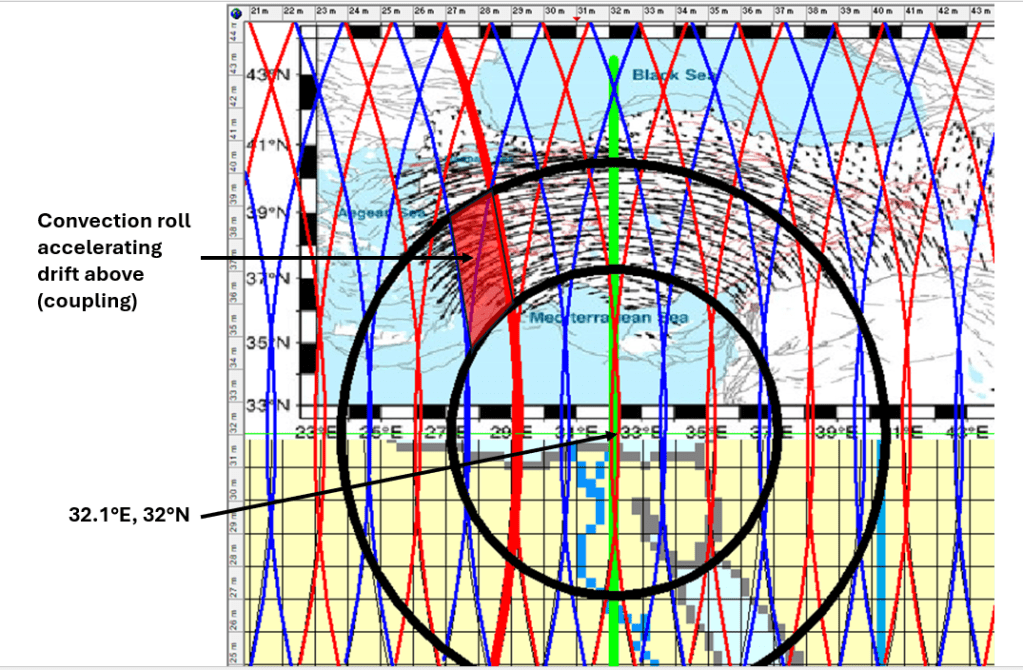
The most significant observation is that this central pivot lies near the 32nd parallel, precisely where two mantle upwelling lines intersect at approximately 32.1°E. Along this latitude, the convection roll system is aligned exactly north–south, making it a key structural feature, comparable in importance to the equator and the 64°N/S parallels. Interestingly, this location corresponds roughly to the eastern edge of the Nile River delta. It has previously been noted that the deltas of the world’s largest rivers—especially the Amazon at the equator—are situated at critical junctions within the convection rolls framework. https://magicmagma.com/2022/10/04/what-do-the-three-famous-rivers-amazon-nile-and-mississippi-have-in-common/

Given this fixed relationship between surface tectonics and mantle convection geometry, the concept of rollback requires reconsideration. In this case, the European continent appears to be drifting away from the latitude at which the African Plate subducts beneath it. Whether we interpret this as northward retreat of the African slab or northeastward drift of Europe, the geological consequences are functionally the same.

The side-view depiction of African Plate subduction shows how numerous geological features have developed over the last 35 million years, since subduction began. These reflect the continuing northeastward movement of the Eurasian Plate, while the northern edge of the African Plate descends beneath it.

This is from https://www.youtube.com/watch?v=cqK-CbuM3Eo

Just to clarify a bit what drives the tectonic drift anomaly of Anatolia, a particular bit of convection roll can be pointed out:

It can also be pointed out that most geothermal activity is found in this part of Turkey. Take a look at this map:

It is from https://www.researchgate.net/figure/Geothermal-map-of-Turkey-MTA-2021b_fig1_365230456

The red area in Western Turkey coincides with the convection roll taking part in driving the rotation of the local tectonic plate. This can explain the geothermal activity anomaly.

Note that the appearence of the aggregate of vectors of GPS drift measurements of the Anatolian Peninsula is not only circular, but also basicly from east to west. The mathematical precision of the drift can only be possible because of a very regular system of convection rolls underneath. The rolls following the drift are coupled to the layers above, the ones opposing are decoupled. Thereby the engine driving this interesting rotational drift of the plate can be explained thoroughly.

Just to clarify further how the convection rolls move the tectonic plate, this drawing is added:

The red areas provide force for the circle to move anti-clockwise in an almost circular way. As previously mentioned, the pivotal point is also a key point within the convection rolls system as a whole, due to the exact N-S alignment of convection rolls at the 32nd latitude.

Uncategorized

Why Convection Rolls of the Mantle Form a Regular Pattern

Convection rolls within the mantle have an adiabatic heat gradient, starting at the border between tectonic plate bottom and the layer below. Logically, the mantle must therefore as a whole be on the verge of being ductile and stagnant. A tectonic plate is 120 km thick, according to the defination that its lowermost border is where convection, or constant flow of mantle material, is found.

It has been found in laboratories, that if mantle material at this point (convecting but very close to becoming stagnant) does form convection rolls. As reality and experimental results are to be compared, especially if no other factors affecting real circumstances than used during experiment can be pointed out, inserting the outcome of experiment into known and measured circumstances is indeed a piece of work any scientist should undertake.

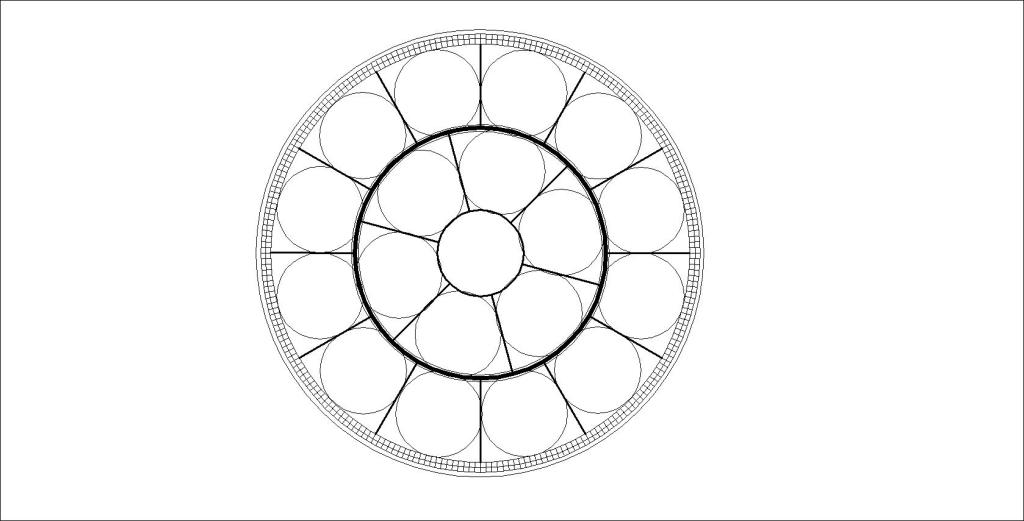
In this case it is easy, because the thickness of inner layers of Earth are known. Putting togherher the outcome of the experiments in laboratories, the logic of adiabadic thermal gradient, and knowledge about the depth of each layer, this is the outcome:

This is the basic picture of a section of convection rolls within the Earth. Inserting the results of experiments, fits exactly into measured environment.

Most people recognize the core, mantle and crust, and some might notice the Gutenberg layer, also known as the core-mantle boundary or CMB. This is a beginning of a study described in the book found here on this webpage. Reading that book is of course more difficult than reading this short post, and most people do certainly not have time enough to read it. It can be said here, though, that all the implications have been worked out, and how the convection rolls form a 3D system within the Earth is thereby fully understood. In turn, it enhances our overall understanding of geology.

Uncategorized

Mantle Convection or Mantle Plumes?

In Iceland, many people think that a mantle plume is responsible for volcanic activity. The plume is thought to be centered around the western part of Vatnajökull. All the same Gilliam R. Foulger came to the conclusion that a plume, of the kind imaged, can not exist. https://www.mantleplumes.org/WebDocuments/P%5E2Rev_Harangi.pdf

In fact, Foulger does find a proof that this kind of plume does not exist. The relevant data shows that no continuous hot mass is ascending under Iceland. Therefore we should stop imaging this plume and continue the search for the inner structure of Earth with measurements and calculations according to the physical properties of the mantle.

Convection does, on the other hand, fit all available data. Experiments show that mantle material forms convection rolls under those circumstances expected to prevail within the Earth. Testing it, by making a model with convection rolls filling the measured layers, shows remarkable results. Features on Earth, both divergent and convergent, fit to the convection rolls underneath.

Now, when this has been solved, it is very easy to proceed with research programs, further improving our understanding of the inner structure of the Earth. First, we have to admit that the former idea about mantle plumes is wrong. A model of a regular system of convection rolls is what brings us farther ahead. Luckily, we have the scientific method to assist us with our work. By having a foundation of physics, measurements, mapping, calculations and logical thinking, besides being able to communicate freely, these steps forwards can be made.