Uncategorized

Reykjanes Eruption – where is the origin?

The tenth eruption on the Reykjanes Peninsula started suddenly on the Sundhnúkagígar fissure. All those eruptions are thought to be connected and considered to be one volcanic event, based on rather constant flow of magma from the interior. The model used here adds an explanation of the geophysical settings of the deep roots of the volcanic site. Two convection rolls division lines coincide under the point where the magma ascends. The lines cross the outer limits of the seismic zone at this location, providing a weakness in the crust.

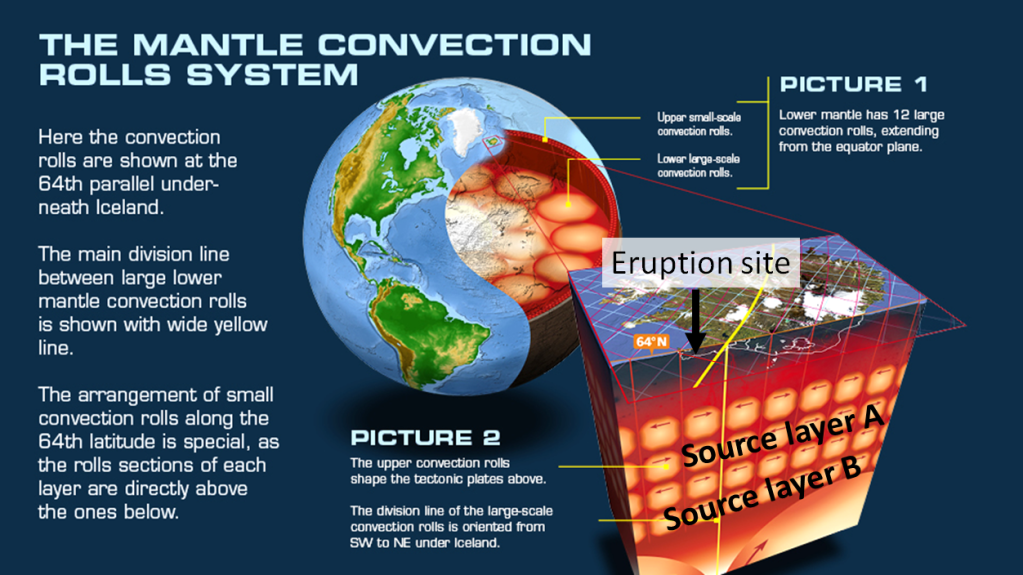
Convection rolls model and site of ascending magma at Reykjanes Peninsula.

To understand how the system works according to the model, this drawning can be studied. The two layeres, with division lines between convection rolls found under the point of ascending magma, are marked here as source layer A and source layer B. Layer A is found at the depth of about 260 km, and layer B at 530 km depth (530-670 km). This means that magma of different types should be found, both from layer A and B. Besides that, the hot magma from below does partially melt the ductile part of the tectonic plate (commonly referred to as upper mantle found below the brittle crust).

The petrology of the lava should therefore be compared with these modelled preconditions of the eruptions. The three eruptions on Fagradalsfjall volcano and the seven eruptions on the Sundhnúkar fissure are originated from the same source, according to the findings in the article: The Fagradalsfjall and Sundhnúkur Fires of 2021–2024: A single magma reservoir under the Reykjanes Peninsula, Iceland? ( https://www.researchgate.net/publication/381756298_The_Fagradalsfjall_and_Sundhnukur_Fires_of_2021-2024_A_single_magma_reservoir_under_the_Reykjanes_Peninsula_Iceland

The authors of the article (Valentin R. Troll. Frances M. Deegan, Thor Thordarson, Ari Tryggvason, Lukáš Krmíček, William M. Moreland, Björn Lund, Ilya N. Bindeman,
Ármann Höskuldsson and James M. D. Day), come to this conclusion: “Whole rock and mineral geochemical data show that the
2023 SVL eruption produced lava compositions that, for the most
part, continue the trends established by the lavas of the late 2021 to
2023 Fagradalsfjall Fires (Figures 4 and 5). A first-order observation
is therefore that all of the recent FVL and SVL magmas are derived
from a similar magma source (excluding perhaps the early parts of
the 2021 Geldingadalir eruption), or a similar combination of sources,
which are different to the source(s) of previous magmas erupted on
the RP…”

Considering that, according to the model of convection rolls, it is quite likely that the uppermost division lines, oriented SW-NE, often provide magma from the mantle. This time it is probably not the case, as it seems likely that the source is from those deeper layers, because the relevant division lines are found exactly under the magma source location, which might explain different composition of the lava samples considered in the said article.

Uncategorized

The Eastern and Western Outposts of Icelandic Volcanoes – Snæfell and Snæfellsjökull

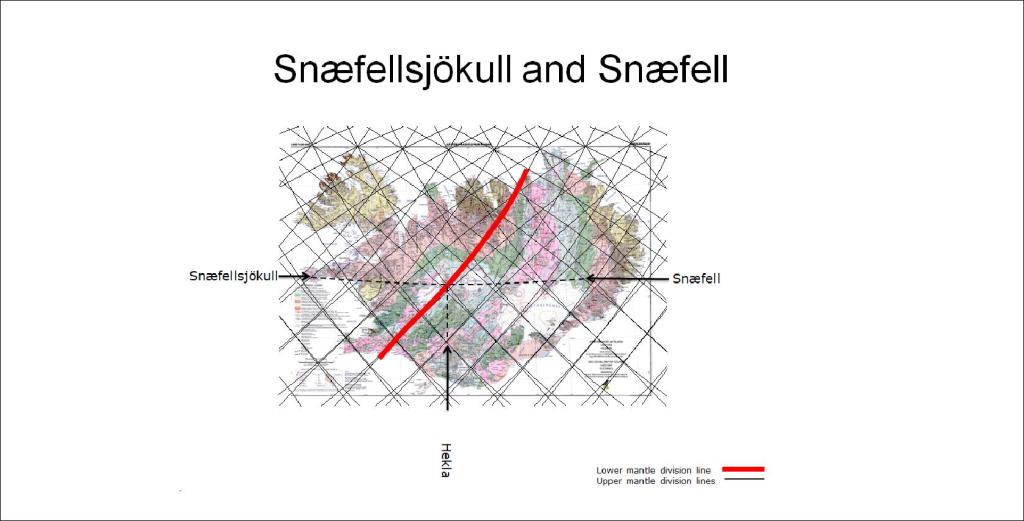
The two outposts of Icelandic volcanoes are both stratovolcanoes. They are outside the main volcanic zones, and do not fit with the most simplified version of Icelandic geology. One is too far to the west, the other too far to the east to match well with our most basic ideas about how Iceland is divided into its North American part and Eurasian part. The convection rolls model considered on this webpage is of course different, and according to the pattern emerging from the division lines between convection rolls, the positions become understandable. If there were no such reasons, such as convection rolls, the coincidence that those two mountains are exactly on the same latitude could not be explained. Of course it is easy just to ignore things like that, but these two volcanoes are both found on division lines between convection rolls, in a mirrored way.

It should also be mentioned that the distance from those two volcanoes to the main division line of the lower mantle, is exactly the same, when compared with the N-S axis of Hekla volcano. That means, of course, that the two Snæffells (Snæfellsjökull and Snæfell) are equidistant from Hekla. Such a coincidence can of course also be ignored, but according to this system of convection rolls, it is explainable, because Hekla does form on important crossings within the convection rolls division lines pattern. Different layers all have division lines under Hekla, four different convecting layers! The location of Hekla is therefore no coincidence, and the uppermost layer of mantle convection is upwelling underneath Hekla, making the location even more understandable. All over the world, countless similar patterns can be found, all in harmony with the convection rolls.

Snæfellsjökull, November 15th 2024.

Uncategorized

How volcanic and seismic zones interact in the Reykjanes eruptions

It is well known that the interplay between volcanic and seismic zones is at work on the Reykjanes Peninsula. The peninsula is being pulled apart by the same forces as shape the Mid-Atlantic Ridge, and that is by definition a divergent effect. This causes the volcanic fissures to open up, being aligned from SW to NE. The dykes responsible for the eruptions have the same alignment, being in the same direction as the model used here. It is important that a mathematical formula can be used to calculate alignment of volcanic dykes, and it also adds to the credibility of the theory that convection rolls are found underneath the tectonic plates.

The seismic area of Reykjanes is bent, but the seismic faults are oriented N-S within the bent area. In addition, the Reykjanes seismic area extends from the South Icelandic Seismic Zone. These two seismic zones are therefore connected, and the connection point is also the point connecting two polygons of the convection rolls model. The Reykjanes seismic zone is formed due to compression of the area, perpendicular to the extension due to the divergent effect of the Mid-Atlantic Ridge. These pressure vectors are quite comparable to those of the South Iceland Seismic Zone.

What makes the Reykjanes Seismic Zone special is the fact that it is bent, making it possible to connect the Reykjanes Ridge and the South Iceland Seismic Zone. The two different forces therefore become compatible, resulting in a wholistic and logical drift system.

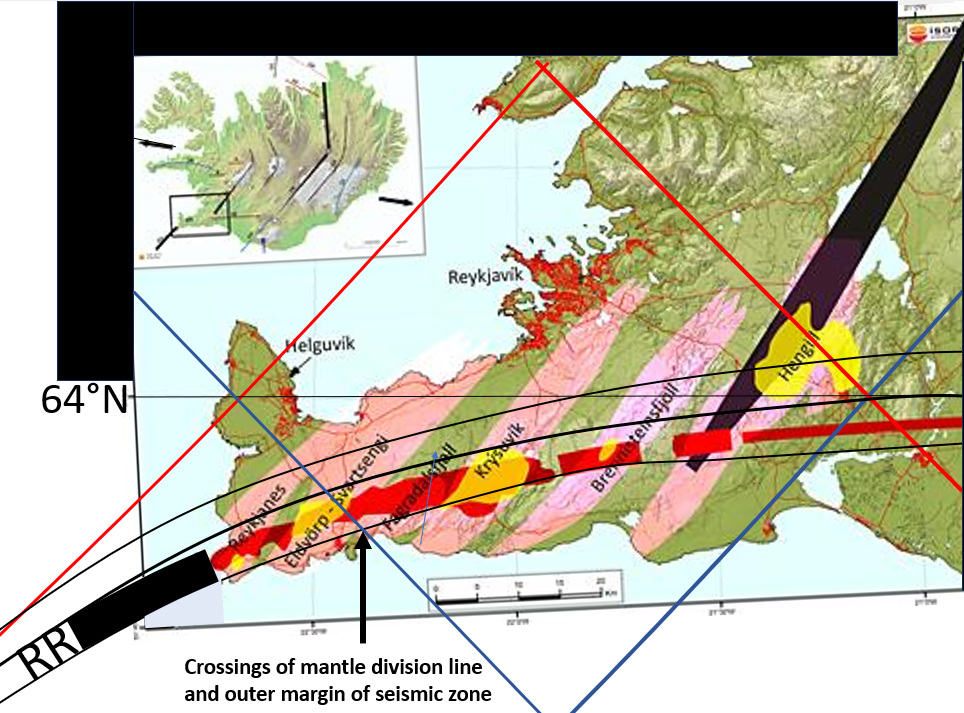
Superimposed blue line, showning mantle divisions, crosses the seismic and volcanic areas on the Reykjanes Peninsula, pointed out with an arrow on the map. Volcanic systems on the Reykjanes peninsula are shown in pink. The red lines indicate the tectonic plate boundary, where earthquakes are common. Geothermal areas are marked in yellow. Black lines indicate fissure swarms. Modelled division lines and the outlines of seismic zones are superimposed on a map base from ISOR.

The main active areas are found within the southern half of the bent seismic area, as it extends from the South Iceland Seismic Zone.

Comparing the model with the basics of the Oblique Rift Zone of Reykjanes does not explain the present activity to a full extent. On the other hand, it shows that the present event brings into light the combined effect of several factors, mainly the volcanic fissure swarms, the seismic zone, and the mantle rolls division lines.

A scientific approach to these three combined factors would be to compare them with petrological and seismic evidence, along with other information available about surface movements. That could answer many questions.

Not much is known about the source of this magma. It is only possible to trace its history with some degree of accuracy from the time when it is already being accumulated somewhere within the tectonic plate. The energy necessary to provide the magma is only found below the tectonic plate, and therefore the flow should be traced all the way down to the depth where convection can take place.

Uncategorized

Volcanic Activity near Grindavík on the Reykjanes Peninsula

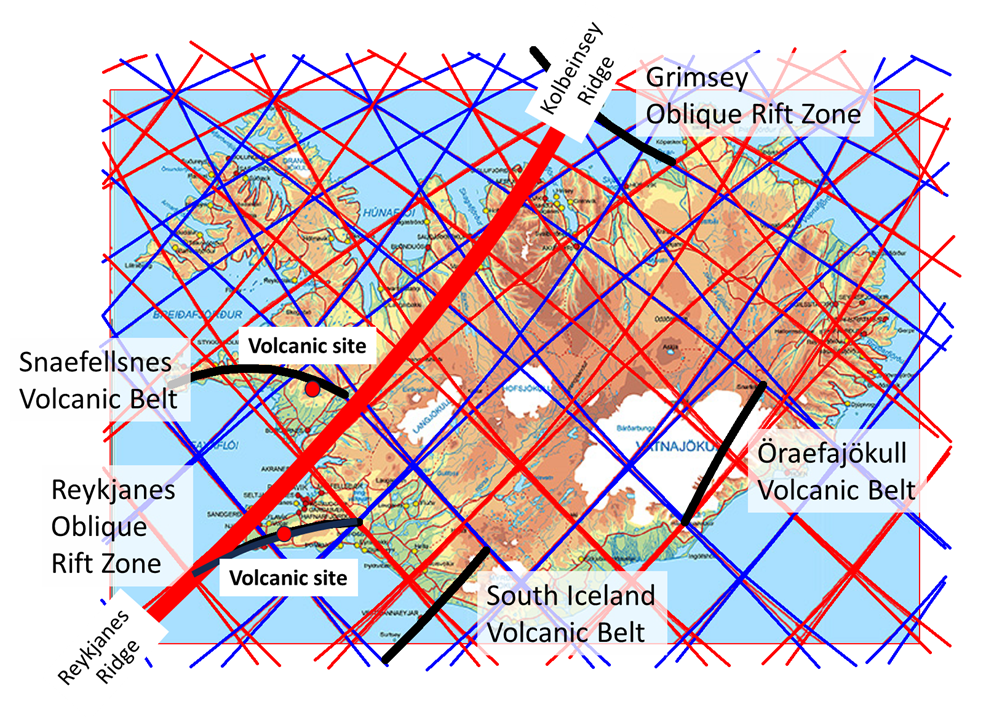
The volcanic activity near Grindavík can be explained by referring to the interaction between a dyke forming within the volcanic zone, and magma from the dyke finding its way to the surface through earthquake faults. A seismic zone creats a weakness of the crust within the area. The orientation of the dyke is quite different from that of the earthquake faults. According to calculations the dyke is oriented about N43°E, and the earthquake faults trend is directly N-S. Real circumstances are not quite so simple, because the upper most manifestations of earthquake faults are en échelon arranged, divided into smaller systems with NE-SW trend. The dyke, when meeting with the earthquake faults, also bends, or follows the N-S trend near the eruption site. As I have been exploring the possibility that convection rolls are found withn the asthenosphere, and mapping the division lines between them, it is interesting to compare those lines with the conditions at the eruption site. Two downwelling lines of the lower parts of the asthenosphere are found directly below the eruption site itself. To understand the situation better, we should have a look at a map showing this:

This shows how the black division line crosses the Reykjanes Seismic Zone shown with red parallel lines. It is tempting to assume that the origin of magma can be traced to those two division lines directly below the eruption site. Another possibility is that the magma is originated from the upper most division line, alinged NE-SW, found slightly west of the eruption site, flowing at first under the crust along the NW-SE aligned line until it reaches the eruption site area. Then it ascends into magma chambers and finally to the surface.

This site shows many different situations where convection rolls system and real circumstances fit together. This is of course a very good example. The fact that the three eruptions along the dyke which formed under Fagradalsfjall, and the four eruption that have already taken place along the dyke forming at the side of Sundshnúkur have the same petrological origin is consistent with this.

This is an explanation built on many years of research. I have taken part in a series of conferences and meetings, publishing papers where the scientific papers pointing in this direction are cited. I also took part in mapping the South Iceland Seismic Zone, giving me the feeling of how the seismic area of Reykjanes works, as those two systems are connected end-to-end.

To explain the heat flow within the Earth, from radioactivity to eruption, is not easy, but it can be done. This eruption deserves much attention, and among the countless examples shown here, this one of those literally to the point.

The two other seismic zones of West Iceland (BTZ) and South Iceland (SISZ) are added to show how likely it is that the polygons surrounding distinct areas of Iceland really exist. To form a seismic area, pressure is nedded. The faults are all N-S oriented, so regularity is needed. The parallel faults are found side by side in E-W direction, having distinct endpoints, so the area is limited. The only solution for an outer framework is a polygon, exactly as drawn on the map here above. The division lines between convection rolls coincide with this enevitable polygonal shape surrounding the seismic zones. Therefore, it makes sense that the division lines are responsible for shaping the polygons in the first place. It is all about logic.