
Visualizing mantle convection rolls becomes significantly easier with the use of AI-based three-dimensional models. What were once abstract concepts—difficult to imagine and even harder to communicate—can now be rendered as coherent flow structures extending through the mantle. These visualizations provide an important bridge between mathematical models of mantle dynamics and the geological features observed at Earth’s surface. Here is a beginning:
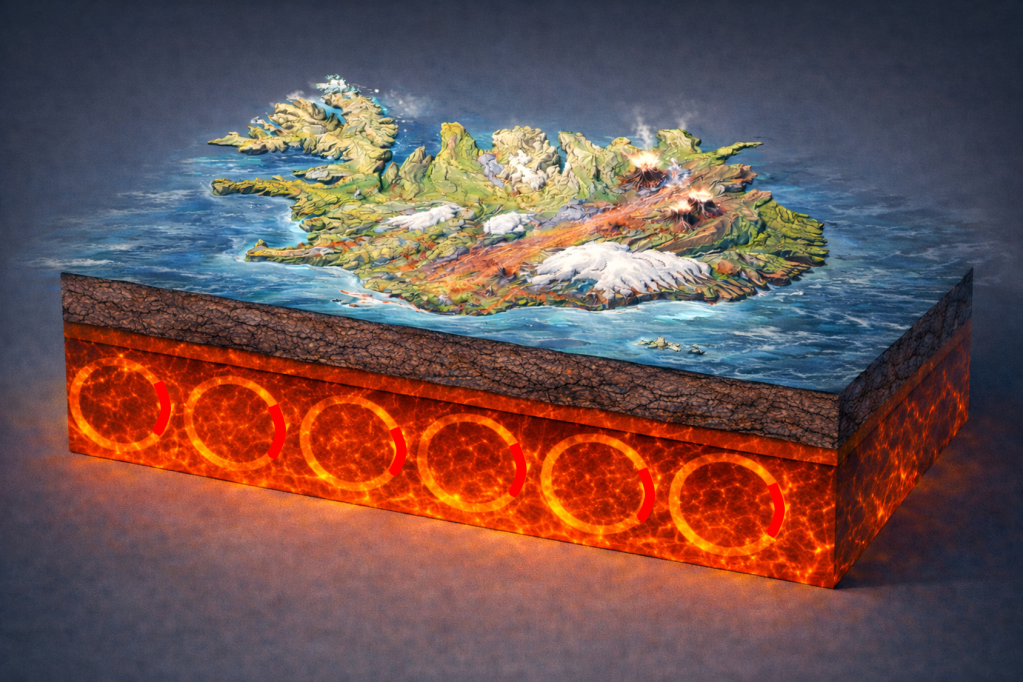
Understanding mantle convection is essential if we are to understand nature correctly. When long-lived convection rolls are taken into account, the spatial distribution of volcanism, rift zones, and seismic belts becomes more intelligible. Location of volcanoes and earthquake zones can be explained, and mid-ocean ridges are not randomly distributed features; instead, they align along sections that can be calculated, and notably, the same mathematical framework can be used to trace subduction zones.
Iceland is exceptionally well suited for testing this type of model. Few regions on Earth display such a concentration of geological features within such a limited area. This makes it possible to compare predicted mantle-flow patterns directly with mapped surface expressions. AI-generated 3D visualizations allow these comparisons to be made more intuitively, helping to explain how the geometry of convection rolls corresponds to volcanic zones and rift systems.
The functioning of mantle convection rolls is not immediately intuitive and requires time to grasp. The mantle behaves neither as a simple liquid nor as a rigid solid. Instead, temperatures are close to the solidus, allowing slow but organized flow to take place over geological timescales. Molten magma—which may eventually erupt as lava at the surface—is originally supplied along the division lines between adjacent convection rolls, where hot mantle undergoes partial melting and ascends through the tectonic plate.
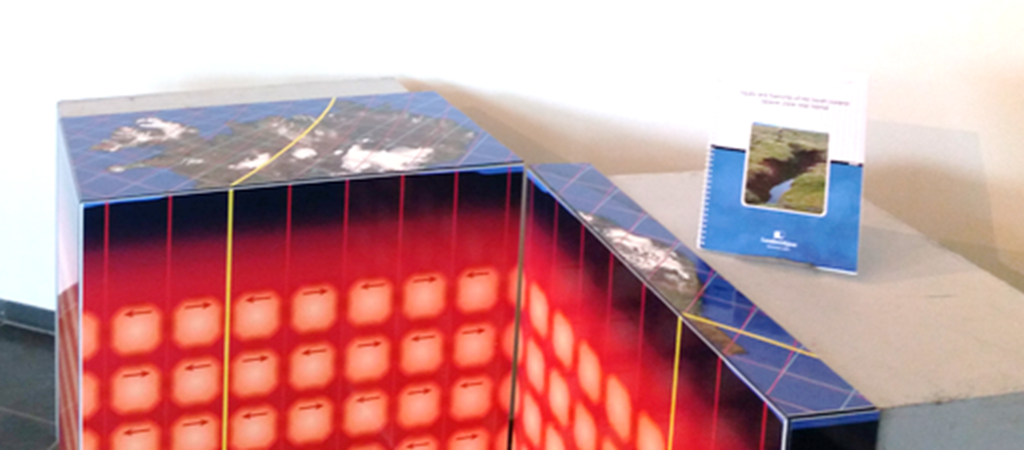
These rolls exert a direct influence on the tectonic plates above them. Through basal traction, the organized mantle flow causes tectonic drift. In most cases, the direction of mantle flow reinforces the dominant tectonic drift. However, in certain regions, a smaller convection roll may locally oppose the main trend of plate motion. When this occurs, extensional stresses can develop in the overlying crust, leading to rifting.
Such rifting is not merely conceptual but measurable. Over time, an active rift zone does typically span 1.5 degrees from east to west. The East Volcanic Zone in Iceland provides a clear example. Its width, orientation, and volcanic productivity are consistent with localized interaction between mantle convection rolls.
By combining mathematical descriptions of mantle flow with AI-based visualization and geological observation, mantle convection rolls can be treated as physically coherent structures linking Earth’s deep interior to its surface expression. Rather than being abstract or speculative, they offer a unifying framework for understanding why geological features appear where they do.
 Magic Magma