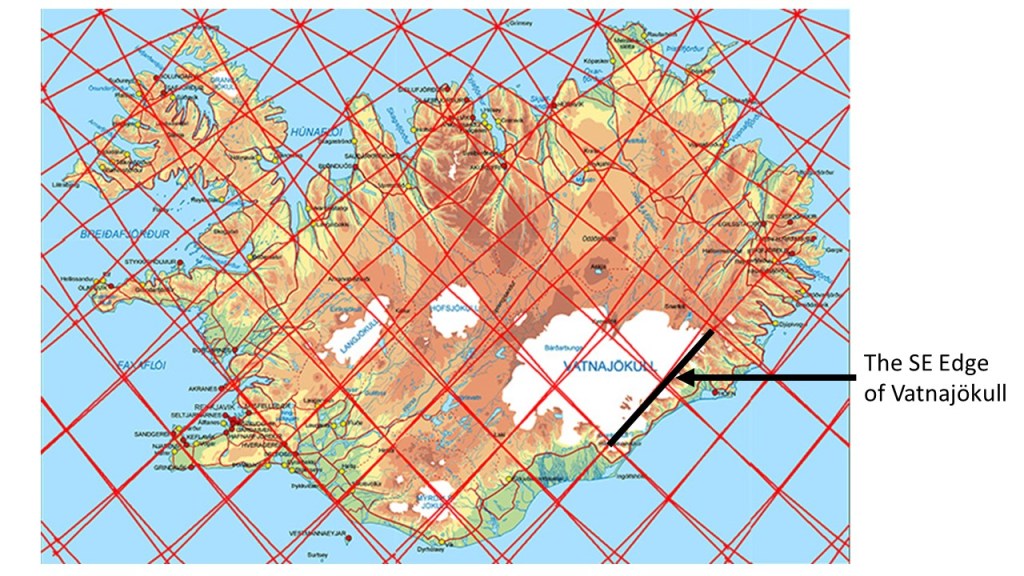
Extending the Reykjanes Ridge, a symmetric picture of Iceland emerges. This is consistent with the presumption that the two convection rolls shaping the Reykjanes Ridge extend under Iceland in the way as drawn with red line across Iceland from SW to NE.
The symmetry around the Reykjanes Ridge extended line (red).
The Icelandic platform forms an ellipse around the extension, aligned E-W. The two volcanoes of Hekla and Eyjafjallajökull are on the NS axis of the ellipse. The two outposts of Icelandic volcanoes, Snæfellsjökull and Snæfell, are equadistant from the NS axis, and located exactly on the same latitude. If the Kolbeinsey Ridge is also extended, it is found reaching the same central point, merging with the NS axis of the ellipse and the volcanoes Hekla and Eyjafjallajökull. This high degree of consistency is in conformity with the analysis of the convection rolls below Iceland.
We know why geothermal heat is found in the area of Reykir near Mosfellsbær, providing Reykjavik with about half of the geothermal energy needed to heat the city. It is explained for instance in an article by Daníel Einarsson (3D modelling of the Reykir geothermal areas in Mosfellssveit, Iceland).
The map generated by Daníel Einarsson, showing the geothermal areas in Mosfellssveit
This shows clearly the NW-SE alignment of the area, even though it is associated with a fissure swarm oriented NE-SW. Therefore a comparison with the mantle convection rolls alignment is needed to see the reason for this topography and arrangement of geothermal resources within the area.
The NW-SE oriented convectin rolls division lines near Mosfellsbær
The alignment is found to be the same as of the calculated NW-SE lines. Therefore it can be reasoned that the geothermal activity is associated with three factors. First an old high temperature area that has cooled down, second the fissure swarm from Krýsuvík and Trölladyngja, and thirdly from the effect of the edge of the relevant polygon, whereas two division lines of convection rolls are found underneath the geothermal fields.
The convection rolls underneath Iceland shape the volcanic and earthquake zones. A line can be drawn between the tectonic plates, and then the interaction between teconic drift and convection rolls can be derived. Here the main zones have been marked on the map:
Here the relationship is shown between Reykjanes Ridge, Reykjanes Seismic Zone, South Iceland Seismic Zone, East Volcanic Zone, North Volcanic Zone, Borgarfjörður Seismic Zone, West Volcanic Zone, Snæfellsnes Volcanic Belt, Skagafjörður-Hofsjökull Volcanic Belt, Öræfajökull Volcanic Belt and Tjörnes Fracture Zone.
Without this grid, the reasons for the location of all those volcanic zones and earthquake zones become obscure. The similarity between the position of SISZ with Hekla and BSZ with Hallarmúli is pointed out specially. Hekla and Öræfajökull appear at the same kind of crossings, 3° apart on the same latitude. The difference between the mountains can be explained, as Hekla is at the edge of a rift zone, whereas Öræfajökull is not. Tjörnes Fracture Zone is aligned along the convection division lines. The South Iceland Seismic Zone polygon is found both south and north of the division line of the tectonic plates. The southern end drifts eastwards, while the northern end drift has a component to the west. Therefore it breaks in the middle in a way known as the bookshelf pattern.
The seismic zones of Reykjanes and South Iceland are similar, yet the SISZ is much more prominent than the RSZ. A certain degree of continuity is suggested on this map:
Suggested continuity of Reykjanes Seismic Zone and South Iceland Seismic Zone.
This suggestion is based on the mapping of faults in the area:
Red line added to the original map.
The accurate bending of the RSZ is suggested by a central axis through 1/3 the length of the SW side of the Reykjanes Polygon, and the ends are found at the corners near Hveragerði and of the Reykjanes Ridge as shown on the map.
To further compare:
Comparing convection rolls grid and earthquakes from Nov 2019 – Feb 2020
Looking at the grid formed by the division lines of the convection rolls, together with the division boundary within the tectonic plate itself, we can identify crossings located precisely where uplift is occurring.
Crossings between tectonic plates division and mantle rolls division lines on the Reykjanes Peninsula
Crossings Between Tectonic Division Boundaries and Mantle-Roll Boundaries on the Reykjanes Peninsula
The broad curvature of the tectonic division boundary extending from Hveragerði to the Reykjanes Ridge is mirrored around a point near the Blue Lagoon and Grindavík. This is also the area where the recent uplift center has developed.
Geologists have discussed why the uplift center is located close to the geothermal power plant, west of the Sundhnúkur crater row and the associated dyke intrusion system. Current observations indicate that magma initially flows eastward from the deeper reservoir before entering a dyke system aligned NE–SW.
However, when the mantle-roll division boundaries are included in the model, the geometry becomes easier to visualize. In this interpretation, one of the deeper mantle division lines is aligned NW–SE beneath the area. This alignment may provide a structural pathway guiding magma movement upward and slightly toward the southeast. After reaching shallower crustal levels, the magma flow then makes an approximately 90° turn and enters the NE–SW-oriented dyke system associated with the Sundhnúkur eruptions.
This arrangement suggests that the magma transport system may reflect the interaction of two different structural controls:
the deeper mantle convection-roll boundary system, influencing the initial ascent and lateral transport of magma, and
the shallower tectonic rift geometry of the Reykjanes Peninsula, which controls the orientation of the dyke swarm and eruptive fissures.
Seen this way, the location of the uplift center west of the crater row is not necessarily anomalous. Instead, it may represent the point where these two structural systems intersect most effectively, concentrating magma accumulation and crustal deformation in a predictable geometrical position.
The regular bow of tectonic division line from Hveragerdi to the Reykjans Ridge is mirrored around the point close to the Blue Lagoon and Grindavik. The point of uplift is therefore central to the system, connecting the Reykjanes Ridge and the so-called South Iceland Seismic Zone.