Blog

Uncategorized

Central Iceland Parallel Zone Axis

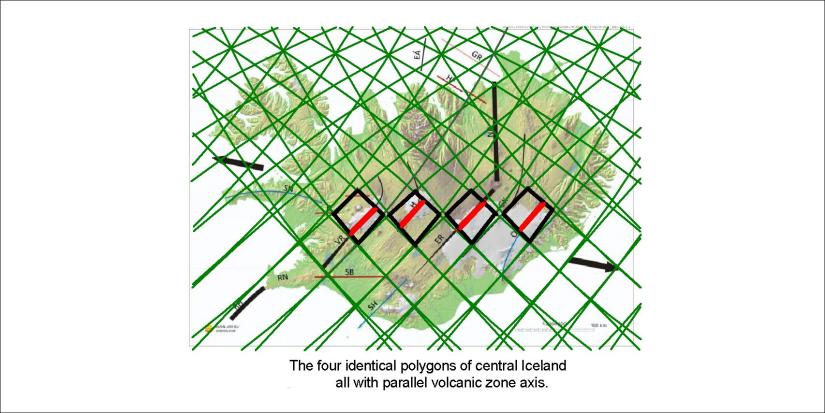
One aspect of science and proof is repeated occurrence. This is found in Central Iceland where four axis of volcanic activity appear parallel to each other, each occupying one of identical polygons of the convection rolls system under the country:

Gosbelti rakin

By simply adding a red line on the lines of the original ISOR map, it can be seen how each volcanic zone occupies one polygon. One of them is the main rift zone, the ER-line. These polygons are all east of the Reykjanes Ridge. The Snæfellsnes Belt is found at a similar latitude, and is due to forces acting to a different direction, that is NW and therefore takes on a different orientation.

Uncategorized

The arrangement of the volcanic zones of Iceland

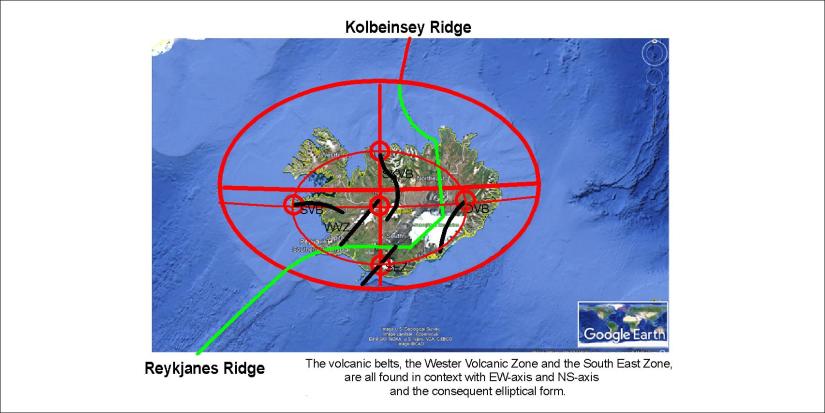
When analyzing the arrangement of volcanic zones in Iceland, an ellipse comes to mind. Snæfell and Snæfellsjökull are equadistance from the center, and also Drangey of Skagafjörður in the north and Eyjafjallajökull in the south.

Iceland and the surrounding ocean floor - volcanoes

The main line of tectonic drift divsion is green, then the four volcanoes mantioned. The center in between these volcanoes is the area of Hveravellir. The volcanic belts and zones of limited or no rifting are marked with black lines (representing central axis of those areas). The outer ellipse and the inner one are of the same proportions. Those are SVB (Snæfellsnes Volcanic Belt), SKVB (Skagajfjörður Volcanic Belt), WVZ (Western Volcanic Zone), SEZ (South-East Zone and ÖVB (Öræfajökull Volcanic Belt.

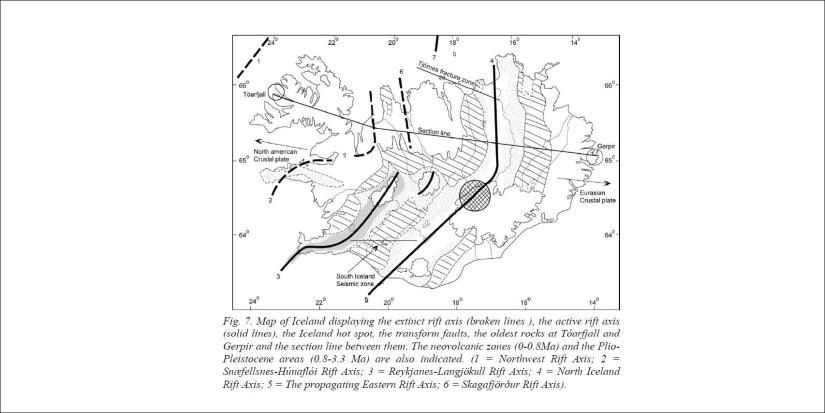
A more elaborate map of the central axis of active volcanic and earthquake areas in Iceland is found in this PhD essay by Árni Hjartarson: file:///C:/Users/Lenovo/AppData/Local/Temp/Arni-Hjartarson-2003-PhD-heil-3.pdf

Árni Hjartarson - Central Axis of Active Zones

Note the differnce between features 1 and 2 on one hand and 6 on the other hand, whereas 1 and 2 are very old and have drifted considerably since those volcanic zones became extinct, but 6 (Skagafjörður Volcanic Belt) has at most drifted for 0.5 million years since last eruption, and it still geothermal heat and earthquake activity are associated with it.

Here, the Skagafjörður Volcanic Belt si drawn as a line, close to NS. The curvature connecting it with MIB is missing. Also, the SVB and ÖVB are omitted.


Uncategorized

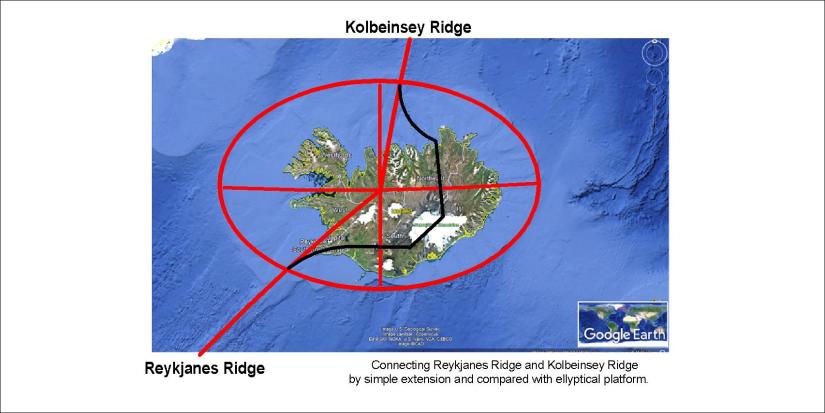
How do the Reykjanes Ridge and Kolbeinsey Ridge combine?

The two ocean ridges point to each other, but is it realistic to consider them as somehow connected? If we do, a beutiful context appear, just have a look:

Iceland and the surrounding ocean floor - drawing

The NS-axis through Eyjafjallajökull, Hekla and the Skagafjörður Volcanic Belt, is also the short axis of the ellyptical form of the Icelandic ocean floor plateu. When taking the volcanic systems north of Iceland into account, in the same way as of those out of Reykjanes, a similar connection appears, merging with the ridges in identical way north and south of Iceland.

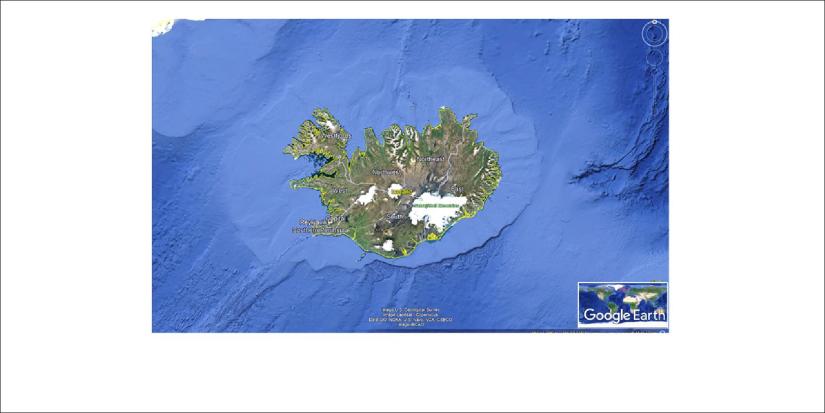
For orientation, the original picture from Google is presented here, to compare with the one with lines drawn on it:

Iceland and the surrounding ocean floor

Adding a few lines can be interesting 🙂

This can be looked into further by extending the line between the two convection cells, responsible for the existence of the Reykjanes Ridge, all over Iceland to the edge of the ocean floor ellyptical edge:

Iceland and the surrounding ocean floor - drawing extended

It does cross the division line of the two plates where the NS-axis from Kverkfjöll to Öxarfjörður ends and the ocean floor volcanic systems are found in a row towards the NW.


Uncategorized

A simplified picture of tectonics in Iceland

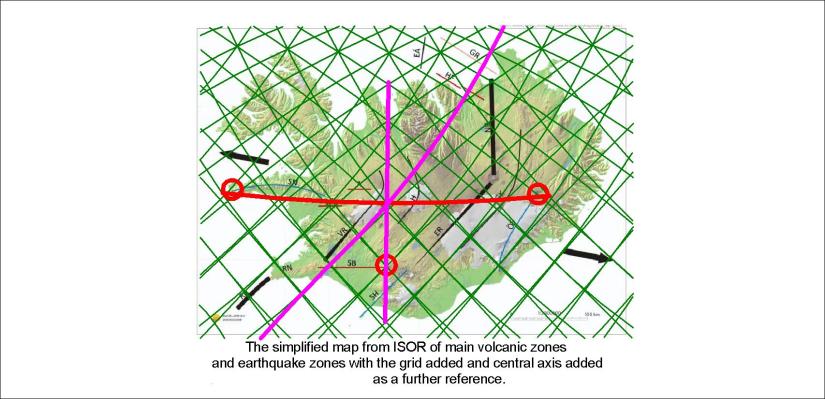
Simplifying tectonics and geological settings can be useful. At ISOR this map was made to give a general idea about the volcanic zones and earthquake areas. Comparing this with the calculated grid shows resemblance:

ISOR map as a base for the grid pattern and main axis

The black lines are originally on the map from ISOR. The EW axis between Snæfellsjökull and Snæfell is then added, and the NS-axis from Hekla.

One aspect of this simplification is that the Skagafjörður volcanic zone appears totally in this manner as a connection with Hofsjökull volcanic system or Mid Iceland Belt.

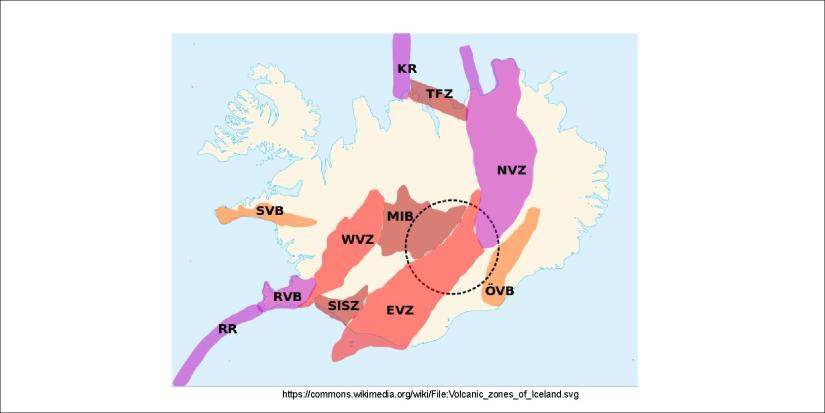
Volcanic Zones and Belts of Iceland

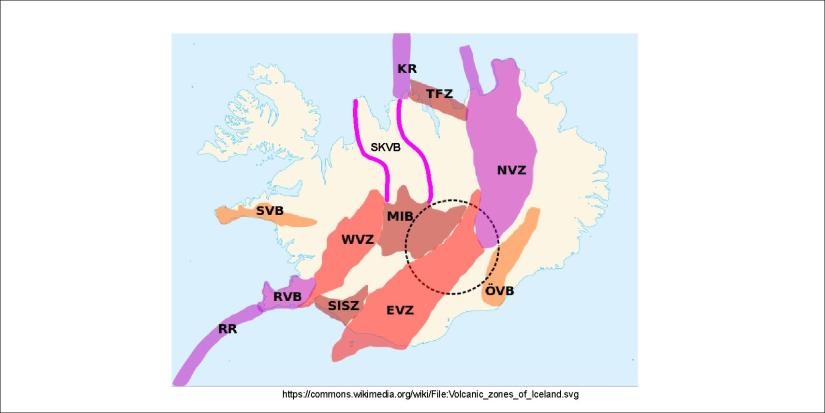
Refering to this drawing, where the Skagafjðrður Volcanic Belt is missing, we can add it to refresh the memory:

Volcanic Zones and Belts of Iceland - Skagafjörður Volcanic Belt added

It also shows how the Skagafjörður Volcanic Belt connects with Kolbeinsey Ridge in a similar way as RVB connects with RR. The parallel functions of SISZ and TFZ also become clearer.

The Skagafjörður Volcanic Belt should therefore be included in the general tectonic layout of Iceland, as it gives a more comprehensive picture of the processes shaping the country.

Connection between Reykjanes Ridge and Kolbeinsey Ridge

This leads to a picture of a connection between the ocean ridges south and north of the country without the help of SISZ and TFZ. The wide red line indicates the ridge originated continuity over Iceland.


Uncategorized

Tjörnes Fracture Zone – the complicated feature of Iceland

Tjörnes Fracture Zone is found both on land and under sea at the north coast of Iceland.

It is similar to the SISZ, but differs as the weakness of the tectonic plate underneath is manifested in different pattern of epicenters.

Gosbeltin öll - Tjörnes

The description found in an article by Bryndís Brandsdóttir and others, here linked, is interesting, as it says that actually Tjörnes Fracture Zone is aligned EW. The three main lines of epicenters show how the polygons brake up in a regular pattern.

Sometimes manipulating with reality can make things clearer. To compare the earthquake zones with the main underlying factors of mantle convection and its polygon pattern and other implications, let us draw this map with Icelands main three axis:
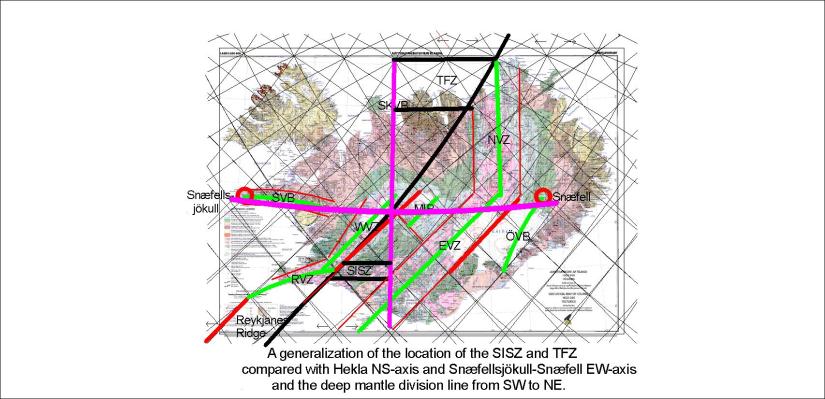
Hypothetic Iceland - Not Real Iceland

The NS-axis through the craters of Eyjafjallajökull, Hekla, Hveravellir area and Drangey of the Skagafjörður Volcanic Zone, the EW-axis from Snæfellsjökull to Snæfell with Hveravellir at the center, clarify the locations of SISZ and TFZ.

Therefore, focusing on the mantle convection cell pattern gives a very clear picture. Tectonic drift is of course the reason for the dynamics of these earthquake zones, but this ‘reason for the reason’ is quite important.

The latitude of 64.75°N plays a major role, and the shift from NE trend to NS coincides with the division between large polygons in the southern half of Iceland and the smaller and more irregular polygons of the northern half.