Uncategorized

Iceland and Greenland compared – the West Fjords counterpart 30° to the west

If regular convection rolls govern the development of tectonics of the Earth’s crust, we should see comparable formations at regular intervals on the surface. With a model of the convection cell system, this can of course be tested. Let us compare Iceland and Greenland:

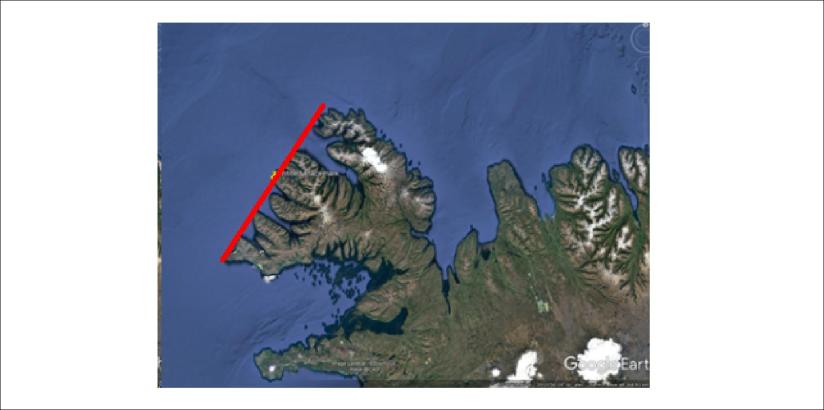
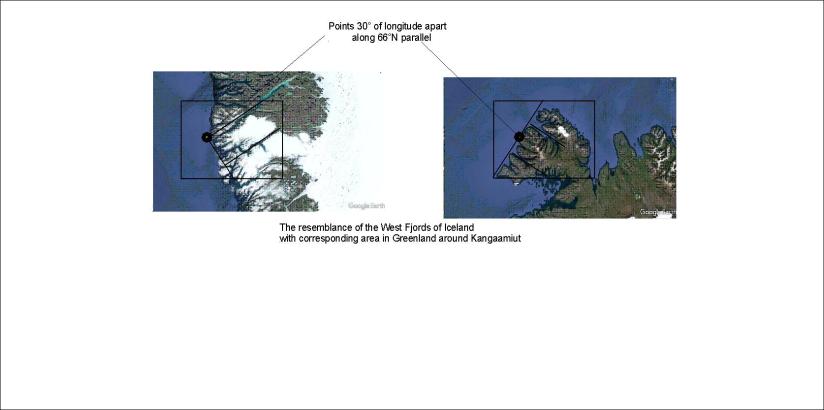
West Fjords of Iceland and West Coast of Greenland

The coasts at 66°N are exactly 30° apart, and the tectonics are mirrored so that the West Fjords of Iceland are aligned W34°S, but the fjords of Greenland are aligned W34°N. The main coast line is also mirrored, the West Fjords of Iceland follow the upper most convection cells to the NW (N31.4°E), but the outer coast of Greenland has the direction N31.4°W.

I have formerly compared the West Fjords with the west coast of Norway. The result is always a manyfold match. The interplay of different convection cell layers is apparent. Have in mind that only one basic formula is used for calculating the lines drawn along the coasts and fjords. It is the equation of the convection cell system that explains these repeated tectonic features, which remain hidden until revealed in this way.

Uncategorized

How did Thingvellir become Iceland’s most special geologic site?

Þingvellir

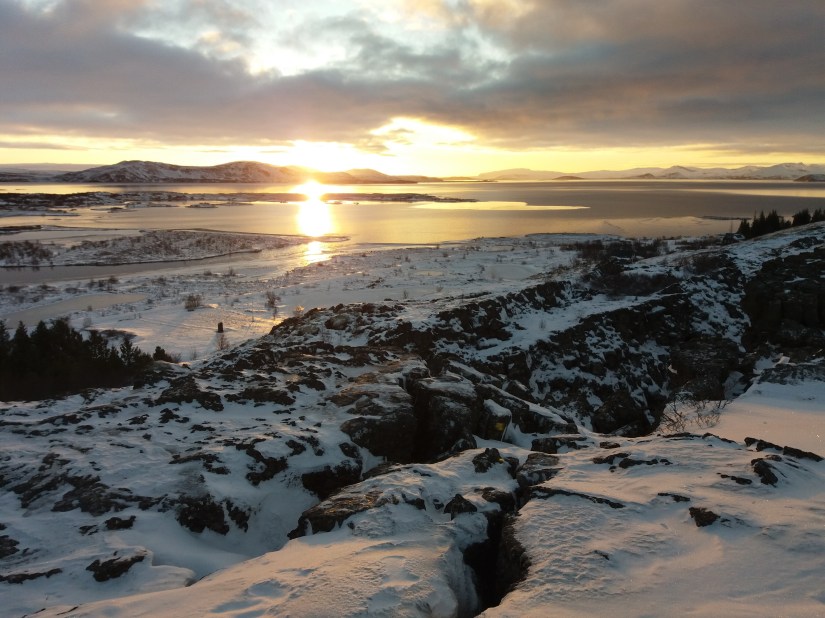
A view over the main rift of Thingvellir, extending to the lake Thingvallavatn.

The location of Thingvellir is quite special and makes us combine geology and history in a very special way. But why are the walls of the rift so prominent in the area of Almannagjá and its surroundings? It can be seen on geology maps, and by analyzing the convection cells underneath. Whereas the lake is at the western edge of the Western Volcanic Zone of Iceland (with direction α), the volcanic system of Hengill (with the direction (3/4)α, a large scale rift valley (with the direction (1/2)α, and the NS axis of the relevant polygon of mantle convection cell division lines.

Thingvellir can therefore be explained by referring to the basic formula of convection cells and the derived main tectonic alignments:

Thingvellir - tectonic background and reason for rift valley - formula

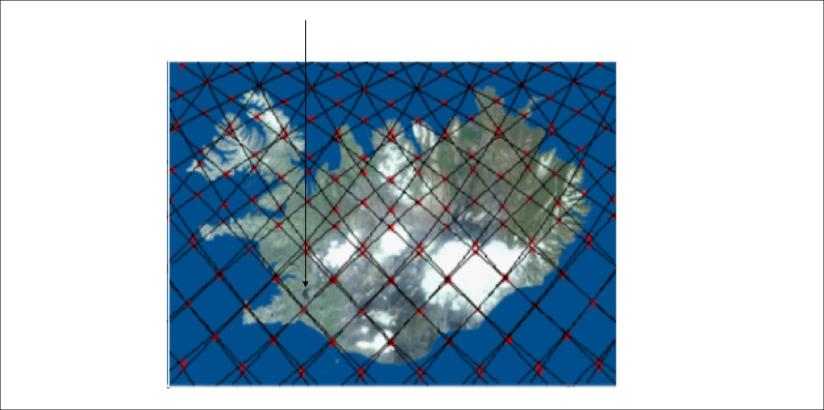
Can you find Thingvellir there? And the relevant tectonic alignments?

Thingvellir - arrow

Please check a detailed geologic map of Iceland and trace the relevant tectonic settings. Then you see why Almannagjá and Hrafnagjá are located where they are 🙂


Uncategorized

Speciality of Hekla volcano

Hekla is the most outstanding volcano of Iceland. It is not the biggest, not the most dangerous, but the most famous one. According to the analysis presented here, it is located above an upwelling line of mantle convection rolls. The mountain is relatively young, as geologists find it to be mostly made of 3000 years old rock or younger. It last erupted in the year 2000. It looks like a boat with the keel turned upwards, and has to be classified as a mixture of a ridge forming on a fissure swarm and a proper stratovolcano. It is located at a spot where four different convection cell layer division lines cross exactly under the mountain’s top crater. Therefore it is often mentioned in scientific articles that it looks like the volcano has different sources of magma. The mountain can be regarded as the central point of volcanic activity in Iceland, manifested by the fact that the distance to the volcanoes farthest in the east and west, Snæfellsjökull and Snæfell, is exactly the same!

geology

Convection cells alignment compared with the Scandinavian Peninsula and Iceland

Norway shows remarkable similarity with the shape of convection rolls pattern.

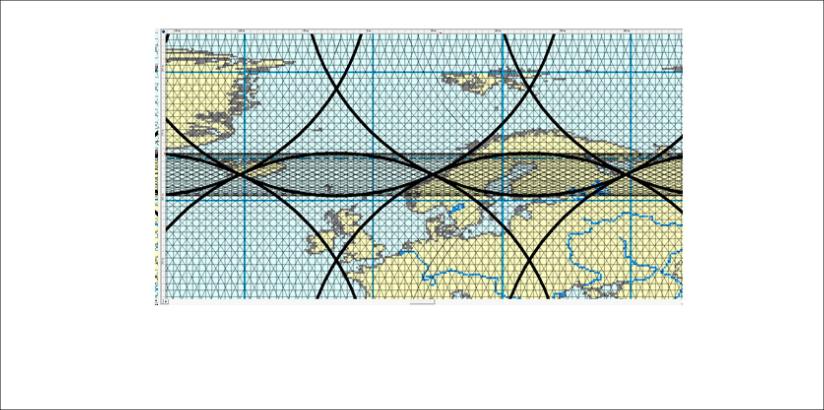
The grid resulting from the relevant analysis looks like this:
Article-Scandinavia-picture-02

With one basic formula, the main features of the Scandinavian Peninsula can be accounted for. One prediction of the theory is that identical latitudes frequently share parallel topographic features.

In northern latitudes (above 60.3°N), this formula is used:

β n = 90° – arc tan {[(35.342 – (ϕ – 96)2) 0.5  / (ϕ – 96)](1/cos ϕ)}

where β represents the direction, either as Nβ°W or Nβ°E of the convection rolls extending from the North Pole to the latitude of 60.3°N, and ϕ is the latitude.

According to the above formula, the direction is about N33°E, and it fits very well to the general trend of both coastlines at the same latitude as shown:
Article-Scandinavia-picture-03

Article-Scandinavia-picture-04

The direction can be detected even more clearly in the mountains of Norway where the valleys have the predicted orientation.

In addition, the fjords of Iceland, for instance Arnarfjörður, have the same orientatin as the side valleys of Scandinavian peninsula, extending between Norway and Sweden. The direction of these valleys can be calculated with the same formula for the convection rolls extending from equator:

β e = 90° – arc tan {[(35.342 – (ϕ – 32)2) 0.5  / (ϕ – 32)](1/cos ϕ)}

The calculation gives the value of about N55°W.

Therefore, when the direction β e is added to the maps, the resemblance becomes clear:

Article-Scandinavia-picture-05

Article-Scandinavia-picture-06

Same directions for Iceland and Scandinavian Peninsula, both for the fjords in Iceland and rivers in Sweden.

We can compare the convection rolls alignment at 60°N  with the Hardangerfjord system. The relevant vector is oriented N33°E, as shown here:

Article-Scandinavia-picture-07

In turn, the E-W orientation of Sognefjord is inherent in the convection roll system everywhere because of the symmetrical form of the polygons resulting from the two uppermost layers below the crust.

There are many other similarities to be pointed out, and I often show people how the volcano Hekla has its counterpart in Norway, exactly 30° of longitude apart. I have already written another blog post about this. Considering that the convection cell system underneath is largely identical at those two places, it becomes easier to understand.
Article-Scandinavia-picture-08

Hekla

Article-Scandinavia-picture-09

Trondheim area 30° of longitude from Hekla along 64°N.

This similarity is a surprise, but still expected according to this theory about the conditions prevalent within the mantle.

Uncategorized

The convection cells below the tectonic plates of the Earth

The convection cells of the mantle are symmetric and stable, constantly affecting our surroundings for billions of years. The basics are so simple that words are not necessary. Just have a look at this sketch below:

Convection cells - basic two rolls

The Reykjanes Ridge is a good example, with a pair of convection cells underneath. These convection rolls extend over all the globe. The subject introduced here as the Convection Cell System of the Mantle is therefore based on a very simple precondition. How this section is then extended over the entire globe and all the relevant implications is of course a bigger piece to swallow 🙂