
A 90° Connection?
Introduction
At first glance, eastern Indonesia and the East African Rift appear to have little in common. One is dominated by deep ocean trenches and subduction zones, while the other is defined by continental rifting and volcanic valleys.
Yet when examined more closely, and positioned relative to specific longitudinal reference points, a striking structural similarity emerges.
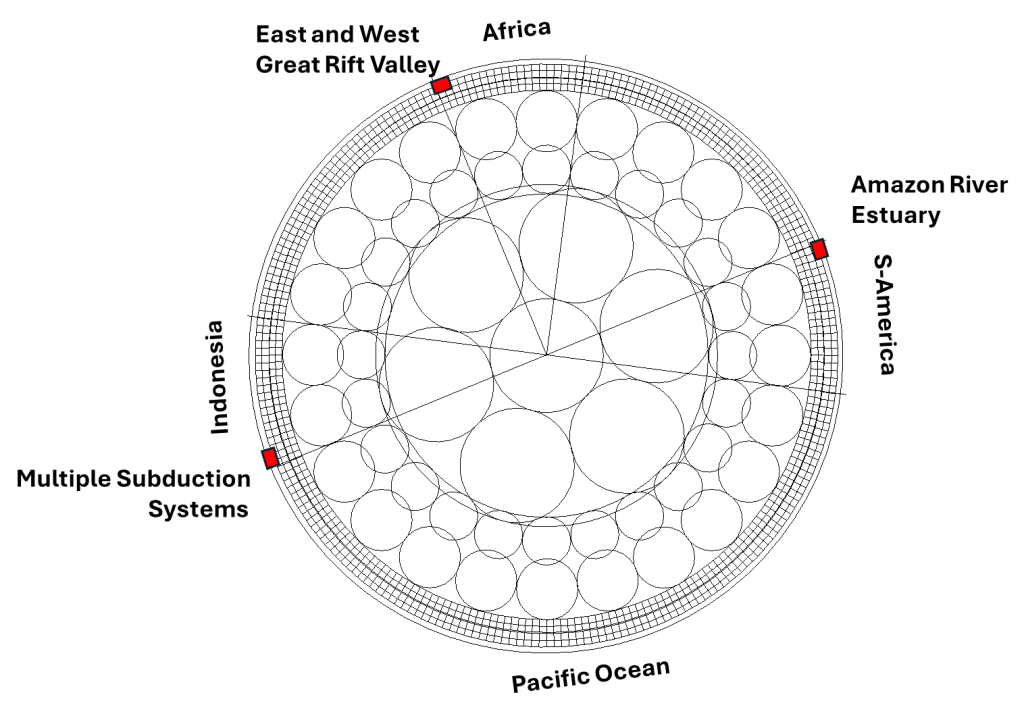
between Great Rift Valley and East Indonesia, with Amazon Estuary included.
Two locations, separated by exactly 90° in longitude (128.9°E in Indonesia and 38.9°E in East Africa), reveal comparable patterns of tectonic division. In both regions, deformation is not concentrated along a single boundary but instead distributed across multiple, parallel or opposing systems.
This raises an important question:
Are these similarities coincidental, or do they reflect deeper, global-scale organization within Earth’s mantle?
The Indonesian Reference Point: A Rare Double Subduction System

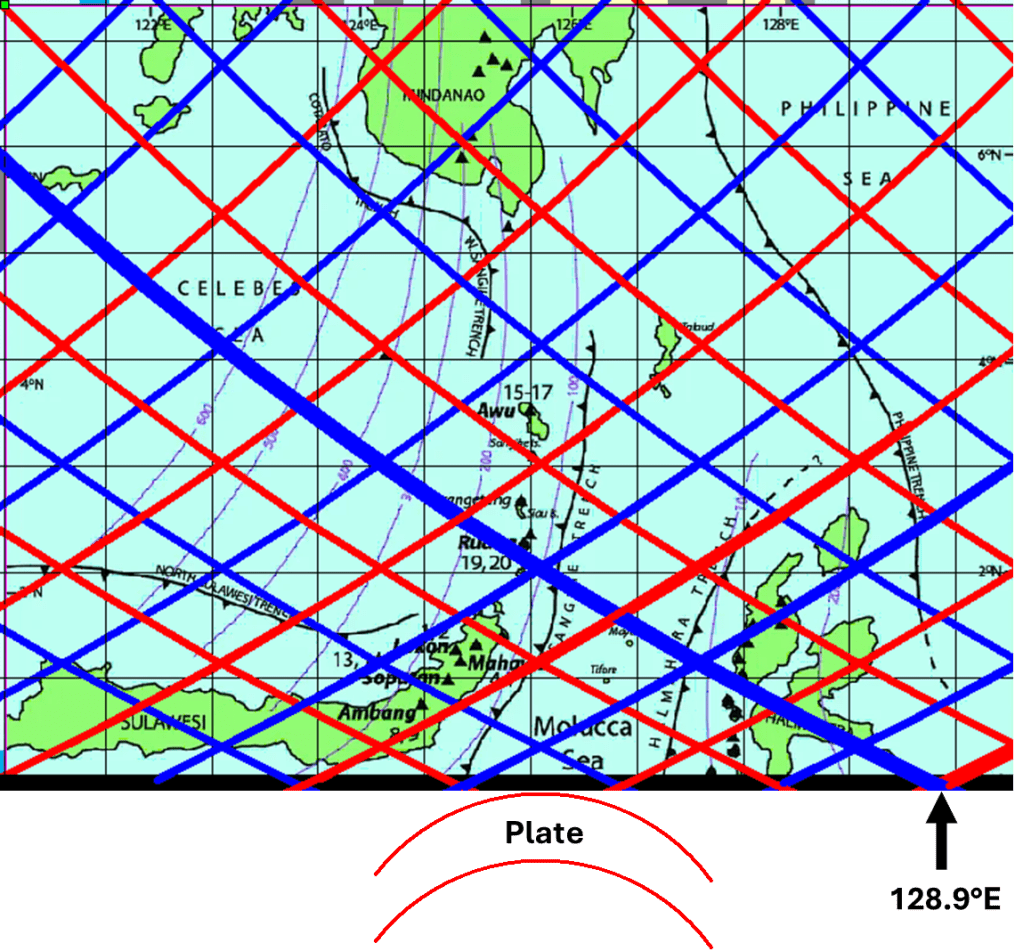
showing the Molucca Sea and the related subduction zones.
The point at 128.9°E lies just south of the Philippine Trench, within one of the most tectonically complex regions on Earth.
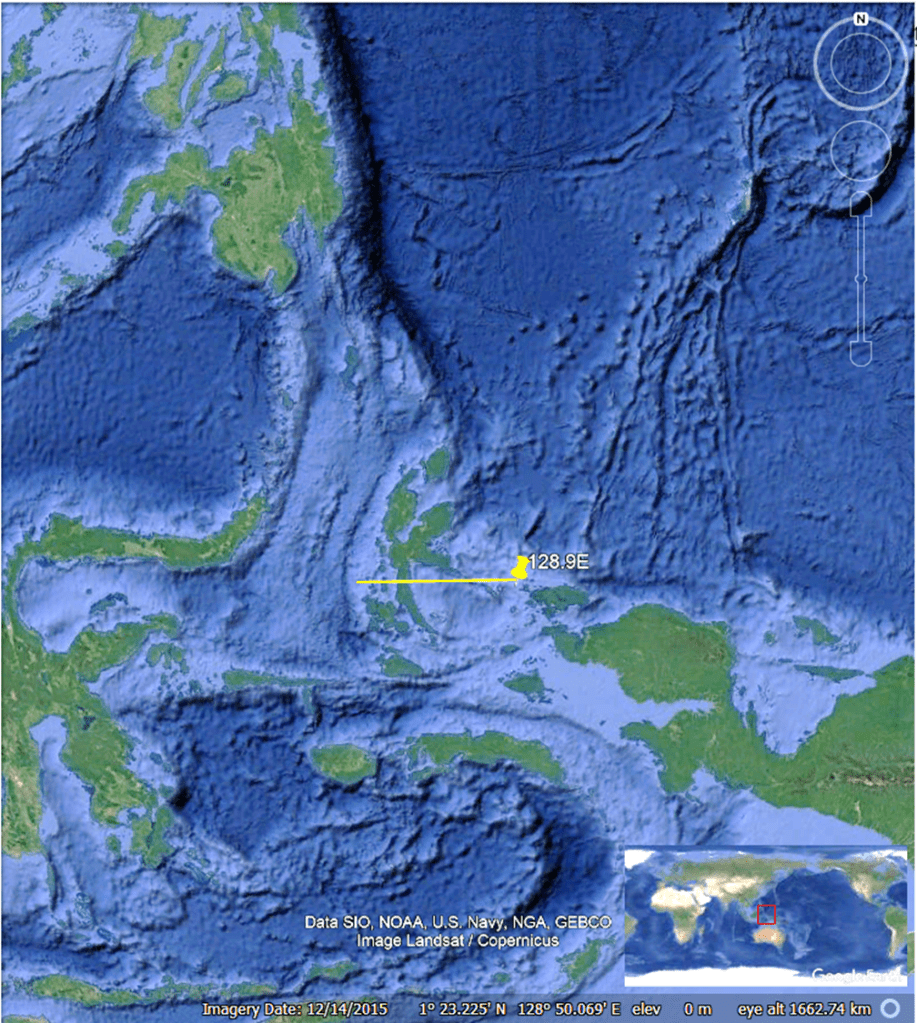
Immediately to the west lies the Molucca Sea region, characterized by a highly unusual configuration:
- Two opposing subduction zones
- Oceanic crust being consumed from both sides
- Formation of colliding island arcs
This system is often described as a double subduction zone, where the Molucca Sea plate is being subducted both eastward and westward.
Key structural feature:
Deformation is split into multiple opposing boundaries rather than a single subduction interface
The African Reference Point: A Bifurcating Continental Rift
At 38.9°E, we encounter the East African Rift—a region where the African continent is actively splitting apart.
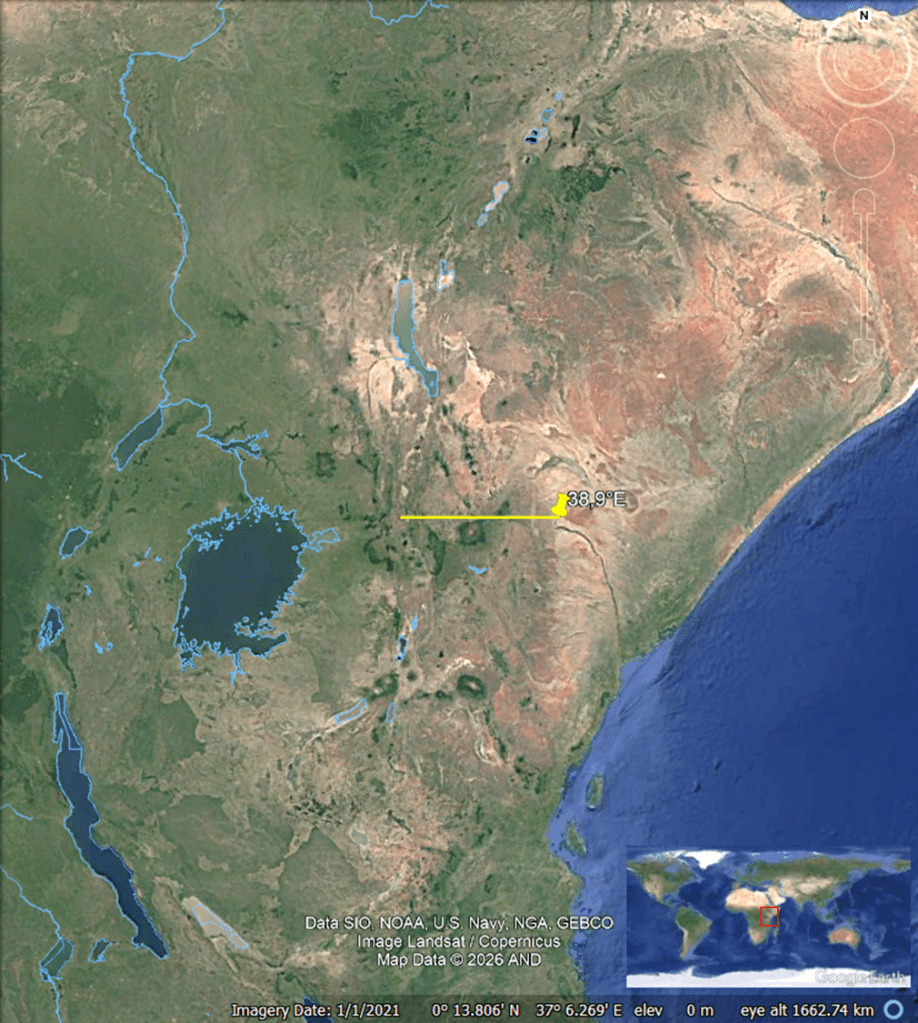
Unlike Indonesia, this is a divergent system, yet it shows a comparable structural division:
- The rift splits into two distinct branches:
- Eastern Rift
- Western Rift
- These branches run roughly parallel, enclosing a broad zone of deformation
Key structural feature:
Extension is distributed across multiple rift valleys instead of a single division.
Structural Similarity: Different Processes, Same Geometry
Despite their very different tectonic regimes, both regions share a common structural pattern:
| Feature | Eastern Indonesia | East Africa |
|---|---|---|
| Tectonic regime | Convergent (subduction) | Divergent (rifting) |
| Structure | Opposing trenches | Parallel rift branches |
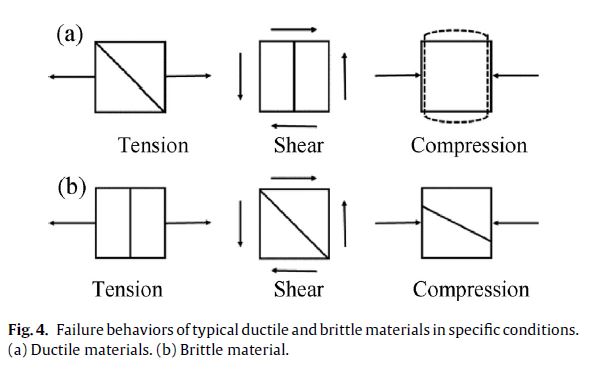
| Deformation style | Compression | Extension |
| Common trait | Multi-branch division | Multi-branch division |
Insight:
In both cases, the lithosphere does not deform along a single boundary.
Instead, it splits into multiple systems.
A Mantle Perspective: Distributed Deformation and Flow Organization
Both regions are located above areas of intense mantle activity:
- Eastern Indonesia sits at the intersection of multiple major plates and microplates
- East Africa overlies a mantle upwelling.
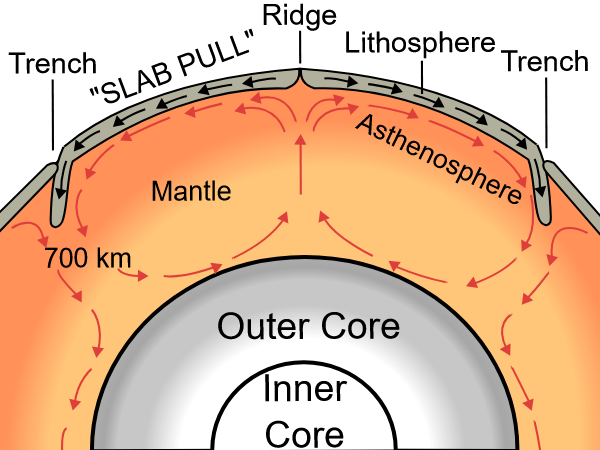
Within the framework of large-scale mantle convection:
- Flow is not necessarily localized
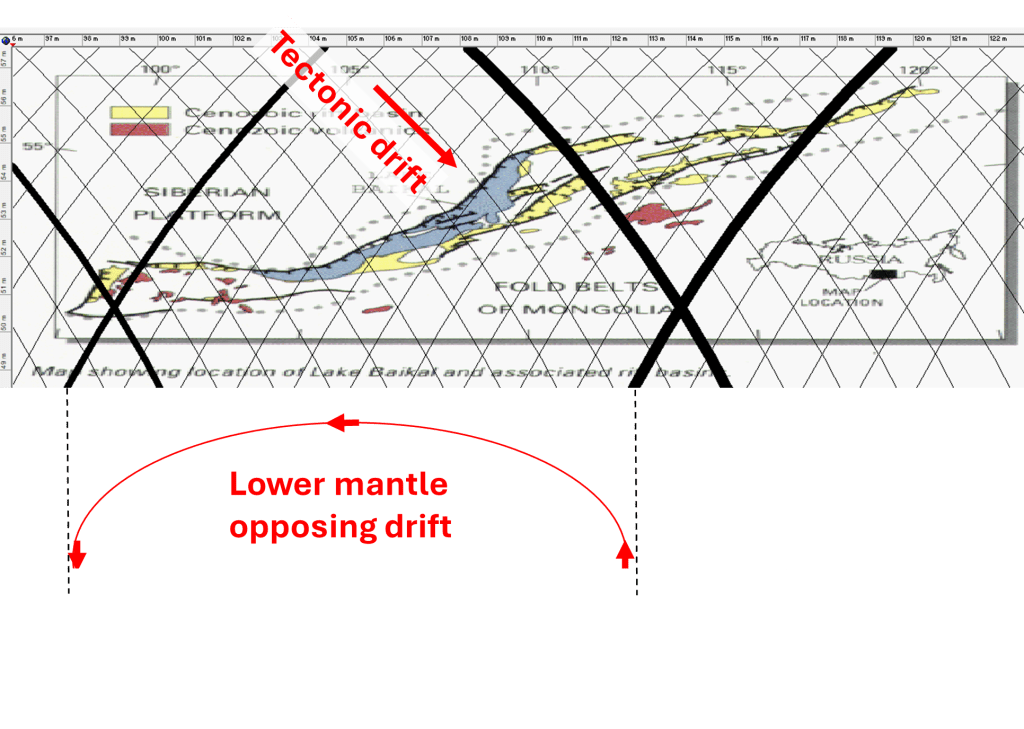
- Instead, it may organize into Reylaigh-Bénard type of convection rolls, very well known in physics.
- These can produce zones of regular deformation at the surface
Hypothesis
Regions of strong mantle flow may not produce a single tectonic boundary, but instead generate paired or multiple systems, reflecting the motion in the overlying lithosphere.
In this view:
- The double subduction in Indonesia (with two others just north and south of there)
- And the dual rift system in Africa
…are different surface expressions of a similar underlying principle:
Deformation partitioning driven by large-scale mantle dynamics
Beyond Coincidence
The comparison between these two regions suggests that:
- Complex tectonic features may follow recurring structural patterns
- These patterns may not depend on whether the regime is compressional or extensional
- Instead, they may reflect how mantle flow organizes lithospheric deformation
This aligns with a broader idea:
Earth’s surface tectonics, as in this case, may be better understood not as isolated plate boundaries, but as parts of a coherent, global system of mantle-driven structure
At approximately 51.1°W, 90° west of East Africa, lies the Amazon River estuary.
Unlike the other two regions, this is not an active plate boundary. It is part of a passive continental margin. However, it is far from simple.
Key characteristics include:
- One of the largest sediment discharge systems on Earth
- The Amazon deep-sea fan extending far into the Atlantic
- A margin shaped by long-term interaction between:
- Continental structure
- Ocean basin evolution
- Sediment loading and flexure
While not tectonically “active” in the same way, it represents a major function of mass redistribution and lithospheric response, and therefore its location can be connected with local lithospheric preconditions.
A Three-Point Pattern
We now have three locations:
- 128.9°E → Eastern Indonesia (double subduction)
- 38.9°E → East African Rift (dual rift)
- 51.1°W → Amazon margin (major sedimentary system)
Each separated by roughly 90° in longitude.
Conclusion
The apparent symmetry between eastern Indonesia and the East African Rift—highlighted by their 90° longitudinal separation and shared multi-branch structure—invites a deeper, while the tectonic mechanisms differ, the structural resemblance is difficult to ignore. Adding the Amazon estuary, also with 90° longitudinal separation as compared with the East African Rift, this arrangement must be regarded as based on something else than coincidence. It should be kept in mind that all those locations are found exactly on the equator.
Rather than viewing these regions as unrelated anomalies, they may represent:
Different manifestations of a common, deep currents within Earth’s mantle
 Magic Magma