
The boundaries of the Nazca Plate can be analysed in relation to both the mantle-convection-roll division system and the elliptical tectonic boundaries associated with the Ring of Fire and the Atlantic tectonic ring. The principal segments of the plate boundary are numbered below.
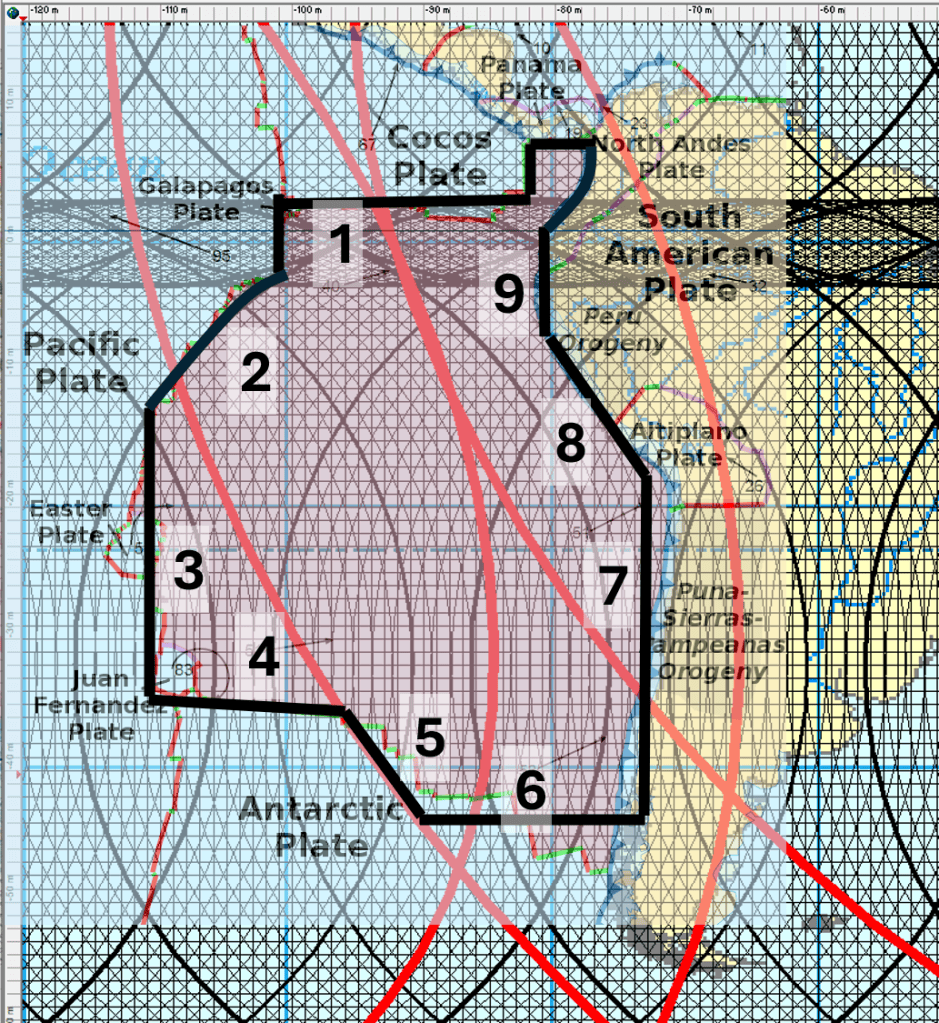
1. The northwestern corner near the equator
At the equator, the northwestern corner of the Nazca Plate is characterized by plate boundaries with conspicuous N–S and E–W orientations. The N–S structures are approximately symmetrical with respect to the equator, while the complex geometry of the northwestern corner includes the Galápagos Microplate.
Within the convection-roll model, the N–S segment can be interpreted as a connection between two principal division lines of the lower-mantle convection system. To the north, the plate boundary then assumes a much more clearly E–W orientation. This makes the equatorial region particularly important, because two of the principal directional components of the proposed mantle geometry meet there.
2. A lower-mantle convection-roll division
The next section of the plate boundary follows very closely a calculated division line between lower-mantle convection rolls. Its western endpoint is also significant: it occurs close to the point where this division is intersected by another major division of the convection-roll system. The geometry of this segment can therefore be described largely in terms of the underlying mantle framework, without requiring an elliptical tectonic boundary to explain its orientation.
3. The major N–S boundary and the Antarctic axis
The boundary then turns into a pronounced N–S segment.
This section is particularly interesting because it lies approximately along the same longitude as the major axis of the Antarctic ellipse in the geometrical framework considered here. The Easter Microplate occurs along this general tectonic corridor, while farther south the Juan Fernández Microplate is also associated with the same broad N–S plate-boundary system.
The correspondence therefore involves not only the orientation of the Nazca Plate boundary but also two important microplates situated along it.
4. The eastward turn
The plate boundary then makes an abrupt turn of almost 90° toward the east. It continues eastward until it approaches the proposed outer elliptical boundary of the Atlantic tectonic ring, in a region where the Atlantic-ring geometry extends into and overlaps the broader geometry of the Pacific Ring of Fire. This represents a transition from a boundary segment primarily associated with the convection-roll system to one that can be examined in relation to the tectonic ellipses.
5. Along the outer Atlantic ellipse
From this point, the plate boundary turns toward the southeast and follows the outer ellipse of the Atlantic tectonic ring for a considerable distance. It continues in approximately this direction until it approaches the region where the outer Atlantic ellipse and the inner Pacific ellipse converge or intersect. This is therefore another example in which a plate boundary appears, within the present model, to occupy an interaction zone between two independently defined tectonic rings.
6. The return toward South America
Near the intersection of the two elliptical boundaries, the plate boundary changes direction again and turns eastward toward the South American continent. The location of this bend is important because it occurs close to the geometrically calculated transition between the Atlantic and Pacific elliptical systems. Thus, the change in direction is not treated here as an isolated feature of the Nazca Plate boundary, but as part of a larger geometrical pattern.
7. The southwestern margin of South America
Along the southwestern coast of South America, the plate boundary assumes a conspicuous N–S component. This direction can also be represented by a major N–S axis within the convection-roll system.The correspondence is especially interesting because this is a convergent boundary rather than a spreading ridge. The same underlying geometrical direction is therefore expressed through a very different type of plate interaction.
8. The northwestern turn along South America
Farther north, approximately in the central part of the western margin of South America, the plate boundary turns toward the northwest. Within the convection-roll model, there is a close correspondence between the calculated direction of the convection-roll divisions and the general orientation of the continental margin. The coastline and subduction system therefore appear to change orientation in a manner broadly consistent with the changing direction predicted by the underlying mantle geometry.
9. Return to the equator
As the plate boundary approaches the equator, its orientation again becomes predominantly N–S. This region coincides with one of the principal equatorial points in the convection-roll model. Such points recur at approximately 30° intervals along the equator and are interpreted in this framework as major divisions of the lower-mantle convection system. Several of these equatorial points correspond to important transitions between major crustal domains, including oceanic and continental plate systems. The northern termination of the Nazca Plate therefore brings the boundary system back to the same equatorial geometrical framework from which the analysis began.
The Nazca Plate as a combined geometrical system
Taken as a whole, the Nazca Plate provides a particularly useful example of how several geometrical systems may interact.
Some sections of its boundary closely follow major lower-mantle convection-roll divisions. Other segments correspond more closely to the inner or outer elliptical boundaries of the proposed Atlantic and Pacific tectonic rings. Still others coincide with major N–S axes, including the continuation of an axis defined by the geometry of the Antarctic Plate.
The most important observation is therefore not that the entire Nazca Plate follows a single geometrical structure. Rather, its boundary appears to transfer repeatedly from one structural element to another, with major bends occurring near intersections between these systems.
The Nazca Plate therefore illustrates how a single plate boundary may be organized by several overlapping geometrical systems: lower-mantle convection-roll divisions, equatorial reference points, Antarctic axes, and the elliptical boundaries of the Atlantic and Pacific tectonic rings.


