
The boundaries of the Somali Plate can be traced around the plate in a remarkably systematic way when both the convection-roll division lines and the proposed elliptical tectonic-ring geometry are taken into account.
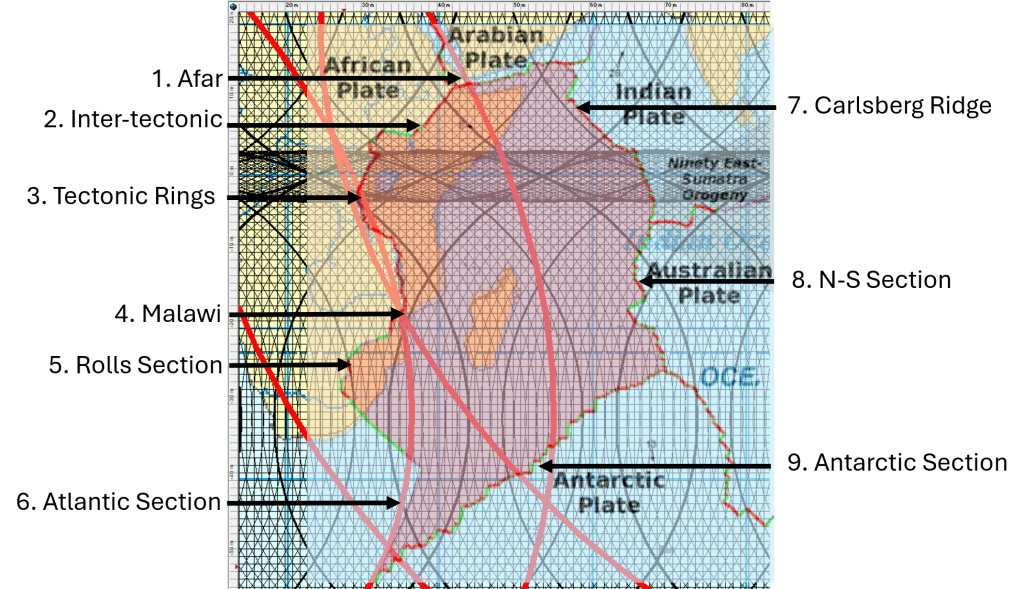
1. Afar
Afar occupies a key position at the southern end of the Red Sea. In the geometrical framework presented here, it also lies close to the outer boundary of the tectonic ring surrounding the Atlantic Ocean. It therefore forms an important transition between the Red Sea rift system and the plate-boundary system farther south.
2. Convection-roll section
From Afar, the Somali Plate boundary follows division lines associated with the mantle-convection-roll system. At the point indicated by the arrow, the boundary makes a distinct bend or step and shifts toward one of the major lower-mantle division lines.
3. Tectonic-ring section
This section is one of the main subjects of the present analysis. Here, the inner elliptical boundaries of the Atlantic and Indian Ocean tectonic rings approach and partly overlap one another. The boundary between the Somali Plate and the African, or Nubian, Plate follows this same zone remarkably closely.
Rather than being controlled by a single line, this region can therefore be viewed as an interaction zone between two large elliptical tectonic structures.
4. Lake Malawi
Lake Malawi occupies a particularly important position within this system. Near the lake and farther south toward the African coast, the two inner elliptical boundaries converge closely. This area also forms a key part of the plate-boundary system separating the Somali and Nubian plates.
The location of Lake Malawi is therefore significant not simply because it lies within the East African Rift, but because it occurs close to the junction of two independently defined tectonic-ring boundaries.
5. Return to the convection-roll system
Farther south and east, the plate boundary again tends toward the nearest major division of the lower-mantle convection-roll system. The geometry therefore appears to alternate between sections controlled primarily by the elliptical tectonic boundaries and sections more closely associated with the underlying convection-roll divisions.
6. Eastward step
A further eastward step then occurs. The boundary shifts from the vicinity of the inner Atlantic-ring ellipse toward the outer boundary of the Indian Ocean ring.
This change of position is important because it suggests that the Somali Plate boundary is not associated throughout with only one geometrical structure. Instead, different segments appear to follow different elements of the combined system.
7. Carlsberg Ridge
The Carlsberg Ridge has been discussed previously. Its orientation and position correspond closely to a major division in the lower-mantle convection-roll system—or, more precisely, to the next subsidiary division immediately east of the principal lower-mantle boundary.
This part of the Somali Plate boundary is therefore primarily associated with the convection-roll geometry rather than with an elliptical ring boundary.
8. North–south section
Another important segment of the boundary trends approximately north–south. In the geometrical model developed here, this segment lies in the direct continuation of the major axis of the Antarctic Plate.
This introduces a third geometrical relationship into the plate-boundary system: in addition to the convection-roll divisions and the tectonic-ring ellipses, some major boundaries appear to correspond to axes defined by the geometry of Antarctica.
9. Somali–Antarctic Plate boundary
The boundary between the Somali Plate and the Antarctic Plate extends from the region near the end of the major axis of the Antarctic Plate toward the outer elliptical boundary of the Indian Ocean tectonic ring.
This southern part of the system therefore provides a direct geometrical connection between the Antarctic Plate and the Indian Ocean ring.
A combined geometrical framework
Taken as a whole, the Somali Plate is particularly useful for examining the proposed global tectonic geometry. Its boundary cannot be described by only one type of structure. Different sections correspond to different components of the model:
- convection-roll division lines, including major and subsidiary lower-mantle divisions;
- inner and outer elliptical boundaries of the Atlantic and Indian Ocean tectonic rings;
- and major axes associated with the geometry of the Antarctic Plate.
The Somali Plate therefore provides a good example of how these different geometrical systems may interact. Rather than forming an arbitrary closed outline, its boundary appears, in this interpretation, to move from one structural element to another around the plate.
The geometry of the Somali Plate suggests that present-day plate boundaries may represent surface expressions of several interacting systems: the older mantle-convection-roll framework, the younger elliptical tectonic-ring geometry, and large-scale axes associated with Antarctica.
The Somali Plate — An Internal View of the Boundary System
The boundaries of the Somali Plate can also be described from the inside, beginning once again at the Afar Triple Junction. In the accompanying figure, a straight reference line has been drawn from Afar and marked as Line 1. From this starting point, the plate boundary can be followed through a series of distinct segments.
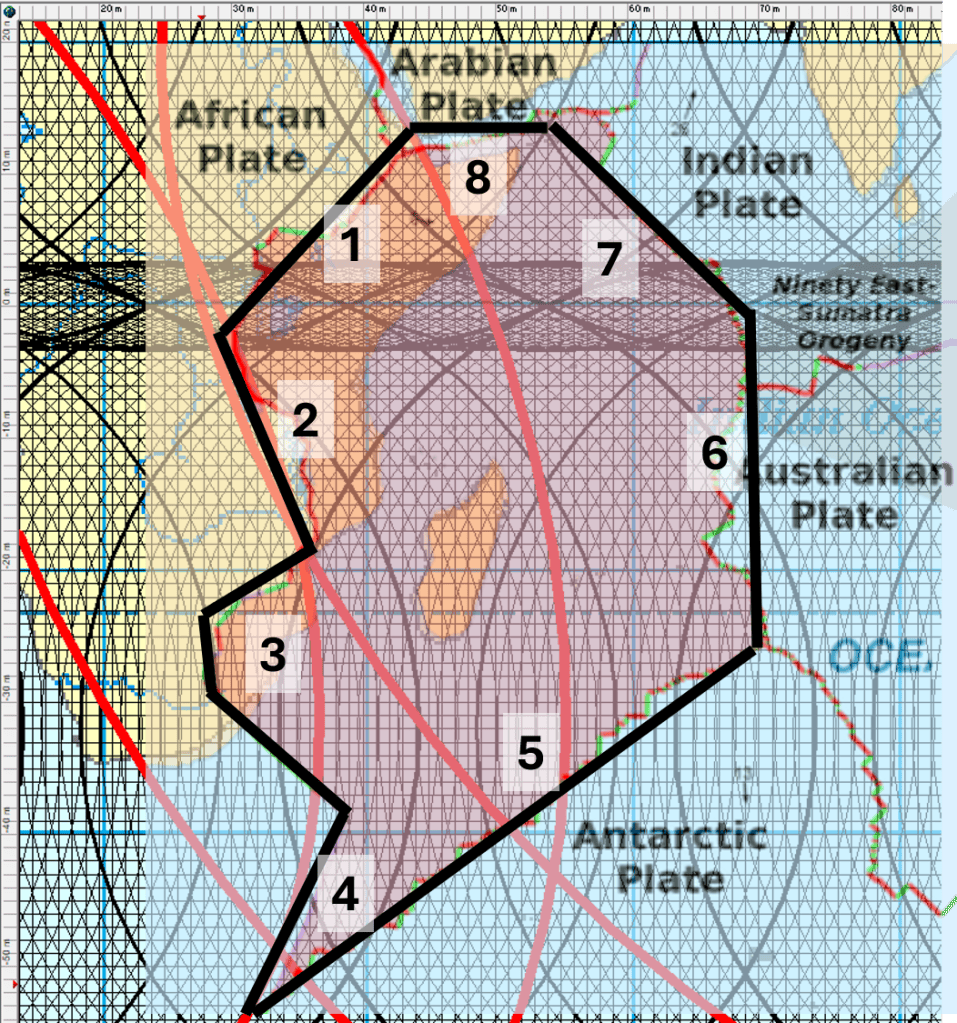
1. From the outer to the inner Atlantic-ring boundary
The first segment extends southwestward from the outer boundary of the Atlantic tectonic ring toward its inner boundary. The direction of this segment corresponds closely to the underlying orientation of the convection-roll system, which in this region trends approximately NE–SW.
This first section therefore represents a case where the surface plate boundary and the calculated mantle-convection geometry have approximately the same orientation.
2. Along the overlap of the two inner ellipses
The boundary then turns abruptly toward the SSE. From this point onward, it follows with considerable accuracy the narrow zone where the inner boundary of the Indian Ocean tectonic ring and the inner boundary of the Atlantic tectonic ring approach and overlap one another.
This is one of the most important sections of the Somali Plate boundary in the present analysis. The plate boundary is not simply following one ellipse; it occupies the interaction zone between two independently defined elliptical tectonic structures.
3. Return toward the African continent
Near the Indian Ocean coast of Africa, the plate boundary turns sharply toward the southwest, bringing it back onto the continent. This change occurs close to the point where the two inner elliptical boundaries—the Atlantic and Indian Ocean ellipses—begin to separate from one another.
The length and position of this section appear to be constrained by two different geometrical systems:
- to the east, by the tectonic-ring boundaries;
- to the west, by the nearest major lower-mantle division of the convection-roll system.
The boundary then turns southward and follows the convection-roll division for some distance. Farther south, another bend carries it toward the southeast, where the next segment continues offshore into the Indian Ocean, extending toward the inner boundary of the Atlantic tectonic ring.
4. A branch along the inner Atlantic ellipse
This branch develops where the plate boundary bends at the inner ellipse of the Atlantic tectonic ring. From there, it follows the elliptical boundary southward for a considerable distance. The segment ends approximately where it passes beyond the outer boundary of the Indian Ocean tectonic ring.
This provides another example of a plate boundary apparently changing from one controlling geometrical element to another as it crosses the larger tectonic-ring system.
5. Somali–Antarctic Plate boundary
The fifth section forms part of the boundary between the Somali Plate and the Antarctic Plate.This is a long oceanic boundary extending toward the major axis of the Antarctic Plate, where the Antarctic, Somali and Australian plates meet.
Within the geometry considered here, this is an important transition because the boundary links the Somali Plate directly with one of the principal axes associated with Antarctica.
6. From the triple junction to the equator
At the triple junction, the plate boundary turns northward. Remarkably, this northward segment terminates at the equator, at one of the principal equatorial division points identified in the convection-roll model. These principal points occur at approximately 30° intervals along the equator.
The position of the northern end of this segment is therefore not treated here as an isolated geographical coincidence, but as part of the larger equatorial organization of the convection-roll system.
7. The Carlsberg Ridge
From the equatorial point, the plate boundary turns toward the northwest and follows the Carlsberg Ridge. The Carlsberg Ridge has been discussed previously in relation to the mantle-convection-roll model. Its position and orientation correspond closely to the calculated division system and show how an oceanic spreading ridge can follow one of the major geometrical directions of the underlying mantle framework.
In this interpretation, the ridge is associated particularly closely with a subsidiary division immediately adjacent to one of the major lower-mantle divisions.
8. The return to Afar
At the southern end of the Red Sea lies the Afar Triple Junction, where one branch extends almost directly eastward. This final section is particularly useful for understanding the geometry of the Somali Plate. It lies between two different structural controls:
- the dominant tectonic boundary associated with the outer ellipse of the Atlantic tectonic ring;
- and the convection-roll division system associated with the Carlsberg Ridge.
The geometry therefore shows an identifiable gap or transition between the two systems. Afar occupies the point where these different structural elements are brought together.
A plate boundary controlled by more than one geometrical system
Viewed from inside the Somali Plate, its boundary appears to consist of a sequence of segments controlled by several different geometrical elements.
Some sections follow the convection-roll division lines. Others follow the inner or outer boundaries of the Atlantic and Indian Ocean tectonic rings. Still others connect with major axes associated with the Antarctic Plate or terminate at principal equatorial division points.
The Somali Plate is therefore particularly useful for studying how these geometrical systems may interact. Its boundaries do not follow one single calculated structure continuously. Instead, the plate boundary appears repeatedly to transfer from one structural framework to another, with sharp bends or step-like shifts occurring near the intersections between them.
The Somali Plate therefore provides a particularly clear example of how plate boundaries may be organized by the interaction of mantle-convection divisions, elliptical tectonic-ring boundaries, and the large-scale geometry associated with Antarctica and the equator.
The length and position of this section appear to be constrained by two different geometrical systems.


