
Once one large-scale pattern in nature has been identified and described, it becomes easier to recognize analogous structures elsewhere. The Pacific Ring of Fire therefore does not necessarily have to be treated as a completely unique tectonic phenomenon.

After examining the geometry of the Ring of Fire in greater detail, its inner tectonic ring appears to span approximately 120° from east to west. This immediately raises a broader possibility: if one such 120° tectonic ring exists, comparable rings may be fitted around the rest of the Earth.
A complete circumference contains three such sectors: 3 × 120° = 360°.
This suggests a possible global system consisting of three major tectonic rings:
- the Pacific Ring of Fire,
- the Indian Ocean Ring,
- and the Atlantic Ring.
The comparison appears to work surprisingly well when these circles are placed against the known tectonic structure of the Earth.
The Indian Ocean Ring
The proposed Indian Ocean Ring provides one of the clearest examples. Its relationship with New Zealand is especially important because this is where it overlaps the Pacific Ring of Fire. The Kermadec–Tonga system, which appears to lie unusually far inside the broader Pacific Ring of Fire, can then be viewed differently.
Rather than being simply an inward deviation of the Pacific Ring, Kermadec–Tonga may belong primarily to the Indian Ocean Ring, within the region where the two tectonic rings overlap.This provides a possible geometric explanation for the complicated tectonic structure of the southwest Pacific. From Kermadec–Tonga, the same system can be followed northward through the Fiji region and towards the Philippine Sea Plate. The northern boundary of the Philippine Sea Plate lies close to the outer geometry of the proposed Indian Ocean Ring.
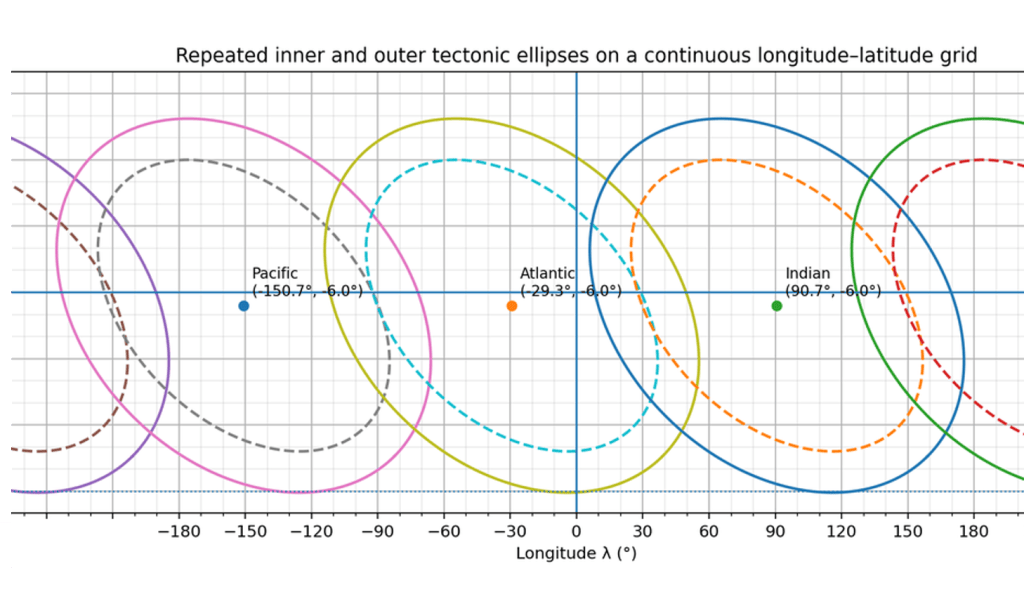
Farther inland, Lake Baikal also falls within the same large-scale ring. This is especially interesting because Baikal represents one of the world’s most prominent examples of active continental rifting. Its position may therefore be examined not only in relation to regional tectonics, but also within this larger geometric system.
The ring continues westward through regions of major tectonic activity. Turkey falls within it, as does Italy, close to the area where the proposed Indian Ocean Ring and Atlantic Ring overlap. The Cameroon Volcanic Line also lies within the geometry of the Indian Ocean Ring. This is particularly noteworthy because the Cameroon Line is an unusual intraplate volcanic structure that crosses both continental and oceanic crust.
None of these individual correspondences is sufficient by itself to establish the existence of such a ring. Their significance lies in whether the same geometric relationship repeatedly appears when independently mapped geological features are compared with the proposed system.
Erebus as an example of overlapping geometries
Mount Erebus in Antarctica provides a useful example of how several geometrical systems may interact. Erebus lies outside the main Pacific Ring of Fire, although it is not far from it. It is also situated slightly away from the minor axis of the elliptical Antarctic Plate geometry.However, when the proposed Indian Ocean Ring is added to the map, Erebus falls close to its outer boundary.
This illustrates an important principle of the model. A geological feature does not necessarily have to be explained by its relationship with only one geometric structure. Its position may instead result from the intersection or overlap of several systems: Antarctic plate geometry + mantle convection-roll divisions + global tectonic rings. A volcanic centre such as Erebus may therefore become particularly informative when its position is analysed simultaneously with respect to all three.
Relationship with the Mantle Convection Roll Model
The three tectonic rings also show a close relationship with the southern part of the Mantle Convection Roll system. From approximately 15°S to 60°S, considerable portions of the proposed rings follow the curvature of the convection-roll pattern and the corresponding division lines in the lower mantle. This relationship is important, but the tectonic rings and the mantle convection rolls should not be regarded as the same type of structure.
The convection rolls represent a three-dimensional mantle-flow system. The tectonic rings, by contrast, are essentially horizontal lithospheric structures, expressed through the tectonic interaction of plates at or near the Earth’s surface. In the interpretation proposed here, the tectonic rings develop as the lithosphere responds to the stresses generated by plate motion, while the larger-scale organization and direction of that motion are influenced by the underlying mantle-flow system.
The relationship can therefore be expressed schematically as:
Earth’s rotation
→ organization of mantle convection
→ systematic mantle-flow geometry
→ plate motion and lithospheric stress
→ large-scale tectonic ring structures.
The rings are therefore not themselves mantle convection rolls. They represent a surface-level tectonic response to a deeper global system.
The importance of the South Pole
When the Pacific, Indian Ocean and Atlantic rings are examined together with the Antarctic Plate, another important feature emerges: the South Polar region becomes a major geometrical reference point.
The elliptical geometry of the Antarctic Plate, its major and minor axes, the possible 60° sector division around Antarctica, and the geometry of the three 120° tectonic rings all appear to interact in this region.
This may help explain why Antarctica shows such pronounced large-scale symmetry around the pole.
The recently identified fan-shaped basin structures beneath East Antarctica add another independent observation to this picture. Their calculated Euler poles lie close to the geographic South Pole, indicating that large-scale deformation within Antarctica itself has developed around a nearly polar centre.
The tectonic rings then extend this geometry outward from Antarctica into the surrounding plate system.
A framework for further investigation
The most important value of this approach is not simply the possibility of drawing three large circles around the Earth.
The real research potential lies in examining the exact position of individual geological structures relative to several independent geometrical systems at the same time.
For any particular tectonic or volcanic region, it becomes possible to ask:
- Where does it lie relative to the inner and outer boundaries of a tectonic ring?
- Is it located where two rings overlap?
- How does it relate to the major or minor axis of the Antarctic Plate?
- Does it coincide with a mantle convection-roll division?
- Does it occur near a lower-mantle boundary or a predicted change in flow direction?
- Does its observed tectonic style agree with what would be expected from that position?
This opens a much wider field of comparison than studying each geological feature only in its local setting.
The Pacific Ring of Fire remains the clearest of the three systems because its tectonic boundaries are exceptionally well expressed. As its geometry becomes more precisely defined, however, the corresponding Indian Ocean Ring and Atlantic Ring also become easier to identify.
This may eventually allow the three rings to be analysed as parts of a single global tectonic framework rather than as unrelated regional structures.
One important question remains unresolved: how the Arctic Ocean fits into this geometry.
The southern hemisphere currently provides the clearest relationships because Antarctica offers a well-defined polar reference system and because the curvature of the proposed tectonic rings corresponds closely with the southern mantle-convection geometry. The northern polar region is considerably more complex, particularly because of the configuration of the Arctic Ocean, Eurasia and North America.
Nevertheless, the picture becomes progressively clearer as the Pacific Ring of Fire and the proposed Indian Ocean and Atlantic rings are defined more precisely.
The key point is therefore not that three tectonic rings have already been demonstrated as established geological entities. Rather, the same geometrical method that helps define the Pacific Ring of Fire can be applied globally. When this is done, major tectonic structures on different continents and ocean basins repeatedly fall into coherent relationships with three approximately 120° systems.
That correspondence is sufficiently systematic to justify much more detailed comparison with the independently derived geometry of the Mantle Convection Roll Model.


