
Because the Antarctic Plate, like other tectonic plates, consists of both continental and oceanic crust, it is treated here as a single tectonic unit.
When the Antarctic Plate is examined in relation to the South Pole and the surrounding plate boundaries, a remarkable geometric pattern emerges. The Pacific–Antarctic Ridge, forming the southern continuation of the East Pacific Rise, and the Southwest Indian Ridge are situated almost exactly opposite one another across the South Pole. A straight line can therefore be drawn from the Pacific–Antarctic Ridge triple junction, across the South Pole, to the triple junction where the Southwest Indian Ridge meets the Antarctic Plate.
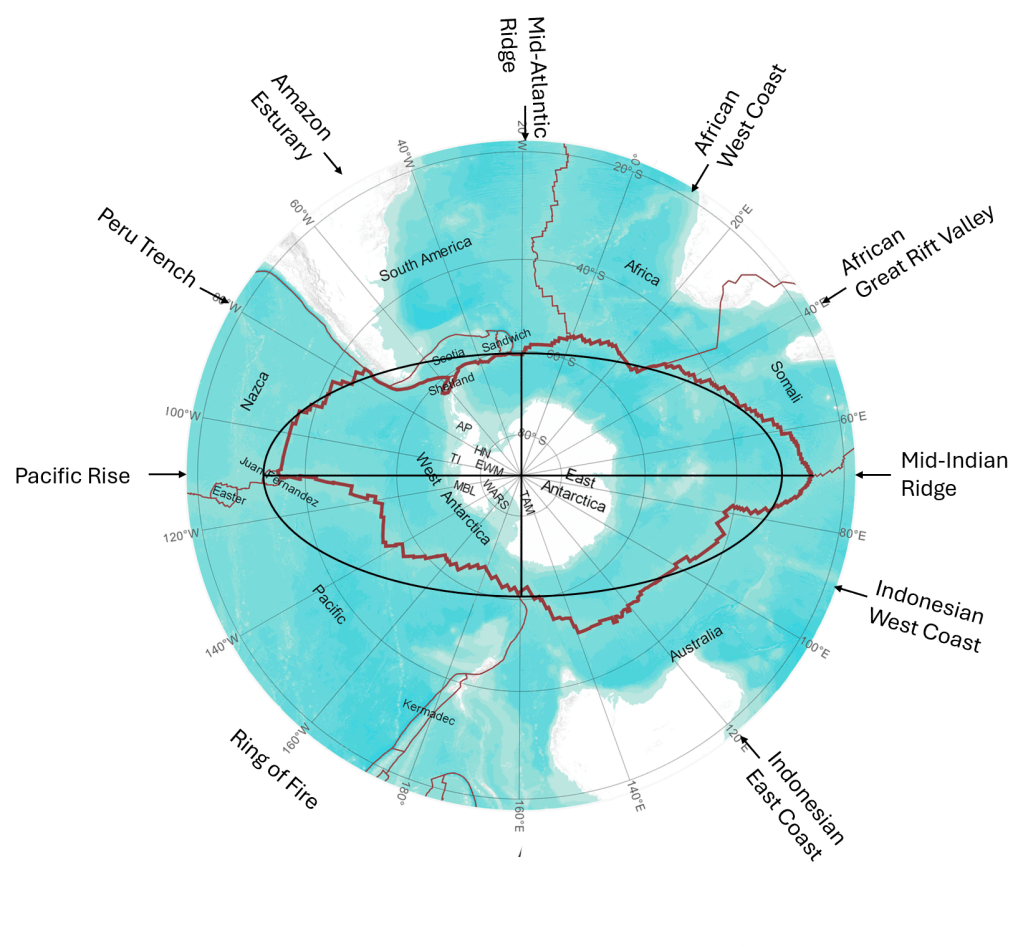
A second line, drawn perpendicular to the first and also passing through the South Pole, intersects two major subduction systems: the South Sandwich Trench in the South Atlantic and the Puysegur–Hjort subduction system south of New Zealand. The South Sandwich Trench also lies close to the southern continuation of the Mid-Atlantic Ridge, which extends northward approximately parallel to this same line.
Using these two perpendicular lines as the major and minor axes, an ellipse can be constructed that closely resembles the outline of the Antarctic Plate. Two additional major plate-boundary systems also meet or approach the elliptical outline: the Peru–Chile Trench along the western margin of South America and the ridge system extending southward from Africa into the Indian Ocean.
Although the geometric fit is not exact everywhere, much of the Antarctic Plate boundary follows the ellipse closely. The principal deviation occurs within the Pacific sector, where part of the plate boundary trends approximately parallel to the major axis rather than following the elliptical curve.
When the major and minor axes are extended northward, another part of the same pattern becomes visible. The two ends of the major axis point toward the East Pacific Rise and the Mid-Indian Ridge, while one end of the minor axis aligns with the Mid-Atlantic Ridge. The opposite end coincides with the southern endpoint of the minor axis of the Ring of Fire. It also meets the southern end of the principal mantle-convection division line proposed in this study, which is associated with subduction along the western Pacific margin.
The same geometric framework can therefore be traced from the South Pole to the principal tectonic divisions near the equator and to the geometry of the Ring of Fire. Major spreading ridges, subduction zones, triple junctions, and axis endpoints repeatedly occur along the same projected lines and intersections. Together, these relationships form a distinct and internally consistent large-scale pattern centred on the South Pole.
Reasons for the Geometric Regularity of Mid-Ocean Ridges and Subduction Zones
Having derived a system of mantle convection rolls from the known thermal structure and layering of the Earth, it is natural to examine the global distribution of mid-ocean ridges and subduction zones in light of these results.
According to the model, the upper mantle contains convection rolls that are approximately 1.5° wide in the east-west direction, aligned with the Earth’s rotation. In the deeper mantle, the larger convection rolls span approximately 15° in width. Consequently, the principal upwelling zones occur at intervals of 30° around the equator.
A comparison with the mapped distribution of plate boundaries, mid-ocean ridges, transitions between continental and oceanic crust, and major subduction systems reveals a striking correspondence: these major tectonic boundaries repeatedly occur at approximately 30° intervals along the equator. This geometric regularity is, by itself, a remarkable observation. The existence of this pattern cannot reasonably be disputed, since the global plate boundaries are among the best-mapped geological features on Earth.
The same regularity also emerges from the Earth’s internal structure. When convection rolls with equal height and width are placed within the known mantle layering, the geometry naturally accommodates 24 rolls in the lower mantle, or twelve counter-rotating convection pairs. This arrangement produces twelve principal upwelling zones spaced 30° apart around the globe.
The derivation is most straightforward along the equator. From these equatorial upwelling points, the principal mid-ocean ridges and subduction zones extend northward and southward. In the following discussion, the focus is placed primarily on the Southern Hemisphere.
On the southern hemisphere, the principal spreading ridges are conspicuously aligned in a north-south direction. This applies to the East Pacific Rise, the South Atlantic Ridge, and the Central Indian Ridge. Southward, these ridges merge into the circum-Antarctic spreading system that surrounds Antarctica.
Two of these junctions exhibit particularly striking symmetry: the connection between the East Pacific Rise and the Antarctic Ridge occurs near 110°W, while the corresponding connection between the Central Indian Ridge and the Antarctic Ridge lies near 70°E. These locations are separated by almost exactly 180°, meaning that a straight line connecting them passes directly across the South Pole.
One might be tempted to dismiss this as a coincidence. However, the broader pattern is far more difficult to ignore. Along the equator, major tectonic boundaries appear repeatedly at intervals of approximately 30°. Moving eastward, one encounters the East Pacific Rise, the western margin of South America, the eastern margin of South America near the Amazon mouth, the Mid-Atlantic Ridge, the western margin of Africa, the East African Rift System, the Central Indian Ridge, the western margin of Indonesia, and the eastern margin of Indonesia—each separated by roughly 30° of longitude.
From a statistical perspective, such a systematic arrangement is unlikely to arise by chance alone. It strongly suggests that an underlying large-scale control governs the distribution of these tectonic features, and the mantle convection-roll model provides a possible physical explanation for that control.
It is important to recognize that continental drift and the mantle convection pattern are not contradictory processes. Plate motions continuously rearrange the continents, so the surface expression of the underlying convection system changes through geological time. Nevertheless, the convection geometry itself may remain comparatively stable, while its surface manifestations evolve. We obviously cannot wait tens of millions of years for the continents to assume a new configuration before investigating whether such a fundamental geometric pattern exists.
A second remarkable relationship emerges when a line is drawn across Antarctica perpendicular to the line joining the East Pacific Rise and the Central Indian Ridge. The endpoints of this second line fall very close to the subduction system south of New Zealand on one side and the South Sandwich subduction system on the other. The South Atlantic Ridge lies close to this same axis.
These four reference points define an ellipse surrounding Antarctica that corresponds surprisingly well with the overall geometry of the Antarctic Ridge system. Two additional tectonic elements also fit naturally within this framework: the South American subduction zone and the spreading system extending southward from Africa.
An even more intriguing relationship appears when this Antarctic ellipse is compared with the ellipse defined by the Pacific Ring of Fire. The Ring of Fire itself displays a pronounced elliptical geometry, with its minor axis extending from Yellowstone, through the eastern side of the San Andreas Fault system, to New Zealand on the western side of the Pacific. When this axis is extended southward, it intersects the endpoint of the minor axis of the Antarctic ellipse.
These observations establish geometric relationships that link the principal spreading ridges and subduction systems of the Earth into a single coherent framework. Whether this remarkable regularity reflects the influence of large-scale mantle convection remains a question for continued investigation. However, the geometric relationships themselves are systematic, internally consistent, and sufficiently striking to warrant careful examination.


