
The Mid-Atlantic Ridge displays a remarkable north–south alignment, and this geometry deserves closer examination. In the Northern Hemisphere, the Kolbeinsey Ridge north of Iceland and the Reykjanes Ridge south of Iceland are both oriented northeast–southwest. South of approximately 53°N, however, the ridge is offset eastward by major transform faults and begins to sway in the opposite direction as it extends toward the Azores. Near the Azores, it again changes orientation, maintaining an overall north–south trend.

At the equator, the ridge becomes almost perfectly aligned north–south. This alignment continues across much of the South Atlantic and remains evident until approximately 45°S, spanning in this way nearly one quarter of Earth’s circumference. Farther south, the ridge bends eastward and eventually merges with the ridge system of the Southern Ocean.
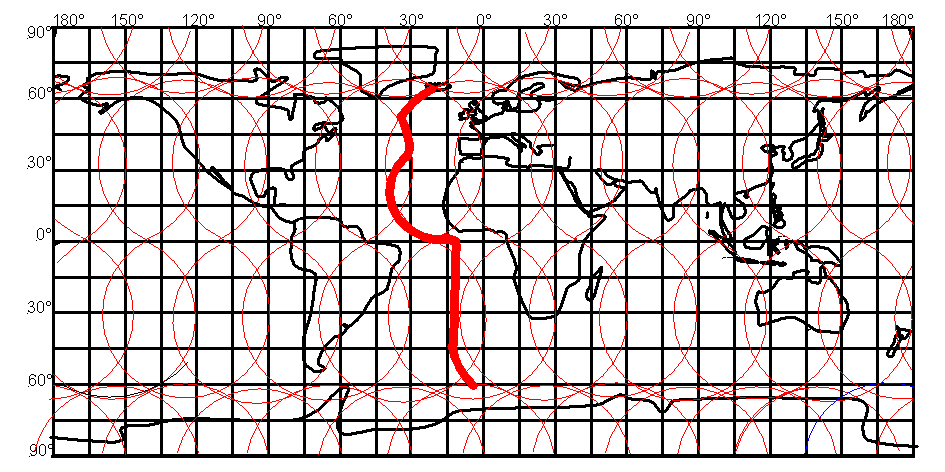
This pattern is not unique to the Atlantic. The major ridge systems of the Pacific and Indian Oceans also exhibit prominent north–south components and are positioned approximately 90° on either side of the Mid-Atlantic Ridge. These recurring geometric relationships suggest that the arrangement of the global ridge system may not be entirely coincidental.
Another important feature is the circum-Antarctic ridge system that surrounds Antarctica. As new crust is continuously added on both sides of these ridges, the surrounding oceanic plates move away from them. The geometry of this system is particularly interesting because Antarctica is bordered by an approximately elliptical plate configuration, with three major mid-ocean ridge systems occupying three sides of the ellipse.
The fourth side of this configuration is equally significant. There, the plate boundary transitions into the subduction zone south of New Zealand, which can be traced northward through the Tonga-Kermadec system, past Japan, and onward to the Aleutian Islands. When viewed in the context of the Mantle Convection Rolls (MCR) model, this sequence forms a continuation of the global pattern represented by the Mid-Atlantic Ridge, or more precisely, its counterpart on the opposite side of the Earth.
The global plate system is often described in simple terms: the Atlantic Ocean is growing while the Pacific Ocean is shrinking. However, the situation is more complex. Plate rotation, the expansion of the Antarctic Plate, and subduction around South America and Indonesia all contribute to the evolving geometry of the plate boundaries.
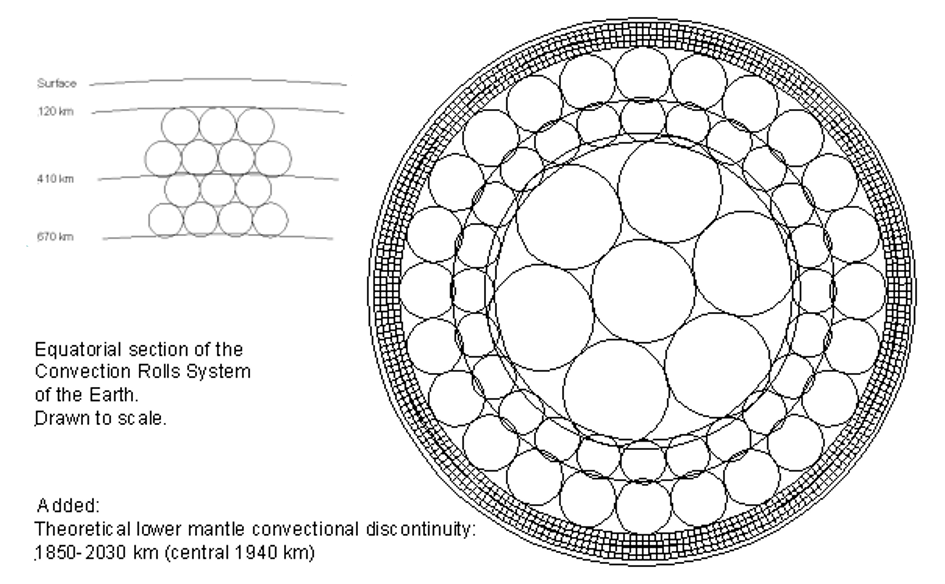
Within the MCR framework, the persistence of the north–south alignment of the Mid-Atlantic Ridge becomes understandable. Earth’s rotation influences the orientation of mantle convection rolls, and near the equator they tend to align north–south. Because multiple mantle layers are affected in a similar manner, large-scale parallel patterns emerge. These patterns can guide the development of geographic structures over immense distances, providing an explanation for why the Mid-Atlantic Ridge maintains its north–south trend across such a large portion of Earth’s surface.


