
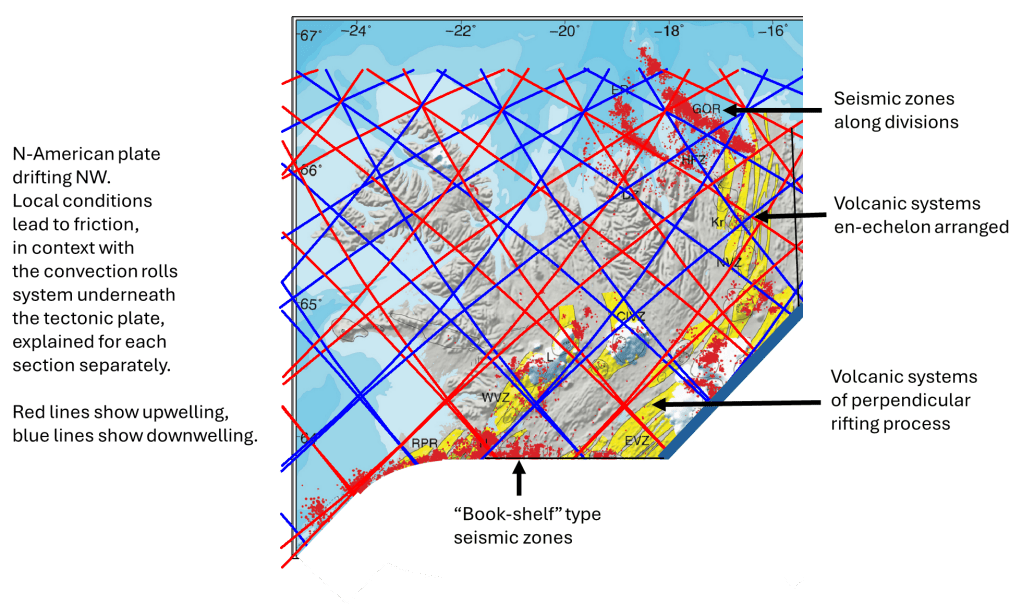
The volcanic activity of Iceland can be examined by emphasizing the role of the North American side of the plate boundary system. In general, the North American Plate lies west of the mid-ocean ridges, the Kolbeinsey Ridge north of Iceland and the Reykjanes Ridge south of it. Iceland, however, is different, because two regions appear to transfer the volcanic activity eastwards. This is commonly explained simply by referring to a mantle hotspot beneath Vatnajökull, but here the process is interpreted somewhat differently.
According to this interpretation, convection rolls in the mantle layers beneath the tectonic plate contain both upwelling and downwelling sides. At the latitude of Iceland, the volcanic activity shifts eastwards from one side of the convection rolls to the other. Instead of forming a simple linear ridge, volcanic zones develop because the convection-roll structure interacts with the tectonic forces associated with the overall westward drift of the North American Plate. This interaction results in a broader rifting process and the formation of distinct volcanic and seismic zones across Iceland.


