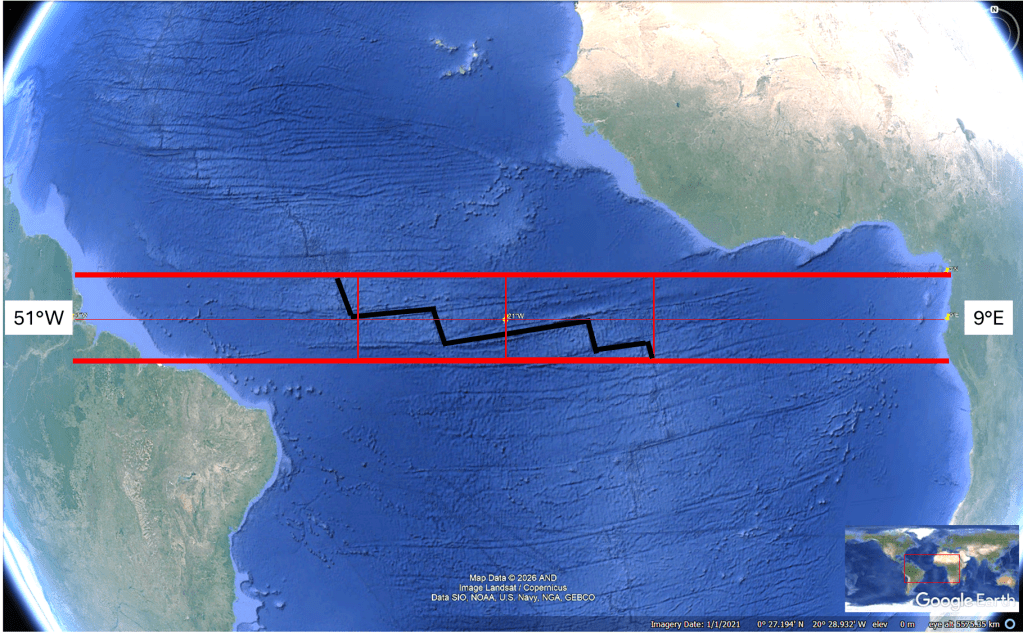
What is special about the equatorial section of the Mid-Atlantic Ridge? This segment extends across roughly one third of the distance between South America and Africa along the equator — approximately 20° of longitude within the roughly 60°-wide Atlantic Ocean at equatorial latitudes. The geometrical midpoint of the Atlantic at the equator therefore lies near 21°W, with about 30° extending westward to the coast of South America near 51°W and about 30° eastward to the African coast near 9°E.
When examining the zigzag geometry of this section of the Mid-Atlantic Ridge, an additional symmetry appears. The major deviations toward more northerly and southerly alignments occur at approximately equal distances from this central point, around 9° to either side. If one considers a basic upper-mantle convection-roll width of roughly 1.5°, together with a broader large-scale equatorial spacing pattern of about 30°, the geometry becomes particularly intriguing.
Naturally, this section of the Mid-Atlantic Ridge has been studied extensively using the full range of modern marine geophysical methods. The individual segments and fracture zones are well mapped and documented. Two of the most prominent equatorial fracture zones are the St. Paul Fracture Zone and the Romanche Fracture Zone, which together form a striking en-echelon pattern along the equatorial Atlantic.
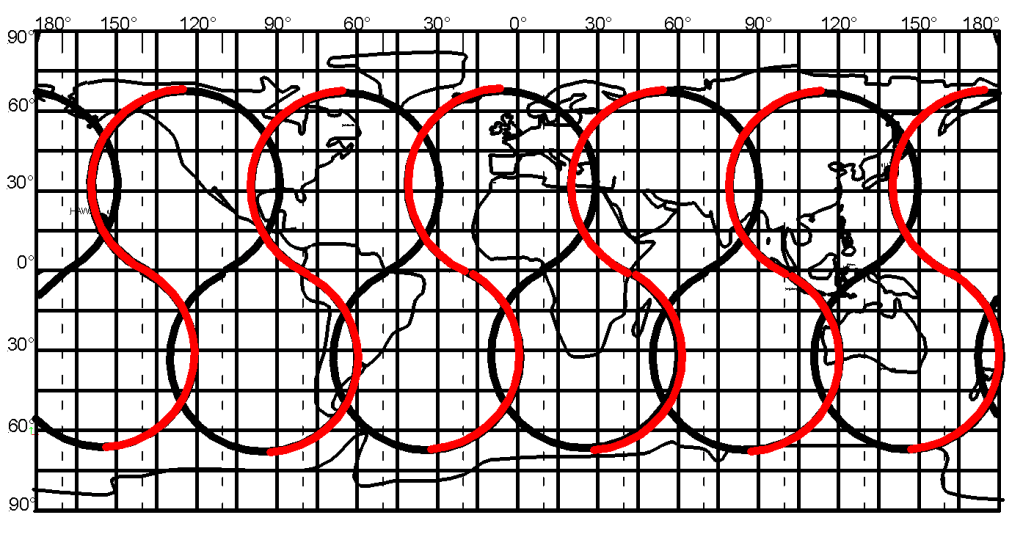
To realize the importance of the equator, the most basic map of convection rolls division lines can be added: