

There are many ways in which Iceland can be meaningfully compared with the mantle convection-rolls model. When viewed from a holistic, bird’s-eye perspective, the pattern of the continental shelf, the mid-ocean ridges, and the position of Iceland’s stratovolcanoes together reveal a coherent geological structure. To understand this fully, it is necessary to recognize both the location and the function of the major convection rolls operating beneath Iceland. In this model, the rolls do not have fixed “axes”; instead, they sway according to their governing equations. Therefore, the true geological significance lies in the division boundaries between adjacent rolls. These boundaries, when projected through the mantle and lithosphere, naturally delimit Iceland’s volcanic zones and help explain their geometry.
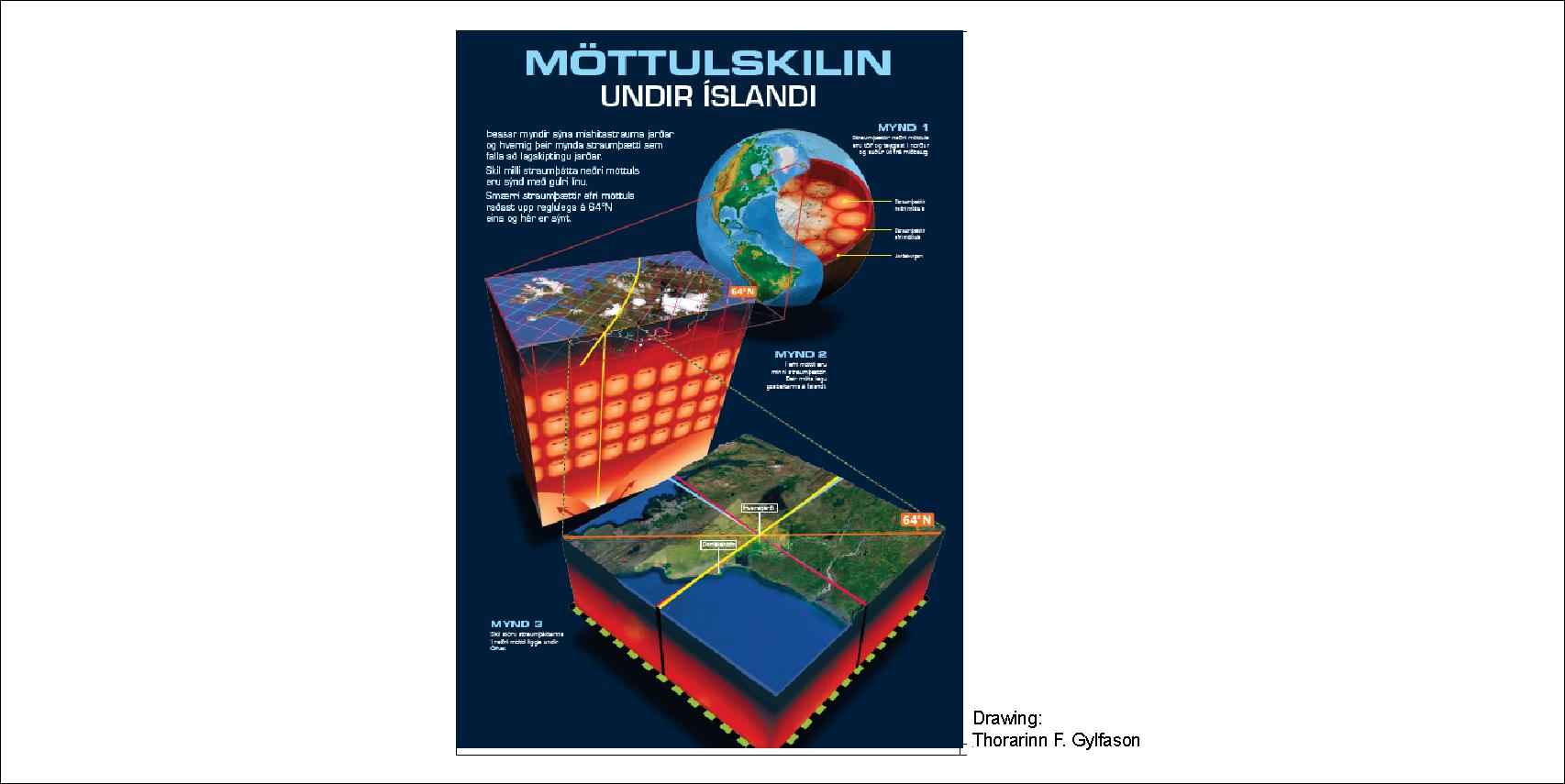
Although Iceland’s brittle lithosphere is thicker than that of the surrounding oceanic crust, this is not a primary control on the island’s unusual activity. The key factor is the complex intersection zone where two long-distance convection-roll systems meet—one extending northward from equatorial regions and another extending southward from high northern latitudes. The interaction of these systems forms an overlapping polygonal pattern beneath Iceland, creating N–S and E–W patterns, such as the South Iceland Seismic Zone and the North Volcanic Zone. This convergence of roll-division boundaries generates the necessary preconditions for Iceland’s exceptional volcanic and geothermal behavior: enhanced mantle temperatures, increased melt supply, localized geothermal intensification, and mechanically weakened pathways that sustain the divergent boundary on land.
Within this framework, specific observations become clearer. Many of the best known geothermal areas closely follow the division line of the convection roll extending from the Reykjanes Ridge beneath the island. Yet they are not controlled by this single division line alone—the overlapping boundaries of other convection rolls also play a defining role. Several major geothermal zones lie precisely where these secondary roll-boundaries intersect the Reykjanes line. This is evident at Hveravellir, located where a northern roll-boundary crosses the central Icelandic system, and at Húsavík’s GeoSea geothermal field, which aligns with another such crossing point. Recent discoveries reinforce this pattern: the high-temperature system near Vaðlaheiðargöng (now supplying hot water to the Forest Lagoon by Akureyri) and the new geothermal resources near Keflavík both lie directly along intersecting convection-roll boundaries exactly as the model predicts. Other geothermal areas, such as at Grímsvötn and Kverkfjöll, are found along a parllel line, 3° east of the eastern margin of the said eastern roll of the Reykjanes Ridge convection rolls pair, also at crossings with other division lines of different depth. Such examples show that geothermal activity in Iceland is not random nor solely linked to one major upwelling line, but is instead the integrated surface expression of multiple interacting mantle-roll boundaries.
The volcanic zones can likewise be subdivided into natural segments that align with roll boundaries, and the tectonic drift vectors correspond closely with the grid formed by the convection-roll divisions. This allows a physically meaningful line to be drawn representing the true boundary between the North American and Eurasian plates—one that reflects deep-mantle dynamics rather than only surface expressions. Even the smaller peripheral volcanic zones align with the edges of adjacent polygons, occupying precisely the distances expected from secondary roll-boundary influences. In fact, all deeper rooted details of Iceland’s tectonic, geothermal, and volcanic structure can be understood by comparing it with the deep-mantle convection-roll system, which provides a unified and dynamically consistent model for interpreting the island’s geological complexity.

 Magic Magma