
The African Rift System has undergone continuous change over millions of years. In reality, it is a complex system that extends across most of eastern Africa south of the Sahara.
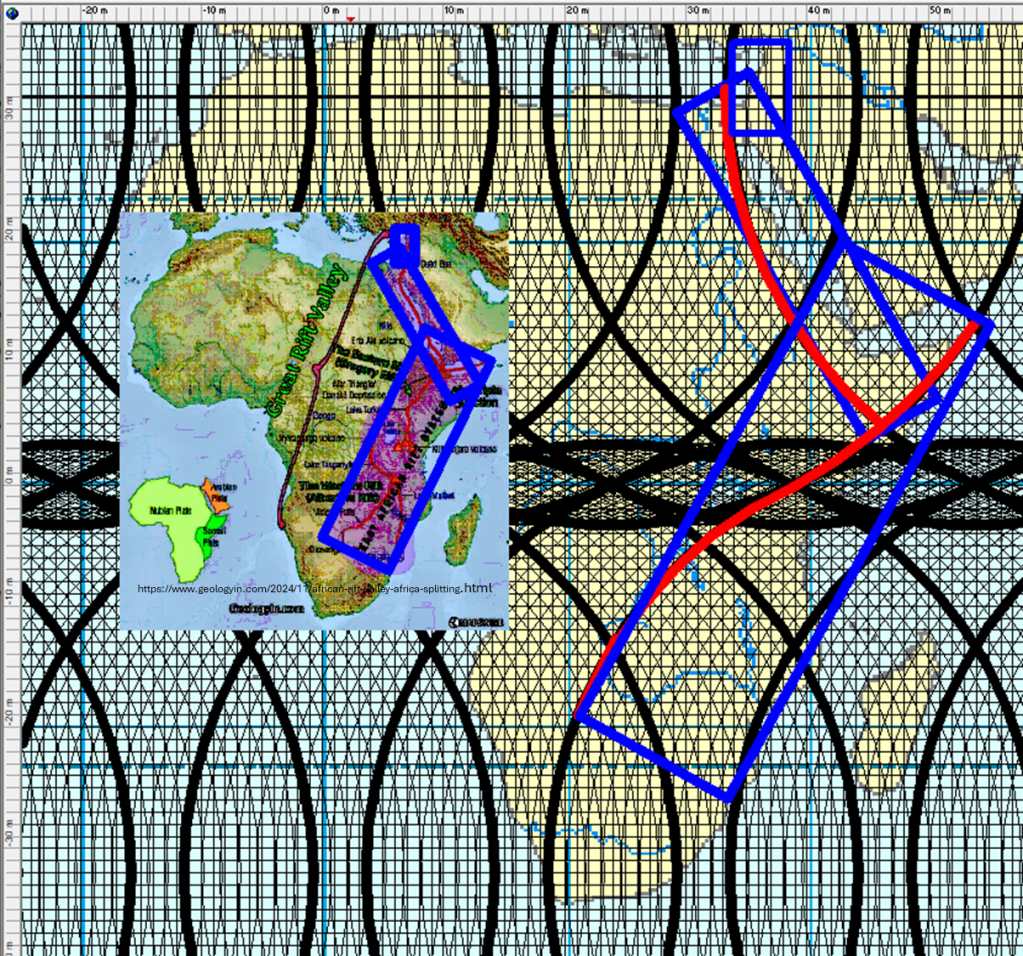
The system connects to the Afar Triangle, where a major tectonic junction occurs, and continues northward along the entire length of the Red Sea. There, a mid-ocean ridge follows a NNW-SSE orientation from the continental rift system in Africa. This shift can be explained by referring to different division lines within the mantle.
When this structure is compared with mantle flow patterns, a striking relationship emerges: the width of the continental rift valleys corresponds closely to the width of a single convection roll in the lower mantle. In contrast, the Red Sea spreading ridge appears to align primarily with a boundary between convection cells. The northern continuation of this boundary lies at the eastern most part of the Mediterranean Sea, trending roughly north–south.
The rift system is broadly symmetrical about the equator, although the NNE–SSW-trending block extends farther south than north. The Red Sea itself reflects a division line and related rifting process from Afar north to boundaries near 32°N, where the structural trend shifts into a more direct north–south orientation.
At the equator, the inferred boundaries in the lower mantle pass directly through the central rift zone. This is the only location on Earth where such deep mantle boundaries appear to coincide with continental surface structures. From this point, the angular distance is approximately 60° to the western coast of Indonesia and about 30° to the eastern coast of Africa.
When mapped, these regions display an unusual rectangular geometry, a pattern that has also emerged from surface geological observations. When compared with the mantle convection system, there is a notable correspondence between deep mantle boundaries and the corners of the rectangular rift domain in East Africa.
This relationship helps explain both the large-scale splitting of the African continent and the formation of the rift valleys themselves. The rifts can be understood as the result of interaction between mantle convection rolls and plate tectonic forces. Only through this combined framework can we explain why extension occurs across such an exceptionally wide region.
To understand the Great Rift Valley better: https://www.youtube.com/watch?v=D9vajUjaEYM
The symmetry around the equator is particularly striking. It is not only observable in mapped data but also consistent with mathematical formulations. When mantle convection rolls are modeled as uniform in both height and width within Earth’s layered structure, the positions of the continents align closely with the boundaries of these rolls. At the equator, or as for the Afar region 11°N, a section based on that method looks like this:
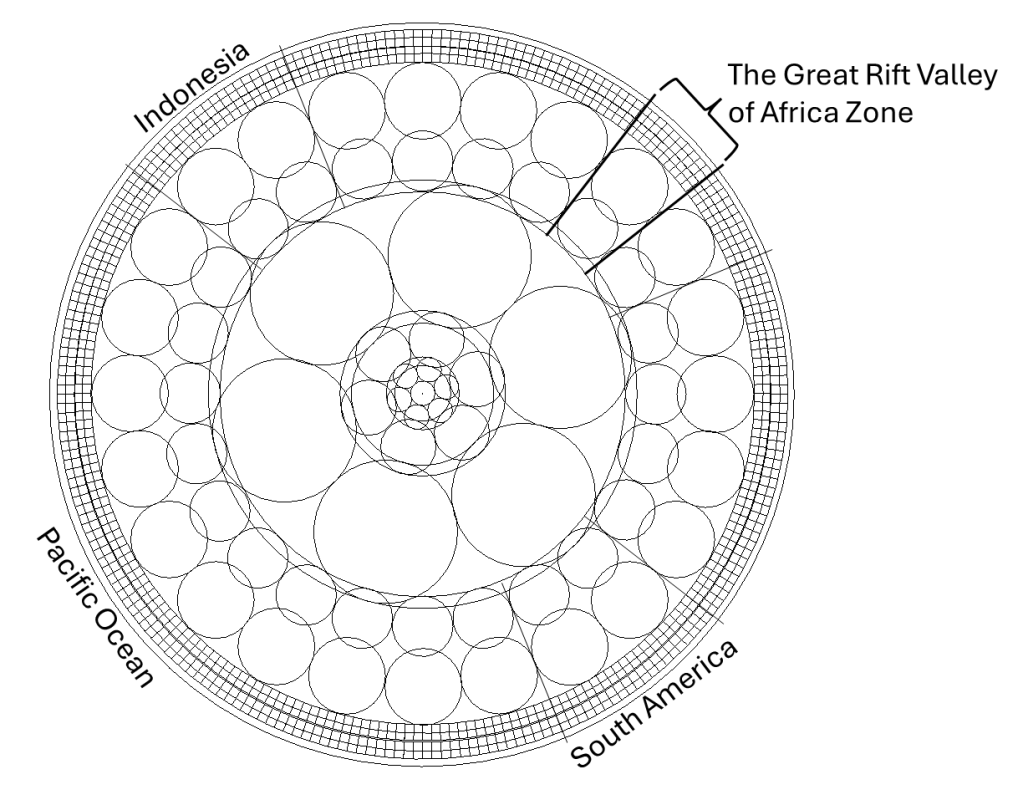
The broad nature of the East African Rift helps explain why Africa differs from regions such as South America and Indonesia. In those regions, continental margins tend to align with intersections of lower mantle convection rolls, whereas in Africa, the rifting occurs within the interior of the plate and does not coincide with such boundaries.
The bifurcation of Africa, and the way the rift system aligns with calculated mantle flow divisions, provides further evidence that can be used to reconstruct the internal structural framework of the Earth. This section of the equatorial plane of the Earth is made according to information about the Earth’s layers. The convection rolls 2D sections fit into those layers, and simultanously explain the existence of relevant transition layers. This also fits with the distribution of land mass along equator.
The pattern along equator is so amazingly clear, that it is strange no one mentions it, at no one therefore tries to explain it. The lack of discussion is a topic to be dealt with according to social science though, or other disciplines.
The East African Rift as a Distributed Zone of Extension
Mantle Flow, Plate Motion, and the Geometry of a Splitting Continent


The East African Rift is often presented as a simple example of a continent breaking apart. While this description is not incorrect, it does not capture the true scale and nature of the system. This is not a single line or a narrow plate boundary, but a vast zone of extension covering a large portion of eastern Africa south of the Sahara.
At certain latitudes, this zone spans up to half the width of the continent and measures approximately 15° in latitude, corresponding to roughly 1000–1500 km. This is highly unusual compared to most rift systems on Earth, which tend to be much narrower and more localized.
The question is therefore not only why Africa is rifting, but:
why the extension is distributed across such a broad region.
Not a Single Rift, but a System
4
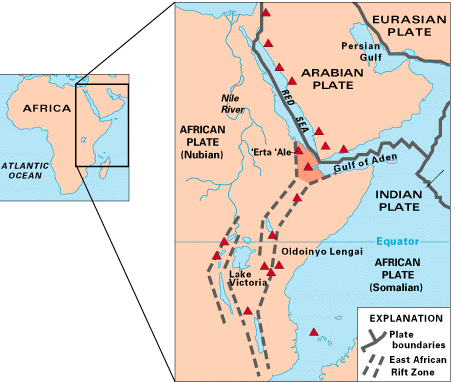
The term “rift valley” can be misleading. It suggests a single structure, but in reality the East African Rift consists of:
- multiple parallel rift branches
- fault systems and fractures
- broad zones of crustal thinning
- large basins occupied by lakes
This is therefore not a single fracture, but a case of:
distributed extension
Deformation is spread across a wide region rather than localized along a single boundary. This immediately suggests that the causes are not confined to shallow levels, but are linked to deeper processes.
Lithosphere: Brittle Above, Ductile Below
To understand how such distributed extension occurs, we must consider the mechanical behavior of the lithosphere.
Above the Moho, the material is brittle and responds to stress by:
- fracturing
- forming faults
- generating earthquakes
Below the Moho, the uppermost mantle behaves ductilely:
- it deforms gradually
- it flows over long timescales
- it does not fracture in the same way
Under horizontal plate motion:
the ductile portion yields and accommodates deformation, while the brittle portion fractures.
This is why the system does not form a single rift, but many.
Below the lithosphere lies the asthenosphere, a lower-viscosity layer where flow is more easily sustained. However, the coupling between this layer and the overlying plate is not constant.
In some cases, a no-slip condition applies:
- mantle flow is directly transmitted to the plate
- motion in the mantle influences plate movement
In other cases, slip occurs:
- the plate moves independently
- mantle flow has limited direct influence
This variability is crucial:
mantle flow does not always directly control plate motion.
Mantle Rolls and the Scale of the System
To explain the width of the rift system, the mantle must be considered as a layered system of flow.
In the upper mantle, from roughly 120 km to 670 km depth, one can identify a system of smaller convection rolls. In this framework, these may be considered as approximately ten rolls, dividing the region into smaller dynamic units and influencing localized deformation.
Below this level, in the lower mantle, the structure appears different. The convection rolls are larger and extend over broader areas. Their surface expression corresponds to a width of 15°.
This is a key observation:
The width of the East African Rift corresponds to the width of these larger lower mantle rolls.
If so, the rift is not a local feature, but:
a surface expression of deeper, large-scale mantle structure.
Resistance to Plate Motion and the Origin of Extension
To understand why such a broad rift develops, it is necessary to consider the balance of forces.
If plate motion were unopposed, the lithosphere would move as a coherent unit. There would be no reason for it to break apart over such a large region.
The key factor is that:
some mantle rolls rotate against the direction of plate motion.
This creates resistance. We therefore have two interacting components:
- the overall plate motion driving the system
- opposing mantle flow providing resistance
The net plate motion is stronger and continues to drive movement. However, where resistance occurs:
- tensile stress builds within the lithosphere
- stress is distributed across a wide region
- the system begins to deform
The result is:
- ductile deformation at depth
- brittle fracturing above
- and the onset of rifting
Difference from Mid-Ocean Ridges
This mechanism differs fundamentally from what occurs at mid-ocean ridges.
At ridges:
- convection rolls exist on either side
- they move away from the ridge axis
- and directly drive symmetrical extension
Thus:
extension is a direct result of divergent mantle flow.
In East Africa, however:
- there is no single central axis
- extension results from interaction between plate motion and opposing mantle flow
This produces:
- a wide deformation zone
- distributed extension
- multiple rift branches
Why Africa Differs from Other Regions


This framework also explains why Africa differs from regions such as South America and Indonesia.
In those regions:
- plate boundaries often lie along continental margins
- they coincide with boundaries between mantle flow systems
- coastlines reflect deep structural divisions
In Africa:
- rifting occurs within the interior of the plate
- it does not coincide with a coastline
- and it is distributed across a broad region
This indicates that the relationship between surface tectonics and mantle structure varies between regions.
A Distributed Response of the Lithosphere
The East African Rift can therefore be understood as a distributed response of the lithosphere to underlying mantle flow.
The lithosphere stretches across a wide region:
- the ductile portion deforms and distributes stress
- the brittle portion fractures into multiple rifts
The result is a coherent but distributed system that reflects both material behavior and deeper forces.
Evolution Toward an Ocean Basin
If this process continues, the system may evolve over time.
Distributed extension may gradually localize:
- forming a more defined plate boundary
- eventually developing into a mid-ocean ridge
The East African Rift may therefore represent:
an early stage in the formation of a new ocean basin.
Conclusion
The East African Rift is not a simple valley, but a large and structured zone of extension. Its width — approximately 15° — suggests a connection to large-scale mantle flow systems.
By analyzing the system in relation to:
- smaller convection rolls between 120–670 km depth
- larger rolls below, spanning ~15°
- and the resistance generated where mantle flow opposes plate motion
- surface tectonics
- lithospheric behavior
- and the internal structure of the Earth
In this way, the rift system is not merely a local feature, but part of a larger and organized dynamic system within the Earth.
it becomes possible to link:
 Magic Magma